admin
A landmark three-month international law enforcement operation, spearheaded by the United Arab Emirates, has identified more than $39 billion in funds and cryptocurrencies linked to widespread scam activity, resulting in over 960 arrests worldwide. The UAE Ministry of Interior officially announced the successful conclusion of this unprecedented initiative, dubbed Operation Confrontation Ghost, on October 22, highlighting a critical step forward in the global battle against sophisticated digital fraud networks.
The comprehensive crackdown, which ran from July 1 to September 30, 2026, united law enforcement agencies from 30 countries alongside critical international bodies like INTERPOL and the Global Anti-Scam Alliance (GASA). A distinctive feature of Operation Confrontation Ghost was the integral involvement of 13 leading companies from the technology and financial sectors, underscoring a growing recognition that combating modern fraud requires a concerted public-private partnership. The operation primarily targeted three rapidly escalating categories of transnational crime: AI-enabled fraud, digital financial fraud, and technology-facilitated sextortion, reflecting the evolving landscape of cybercrime.
The significant results of this multi-faceted effort were formally presented in Vienna, during a UAE-hosted side event held concurrently with the 13th session of the Conference of the Parties to the United Nations Convention against Transnational Organized Crime (UNTOC COP13). This presentation served not only to report on the operation’s success but also to foster dialogue on sustainable strategies for international cooperation against organized fraud.
The Global Scourge of Digital Fraud and AI’s Rising Threat
In an increasingly interconnected world, the digital realm has become a fertile ground for criminal enterprises. Fraud, once largely confined by geographical barriers and slower communication methods, now transcends borders at the speed of light, facilitated by advanced technology. Cybercriminals exploit anonymity, rapid transaction speeds, and the vast reach of the internet to defraud individuals and businesses globally. The sheer scale of identified scam-linked funds—$39 billion—underscores the immense financial damage inflicted by these networks annually.
The rise of artificial intelligence (AI) has added a new, ominous dimension to this threat. Criminal groups are increasingly leveraging AI to craft highly convincing fake identities, generate deepfake voices and videos, and automate sophisticated phishing campaigns. These AI-powered tools make scams harder for victims to detect and enable fraudsters to operate at an unprecedented scale, overwhelming traditional detection methods. From personalized phishing emails that mimic trusted sources to deepfake videos impersonating executives for business email compromise (BEC) scams, AI is transforming the criminal playbook, necessitating a correspondingly advanced and coordinated response from law enforcement and the private sector.
Similarly, technology-facilitated sextortion has emerged as a particularly heinous crime, preying on the vulnerability of individuals, often children and teenagers. Perpetrators use social media and messaging platforms to manipulate victims into sending explicit images or videos, which are then used as leverage for financial extortion. The psychological trauma inflicted on victims and their families can be devastating and long-lasting, making the targeting of such crimes a critical humanitarian priority. Operation Confrontation Ghost’s focus on these specific threats highlights the urgent need to address the most damaging and rapidly evolving forms of digital criminality.
Operation Confrontation Ghost: A Chronology of Collaboration
The conceptualization and execution of Operation Confrontation Ghost involved extensive preparatory work before its official launch. Initial intelligence sharing and strategic planning sessions likely brought together key stakeholders from various nations and organizations, identifying common threats and establishing operational protocols.
- Pre-Operational Phase (Early 2026): Discussions and intelligence exchanges among the UAE, INTERPOL, GASA, and other nations to map the scope of rising digital fraud, particularly AI-enabled schemes and sextortion. Identification of key private sector partners whose platforms were frequently exploited.
- Operational Phase (July 1 – September 30, 2026): The intensive three-month period saw coordinated efforts across five continents. Law enforcement agencies, supported by technological insights from private companies, actively tracked illicit funds, identified scam centers, and monitored suspicious online activities. This phase involved real-time intelligence sharing, cross-border investigations, and synchronized raids.
- Post-Operational Analysis and Reporting (October 2026): Following the operational period, data was consolidated, and results were analyzed. The findings were then prepared for official announcement and presented at the UNTOC COP13 side event in Vienna, solidifying the operation’s impact and establishing a framework for future collaboration.
Throughout the operational phase, participating agencies exchanged over 9,000 pieces of intelligence. This continuous flow of information was instrumental in helping investigators identify suspects, meticulously map the intricate operational structures of scam networks, and trace illicit financial flows across numerous international borders. Investigators also meticulously documented distinct criminal methodologies, collaboratively building a comprehensive shared picture of how fraud groups recruit and deceive victims, and subsequently launder the ill-gotten proceeds. This detailed understanding is crucial for developing proactive prevention strategies and improving future interdiction efforts.
A Wide Net Across Five Continents: Scope and Impact
The scale of Operation Confrontation Ghost was truly global, spanning numerous countries and continents. According to the UAE Ministry of Interior, investigators successfully identified more than 15,500 victims and over 3,500 suspects involved in these illicit schemes. The enforcement actions were significant: authorities conducted raids on 29 fraud centers, effectively dismantling key operational hubs for these criminal networks. Furthermore, a concerted effort was made to disrupt the online infrastructure used by fraudsters, leading to the shutdown of more than 570 social media accounts specifically employed to manipulate victims and facilitate money transfers. In the financial realm, 4,126 bank accounts connected to fraudulent activities were flagged, hindering the flow of illicit funds.
The participating countries represented a diverse cross-section of global jurisdictions, highlighting the universal nature of the digital fraud threat. These included the UAE, the United Kingdom, Canada, Japan, China, France, the Netherlands, Singapore, the Philippines, Myanmar, Indonesia, the Republic of Korea, Brazil, Kenya, Senegal, and Morocco, among others. This extensive list underscores the broad international commitment to tackling these crimes. While the ministry did not provide a country-by-country breakdown of arrests or disclose the precise locations of the 29 raided centers, the geographical diversity of the participants points to a truly global investigative reach and impact.

The Pivotal Role of the Private Sector
A truly defining and innovative characteristic of Operation Confrontation Ghost was the deep and unprecedented involvement of private sector companies. The 13 partners — Bayut, Crypto.com, Dubizzle, Feedzai, Ghostly Solutions, Group-IB, Huawei, Mastercard, Meiya Pico, Meta, Outseer, TikTok, and Trend Micro — represent a crucial cross-section of industries whose platforms and payment systems are frequently exploited by scammers.
This diverse mix of partners reflects the multi-channel nature of modern fraud. Social media giants like Meta (Facebook, Instagram) and TikTok are often the initial points of contact for fraudsters to groom victims, employing elaborate psychological manipulation tactics. Online marketplaces such as Bayut and Dubizzle can serve as sophisticated bait, luring victims into fake investment schemes or bogus purchases. Payment networks like Mastercard, alongside cryptocurrency exchanges such as Crypto.com, are the conduits through which illicit funds are rapidly moved across jurisdictions, exploiting the speed and perceived anonymity of digital transactions. Cybersecurity and fraud-detection firms, including Feedzai, Ghostly Solutions, Group-IB, Meiya Pico, Outseer, and Trend Micro, provide the essential technological tools, forensic expertise, and real-time intelligence necessary to trace these complex flows, identify suspicious patterns, and build prosecutable cases. Huawei’s involvement further highlights the necessity of broad tech industry participation in securing digital infrastructure.
Colonel Dana Humaid Al Marzouqi, Director General of the International Affairs Bureau at the UAE Ministry of Interior, emphasized the transformative impact of this collaboration. She stated that the operation successfully converted shared intelligence into robust, coordinated action, demonstrating a new paradigm for combating transnational digital crime. Colonel Al Marzouqi described the initiative as a "first-of-its-kind," showcasing the UAE’s leadership in driving practical and effective international responses to the escalating threats posed by AI-enabled fraud and cross-border scams. This public-private synergy is increasingly viewed as indispensable, as criminals constantly innovate to exploit technological advancements and jurisdictional gaps.
Identified, Not Yet Recovered: The Asset Recovery Challenge
While the headline figure of $39 billion in identified scam-linked funds is staggering and indicative of the operation’s investigative prowess, it comes with an important caveat: this figure represents funds and digital assets that investigators identified as connected to scam activities, not money that has been successfully seized or returned to victims. The distinction is critical in understanding the full scope of the financial impact and the ongoing challenges.
The Ministry of Interior confirmed that participating countries, jurisdictions, and private-sector partners are actively working towards the complex process of recovering these assets. However, they did not specify how much of this substantial sum has been recovered to date, nor did they provide a breakdown of what share of the total is held in cryptocurrency versus traditional financial instruments.
Asset recovery, especially in cases involving transnational digital fraud and cryptocurrencies, is an inherently intricate and time-consuming process. It often involves navigating differing legal frameworks across jurisdictions, overcoming challenges in freezing assets held on decentralized ledgers, and proving direct links to specific victims for restitution. The process can be lengthy, involving international mutual legal assistance treaties (MLATs) and complex judicial procedures.
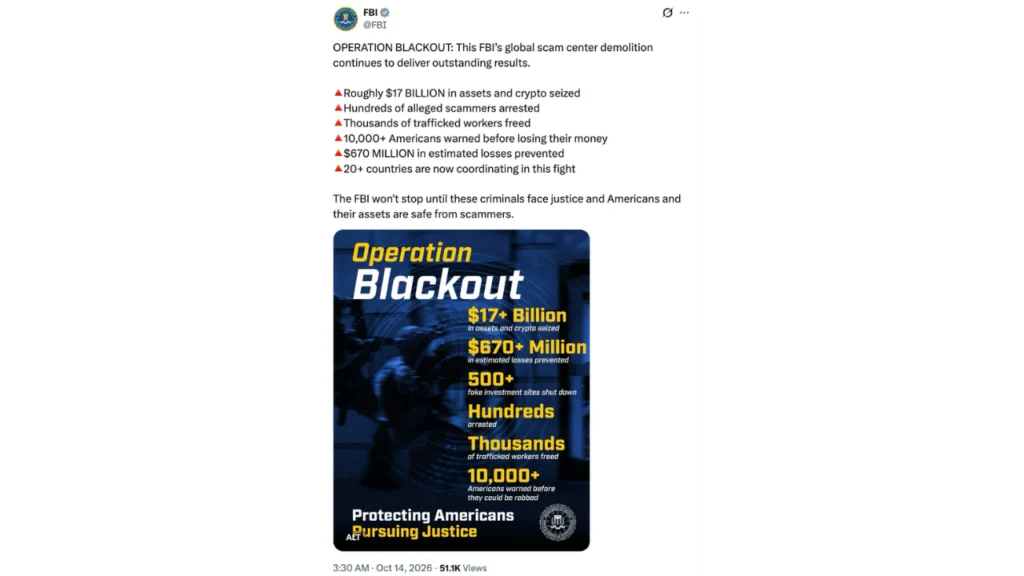
This distinction is crucial when comparing Operation Confrontation Ghost with other recent enforcement efforts. For instance, INTERPOL’s Operation Serengeti III, conducted from late June through August 2026 across 20 African countries and the United States, reported 1,462 arrests and the recovery of over $105 million in illicit funds. Separately, the FBI announced on October 13 that its global Operation Blackout had seized approximately $17 billion in assets and crypto. Given that these operations measure different aspects (identified vs. recovered, and potentially different types of illicit activities), and because it is unclear whether their totals overlap or represent distinct pools of criminal proceeds, the figures should not be combined or directly compared. Each operation contributes uniquely to the global fight, and their methodologies reflect the diverse challenges faced.
UN Recognition and Future Implications
The United Nations Office on Drugs and Crime (UNODC) lauded Operation Confrontation Ghost, specifically commending the UAE’s instrumental role in orchestrating such a broad coalition. UNODC recognized the innovative approach of bringing together law enforcement agencies, financial institutions, and technology companies under a unified framework – a model increasingly seen as essential for tackling complex transnational organized crime.
Speaking at the UNTOC COP13 side event, UNODC Executive Director Monica Juma praised the UAE for leveraging its significant convening power to make the operation a reality. She further acknowledged the leadership of UAE President Sheikh Mohamed bin Zayed Al Nahyan in championing and advancing this critical international effort. The event itself, aptly titled "From Cooperation to Action: How Law Enforcement, International Organizations and the Private Sector Can Jointly Counter Organized Fraud," served as a crucial platform. It aimed to translate the valuable lessons learned from Operation Confrontation Ghost into sustained cooperation and stronger, more resilient public-private partnerships, laying the groundwork for future collaborative initiatives.
The broader implications of Operation Confrontation Ghost are significant. Scam networks have historically thrived by exploiting the inherent gaps and jurisdictional boundaries between national legal systems. Criminals operate from one country, target victims in another, and rapidly move illicit money through a third, making traditional, nationally-focused law enforcement efforts less effective. Operations like Confrontation Ghost are explicitly designed to bridge these gaps, fostering seamless information exchange and coordinated action among investigators, platform providers, and financial institutions across the globe.
Looking ahead, the biggest open question remains the ultimate recovery rate of the identified $39 billion. The UAE Ministry of Interior has indicated that asset recovery efforts are ongoing and has committed to continuing its collaboration with international and private-sector partners. This sustained cooperation is vital not only for recovering funds but also for strengthening global resilience against the ever-evolving threat of transnational digital fraud. The success of Operation Confrontation Ghost provides a powerful blueprint for how coordinated, multi-stakeholder efforts can effectively disrupt sophisticated criminal networks and protect individuals and economies worldwide from the pervasive and damaging impact of digital deception.