admin
admin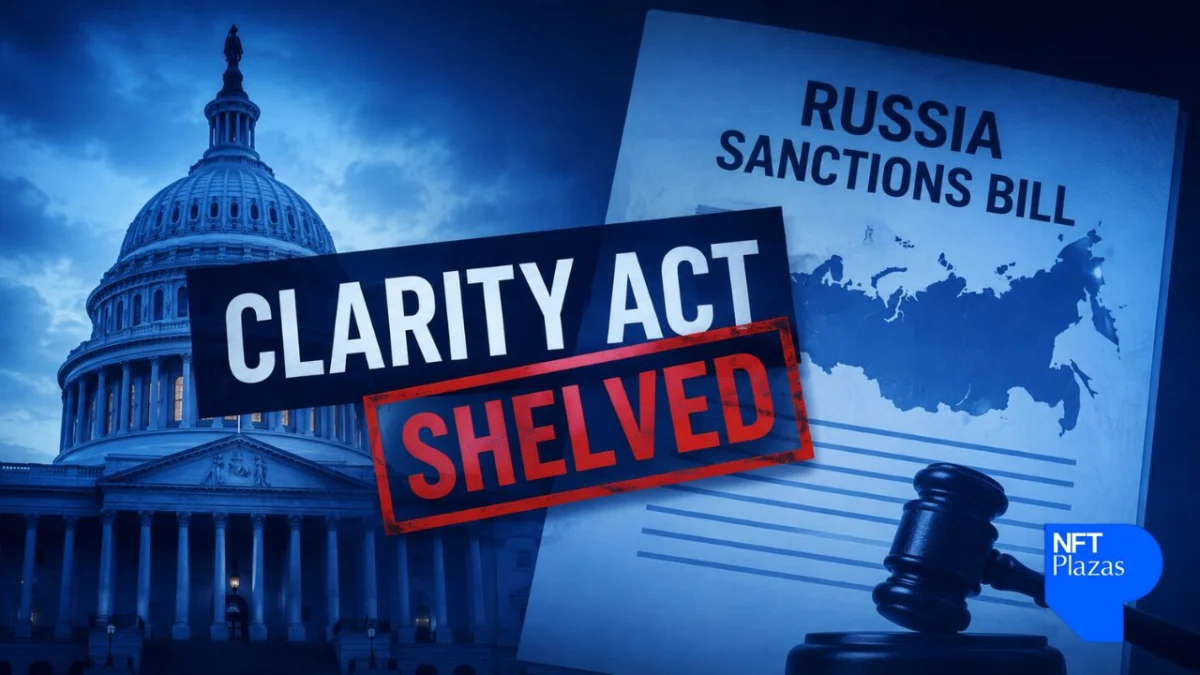
The United States Senate has temporarily sidelined the Digital Asset Market Clarity (CLARITY) Act, a pivotal piece of legislation for the cryptocurrency industry, as lawmakers prioritize a comprehensive Russia sanctions package and navigate a backlog of federal nominations. This shift significantly compresses the already tight legislative window for passing comprehensive crypto market structure legislation before Congress embarks on its summer recess, scheduled to begin on August 8. While Senate leadership has not definitively ruled out bringing the bill to the floor before the break, the increasingly crowded legislative calendar and persistent unresolved negotiations make a timely vote highly improbable in the immediate future.
The Immediate Legislative Landscape: Russia Sanctions Take Precedence
The current legislative week in the Senate commenced with Senate Majority Leader John Thune directing the chamber’s focus towards advancing critical executive and judicial nominations. This procedural groundwork was swiftly followed by the introduction and progression of a bipartisan legislative initiative aimed at substantially strengthening sanctions against Russia. This priority bill seeks to expand punitive measures targeting Russian leadership and implement tariffs on nations that maintain trade relations with Moscow, underscoring a unified congressional stance against ongoing geopolitical aggressions. The gravity and bipartisan support for this measure have cemented its position at the forefront of the Senate’s agenda.
Under established Senate rules, the chamber typically dedicates its floor time to a single major contested bill at any given moment. Before the Russia sanctions legislation can fully advance to a final vote, senators must complete the intricate cloture process—a series of procedural steps designed to overcome potential filibusters and bring a bill to a vote. This process, by its very nature, often spans several days, consuming valuable legislative hours. Consequently, the CLARITY Act is not expected to receive floor consideration until the conclusion of the sanctions debate, effectively pushing any potential vote on digital asset regulation into the following week at the absolute earliest. This procedural reality highlights the inherent challenges of legislating in a body with a finite calendar and numerous high-stakes priorities.
The CLARITY Act: A Quest for Regulatory Certainty
The Digital Asset Market Clarity (CLARITY) Act represents one of the most significant and eagerly anticipated legislative efforts concerning digital assets currently before Congress. Its core objective is to establish a comprehensive and coherent regulatory framework for cryptocurrencies and related activities, addressing a long-standing demand from the rapidly evolving crypto industry. The legislation is specifically designed to clarify the jurisdictional boundaries between the U.S. Securities and Exchange Commission (SEC) and the Commodity Futures Trading Commission (CFTC) regarding various digital assets. This clarity is crucial, as the current ambiguity has led to a "regulation by enforcement" approach, creating an environment of uncertainty for market participants.
Beyond jurisdictional definitions, the CLARITY Act aims to provide explicit compliance rules for token issuers, digital asset exchanges, custodians, and other businesses operating within the cryptocurrency ecosystem. Supporters of the bill argue that the existing regulatory vacuum and the fragmented approach by various agencies have severely hampered innovation and investment in the United States, prompting numerous firms to explore expansion or relocation to more crypto-friendly jurisdictions overseas. A clear, comprehensive framework is seen as essential not only for fostering a robust domestic industry but also for safeguarding investors and consumers through clearly defined rules of engagement.
The House of Representatives has already demonstrated its commitment to this issue by approving its own version of a crypto market structure bill. While the House’s passage signals strong bipartisan interest in establishing a regulatory framework, the Senate’s version of the CLARITY Act contains distinct differences, necessitating another vote in the House if the Senate successfully passes its bill. This procedural requirement further complicates the legislative path, demanding consensus between both chambers before the legislation can advance to the President’s desk.
A Shrinking Window: Time Constraints Before Recess
The ongoing delay leaves lawmakers with an increasingly limited number of legislative days before Congress adjourns for its annual August recess. The recess period, typically commencing around August 8, marks a significant pause in legislative activity, during which members often return to their home districts and states. This looming deadline intensifies the pressure on negotiators to resolve outstanding issues swiftly.
Senate Majority Leader John Thune has consistently expressed his aspiration to bring the CLARITY Act to the Senate floor before lawmakers depart Washington. However, he has also pragmatically acknowledged that leadership must first secure a sufficient level of bipartisan support to ensure the legislation’s successful passage. With Senate floor time becoming an increasingly scarce commodity, negotiators are under immense pressure to bridge remaining disputes. Without a clear path to bipartisan agreement, leadership is hesitant to commit valuable debate time to a bill that might ultimately falter, especially when other critical legislative priorities, such as the Russia sanctions package, demand immediate attention.
The Sticking Point: Government Ethics Provisions
The most significant obstacle to Senate approval of the CLARITY Act continues to be a contentious debate surrounding government ethics provisions. Negotiators are currently grappling with language designed to restrict senior government officials, including the President, from actively promoting or financially benefiting from cryptocurrency projects while serving in office. This particular provision has become a focal point of partisan disagreement.

Democrats advocate for stricter safeguards, arguing they are indispensable for preventing potential conflicts of interest, particularly in light of reports detailing the increasing involvement of figures like former President Donald Trump in various digital asset ventures. They contend that robust ethical guidelines are necessary to maintain public trust and prevent the perception or reality of self-enrichment through public office. Republicans, conversely, have sought to craft language that addresses legitimate ethics concerns without imposing restrictions they perceive as unfairly targeting specific officeholders or, more broadly, discouraging innovation within the burgeoning digital asset space. They argue that overly broad prohibitions could stifle the very industry the bill aims to regulate and legitimize.
Reports last week suggested that negotiations had made some headway, with indications that President Trump might accept new limitations governing presidential involvement in digital assets. However, these reported concessions were met with skepticism from Democrats, who argued the proposed measures still did not go far enough to adequately address their concerns regarding potential conflicts of interest. Consequently, discussions remain ongoing and unresolved. Until both parties can reach a mutually acceptable agreement on these critical ethics provisions, Senate leadership appears unlikely to schedule a final vote on the CLARITY Act, leaving its fate hanging in the balance.
Broader Implications for the Crypto Industry and U.S. Competitiveness
Should the Senate fail to pass the CLARITY Act this year, the cryptocurrency industry in the U.S. would likely continue to operate under a patchwork of existing regulations and rely on other, more narrowly focused regulatory initiatives. These include the ongoing implementation of the GENIUS Act, which aims to establish a federal framework for payment stablecoins, as well as continued rulemaking efforts by the SEC and the CFTC. While these initiatives provide some level of guidance, they do not offer the comprehensive market structure clarity that the CLARITY Act promises.
The Senate has already invested months in negotiating this complex legislation, with earlier disputes centering on whether stablecoin issuers should be permitted to offer yield-bearing products that could potentially compete with traditional bank deposits. Lawmakers eventually reached a compromise on limiting these rewards programs, allowing negotiations to shift almost entirely to the government ethics rules that now form the primary sticking point. The prolonged nature of these negotiations underscores the inherent difficulty in crafting legislation for a novel and rapidly evolving technological sector.
For the crypto industry, a failure to pass the CLARITY Act would perpetuate the regulatory uncertainty that has long been a source of frustration. This uncertainty not only complicates business operations and stifles domestic innovation but also places the U.S. at a disadvantage compared to other jurisdictions. Countries and blocs like the European Union have already moved forward with comprehensive regulatory frameworks, such as the Markets in Crypto-Assets (MiCA) regulation, which provides a clear rulebook for digital asset issuers and service providers. Without a similar framework, the U.S. risks ceding its leadership position in financial innovation to regions with more predictable regulatory environments.
The Pressures of the Political Calendar
Even if the Senate were to successfully approve the CLARITY Act in the coming weeks, the legislative journey would still not be complete. Because the Senate’s version of the bill differs from the legislation previously passed by the House of Representatives, another House vote would be required to reconcile the two versions. This necessitates additional legislative time and the ability for both chambers to reach a final consensus, a task made more challenging by the rapidly approaching political calendar.
After a brief return in September, lawmakers will increasingly shift their focus towards the November elections, a period during which bipartisan cooperation often diminishes as political campaigns intensify. Following the elections, Congress enters the traditional "lame-duck" session, a unique period that can either facilitate the passage of bipartisan compromises on lingering issues or descend into further political gridlock, depending on the election outcomes and the prevailing political climate.
If Congress fails to complete its work on the CLARITY Act before the current legislative session concludes, the entire legislative process would likely need to restart in the next Congress. This would entail reintroducing the legislation, going through committee hearings again, and potentially facing new political dynamics and priorities, effectively resetting the clock on years of work and negotiation.
Industry Awaits the Next Move
Despite the latest setback, advocates within the cryptocurrency industry remain cautiously optimistic. Many hope that the Senate can at least initiate crucial procedural steps before lawmakers depart for recess, which would allow the bill to move more quickly once Congress reconvenes. This would preserve some of the momentum built over months of negotiation and demonstrate a continued commitment to addressing regulatory clarity.
However, for the immediate future, the Senate’s agenda remains dominated by high-stakes issues: the Russia sanctions package, the confirmation of federal nominations, and the intricate, unresolved negotiations surrounding government ethics provisions. With legislative time rapidly dwindling, the coming weeks are poised to be critical. They will likely determine whether the CLARITY Act advances towards becoming the United States’ first comprehensive crypto market structure law, thereby ushering in a new era of regulatory predictability, or whether the industry’s long-awaited framework faces yet another prolonged and uncertain delay, leaving stakeholders to navigate a complex and evolving landscape without definitive guidance. The outcome will have profound implications for the future of digital assets in the U.S. and its position on the global stage of financial innovation.