admin
admin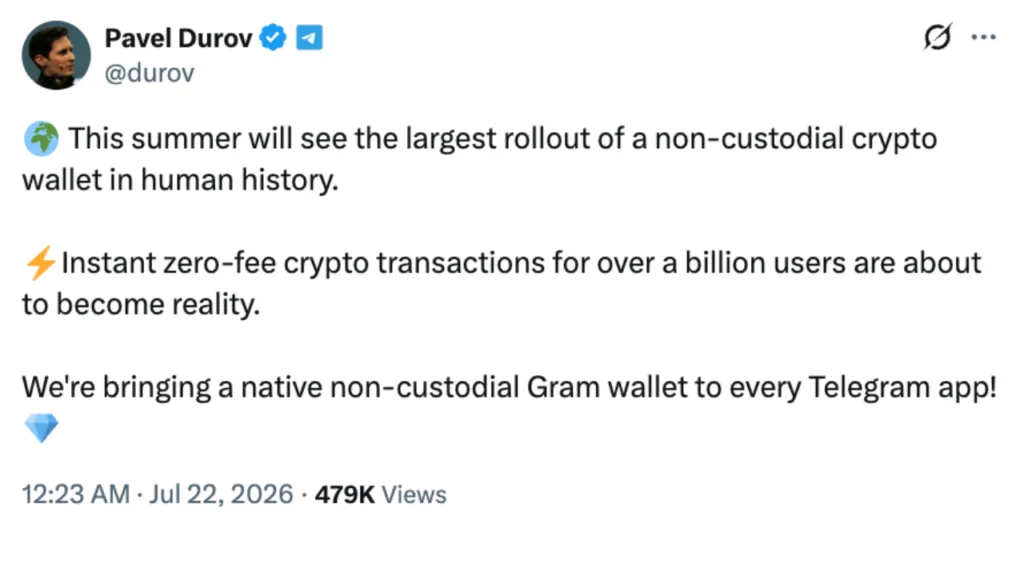
In a move poised to redefine global cryptocurrency adoption, Telegram founder and CEO Pavel Durov has unveiled ambitious plans to embed a native, non-custodial crypto wallet directly into every version of the messaging platform. This groundbreaking initiative, announced on July 21st, 2026, promises to grant Telegram’s colossal user base of over one billion monthly active users unprecedented access to instant, zero-fee cryptocurrency transfers, marking what could be the largest onboarding effort into the world of digital assets ever attempted. The strategic integration aims to democratize access to self-custody wallets, effectively lowering the entry barrier for mainstream users and potentially accelerating the widespread adoption of blockchain technology beyond its traditional enthusiast base.
A Landmark Move for Global Cryptocurrency Adoption
Durov’s announcement, shared via his official Telegram channel, represents a pivotal moment in the company’s long-standing strategy to deeply integrate blockchain capabilities into its expansive messaging ecosystem. If the proposed rollout materializes before the end of summer 2026, it is anticipated to dramatically expand the reach of self-custody wallets, pushing direct ownership of digital assets into the hands of a global audience largely unfamiliar with the complexities of existing crypto infrastructure. This initiative goes beyond merely offering crypto services; it seeks to fundamentally alter how everyday individuals interact with digital finance, making cryptocurrency transfers as intuitive and commonplace as sending a message.
The sheer scale of Telegram’s user base provides an unparalleled launchpad for mass adoption. With over a billion active users, the platform dwarfs the reach of even the most popular standalone self-custody wallets like MetaMask, which, despite its prominence, serves tens of millions rather than billions. By integrating a wallet natively, Telegram bypasses the traditional hurdles of downloading separate applications, navigating complex setup processes, or relying on centralized exchanges, thereby streamlining the user journey into the crypto space.
The Vision: A Native "Gram" Wallet for Seamless Transfers
According to Durov, the forthcoming integration will feature a native, non-custodial Gram wallet, eliminating the need for users to seek out and activate a distinct wallet service. This "built-in" approach signifies a crucial departure from existing models, where users typically interact with cryptocurrency through third-party applications or bots. Durov himself hailed this impending launch as "the largest rollout of a non-custodial crypto wallet in human history," emphasizing the transformative potential of instant, zero-fee transactions within the Telegram environment.
This development marks a significant evolution from Telegram’s current cryptocurrency offerings. Presently, users can engage with crypto via the "@wallet bot" within Telegram, a service that has garnered over 150 million registered accounts. However, this existing product is managed by The Open Platform (TOP), an independent entity, rather than being a direct Telegram-operated service. The primary distinction of the new native wallet lies in its asset management model. While the "@wallet bot" predominantly employs a custodial framework—meaning a third party retains control of private keys unless users explicitly opt for self-custody—the upcoming native wallet is slated to be non-custodial by default. This crucial difference empowers users with direct ownership and control over their private keys and, consequently, their digital funds, aligning with the core ethos of decentralized finance.
As of the announcement, Telegram has yet to clarify whether this native wallet will supersede the existing "@wallet bot" or function in parallel. Furthermore, details regarding which cryptocurrencies will be supported beyond Gram, the native token of The Open Network (TON), remain undisclosed, leaving room for speculation about future multi-asset capabilities.
Demystifying Self-Custody: A Paradigm Shift for Mainstream Users
At its core, a non-custodial wallet grants users absolute control over their private keys, negating the necessity of entrusting their assets to an exchange or any third-party service. This inherent feature ensures that funds cannot be frozen, censored, or transferred without the explicit permission of the owner. However, this autonomy comes with the significant responsibility of securely managing recovery credentials and safeguarding private keys, making wallet security a paramount concern for users. The adage "not your keys, not your crypto" encapsulates the fundamental principle of self-custody, advocating for individual financial sovereignty.

Historically, the concept of self-custody, while central to the cryptocurrency philosophy, has often been perceived as overly complex and intimidating for individuals outside the immediate crypto community. The technical intricacies of seed phrases, private keys, and transaction signing have acted as formidable barriers to mainstream adoption. By seamlessly integrating wallet functionality into a globally ubiquitous messaging application like Telegram, the company aims to dramatically lower these barriers. This strategic move could introduce billions to the benefits of direct asset ownership without requiring them to navigate the often-steep learning curve associated with traditional crypto interfaces.
The potential impact on user experience (UX) and user interface (UI) design is immense. Telegram’s challenge will be to abstract away the technical complexities while educating users on the critical importance of security and self-responsibility. Simplified key management solutions, intuitive backup processes, and robust in-app guidance will be crucial for the success of this initiative. If executed effectively, Telegram could set a new standard for user-friendly crypto access, making self-custody as simple as sending a text message, thereby unlocking a new era of digital financial empowerment.
Telegram’s Blockchain Odyssey: From Ambitious Launch to Regulatory Setback and Resurgent Vision
Telegram’s journey into the blockchain arena commenced with considerable fanfare in 2018. The company embarked on an ambitious project known as the Telegram Open Network (TON), raising an astonishing $1.7 billion from private investors through an Initial Coin Offering (ICO). The vision was to create a decentralized platform capable of handling millions of transactions per second, with its native token, Gram, designed to facilitate payments and power a new generation of decentralized applications. This early venture positioned Telegram at the forefront of blockchain innovation, attracting significant attention from both the tech and financial sectors.
However, this grand vision encountered a formidable obstacle in 2020 when the U.S. Securities and Exchange Commission (SEC) intervened. The SEC alleged that Telegram’s Gram token sale constituted an unregistered securities offering, violating federal securities laws. The ensuing legal battle culminated in a settlement, forcing Telegram to halt the TON project, return approximately $1.2 billion to investors, and pay an $18.5 million civil penalty. Following this regulatory setback, Telegram officially distanced itself from the project, seemingly abandoning its blockchain aspirations. This period marked a significant turning point, not just for Telegram but for the broader crypto industry, as it highlighted the increasing scrutiny from regulatory bodies concerning token sales and their classification.
Despite Telegram’s official withdrawal, the underlying blockchain technology and the community’s passion for the project endured. The codebase, originally developed by Telegram, was adopted by independent developers and enthusiasts, leading to the rebirth of the network under community stewardship. This decentralized effort eventually solidified into The Open Network (TON), with Toncoin serving as its new native token. This resilient community-led revival demonstrated the power of decentralization and open-source collaboration in the face of regulatory challenges, allowing the vision for a scalable, high-performance blockchain to persist and evolve.
The Open Network’s Evolution and the Return of "Gram"
Under the guidance of the TON Foundation, a non-profit organization dedicated to supporting the network’s development, The Open Network has flourished as a vibrant, community-driven ecosystem. Over the years, the network has continued to build out its infrastructure, attract developers, and foster a growing user base. Telegram, while initially stepping away, has gradually re-engaged with the ecosystem, acknowledging the community’s success and the potential of the underlying technology. This renewed involvement has been strategic, demonstrating Telegram’s recognition of TON’s organic growth and its potential synergy with the messaging app’s core functionalities.
A significant milestone in this renewed partnership occurred in June 2026, when the network’s native token underwent a rebranding. Following an overwhelming 81% community vote, Toncoin (TON) officially reverted to its original name, Gram (GRAM). While the underlying blockchain continues to operate as The Open Network, this symbolic rebranding signifies Telegram’s deepening commitment and a restoration of the original vision for its blockchain project. The decision to revert to "Gram" not only pays homage to the project’s roots but also signals a closer alignment between Telegram’s corporate strategy and the decentralized aspirations of the TON ecosystem, setting the stage for the native wallet integration.
Market Response: GRAM Token’s Volatility Amidst Renewed Optimism
The market’s reaction to Durov’s announcement was immediate and overwhelmingly positive. Following the news on July 21st, 2026, the GRAM token experienced a notable climb of approximately 7%, pushing its price back above the $1.50 mark. This surge provided a much-needed recovery after a period of decline throughout much of July, reflecting investor optimism regarding Telegram’s direct embrace of the token and the network.

However, despite this positive movement, GRAM’s current valuation remains considerably below its previous all-time highs, indicating that the token’s journey is still subject to broader market dynamics and ongoing development milestones. Its historical peak of around $8.25 was recorded in June 2024, during a period characterized by a "tap-to-earn" gaming boom within the Telegram ecosystem, which significantly amplified user engagement and, consequently, demand for the token. A more recent peak of approximately $2.89 occurred in May 2026, coinciding with Telegram’s announcement of its renewed leadership and deeper involvement in the TON network.
Market analysts are closely watching GRAM’s performance, noting that while the native wallet integration is a powerful catalyst, sustained growth will depend on various factors. These include the smooth execution of the rollout, the clarity of regulatory frameworks, the adoption rate among Telegram users, and the ongoing development of the broader TON ecosystem. The inherent volatility of cryptocurrency markets means that while such announcements provide significant boosts, long-term stability and value appreciation are contingent on tangible utility and robust network effects.
Broader Implications: Reshaping Digital Finance and the Web3 Landscape
If Telegram successfully deploys this native wallet as planned, the ramifications for how everyday users interact with digital assets could be profound. The ability to send cryptocurrency as effortlessly as a text message fundamentally streamlines the user experience, potentially rendering separate crypto applications or exchange accounts less essential for basic transactions. This ease of use could unlock unprecedented opportunities for financial inclusion, particularly in regions with limited access to traditional banking infrastructure. For billions globally, Telegram could become their primary gateway to digital finance, facilitating remittances, cross-border payments, and local commerce with instant, zero-fee transactions.
For creators, merchants, and businesses, the integration offers access to a global payment network embedded within one of the world’s largest communication platforms. This could foster new economic models, enabling direct payments for content, goods, and services without the intermediaries and associated fees of traditional financial systems. The vision aligns with the broader Web3 movement’s goal of empowering individuals and decentralizing control over digital interactions and assets.
However, this ambitious undertaking is not without its challenges. The increased visibility and mass adoption will undoubtedly attract heightened scrutiny from global regulatory bodies, similar to the SEC’s past actions. Telegram will need to navigate a complex and evolving regulatory landscape, addressing concerns related to anti-money laundering (AML), know-your-customer (KYC) compliance, and consumer protection. Furthermore, ensuring the security of such a vast user base, particularly with non-custodial wallets where users bear ultimate responsibility for their keys, will require robust security measures, continuous user education, and effective support mechanisms. The potential for scams, phishing attempts, and user error in managing private keys represents a significant risk that Telegram must proactively mitigate.
Looking Ahead: Unanswered Questions and the Road to Mass Adoption
While Durov’s announcement has generated considerable excitement, several critical details remain unconfirmed. The exact launch date, beyond "before the end of summer 2026," is eagerly awaited. The scope of supported cryptocurrencies beyond Gram is another key question; a multi-asset wallet would significantly broaden its utility and appeal. Perhaps most importantly, Telegram must articulate how it plans to simplify the complex process of key management for new users, many of whom will be encountering non-custodial crypto for the first time. Solutions like multi-party computation (MPC) wallets or social recovery mechanisms could offer user-friendly alternatives to traditional seed phrases, balancing security with ease of use.
The potential for further integration of decentralized applications (dApps) and Non-Fungible Tokens (NFTs) within the Telegram ecosystem also presents an exciting future. Imagine a world where users can seamlessly trade NFTs, access decentralized finance (DeFi) protocols, or interact with Web3 games directly within their messaging app. This level of integration would transform Telegram from merely a communication tool into a comprehensive "super-app" for the decentralized internet.
Ultimately, integrating a self-custody wallet into an application with over a billion users is an undertaking of monumental proportions. It represents one of the most ambitious and potentially impactful attempts to weave cryptocurrency into the fabric of everyday digital life. If Telegram can successfully overcome the technical, educational, and regulatory hurdles, this initiative could fundamentally alter the trajectory of global crypto adoption, ushering in an era where digital financial sovereignty is accessible to everyone. The coming months will be crucial in observing how Telegram executes this vision and whether it can truly deliver on the promise of bringing billions into the decentralized future.