admin
admin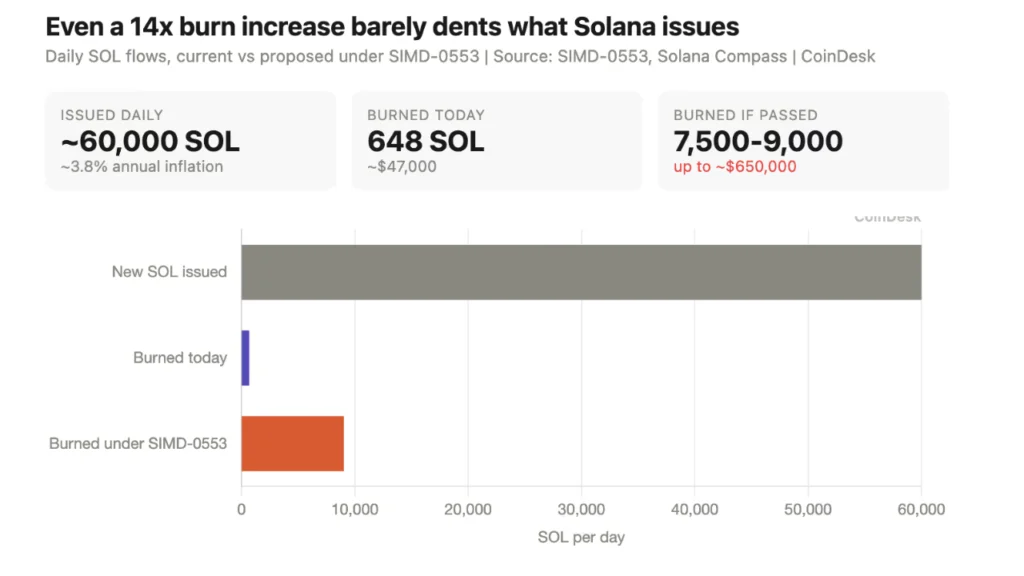
Solana validators are rapidly converging on a pivotal governance decision that stands to fundamentally alter the economic framework of the network, dramatically increasing the amount of SOL permanently removed from circulation while simultaneously accelerating the reduction of new token issuance. This comprehensive proposal, designated SGP-0003, represents a significant evolution in Solana’s monetary policy, designed to tighten the supply dynamics of its native asset, SOL, and potentially solidify its long-term value proposition within the fiercely competitive blockchain ecosystem.
A Pivotal Shift in Solana’s Tokenomics
SGP-0003 is a powerful amalgamation of two previously independent Solana Improvement Documents (SIMDs): SIMD-0553 and SIMD-0550. This strategic merger creates a unified governance package aimed at addressing both sides of SOL’s supply equation – reducing the inflow of new tokens and increasing the outflow of existing ones through burning mechanisms. If successfully approved and implemented, this proposal is projected to elevate daily token burns by more than a factor of ten, alongside an expedited journey towards a lower, more stable inflation rate. Such a dual-pronged approach is anticipated to foster greater scarcity for SOL, potentially enhancing its appeal to investors and strengthening its foundational economics.
The proposal is currently navigating its crucial signaling phase, a preliminary stage where validators express their initial support before a formal vote. Already, it has garnered substantial backing from a diverse array of prominent validators and essential infrastructure providers within the Solana ecosystem. This growing consensus is steadily pushing SGP-0003 closer to the critical threshold required to transition from the signaling phase to a full-fledged, formal vote, indicating a strong community appetite for these significant tokenomic reforms. The outcome of this process could mark one of the most consequential updates to Solana’s economic model since its inception.
Unpacking SGP-0003: A Dual-Action Mechanism
At its core, SGP-0003 is engineered to tackle SOL’s supply dynamics from two distinct but complementary angles, each championed by one of the merged SIMDs. SIMD-0553 focuses on the destruction of existing tokens through an enhanced burning mechanism tied to network activity, while SIMD-0550 targets the rate at which new tokens are introduced into circulation, effectively slowing down the supply expansion.
SIMD-0553: Revolutionizing Transaction Fees and Boosting Burns
The first component, SIMD-0553, proposes a transformative shift in Solana’s transaction fee structure. Currently, Solana operates with a relatively uniform and low transaction fee model, a feature that has contributed to its reputation for cost-effectiveness and high throughput. However, this model does not fully differentiate between the computational resources consumed by various types of transactions. SIMD-0553 aims to replace this with a more sophisticated resource-based transaction fee model.
Under this new paradigm, users would be charged according to the actual network resources—such as computational units (CPU time), memory, and storage—that their transactions utilize. This means that computationally intensive operations, like complex smart contract interactions or intricate decentralized finance (DeFi) transactions, would incur higher fees compared to simpler operations, such as basic token transfers. This move aligns Solana more closely with models seen in other major blockchains, like Ethereum’s gas mechanism, where transaction complexity directly influences cost. The rationale behind this change is twofold: to more accurately price network usage and, crucially, to significantly increase the amount of SOL permanently removed from circulation.
A portion of Solana’s transaction fees is designated for burning, a mechanism that permanently removes tokens from the supply, thereby contributing to scarcity. Projections based on network activity indicate that SIMD-0553 would lead to an extraordinary surge in daily SOL burns. Estimates suggest that daily burns could skyrocket from approximately 650 SOL to a range of 7,500 to 9,000 SOL. To put this into financial perspective, the value of burned tokens would increase dramatically from roughly $48,000 per day to as much as $668,000 per day, depending on the volume and complexity of transactions on the network. This annualized figure could translate to hundreds of millions of dollars worth of SOL being permanently removed from the ecosystem each year, a substantial move towards strengthening the asset’s intrinsic value through scarcity. This mechanism mirrors, in spirit, Ethereum’s EIP-1559, which introduced a base fee burn, leading to periods of deflation for ETH. For Solana, it represents a commitment to a more robust value accrual mechanism for its native token.

SIMD-0550: Accelerating the Path to Lower Inflation
Complementing the enhanced burning mechanism, SIMD-0550 focuses on the other side of the supply equation: reducing the rate of new token issuance. This proposal aims to double Solana’s annual disinflation rate from its current 15% to an accelerated 30%. Disinflation, in this context, refers to a decrease in the rate of inflation, meaning that while new tokens are still being issued, the rate at which they are introduced is slowing down more rapidly.
Solana’s existing disinflation schedule has seen its inflation rate gradually decline from an initial launch rate of 8%. It currently stands at approximately 3.8%. SIMD-0550 seeks to significantly hasten this trajectory, enabling the network to reach its long-term inflation floor of 1.5% by 2029, three years earlier than the previously projected date of 2032. This accelerated timeline has substantial implications for the future supply of SOL.
Developers have calculated that this faster disinflation schedule would result in a reduction of approximately 18.9 million tokens in future SOL emissions over the next six years. At current market prices, this equates to a staggering $1.36 billion worth of SOL that would not enter circulation, preserving value for existing holders and contributing to a tighter overall supply. This strategic reduction in future supply is a powerful statement about Solana’s commitment to long-term value and sustainability.
Disinflation vs. Deflation: A Crucial Distinction
Despite the dramatic increase in token burns and the accelerated disinflation, it is crucial to understand that SOL would not immediately become deflationary upon the approval and implementation of SGP-0003. A deflationary asset is one where the total supply decreases over time, meaning more tokens are burned or removed than are issued.
The Solana network currently issues around 60,000 SOL every day through its inflation schedule, primarily as rewards for validators who secure the network. Even with the projected maximum daily burns of 9,000 SOL under the new fee model, the number of newly issued tokens would still significantly outnumber those permanently removed from circulation. This is precisely why SIMD-0553 and SIMD-0550 have been strategically packaged together. While the former increases token destruction through transaction fees, the latter simultaneously reduces the pace of new issuance. The combined effect aims to substantially narrow the gap between supply entering and leaving the market, moving Solana closer to a potentially deflationary future, or at least one with much tighter supply growth. The current inflation rate of 3.8% reflects the ongoing issuance, and while the proposal won’t flip SOL into deflation overnight, it sets a clear and aggressive path towards a much more constrained supply model.
The Road to Approval: Validator Backing and Governance Mechanics
Before SGP-0003 can be enacted, it must successfully navigate Solana’s robust governance process. This multi-stage journey ensures broad consensus among network participants. The first critical hurdle is the validator signaling phase. Under governance rules established by the Solana Foundation, any proposal aspiring to a network-wide vote must first secure initial support representing 15% of the total staked SOL on the network. This threshold acts as a filter, ensuring that only proposals with significant community interest proceed to deeper scrutiny.
Support for SGP-0003 has been steadily mounting throughout the week, reflecting growing enthusiasm for these tokenomic adjustments. According to the Solana Validator Governance dashboard, the proposal has already accumulated backing from approximately 63 million SOL, which translates to just over 14.4% of the network’s total staked supply. This means the proposal is tantalizingly close to its target, requiring roughly 3 million additional SOL to reach the crucial 65.16 million SOL threshold before the impending deadline of August 18.
The list of validators pledging their support for SGP-0003 is impressive, encompassing 73 distinct entities that play vital roles in securing and operating the Solana network. These include major ecosystem participants and infrastructure providers such as Helius, Jupiter, Staking Facilities, Drift, OtterSec, and Solana Compass. The early and substantial backing from such influential players underscores the perceived importance and potential benefits of the proposal. Notably, Helius, a prominent infrastructure provider, was an early and significant contributor of pledged support. The company has drawn additional attention because an engineer from its team was instrumental in drafting SIMD-0550, highlighting a direct link between a key ecosystem player and the genesis of this transformative proposal. Should SGP-0003 successfully clear the 15% signaling threshold, it will then advance to a dedicated discussion phase, allowing for further community input and refinement, before ultimately facing a formal validator vote for final approval.

Economic Implications and Market Sentiment
If ultimately approved, SGP-0003 would represent arguably one of the most profound and far-reaching updates to Solana’s monetary policy since the network’s inception. Supporters of the proposal articulate a compelling vision: by significantly curbing long-term token issuance and dramatically increasing transaction-fee burns, the scarcity of SOL would be inherently strengthened over time. While no tokenomic adjustment can guarantee immediate price appreciation, a more constrained supply growth trajectory could undeniably enhance the token’s long-term fundamentals, particularly if Solana continues its impressive growth in network adoption, developer activity, and investor demand. This aligns with the broader "ultra-sound money" narrative often discussed in the crypto space, where assets with deflationary or highly disinflationary characteristics are seen as superior stores of value.
However, the price of SOL, like any other cryptocurrency, remains a complex interplay of various factors. It will continue to be influenced by broader macroeconomic conditions, the ebb and flow of institutional participation in the crypto market, the vibrancy of on-chain activity, and the overarching sentiment across the entire cryptocurrency sector. Tokenomic shifts, while powerful, are one piece of a much larger puzzle.
Currently, SOL is trading around $74, giving the network a substantial market capitalization of approximately $43 billion. While the token has demonstrated modest gains in recent periods, it still trades significantly below its all-time high of nearly $293, which was achieved during the peak of the previous bull market cycle. This stark difference highlights the inherent volatility and the cyclical nature of the crypto market.
Market sentiment surrounding SOL remains cautiously optimistic, yet tinged with uncertainty. For instance, traders on Myriad, a prediction market developed by Decrypt’s parent company Dastan, currently assign roughly 70% odds that SOL might experience a decline to $40 before eventually recovering to $160. This data point reflects a broader market apprehension, suggesting that despite potentially bullish supply reforms, investors are weighing other factors such as macroeconomic headwinds, regulatory uncertainties, and overall risk appetite. The success of SGP-0003 could certainly act as a long-term catalyst, but its immediate impact on price will likely be filtered through prevailing market conditions.
Historical Context of Solana’s Monetary Policy
Solana launched with an ambitious vision of high-performance blockchain infrastructure, and its initial tokenomics were designed to balance network security, validator incentives, and long-term sustainability. The initial inflation rate of 8% was a strategic choice to bootstrap the network, providing attractive rewards for validators to stake SOL and secure the nascent blockchain. This rate was always intended to gradually decrease through a predefined disinflation schedule.
Over the years, Solana has adhered to this schedule, seeing its inflation rate steadily decline to the current 3.8%. This disciplined approach to monetary policy has been a cornerstone of its economic stability. However, as the network matures, and as the competitive landscape evolves, there is a natural imperative to review and optimize these foundational economic parameters. SGP-0003 is not an isolated event but rather the latest, and perhaps most significant, iteration in Solana’s ongoing commitment to refining its tokenomics to best serve its long-term vision and community. It signifies a proactive step to align the token’s supply mechanics with the network’s growing utility and adoption.
Looking Ahead: The Future Trajectory of SOL’s Supply
With less than two weeks remaining until the critical August 18 signaling deadline, the coming days will be pivotal in determining the immediate future of SGP-0003. The continued accumulation of validator support is essential for the proposal to advance to the next stages of Solana’s intricate governance process. Should it successfully clear this initial hurdle and eventually gain final approval, SGP-0003 would unequivocally represent one of the network’s most transformative tokenomic changes to date.
The combined force of increasing token burns and accelerating the reduction of new issuance tackles SOL’s supply from both ends. This strategic tightening of supply, if met with continued demand and adoption, could indeed solidify SOL’s position as a valuable digital asset with enhanced scarcity characteristics. It underscores the power of decentralized governance, where the collective will of validators and the community can steer the economic destiny of a major blockchain. As Solana continues to expand its ecosystem, attract developers, and onboard millions of users, a well-defined and robust monetary policy will be paramount to its sustained success and long-term value proposition. The world watches as Solana validators deliberate a future where SOL’s scarcity is not just a promise, but a fundamental design principle.