admin
admin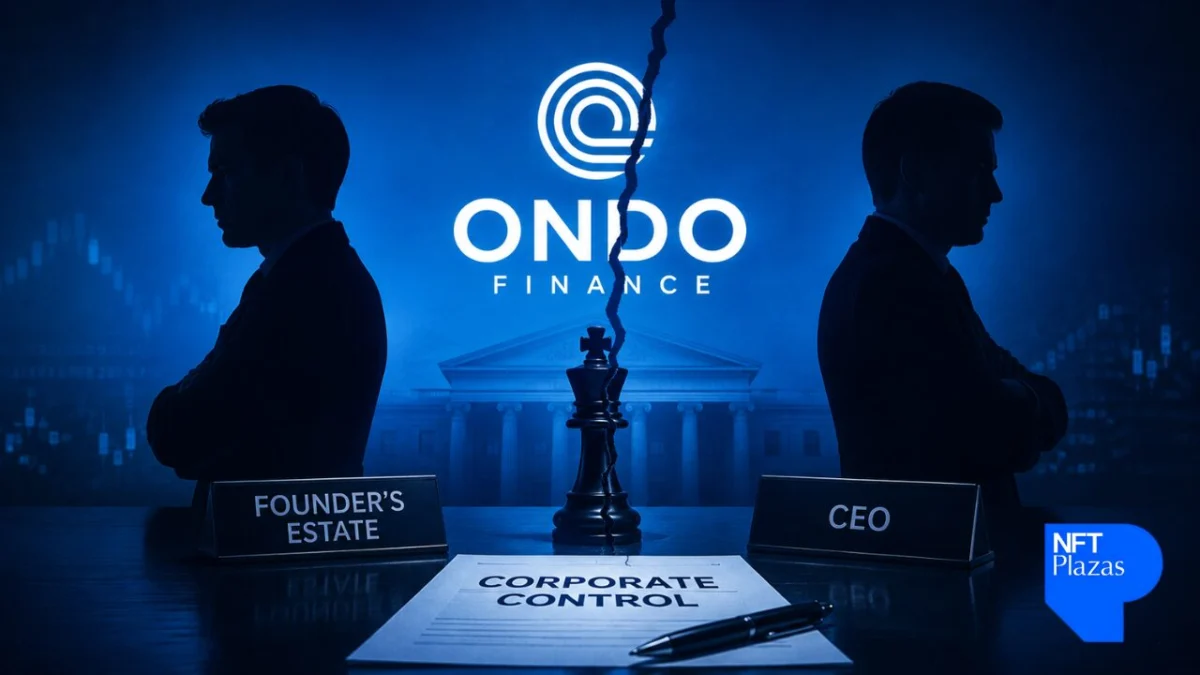
The sudden and tragic passing of Ondo Finance founder Nathan Allman has ignited an intense governance dispute, threatening to cast a long shadow over one of the fastest-growing entities in the tokenized real-world asset (RWA) sector. Filings in the Delaware Court of Chancery reveal a bitter legal confrontation between Allman’s estate and current CEO Ian De Bode, centered on the legitimate authority to steer the company in the wake of its visionary founder’s demise. This high-stakes legal battle unfolds at a critical juncture for Ondo Finance, a company that has emerged as a vanguard in bridging traditional finance with blockchain infrastructure, bringing substantial assets on-chain and attracting significant institutional interest.
Ondo Finance: A Pillar in the Evolving RWA Landscape
Founded in 2021, Ondo Finance swiftly ascended to prominence, establishing itself as a pivotal platform for tokenizing real-world assets. Under Nathan Allman’s astute leadership, the company expanded its offerings, including flagship products like USDY (a tokenized note collateralized by U.S. Treasuries and bank demand deposits) and OUSG (a tokenized BlackRock Short-Term U.S. Treasury Bond ETF). These innovations allowed a broader spectrum of investors to access traditional financial instruments through blockchain technology, democratizing investment opportunities and enhancing liquidity. The company’s reported management of approximately $3.5 billion in tokenized RWA products underscores its significant footprint and the trust it had garnered within the nascent, yet rapidly expanding, digital asset ecosystem.
Ondo’s strategic partnerships with established financial infrastructure providers such as Broadridge and its collaborations with platforms like Oasis Pro further solidified its position. These alliances were instrumental in its initiatives to tokenize U.S. securities, including products linked to Micron stock and BlackRock’s iShares Core S&P 500 ETF. Beyond product development, Ondo Finance actively engaged with regulatory bodies, notably the U.S. Securities and Exchange Commission (SEC), to forge compliance frameworks for tokenized securities. This proactive approach not only enhanced its credibility but also positioned it as a thought leader in navigating the complex regulatory landscape of digital assets. The company’s mission to create transparent, efficient, and accessible financial markets through tokenization resonated deeply with both crypto-native investors and institutional players looking to dip their toes into the digital asset space. The current governance turmoil, therefore, is not merely an internal corporate affair but a development with broader implications for the trajectory of the RWA sector and the confidence of institutional participants eyeing this burgeoning market.
The Genesis of the Dispute: A Leadership Vacuum
The legal dispute, detailed in extensive filings with the Delaware Court of Chancery (Case ID: 2026-0978), traces its origins to Nathan Allman’s passing in May. At the time of his death, Allman held a unique and powerful trifecta of roles within Ondo Finance: he was simultaneously the Chief Executive Officer, the sole director on the company’s board, and its controlling shareholder. This concentrated power structure, common in many early-stage, founder-led technology companies, inadvertently created a critical governance vulnerability upon his unexpected departure.
According to the estate’s legal counsel, Allman’s considerable voting power, tied to his controlling shareholding, immediately became an asset of his estate. However, the exercise of these crucial voting rights was legally suspended until the completion of probate proceedings, which were initiated in Hawaii. This interim period, characterized by a legitimate and unavoidable governance gap, became the fertile ground for the subsequent power struggle. The estate contends that this temporary vacuum was exploited by Ian De Bode, who, in the absence of an active board or clear succession plan, allegedly moved to consolidate control.

Chronology of Contention: The Estate’s Account
The timeline of events, as presented by Kathleen Allman, Nathan Allman’s mother and the personal representative of his estate, paints a picture of escalating tensions and alleged unilateral actions.
- May: Nathan Allman passes away, leaving Ondo Finance without an active CEO, sole director, or an immediate mechanism for his controlling shares to be voted. The company’s bylaws, according to the estate, did not provide for automatic succession for the CEO role, instead requiring formal board approval.
- Post-May, Pre-June 26: During this period, before the probate process in Hawaii concluded and the estate gained formal authority, Ian De Bode allegedly claimed that he automatically assumed the role of CEO under Ondo’s bylaws. The estate disputes this interpretation, asserting that the bylaws mandated board approval, which was impossible given Allman’s death as the sole director. Furthermore, the lawsuit contends that De Bode utilized a voting agreement to appoint himself as Ondo’s sole director. Following this self-appointment, he is accused of taking several significant corporate actions without proper authorization. These actions reportedly included approving substantial equity compensation packages, engaging new advisors, and attempting to expand the company’s board of directors. The estate argues that these actions were invalid because they lacked the requisite board approval from a legitimately constituted board.
- June 26: A pivotal moment arrived when Kathleen Allman was formally appointed as the personal representative of Nathan Allman’s estate. This legal designation empowered her with the authority to exercise the voting rights associated with the founder’s controlling shares, effectively giving her the legal means to influence the company’s governance.
- Initial Attempts at Cooperation: Rather than immediately moving to assert control or replace existing leadership, Kathleen Allman reportedly sought a path of cooperation. Court filings indicate that she appointed herself to the board, adopted an interim policy designed to allow ordinary business operations to continue uninterrupted, and reaffirmed De Bode in his role as president. Crucially, she also requested access to fundamental corporate information, including shareholder records, to understand the company’s internal state and ensure transparency.
- Breakdown of Cooperation: These efforts, however, allegedly met with resistance. The estate claims that De Bode, along with the company’s outside legal counsel, refused to acknowledge Kathleen Allman’s legitimate authority as the representative of the controlling shareholder. They purportedly denied her access to the requested corporate documentation, leading to a complete breakdown in communication and collaboration.
- July 24: Faced with what she perceived as a lack of cooperation and a refusal to recognize the estate’s legal authority, Kathleen Allman took decisive action. She proceeded to expand the company’s board of directors, leveraging the voting power of the estate. Following this, a board meeting was convened where the directors voted to remove Ian De Bode from all his positions within Ondo Finance. Subsequently, Kathleen Allman was appointed interim chair and interim CEO, signaling a temporary but firm assertion of the estate’s control, pending the search for a permanent successor to her late son. The estate emphasizes that its primary objective through these actions is to stabilize corporate governance, ensure the continuity of business operations, and facilitate a smooth leadership transition, rather than to permanently control Ondo Finance itself.
Ian De Bode’s Firm Rebuttal
In response to the serious allegations leveled by the Allman estate, Ian De Bode has vehemently rejected the claims, characterizing the lawsuit as detrimental to Ondo Finance and its broader ecosystem. In public statements, including those provided to CoinDesk, De Bode expressed regret over the legal action, asserting that the allegations were "regretful" and lacked substantive merit.
De Bode has consistently maintained that he continues to enjoy robust backing from Ondo’s board of directors, its lead investors, and the Ondo Foundation. This assertion suggests a counter-narrative of legitimate leadership and continued operational stability, despite the legal challenge. He reiterated his commitment, and that of the current leadership team, to fulfilling Nathan Allman’s long-term vision for expanding on-chain financial markets. This position aims to reassure stakeholders that the company’s strategic direction remains unchanged and that day-to-day operations are unaffected.
Separately, the broader board of Ondo Finance has issued statements emphasizing the company’s unwavering focus on serving its customers and supporting ongoing business operations. These statements underscore a collective effort to project stability and continuity during this period of leadership uncertainty, while simultaneously confirming that the search for a permanent successor to the late founder is actively underway. The differing narratives highlight the deep rift that has emerged within Ondo Finance’s leadership, creating a complex situation for investors and partners to navigate.
Legal Precedents and Corporate Governance Implications
The dispute’s resolution, sought through an expedited ruling from the Delaware Court of Chancery, carries significant weight beyond the immediate control of Ondo Finance. Delaware is widely recognized as a preeminent jurisdiction for corporate law in the United States, and its courts frequently establish precedents that influence corporate governance practices nationwide. The estate’s request for an expedited decision stems from the critical need to resolve the uncertainty surrounding corporate authority, which could otherwise paralyze numerous vital business decisions. Unresolved questions about who legitimately controls the company could impact the validity of contracts, the approval of spending, the issuance of equity, and other significant corporate actions if competing leadership groups continue to assert conflicting authority.

This case is particularly noteworthy because it involves a rapidly growing crypto company where the founder held an unusually concentrated degree of power—serving as CEO, sole director, and controlling shareholder. Such a structure, while common in the nascent stages of many startups, highlights the critical importance of robust succession planning and clear corporate bylaws. The absence of such mechanisms or ambiguous interpretations of existing ones can lead to precisely the kind of post-founder governance crisis now unfolding at Ondo Finance. The court’s eventual ruling may not only determine the legitimate leadership of Ondo but could also establish crucial legal interpretations concerning succession disputes in the evolving landscape of digital asset companies. It could set a benchmark for how Delaware courts assess the transfer of authority and control in highly centralized, founder-led organizations within the blockchain space, potentially influencing future corporate structuring and governance best practices for the entire industry.
Market Reaction and Broader Industry Scrutiny
Even as Ondo Finance maintains that its operations continue normally, the leadership dispute has not gone unnoticed by the broader crypto market. Market observers have reported noticeable shifts in investor behavior following the public disclosure of the lawsuit. There have been indications of increased token transfers of ONDO (Ondo Finance’s native token) to exchanges, often a precursor to selling activity, and heightened selling pressure. This suggests that investors are actively reassessing the project’s governance risk alongside its long-term fundamentals. Reports also highlighted significant price volatility for ONDO in the days immediately following the news of the legal battle, reflecting market uncertainty and a degree of investor apprehension.
This heightened scrutiny is particularly significant given Ondo’s role as a leading bridge between traditional finance and blockchain infrastructure. Institutional participants, who typically prioritize stability, regulatory clarity, and sound governance, are undoubtedly watching this situation closely. A prolonged or acrimonious legal confrontation could potentially dampen institutional confidence in not just Ondo, but also in the broader RWA sector, raising questions about the maturity and resilience of governance structures within the digital asset space. For a company that has championed the integration of traditional financial assets on-chain, restoring absolute governance clarity may prove to be as critical, if not more so, than continuing its impressive pace of product innovation. The outcome will serve as a test case for how quickly and effectively a prominent decentralized finance (DeFi) entity can navigate a severe corporate governance challenge, ultimately influencing investor perception of risk in the rapidly evolving RWA market.
The Path Forward: Awaiting Judicial Resolution
The current state of affairs at Ondo Finance remains one of flux and uncertainty. While the company’s board has publicly stated its commitment to business continuity and the search for a permanent CEO, the legal battle in Delaware looms large. The claims presented in court filings represent the estate’s version of events, and the court has yet to issue a definitive ruling on the allegations. Both sides are undoubtedly preparing for a robust legal defense and prosecution of their respective positions.
The resolution of this dispute will be a defining moment for Ondo Finance. It will determine not only who holds the reins of power but also how the company’s future strategy and growth trajectory will be shaped. For the broader digital asset industry, particularly the RWA sector, the case offers a crucial lesson in corporate governance, succession planning, and the intersection of traditional legal frameworks with the unique structures of blockchain-native companies. As the Delaware Court of Chancery deliberates, the crypto world watches, understanding that the precedent set here could influence how future leadership transitions are managed, ensuring stability and investor confidence in a rapidly maturing ecosystem. The journey from a promising startup to a stable, institutionally recognized financial entity often involves navigating unforeseen challenges, and for Ondo Finance, this legal battle represents one of its most significant trials yet.