admin

The prevailing wisdom regarding the evolution of on-chain foreign exchange (FX) has long been anchored in a top-down paradigm: a vision where major financial institutions tokenize national currencies, subsequently migrating their extensive FX operations to blockchain infrastructure, thereby drawing institutional liquidity and eventually mirroring the vast scale of traditional FX markets. However, Michael Egorov, the founder of leading decentralized finance (DeFi) protocol Curve Finance and Yield Basis, posits a compelling counter-narrative, suggesting that the development of on-chain FX is increasingly demonstrating signs of a bottom-up, grassroots evolution, driven by the practical needs of everyday users and businesses rather than institutional mandates.
This perspective challenges the conventional understanding of how a nascent financial market achieves critical mass. Rather than waiting for the behemoths of traditional finance (TradFi) to initiate large-scale adoption, Egorov argues that the market is already building organically around immediate, tangible user requirements. The emergence and growing utility of localized stablecoins, such as the Brazilian Digital (BRZ) and Monerium’s EURe, serve as prime examples of this phenomenon. These digital assets facilitate swift on-chain redemption and seamless transfer between digital wallets and conventional bank accounts, generating robust trading activity within decentralized exchange (DEX) pools as DeFi participants leverage them for direct digital-to-fiat conversions.
The Genesis of Grassroots Adoption in On-Chain FX
The concept of on-chain FX, at its core, refers to the exchange of different fiat-pegged cryptocurrencies (stablecoins) or tokenized national currencies directly on a blockchain. Traditionally, foreign exchange is a highly centralized, multi-trillion-dollar daily market dominated by interbank trading, large financial institutions, and sophisticated algorithmic systems. The initial hypothesis for its blockchain migration envisioned these established players as the primary drivers, bringing their vast liquidity and existing client networks onto distributed ledger technology.
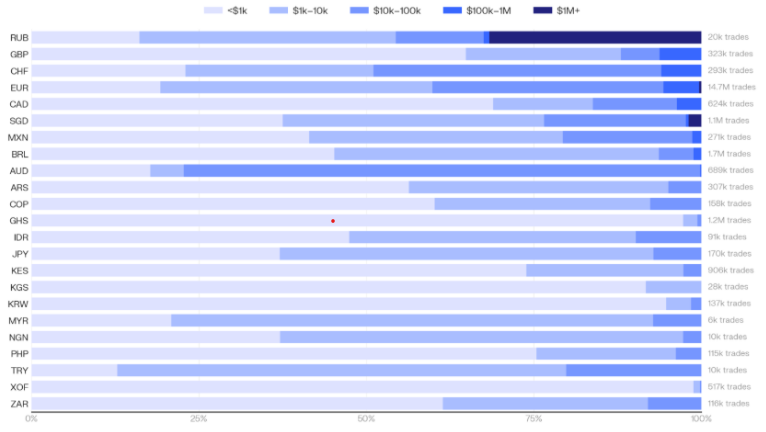
However, Egorov’s analysis, informed by real-world data, indicates a different trajectory. Markets are not waiting for institutional onboarding; instead, they are evolving in real-time to address a fundamental user need: the efficient movement of value across currency denominations. Research from Keyrock, a prominent digital asset liquidity provider, underscores this point, revealing that a significant portion of on-chain stablecoin trades involving emerging market currencies falls within the $1,000 to $10,000 range. These figures, while modest when compared to the colossal volumes typical of institutional FX, are precisely indicative of a market being shaped by practical payment requirements rather than speculative trading at an institutional scale. This data suggests a broad base of smaller transactions collectively forming the foundation of a new FX ecosystem.
Utility Over Scale: The "Small is Not Useless" Principle
A common misconception surrounding on-chain FX, and indeed many emerging financial technologies, is that a market must possess immense liquidity from its inception to be genuinely useful. Egorov refutes this, articulating a "small is not useless" principle. He contends that if there exists a genuine, practical demand from individuals or businesses needing to exchange, for instance, U.S. dollars into euros or Swiss francs, even a relatively modest liquidity pool can effectively process these transactions and fulfill a critical economic function. The utility of a financial service is not solely determined by its aggregate market size but by its ability to solve specific, real-world problems for its users.

This perspective aligns with the historical development of stablecoins themselves. Initially conceived as a niche crypto-native solution primarily for facilitating trading within cryptocurrency exchanges, stablecoins have rapidly transcended their origins. Today, they are integral components of a much broader global financial infrastructure, underpinning a wide array of DeFi applications, cross-border remittances, and digital payment systems. Chainalysis, a leading blockchain analytics firm, provides compelling evidence of this growth, reporting that cross-border stablecoin activity surged to over $220 billion by mid-2026, representing an almost 80% increase within a single year. This explosive growth in adoption, driven by demonstrable demand and utility, provides a powerful precedent for the potential trajectory of on-chain FX. If stablecoins could grow from a niche application to a cornerstone of digital finance by addressing user needs, there is every reason to believe on-chain FX can follow a similar path.
User-Centric Efficiency: The On-Chain Advantage
From the user’s vantage point, the sheer size of the global FX market is often an abstract concern. What truly matters is the ability to execute financial transfers with minimal friction, cost, and delay. For individuals and entities already operating within the blockchain ecosystem, the ability to convert a USD stablecoin into a EUR stablecoin (or other alternatives) on-chain for payment purposes represents a significant leap in efficiency. Such direct, on-chain swaps often prove to be substantially faster and more economical than traditional international bank transfers, which are typically encumbered by multiple intermediaries, high fees, and extended settlement times.
Consider the operational needs of a fintech company or a crypto-card issuer. Their primary objective is not to replicate the entirety of the institutional FX market but to efficiently move their customers’ funds between different currencies. In a traditional setup, converting currencies for cross-border payments often involves processing fees levied by payment networks like Visa or Mastercard, which can amount to approximately 1% per transaction. When customer funds are already on blockchain rails, however, swapping stablecoins can be executed directly within a decentralized exchange environment. This eliminates numerous "in-between" steps and traditional intermediaries, resulting in a streamlined process that is both quicker and less costly.
While traditional banks will undoubtedly retain their crucial role as primary entry and exit points for digital money interacting with the real world – handling the issuance and redemption of local currencies, managing bank accounts, and ensuring compliance with regulatory frameworks – the on-chain segment offers unparalleled efficiency. Once funds are tokenized and exist on the blockchain, many of the conventional intermediary steps in a cross-currency transaction can be bypassed, leading to a more direct and efficient value transfer. This represents a highly positive improvement from the perspective of a user seeking uncomplicated financial transfers, irrespective of the overall market’s scale.
Addressing the Liquidity Conundrum: The Role of Automated Market Makers
While genuine demand is indispensable, it alone does not magically resolve the persistent challenge of liquidity. The goal is not merely to establish a EUR/USD or CHF/USD stablecoin pool but to ensure its economic sustainability. This is where Automated Market Makers (AMMs) emerge as a transformative solution, particularly for nascent or niche on-chain FX markets.
Traditional market-making firms, driven by profit motives and operational costs, typically find it unattractive to provide liquidity for smaller FX markets where trading volume might not justify the resources expended. The operational overheads associated with managing bids and offers, monitoring market conditions, and hedging positions can quickly outweigh the potential profits in low-volume scenarios.
AMMs fundamentally alter this equation. These smart contract-driven protocols allow liquidity to be provided continuously and algorithmically, without requiring human intervention for every trade. Instead of relying on order books maintained by traditional market makers, AMMs utilize mathematical functions to determine asset prices and facilitate swaps, earning small fees for liquidity providers with every transaction.
To illustrate, consider the scenario of two prominent dollar-pegged stablecoins, USDC and Tether (USDT). From a traditional exchange’s perspective, facilitating swaps between two assets designed to maintain parity with the U.S. dollar might appear to be a low-profit, "boring" business due to minimal price volatility. However, if a genuine user need exists to switch between these stablecoins – perhaps due to different ecosystem integrations, risk preferences, or regulatory considerations – an AMM can create a pool specifically for this purpose. Each trade, no matter how small, generates a fee for the liquidity providers. When a sufficient number of users consistently require such conversions, an economically viable market can emerge, even for pairs that might not pique the interest of traditional market makers.
This mode of adoption may not be characterized by explosive, overnight growth. Instead, it embodies a slower, more natural expansion. New markets frequently germinate from a relatively small cohort of users facing a problem that existing infrastructure inadequately addresses. If these early adopters can collectively render the market economically viable, a flywheel effect can commence, attracting further liquidity and users as the utility and efficiency become more apparent.
Broader Implications and Future Outlook
The bottom-up development of on-chain FX, as articulated by Michael Egorov, carries profound implications for the future of global finance. It suggests a potential democratization of foreign exchange services, making them more accessible, affordable, and efficient for individuals and small businesses, particularly in emerging markets where traditional financial infrastructure can be costly and cumbersome.
- Enhanced Financial Inclusion: By reducing transaction costs and increasing speed, on-chain FX can significantly benefit cross-border remittances and micro-payments, empowering populations often underserved by traditional banking.
- Decentralized Economic Infrastructure: This approach fosters the development of a more robust and resilient decentralized financial ecosystem, where essential services like currency exchange are less reliant on centralized intermediaries.
- Innovation in Payment Systems: It paves the way for new payment solutions and business models that leverage the inherent efficiencies of blockchain technology, potentially integrating seamlessly with DeFi applications and digital wallets.
- A Redefined Role for TradFi: While banks will remain critical for fiat on/off-ramps and regulatory compliance, their "in-between" roles in cross-currency transfers may diminish as on-chain solutions gain traction, pushing them to innovate and adapt their services.
Michael Egorov, a physicist, entrepreneur, and crypto maximalist with a PhD in ultracold atoms, brings a unique blend of scientific rigor and practical industry experience to this analysis. His vision, rooted in the observable trends within DeFi and stablecoin adoption, challenges the established paradigms and offers a compelling roadmap for how on-chain foreign exchange could genuinely scale and integrate into the global economy – not through a top-down mandate, but through the aggregate power of user-driven utility. This gradual, organic growth, fueled by automated liquidity solutions and focused on solving practical problems, positions on-chain FX as a critical component of the evolving digital financial landscape. The market may not yet compete with the sheer volume of global FX, but its ability to solve real problems for users already on-chain marks a significant and impactful stride towards a more efficient and accessible financial future.