admin
admin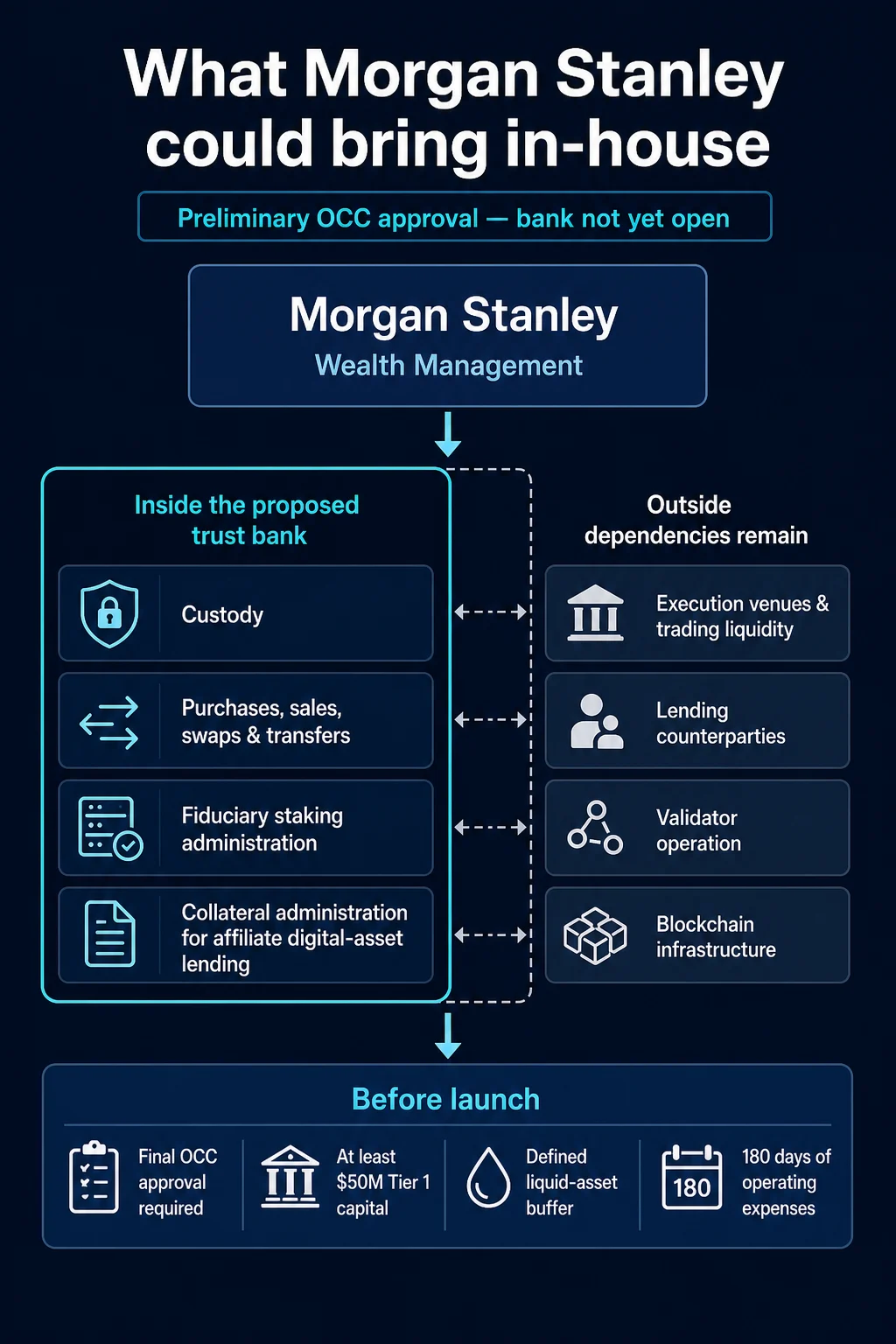
In a significant move poised to reshape the landscape of institutional digital asset management, Morgan Stanley has received preliminary conditional approval from the Office of the Comptroller of the Currency (OCC) to establish a national trust bank dedicated to digital assets. This groundbreaking decision, reached in June 2026, opens a regulated pathway for the financial giant to bring critical cryptocurrency functions, including custody, transaction administration, fiduciary staking, and collateral support for lending, under its direct purview. The proposed entity, Morgan Stanley Digital Trust, would operate as a wholly owned subsidiary, marking a strategic shift from relying on external specialized providers to building an integrated in-house infrastructure for its Wealth Management clients.
A New Era for Institutional Crypto Services
The OCC’s approval signifies a pivotal moment for the integration of digital assets within traditional finance. For years, financial institutions looking to offer cryptocurrency-related services to their clients have largely depended on third-party custodians, staking service providers, and collateral management firms. These external partners have played a crucial role in bridging the gap between established financial systems and the nascent digital asset ecosystem. However, Morgan Stanley’s strategic initiative suggests a desire to capture greater control over client relationships, operational workflows, and the associated revenue streams by internalizing these core functions.
The public application for Morgan Stanley Digital Trust, classified by the OCC as a new bank charter with requested trust powers under a holding company structure, outlines a comprehensive suite of services. These include the secure safeguarding of client assets, the administration of purchases, sales, swaps, and transfers of digital assets, and fiduciary oversight of staking operations. Crucially, the trust bank will also provide collateral administration to support affiliate digital-asset lending activities. This integrated approach aims to streamline operations, enhance security, and potentially offer a more cohesive client experience by consolidating these vital services within a single, regulated entity.
Chronology of a Landmark Approval
The journey towards this integrated digital asset trust began with the submission of Morgan Stanley’s application to the OCC. While the exact date of the initial filing is not publicly detailed, the OCC’s official record indicates that the charter action was approved on June 18, 2026. This approval, however, is conditional, necessitating Morgan Stanley to meet stringent capital and liquidity requirements before the trust bank can commence full operations.
Specifically, as outlined in Corporate Decision 1378, Morgan Stanley Digital Trust must demonstrate a minimum of $50 million in Tier 1 capital. Additionally, the institution needs to establish a designated pool of liquid assets and maintain sufficient liquidity to cover 180 days of projected operating costs. These requirements underscore the OCC’s commitment to ensuring the stability and soundness of any new financial institution operating within the digital asset space, particularly one as significant as Morgan Stanley. The preliminary conditional approval signifies that the OCC has reviewed the application and found it to be compliant with regulatory frameworks, pending the fulfillment of these specific financial and operational prerequisites.

Integrated Functions vs. External Infrastructure
The core of Morgan Stanley’s strategic pivot lies in its ability to internalize functions that were previously outsourced. This includes the direct management of client asset custody, the administration of all digital asset transactions, the oversight of staking rewards and participation, and the management of collateral pledged for lending. By bringing these operations in-house, Morgan Stanley aims to reduce the number of intermediaries involved in its clients’ digital asset activities. This consolidation could lead to a more efficient and secure operational model, potentially reducing latency and the risk of errors associated with multiple handoffs between different service providers.
However, it is crucial to note that the OCC filing explicitly defines what Morgan Stanley intends to keep within its regulated trust bank structure. Several critical components of the digital asset ecosystem will continue to rely on external venues and infrastructure. These include:
- Execution Venues: The platforms where digital assets are bought and sold will remain external. Morgan Stanley will likely connect to various exchanges and over-the-counter (OTC) trading desks to facilitate client transactions.
- Trading Liquidity: Access to deep pools of trading liquidity will continue to be sourced from external markets and liquidity providers.
- Lending Counterparties: While Morgan Stanley will manage collateral for its own affiliate lending, the actual lending counterparties for its clients will likely be external financial institutions or decentralized finance (DeFi) protocols, depending on the specific offering.
- Validator Operations: For proof-of-stake (PoS) networks, the actual operation of validator nodes, responsible for validating transactions and securing the blockchain, will likely remain with specialized third-party validators or infrastructure providers. Morgan Stanley’s role will be in the fiduciary administration of staking, ensuring client assets are directed towards reputable validators.
- Broader Blockchain Infrastructure: The underlying blockchain networks themselves, including consensus mechanisms, network security, and protocol upgrades, represent an external infrastructure layer upon which all digital asset activities are built.
This distinction highlights that while Morgan Stanley is significantly expanding its in-house capabilities, it will still operate within the broader, interconnected digital asset ecosystem. The success of its integrated model will depend on its ability to forge robust partnerships with these external infrastructure providers.
Implications for the Crypto-Native Industry
The move by a financial titan like Morgan Stanley carries significant implications for existing crypto-native intermediaries. Third-party custodians, staking administrators, and collateral service providers that have historically served institutional clients will face increased pressure. As Morgan Stanley brings these functions in-house, their services may become less attractive or redundant for clients who can now access integrated solutions directly from their trusted banking partner.
This could lead to a consolidation within the crypto-native service provider market, with firms needing to differentiate themselves by offering highly specialized services, superior technology, or unique market insights that Morgan Stanley’s in-house solution might not initially encompass. The challenge for these firms will be to demonstrate continued value in a landscape where major Wall Street players are increasingly building their own foundational capabilities.
Furthermore, by consolidating the client relationship and operational control, Morgan Stanley could significantly enhance its competitive positioning. The ability to offer a seamless, end-to-end digital asset service, from secure custody to active participation in staking and lending, directly from a single, trusted Wall Street institution, could be a powerful draw for both existing and new wealth management clients. This could potentially reduce the reliance of these clients on a fragmented network of specialized crypto service providers.

Regulatory Scrutiny and Future Outlook
The OCC’s approval of Morgan Stanley Digital Trust is not merely a business decision; it is also a testament to the evolving regulatory stance on digital assets within traditional financial institutions. The OCC, as the primary regulator for national banks, has been gradually developing frameworks to accommodate digital asset activities. This approval signifies a growing comfort level with supervised institutions engaging in these complex financial operations.
The stringent capital and liquidity requirements underscore the regulatory emphasis on risk management and financial stability. As Morgan Stanley navigates the final stages of obtaining full operational approval, the industry will be watching closely to observe the implementation details and the impact on client adoption.
The long-term outlook suggests that more traditional financial institutions may follow suit, seeking to build similar integrated digital asset capabilities. This trend could accelerate the mainstream adoption of digital assets by providing a more familiar and regulated on-ramp for institutional investors. However, it also raises important questions about market concentration, the potential for systemic risk, and the continued innovation and decentralization that the crypto-native industry has championed.
In conclusion, Morgan Stanley’s preliminary OCC approval for its national trust bank represents a monumental step in the institutionalization of digital assets. By strategically bringing custody, staking, and lending support in-house, the financial giant is poised to redefine how its clients engage with the cryptocurrency market, while simultaneously presenting new challenges and opportunities for the existing crypto-native service provider ecosystem. The successful launch of Morgan Stanley Digital Trust will undoubtedly serve as a bellwether for the future of digital asset management within the traditional financial sector.