admin
admin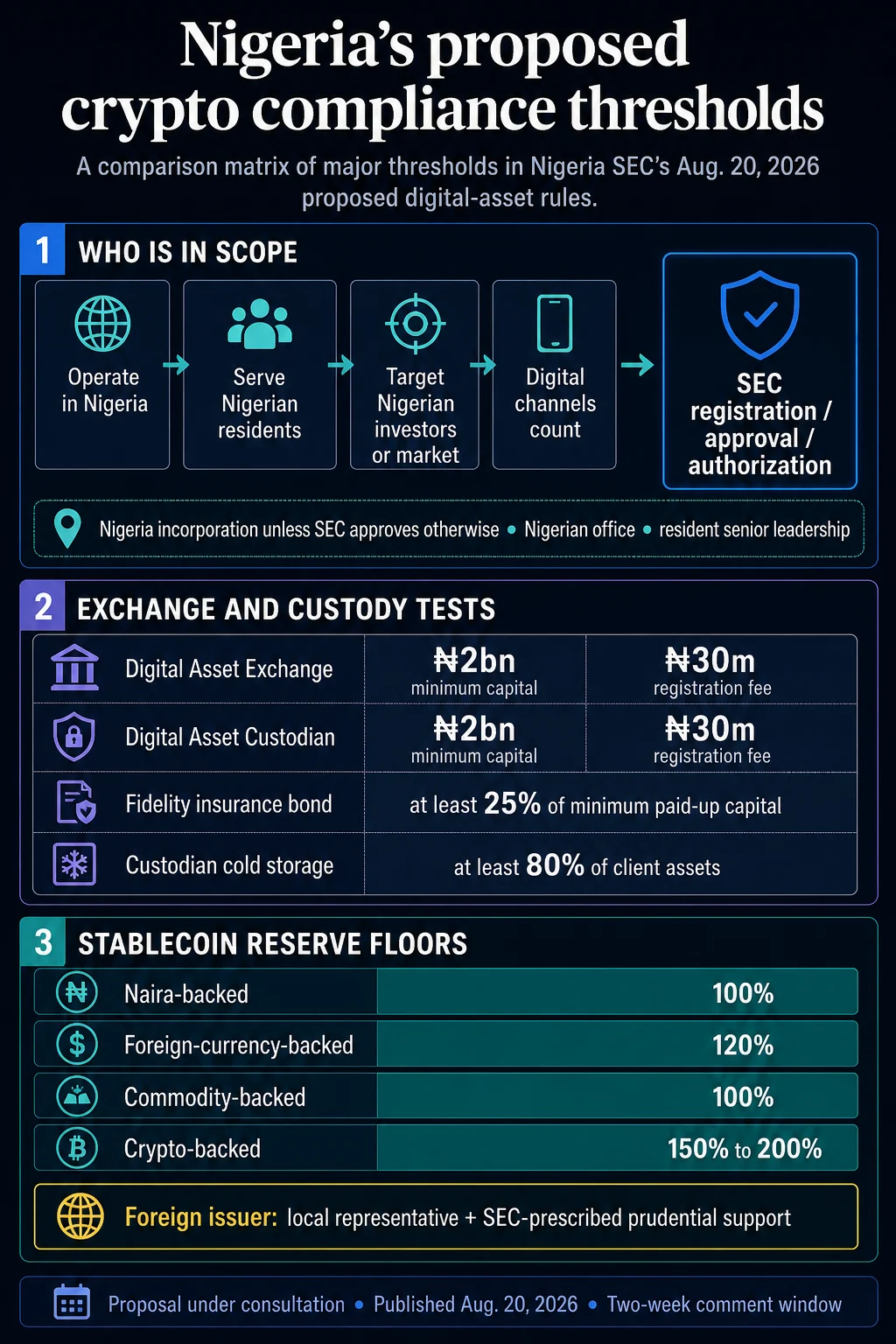
Nigeria’s Securities and Exchange Commission (SEC) has unveiled a comprehensive set of proposed rules aimed at bringing a wide array of digital asset businesses operating within or targeting the Nigerian market under its regulatory purview. The sweeping proposals, published on August 20th and open for public comment until September 3rd, introduce significant capital requirements, operational mandates, and reserve standards that could fundamentally alter the landscape for both local and international cryptocurrency platforms serving Nigerian residents. At the heart of the proposed regulations is a stipulation that exchanges and custodians would need to hold a minimum of ₦2 billion (approximately $1.3 million USD, based on current exchange rates) in capital, while foreign-currency stablecoins would face a stringent 120% backing requirement.
The Nigerian SEC’s initiative marks a significant step in its ongoing efforts to establish a clear regulatory framework for the burgeoning digital asset sector. Historically, the country has demonstrated a dynamic approach, with initial reservations about cryptocurrencies evolving towards a more structured regulatory engagement. This latest proposal signals a mature regulatory posture, seeking to balance innovation with investor protection and market integrity. The broad scope of the rules is particularly noteworthy, extending regulatory reach beyond entities physically incorporated within Nigeria to encompass any business serving Nigerian residents or actively targeting the Nigerian investment market through digital channels. This inclusive approach aims to close potential regulatory gaps and ensure a consistent level of oversight regardless of a platform’s geographical base.
The proposed rules are not yet enacted legislation but represent a crucial stage in the policy-making process. The SEC has provided a two-week window for stakeholders to submit feedback, indicating a commitment to an consultative approach. This period is critical for industry participants to voice concerns, offer alternative solutions, and contribute to the shaping of the final regulations. The deadline for submissions, September 3rd, is a key date for all entities involved in Nigeria’s digital asset ecosystem.
Expanding Regulatory Reach: Scope and Jurisdiction
A cornerstone of the proposed framework is its expansive definition of entities subject to SEC regulation. The rules stipulate that any digital asset business operating within Nigeria, providing services to Nigerian residents, or targeting Nigerian investors or the Nigerian market, whether directly, indirectly, or via digital channels, will fall under the SEC’s jurisdiction. This broad interpretation is designed to capture the pervasive nature of digital asset services, which often transcend geographical borders through online platforms.
For foreign entities, this means that simply serving Nigerian customers online could necessitate compliance with Nigerian regulations. The proposals suggest that such businesses would generally be required to incorporate in Nigeria. However, an avenue for alternative arrangements exists, with the Commission reserving the right to approve other structures if deemed appropriate. This flexibility acknowledges the diverse operational models within the digital asset space.

Furthermore, entities operating under these proposed rules would be mandated to maintain a registered office within Nigeria. They would also need to appoint a resident chief executive officer, managing director, or an equivalent principal officer, along with resident sponsored individuals. These requirements aim to establish a tangible local presence and accountability for digital asset businesses operating in the country. The framework also contemplates the possibility of foreign entities obtaining registration or authorization through specific SEC frameworks when they meet pre-defined conditions, offering a potential pathway for established international players.
Stringent Capital Requirements and Operational Mandates
The proposed rules introduce a tiered system of capital requirements, with specific thresholds set for different categories of digital asset businesses. The most significant capital floor, set at ₦2 billion, is designated for Digital Asset Exchanges and Digital Asset Custodians. These entities, which form the backbone of the cryptocurrency market infrastructure, are subjected to the highest capital demands, reflecting the inherent risks associated with trading and safeguarding digital assets. Accompanying these capital requirements is a substantial registration fee of ₦30 million for each of these categories.
Other digital asset service providers will face different, albeit still considerable, capital obligations. Digital Asset Platforms, Digital Asset Offering Platforms, and Real World Asset Tokenization Offering Platforms are slated to require a minimum capital of ₦500 million, coupled with a registration fee of the same amount. The broader category of Virtual Asset Service Providers (VASPs) is subject to a capital requirement of ₦200 million and a registration fee of ₦15 million. These differentiated capital levels appear to be calibrated based on the perceived risk profile and operational scope of each business type.
Beyond the capital infusion, the proposals mandate that entities secure a current fidelity insurance bond. This bond must cover at least 25% of the stipulated minimum paid-up capital. This insurance requirement serves as an additional layer of financial protection for investors, ensuring that there are funds available to mitigate losses in the event of operational failures or fraudulent activities. The fidelity bond is designed to complement, rather than replace, the minimum capital requirements.
Custody and Stablecoin Reserves: Enhancing Security and Stability
The proposed regulations also address the critical aspects of asset custody and the stability of digital currencies. For digital asset custodians, a significant operational requirement is introduced: at least 80% of client digital and virtual assets must be held in cold storage. This provision is a direct response to the prevalent security risks associated with hot wallets, which are more susceptible to cyberattacks. The SEC’s emphasis on cold storage underscores a commitment to safeguarding client assets from theft and unauthorized access. The rules do allow for the SEC to set alternative percentages, providing a degree of regulatory adaptability. Hot and warm wallets will be permitted, but their use will be strictly limited to operational necessities, ensuring that the majority of assets remain in the most secure form of storage.
The framework also introduces specific reserve requirements for stablecoin issuers, particularly those targeting the Nigerian market or whose tokens are intended for use by regulated entities within Nigeria. This measure is aimed at bolstering the trustworthiness and stability of stablecoins, which are often pegged to traditional currencies or commodities. For Naira-backed and commodity-backed stablecoins, issuers will be required to maintain a 100% reserve. This ensures that the value of the token is fully collateralized by the underlying asset.

A more stringent requirement is placed on foreign-currency-backed stablecoins, which must maintain a 120% backing. This higher reserve ratio for foreign currency pegs likely aims to account for potential currency fluctuation risks and ensure an additional buffer of stability. The most rigorous reserve requirements are reserved for crypto-backed stablecoins, which will start at a 150% collateralization level. Schedule II of the proposed rules further refines this, setting a collateral range of 150% to 200%, contingent on factors such as volatility, liquidity, concentration risk, and the overall quality of the collateral backing the stablecoin. This tiered approach to stablecoin reserves reflects a nuanced understanding of the varying risks associated with different collateral types.
Implications for the Nigerian Digital Asset Ecosystem
The implications of these proposed rules for Nigeria’s digital asset ecosystem are substantial and multifaceted. Firstly, the high capital requirements are likely to act as a significant barrier to entry for smaller startups and individual operators. This could lead to a consolidation within the industry, favoring larger, well-capitalized entities that can meet the stringent financial demands. While this may enhance the stability and credibility of the market, it could also stifle innovation and reduce competition, potentially limiting the diversity of services available to Nigerian users.
Secondly, the broad jurisdictional scope means that international crypto exchanges and service providers will need to carefully assess their operations in relation to Nigeria. Those serving Nigerian residents will likely face a choice: either comply with the proposed Nigerian regulations, which may involve establishing a local presence and meeting substantial capital and operational requirements, or cease serving the Nigerian market. This could lead to a reduction in seamless access to global crypto platforms for Nigerian users, potentially pushing some activity into less regulated or informal channels if compliance becomes too burdensome.
The emphasis on cold storage for custodians and robust reserves for stablecoins signals a strong regulatory push towards enhanced security and financial stability. These measures, if implemented, would significantly reduce the risk of asset loss due to hacks or stablecoin de-pegging events, thereby fostering greater investor confidence in the Nigerian digital asset market. However, the cost of implementing these stringent security measures and maintaining higher reserves could be passed on to consumers in the form of higher fees or reduced service offerings.
The introduction of these comprehensive regulations by the Nigerian SEC reflects a global trend of increasing regulatory scrutiny over the digital asset space. Countries worldwide are grappling with how to effectively regulate cryptocurrencies and other digital assets to protect investors, prevent illicit activities, and maintain financial stability, all while fostering innovation. Nigeria’s proposed framework, with its emphasis on capital adequacy, operational integrity, and asset backing, positions it as a jurisdiction taking a proactive and robust stance in this evolving regulatory landscape. The coming weeks, as public comments are considered, will be crucial in determining the final form and impact of these significant proposals on Nigeria’s digital future.