admin
admin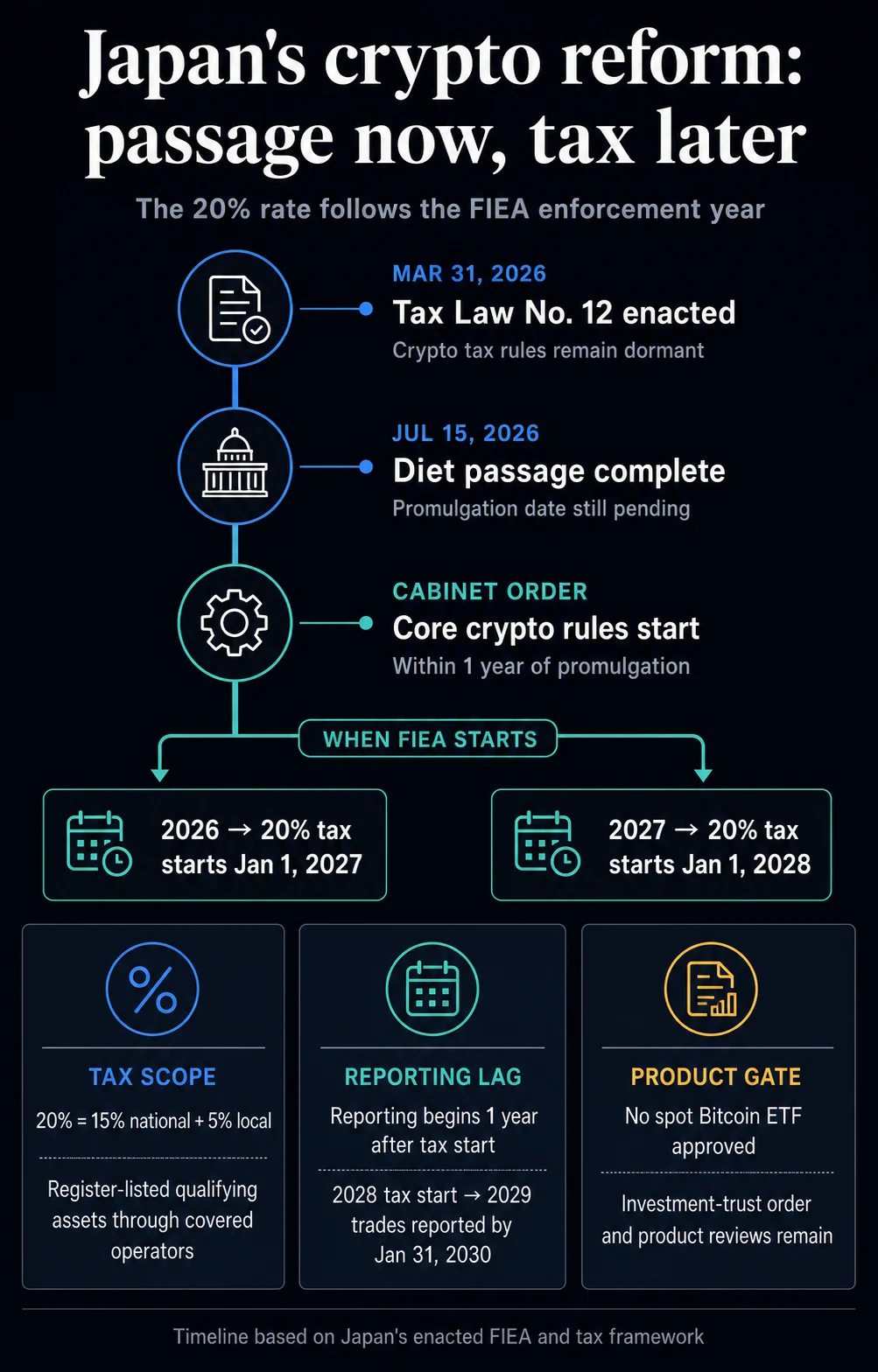
Japan’s House of Councilors has overwhelmingly approved Cabinet Bill 57, a pivotal piece of legislation that will integrate regulated cryptocurrency activities into the stringent framework of the Financial Instruments and Exchange Act (FIEA). This legislative milestone, passed on July 15, 2026, marks a significant shift in how Japan approaches digital assets, aiming to bolster investor protection and market integrity. However, the eagerly anticipated implementation of new market rules and a potentially beneficial 20% tax rate for crypto traders may still face a waiting period, with a start date contingent on the Cabinet’s decree, potentially pushing full realization to 2027 or even 2028.
The core of the new legislation dictates that the primary provisions concerning cryptocurrency will come into effect on a date determined by a Cabinet order, to be issued within one year of the law’s promulgation. This means that if the Cabinet enforces the FIEA integration during 2026, the associated tax reforms, including the 20% tax rate, would commence on January 1, 2027. Conversely, if the enforcement is delayed until 2027, the tax benefits would then be postponed to January 1, 2028. The precise timing, therefore, rests with the executive branch, leaving the industry and investors in a state of anticipation.
A Strategic Shift: Integrating Crypto into FIEA
The fundamental change brought about by this reform is the relocation of crypto transaction regulation from the Payment Services Act to the FIEA. While cryptocurrencies will continue to be legally distinguished from traditional securities, the activities involving them will now be subject to a compliance and oversight regime akin to that governing the securities market. This move is intended to bring a higher level of regulatory scrutiny and standardization to the burgeoning digital asset space in Japan.
According to explanatory materials released by the Financial Services Agency (FSA), the amended FIEA will encompass enhanced disclosure requirements and registration mandates for various crypto-related activities. This includes the sale of cryptocurrencies, token offerings controlled by issuers, borrowing of digital assets, as well as stringent asset screening, secure custody practices, robust customer safeguards, and comprehensive insider-trading controls. Exchanges and other intermediaries operating within Japan can begin preparing their systems and processes to align with these forthcoming requirements, as their full implementation is tied to the FIEA’s commencement date. Detailed operational guidelines and specific regulatory requirements will be further elaborated through subsequent Cabinet orders and FSA ordinances.
The Tax Conundrum: A 20% Rate with a Delayed Fuse
While the legislative framework for crypto regulation is now firmly in place, the tax implications are intricately linked to the FIEA’s effective date. Japan’s Parliament had previously enacted the necessary tax reforms, specifically the fiscal 2026 tax amendments (Law No. 12), which were promulgated on March 31, 2026. These amendments, once active, are set to introduce a combined 20% tax rate on qualifying gains from cryptocurrencies. This rate is a composite of a 15% national income tax and a 5% local inhabitant tax.

However, the application of this 20% rate is conditional. It will only apply when investors sell eligible tokens through registered crypto businesses, and the assets themselves must appear on Japan’s official register of approved digital assets. This conditionality underscores the government’s intent to channel trading activity through regulated platforms, thereby enhancing transparency and facilitating tax collection.
A significant benefit introduced by the reform is the provision for carrying forward unused losses within the same tax-defined crypto category for up to three years, subject to specific conditions. This aims to mitigate the impact of market volatility on investors. It is crucial to note that tokens, trading venues, and transactions that fall outside this newly defined regulated channel will continue to be subject to existing tax treatments.
The reporting obligations for these new tax rules are scheduled to commence a year after the tax and loss provisions themselves become active. Based on the framework outlined by the Ministry of Finance, businesses will be required to furnish tax authorities with customer identities, Japan’s My Number identifier, and detailed transaction data by January 31 of the year following the tax year in question. Consequently, if the 20% tax regime officially begins in 2028, the reporting would encompass transactions from 2029, with the first reports due by January 31, 2030.
Charting the Path for Crypto Investment Products
Beyond trading and taxation, the reform package also lays out a potential pathway for the development and offering of cryptocurrency investment products within Japan. The legislation brings crypto investment management and advisory services under the purview of the FIEA. Furthermore, it anticipates the establishment of certain investment trusts that can hold tax-qualifying, registered crypto assets. However, realizing this aspect will necessitate a separate amendment to the enforcement order of the Investment Trusts Act, indicating further regulatory steps are required.
It is important to clarify that the current legislation does not explicitly name or approve spot Bitcoin Exchange-Traded Funds (ETFs). The FSA, in an announcement in October 2025, had previously stated that the formation and sale of domestic crypto ETFs were prohibited under the existing regulatory framework. Sponsors seeking to launch such products will still need to navigate applicable product and listing reviews once the detailed rules for this new route are finalized and implemented.
A Chronology of Key Dates and Dependencies
The precise timeline for the full implementation of these reforms is a complex interplay of several factors:

- July 15, 2026: The House of Councilors approves Cabinet Bill 57, completing the Diet passage of the crypto legislation.
- Within One Year of Promulgation: The Cabinet will issue an order to bring the FIEA amendments into force.
- Early 2027 (Potential): If the Cabinet order is issued in 2026, the FIEA integration begins, and the 20% tax rate and reporting rules could start on January 1, 2027.
- Early 2028 (Potential): If the Cabinet order is issued in 2027, the FIEA integration begins, and the 20% tax rate and reporting rules would commence on January 1, 2028.
- January 31, 2030 (Potential): If the 20% tax regime starts in 2028, the first reports on transactions from 2029 would be due.
The successful integration of crypto into the FIEA is a critical prerequisite for the activation of the new tax regime. This phased approach allows regulators and market participants to adapt to the evolving landscape of digital assets.
Broader Implications and Industry Reactions
The passage of this legislation is a significant development for Japan’s digital asset industry, which has been seeking greater regulatory clarity and a more favorable tax environment. By bringing crypto under the FIEA, Japan signals its commitment to fostering a mature and responsible market, potentially attracting institutional investors and innovative businesses. The move is seen as a departure from a more restrictive stance, aiming to balance innovation with robust investor protection.
Industry observers have generally welcomed the move towards greater regulatory certainty. However, the delayed effective date for the tax benefits has led to mixed reactions. While some understand the need for a staggered implementation, others had hoped for a more immediate realization of the tax incentives to boost domestic trading activity and attract capital. The FSA’s methodical approach, emphasizing careful implementation and detailed rule-making, suggests a deliberate strategy to ensure the long-term stability and integrity of the Japanese crypto market.
The FSA’s proactive communication regarding the timeline and dependencies is crucial for market participants to plan accordingly. As Japan continues to navigate the complexities of digital asset regulation, the successful implementation of this FIEA integration and the subsequent tax reforms will be closely watched by global financial markets. The ultimate success of these measures will hinge on their ability to foster a thriving yet secure environment for cryptocurrency innovation and investment in the world’s third-largest economy.