Dwi Wanna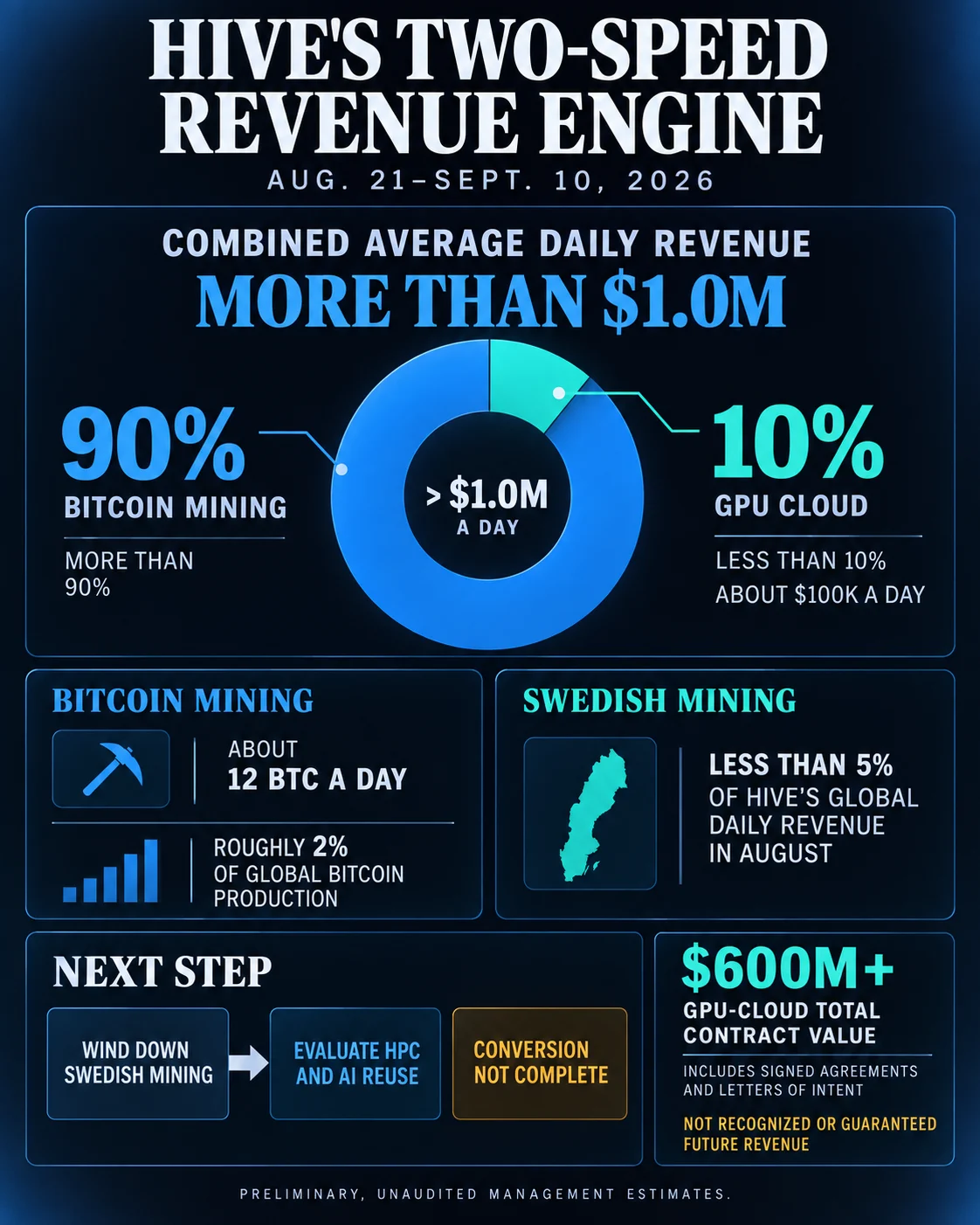
HIVE Digital Technologies, a pioneer in the intersection of blockchain infrastructure and data center operations, recently released preliminary financial figures that underscore a significant milestone in its operational history. Between August 21 and September 10, 2024, the company reported a combined average daily revenue exceeding $1 million. While the company has been vocal about its strategic pivot toward artificial intelligence (AI) and high-performance computing (HPC), the data reveals that its legacy Bitcoin mining business remains the overwhelming driver of its financial performance. Specifically, the company’s GPU-cloud services contributed approximately $100,000 per day, representing roughly 10% of total revenue, while Bitcoin mining accounted for the remaining 90%.
This disclosure provides a rare, quantified look at the "two-speed" transition currently defining the company’s evolution. As HIVE seeks to reposition itself as a diversified technology firm rather than a pure-play miner, it must balance the capital-intensive demands of AI infrastructure with the volatile but lucrative cash flows generated by its global mining fleet.
The Financial Engine: Bitcoin Mining Dominance
Despite the growing narrative surrounding HIVE’s AI expansion, the company’s mining operations continue to operate at a scale that dwarfs its nascent cloud business. During the reporting period, HIVE successfully mined an average of 12 Bitcoin per day. To put this in perspective, this output represents approximately 2% of the total global Bitcoin network production.
The company’s ability to maintain such a high share of the global hash rate is a testament to its aggressive hardware renewal program. HIVE has consistently invested in the latest generation of Application-Specific Integrated Circuit (ASIC) miners, which offer higher terahash output with lower energy consumption. This efficiency is critical in a post-halving environment where mining rewards have been slashed, and only the most efficient operators can maintain healthy margins.
The $900,000 in daily revenue attributed to mining is subject to the fluctuations of the broader cryptocurrency market. HIVE noted that these preliminary figures are management estimates and are heavily influenced by prevailing Bitcoin prices, network difficulty, and operational uptime. As of late 2024, Bitcoin’s price stability has allowed HIVE to generate the cash flow necessary to fund its ambitious transition into the AI sector.
The AI Pivot: Analyzing the $600 Million Pipeline
The GPU-cloud segment, while currently contributing only 10% of daily revenue, is where HIVE sees its long-term growth potential. The company reported that it has closed more than $600 million in Total Contract Value (TCV) for its GPU-cloud business year-to-date. This figure is a composite of signed customer agreements and formal Letters of Intent (LOIs).

However, HIVE was careful to distinguish between TCV and recognized revenue. TCV represents the potential value of contracts over their entire lifespan, which can span several years. It does not guarantee immediate cash flow and is contingent upon the company’s ability to meet rigorous service-level agreements (SLAs) and complete infrastructure buildouts.
A significant portion of this pipeline is tied to a $350 million AI cloud agreement announced in August. This deal is a cornerstone of HIVE’s strategy but comes with substantial execution risks. To fulfill the contract, HIVE requires a $185 million capital expenditure to build out the necessary GPU clusters, likely utilizing NVIDIA’s high-end H100 or Blackwell architectures. The transition from "signed intent" to "$100,000 per day in revenue" is a complex technical and financial hurdle that HIVE is currently navigating.
Chronology of the Transition: From Blockchain to Digital Tech
HIVE’s journey toward its current revenue mix has been a multi-year process marked by strategic rebrandings and infrastructure overhauls.
- July 2023: The company officially rebranded from HIVE Blockchain Technologies to HIVE Digital Technologies. The move signaled a shift in focus toward the broader "digital" economy, specifically targeting the demand for compute power driven by Large Language Models (LLMs) and generative AI.
- Late 2023 – Early 2024: HIVE began repurposing its existing Ethereum-era GPU fleet. After the Ethereum "Merge" rendered GPU mining for Ether obsolete, HIVE was one of the few firms that successfully pivoted its hardware to provide Infrastructure-as-a-Service (IaaS) for non-crypto clients.
- August 2024: The company announced a landmark $350 million agreement with a major AI firm. This served as a validation of HIVE’s ability to compete in the enterprise cloud space, though it also highlighted the need for significant new capital.
- September 2024: The release of the August/September revenue figures provided the first clear evidence that the AI business is generating six-figure daily revenue, even as it remains a minority of the total business.
The Swedish Evaluation and High-Performance Computing
A key element of HIVE’s strategy involves its facilities in Boden, Sweden. Historically used for Bitcoin mining due to the region’s cold climate and abundant renewable energy, these sites are currently under evaluation for a full conversion to HPC data centers.
HIVE has stated its intention to wind down mining operations at certain Swedish facilities to make room for AI-focused server racks. This process, however, is not instantaneous. Repurposing a data center for AI requires significant upgrades to power density, cooling systems, and networking infrastructure. Unlike Bitcoin mining, which is relatively "plug-and-play," AI workloads require low-latency environments and highly specialized cooling to handle the thermal output of modern GPUs.
The company cautioned that the wind-down and repurposing might not proceed exactly as planned, citing potential delays in hardware delivery or regulatory hurdles. In the interim, these sites contributed less than 5% of global daily revenue in August, reflecting their transitional status.
Comparative Industry Landscape: The "Great AI Pivot"
HIVE is not alone in its pursuit of AI revenue. The entire Bitcoin mining industry is currently undergoing a structural shift. Companies like Core Scientific, Iris Energy, and TeraWulf have all announced initiatives to lease their power capacity and infrastructure to AI firms.

- Core Scientific: Recently signed a multi-billion dollar deal with CoreWeave, a leading AI hyperscaler, to provide over 200MW of power for HPC.
- Iris Energy: Has rebranded to IREN and is aggressively marketing its data centers as "next-generation" facilities for AI workloads.
- TeraWulf: Utilizing its zero-carbon energy sources to attract sustainability-focused AI clients.
HIVE’s distinction lies in its hybrid approach. While some competitors are pivoting entirely away from mining, HIVE continues to leverage its 12 BTC-per-day output to self-fund its AI ambitions. This strategy minimizes the need for dilutive equity raises, though the $185 million requirement for its latest GPU buildout suggests that some form of external financing or debt will be necessary.
Strategic Implications and Future Outlook
The current $1 million daily revenue figure is a milestone, but it also highlights the vulnerability of HIVE’s current model. With 90% of its revenue tied to Bitcoin, HIVE remains highly sensitive to "hashprice"—a metric that combines Bitcoin price and network difficulty. If Bitcoin prices were to drop significantly, the "financial engine" carrying the AI shift could stall.
Conversely, the AI cloud business offers a more stable, recurring revenue stream. Enterprise contracts typically involve multi-year commitments with fixed pricing, providing a hedge against the volatility of the crypto markets. The challenge for HIVE’s management in the coming quarters will be to increase the AI revenue contribution from 10% to 30% or 50% without degrading the efficiency of its mining operations.
Market analysts will be watching HIVE’s next quarterly earnings report closely to see if the $100,000 daily GPU revenue shows an upward trend. Success will depend on three factors:
- Execution of the $185 Million Buildout: Can HIVE secure the hardware and power necessary to fulfill its $350 million contract?
- Bitcoin Price Stability: Can the mining business continue to generate ~$900,000 a day to provide the liquidity needed for expansion?
- Operational Efficiency in Sweden: Will the repurposing of European sites yield the high margins expected from the HPC sector?
For now, HIVE Digital Technologies stands as a prime example of the industrialization of digital compute. While the "AI" label attracts investor attention, it is the hum of thousands of Bitcoin ASICs that continues to pay the bills. The transition is underway, but the "two-speed" nature of the company’s revenue ensures that for the foreseeable future, HIVE remains a Bitcoin miner at its core, with a very expensive and promising AI side-hustle.