admin
admin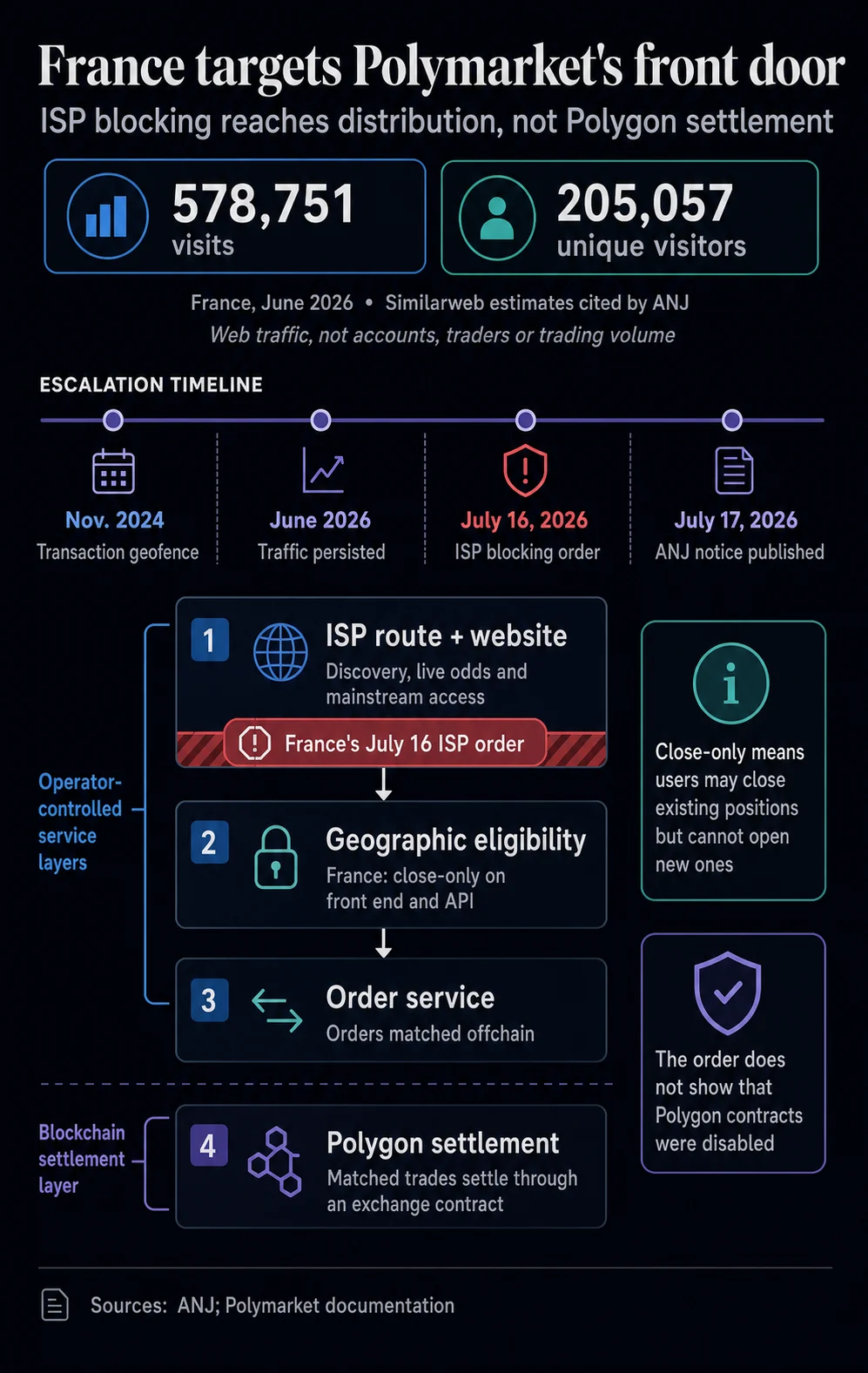
France’s national gambling regulator, the Autorité nationale des jeux (ANJ), has escalated its enforcement actions against Polymarket, a prominent cryptocurrency-based prediction market platform, by ordering internet service providers (ISPs) to block public access to the entire website. This decisive move signifies a departure from previous measures, which involved attempting to geofence financial transactions originating from France. The ANJ contends that Polymarket’s online presence actively promotes unauthorized gambling activities, irrespective of earlier efforts to curb financial flows. The regulator’s decision, published on July 17, 2026, follows a period of significant French user engagement with the platform, underscoring the growing challenge of regulating decentralized finance (DeFi) applications within national legal frameworks.
The ANJ’s directive to ISPs highlights a critical vulnerability in the notion that on-chain markets are inherently beyond the reach of national jurisdictions. While settlement of trades can occur on a blockchain, the mainstream user experience remains heavily reliant on operator-controlled websites and interfaces for market discovery, order placement, and overall engagement. This reliance provides national regulators with a tangible point of intervention, even when the underlying financial infrastructure is decentralized.
A Geofence Proved Insufficient Against Persistent Audience Reach
This latest regulatory action represents an escalation from France’s initial intervention in November 2024. At that time, the ANJ had engaged with Adventure One QSS Inc., a Panamanian entity identified as Polymarket’s operator. The ANJ’s assessment concluded that Polymarket’s services potentially constituted unauthorized gambling under French law. In response to this initial regulatory pressure, Adventure One implemented a geoblock, which the ANJ initially interpreted as effectively preventing bets from France.
However, the ANJ’s July 2026 notice reveals that this transaction-focused restriction proved insufficient. The regulator stated that while the earlier control aimed to prevent financial transactions originating from French territory, practical workarounds emerged. Crucially, the Polymarket homepage continued to display live odds and market information, attracting a substantial French audience. According to data cited by Similarweb, the platform garnered an estimated 578,751 visits and 205,057 unique visitors from France in June 2026 alone. These figures illuminate the ANJ’s rationale for shifting from transaction-based restrictions to a comprehensive website block.
The ANJ’s perspective is that a control mechanism which merely rejects new transactions, while still allowing users to view market dynamics and circulating betting prices, leaves the platform’s promotional capacity largely intact. The regulator considers the dynamically updated odds displayed on the Polymarket homepage as a significant channel for promoting what it deems an illegal activity.
French legal frameworks provide the ANJ with specific tools to address such online interfaces. Article 61 of the relevant legislation empowers the ANJ, after statutory notice and response periods, to issue orders to access providers. These orders can compel ISPs to prevent access to specified illegal online interfaces and instruct search engines or directories to cease referencing them. This legal recourse has been actively utilized by the ANJ, which reported blocking 1,290 URLs associated with illegal gambling in 2025 through this process.
The current action against Polymarket represents a broader distribution sanction. Instead of solely relying on the platform operator to self-enforce transaction rejections, France is now targeting the domestic networks and discovery services that connect a mainstream audience to the platform. This strategic shift aims to disrupt the entire user acquisition and engagement funnel.
Regulatory Framework and Classification of Prediction Markets
The ANJ has firmly grounded its case in gambling law, rather than focusing on the cryptocurrency aspect of Polymarket’s operations. The regulator’s initial notice in 2024 emphasized the broader gambling character of the offering. This rationale was further elaborated in the ANJ’s policy statement released in February 2026. In this statement, the ANJ officially classifies prediction markets as unauthorized gambling within France.
The ANJ’s concerns stem from what it perceives as the inherent risks associated with these platforms. The regulator highlights the combination of continuous accessibility and viral distribution mechanisms, coupled with what it views as inadequate consumer protections compared to licensed operators. Specific risks cited include addiction potential, integrity concerns within the markets, and the absence of robust identity and age verification processes. These factors collectively contribute to the ANJ’s decision to restrict access to such services for French residents.
The ANJ’s reasoning underscores why a platform displaying live odds is not considered a neutral interface from a regulatory standpoint. Dynamically updated prices are interpreted as a form of product marketing. Furthermore, the presence or absence of identity, age control, and integrity systems around the market dictates how authorities perceive its acceptability for local users.

The Blockade Targets the Service, Not the Underlying Blockchain Settlement
Polymarket’s own technical documentation clearly delineates the separation between its user-facing services and its on-chain settlement layer. The platform’s geographic restrictions page explicitly lists France as a "close-only" region for both its front-end interface and its Application Programming Interface (API). This restriction means that users in France can close existing positions but are prohibited from opening new ones. Polymarket enforces this geographic access control through its own infrastructure, with the IP eligibility check hosted on polymarket.com.
Concurrently, Polymarket describes its central limit order book as a hybrid system. Orders are matched off-chain, a process that occurs before the trade is settled atomically through a smart contract deployed on the Polygon blockchain. According to the platform’s disclosures, this trading mechanism is non-custodial, meaning users retain control of their assets.
France’s recent order specifically targets access to Polymarket’s website and its service interface. It does not extend to disabling or interfering with Polymarket’s settlement contracts on the Polygon network. The practical leverage for the French regulator lies not in altering the blockchain’s execution logic but in disrupting the layers that make the product accessible and usable for ordinary consumers.
The ability to reach a broad audience is contingent upon several interconnected components: a recognizable and functional front-end, reliable mechanisms for submitting orders, efficient off-chain matching processes, effective geographic eligibility checks, and a compliance posture that facilitates interaction for users and distribution partners. An Internet Service Provider block directly disrupts this commercial pathway. The fact that settlement occurs on-chain does not inherently render the distribution layer permissionless; the "front door" to the service remains a point where national regulators can exert significant influence.
A Patchwork of European Regulatory Responses
France’s action is part of a broader trend across Europe, where regulatory responses to prediction markets remain a complex and fragmented landscape rather than a unified EU-wide ban. The ANJ has identified at least 12 European jurisdictions that have implemented restrictions or outright blocks on prediction markets. These countries include Germany, Belgium, Romania, Switzerland, Poland, the Netherlands, Greece, Italy, Portugal, Spain, Ukraine, and the Czech Republic.
The nature and severity of these regulatory interventions vary considerably by jurisdiction. Spain, for instance, provides another recent example of stringent enforcement. On May 26, 2026, the Directorate General for Gambling Regulation in Spain ordered the immediate blocking of both Polymarket and Kalshi websites as an interim measure. This action was taken while the regulator pursued proceedings concerning potential unlicensed gambling operations. The Spanish regulator emphasized concerns related to licensing requirements, identity verification protocols, access controls for minors, and the provision of self-exclusion mechanisms.
This patchwork of national regulations creates a challenging operating environment for prediction market platforms. While implementing stronger geographic gating might reduce immediate regulatory exposure in certain markets, France’s experience suggests that a transaction-only restriction may not satisfy authorities who view the visible odds and the broad audience reach as integral components of the gambling offer.
To address some of these regulatory concerns, prediction markets might need to implement more extensive identity verification processes and bolster consumer protection measures. Alternatively, platforms could seek licensed entry into national markets, which would necessitate adapting to diverse legal categories that vary significantly across different European countries.
The immediate future for prediction markets hinges on their ability to adapt to evolving regulatory landscapes. The core challenge lies in determining whether platforms like Polymarket will modify their front-end controls, adjust their regulatory posture, or fundamentally alter their distribution models to sustain mainstream access as more European jurisdictions formally classify prediction markets as a form of gambling.
France’s recent actions clearly demonstrate the leverage points available to national regulators. A regulator does not necessarily need to intervene in the on-chain settlement logic of a decentralized market. Instead, by making the website more difficult to access and by increasing the compliance costs associated with serving a national audience through operator-controlled access and distribution layers, authorities can effectively curtail the reach and operation of these platforms within their borders. This strategic approach underscores the ongoing tension between the decentralized nature of blockchain technology and the persistent authority of national regulatory bodies.