admin
admin
The Ethereum network, the world’s most prominent smart-contract blockchain and the second-largest cryptocurrency by market capitalization, is approaching a historic pivot point. In a move often compared by developers to "replacing an airplane engine mid-flight," the network is slated to transition from its current Proof-of-Work (PoW) consensus mechanism to a Proof-of-Stake (PoS) system. This transition, known as "The Merge," represents a fundamental shift in how hundreds of billions of dollars in digital assets are secured. While the technical milestone promises significant reductions in energy consumption and a new economic model for the ETH token, a growing chorus of developers and researchers is sounding the alarm over a specific vulnerability: the lack of diversity among the software clients that power the new system.
Unlike the Bitcoin network, which relies almost exclusively on a single software implementation (Bitcoin Core) due to its relatively simple protocol, the Ethereum Foundation (EF) and the broader developer community have intentionally fostered a multi-client ecosystem. This design philosophy is intended to protect the network from catastrophic failure; if a critical bug is discovered in one software client, other clients running different codebases should, in theory, keep the network operational. However, as the deadline for The Merge approaches, data indicates that the network has become dangerously dependent on a single client implementation, threatening the very resilience the multi-client strategy was designed to ensure.

The Architecture of the Post-Merge Network
To understand the risks associated with client diversity, it is necessary to examine the structural changes The Merge introduces. Currently, Ethereum nodes perform two primary functions simultaneously: executing transactions and validating them through mining. Post-Merge, these duties will be formally bifurcated into two distinct layers.
The Execution Layer will continue to house the Ethereum Virtual Machine (EVM), where smart contracts are processed and user transactions are initiated. These nodes will function much as they do today, but they will no longer be responsible for achieving consensus via mining. Instead, they will pass the results of their computations to the Consensus Layer.
The Consensus Layer, powered by the Beacon Chain which has been running in parallel to the mainnet since December 2020, will take over the responsibility of securing the network. It will use a set of validator nodes to reach an agreement on the state of the blockchain. This "separation of duties" is a classic architectural approach to enhancing system robustness, but it introduces a new dependency: the consensus client software.
The Mathematical Thresholds of Network Failure
The Ethereum community has identified several consensus clients, including Prysm, Lighthouse, Teku, Nimbus, Grandine, and Lodestar. In an ideal scenario, the distribution of these clients across the network’s staking power would be roughly equal. The security of the PoS system relies on specific mathematical thresholds regarding this distribution.
If a client with less than 33% of the total staked ETH experiences a bug or a consensus failure, the impact on the network is negligible. The remaining 67% of the network continues to reach finality, and the buggy nodes are eventually penalized or "slashed" until the issue is resolved. If a client controls between 33% and 50% of the network, a bug could prevent the network from reaching finality—the point at which a block is considered irreversible—but the system remains stable enough for automatic recovery mechanisms to eventually mend the state.
The danger zones begin when a single client controls more than 50% of the staking power. At this level, a bug could lead to significant network disturbances and complications for users. However, the "critical" threshold is 66% (or a two-thirds supermajority). If a client used by more than 66% of the staking power suffers a consensus-breaking bug, it is considered a "game over" scenario. In this instance, the buggy clients have the power to finalize an incorrect chain. Non-buggy clients would then be faced with a catastrophic choice: either follow the buggy chain, effectively corrupting the ledger, or split into a separate network, resulting in a permanent and contentious hard fork.
Analysis of Current Client Distribution
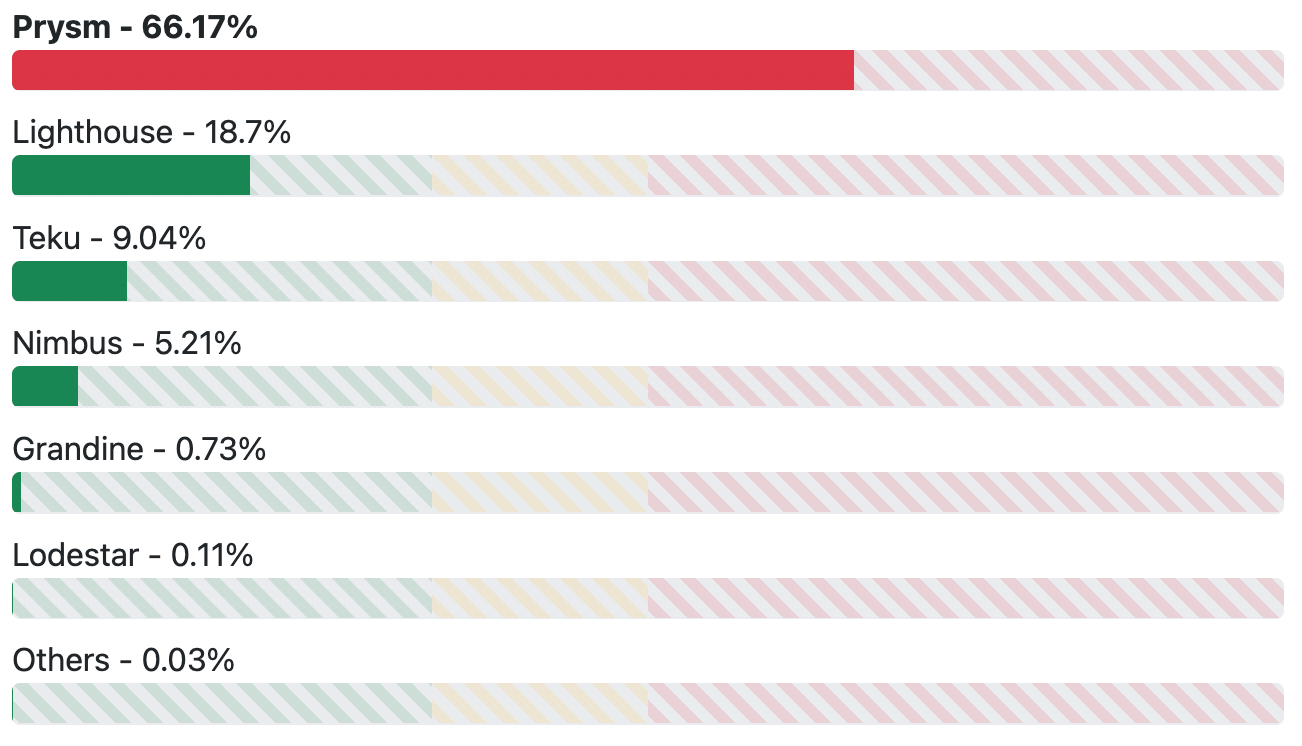
As of the current reporting period, the network is dangerously close to this supermajority threshold. Data from clientdiversity.org and other monitoring tools indicate that the Prysm client, developed by Prysmatic Labs, maintains a dominant position. Approximately 66% of the network’s staking power is currently running Prysm. While this is technically just below the absolute "game over" line, it leaves no margin for error.
The secondary clients, Lighthouse and Teku, hold significantly smaller market shares, while Nimbus, Grandine, and Lodestar remain in the low single digits or below 1%. This concentration of power in Prysm is viewed by core developers as a "non-zero risk" that could jeopardize the entire transition.
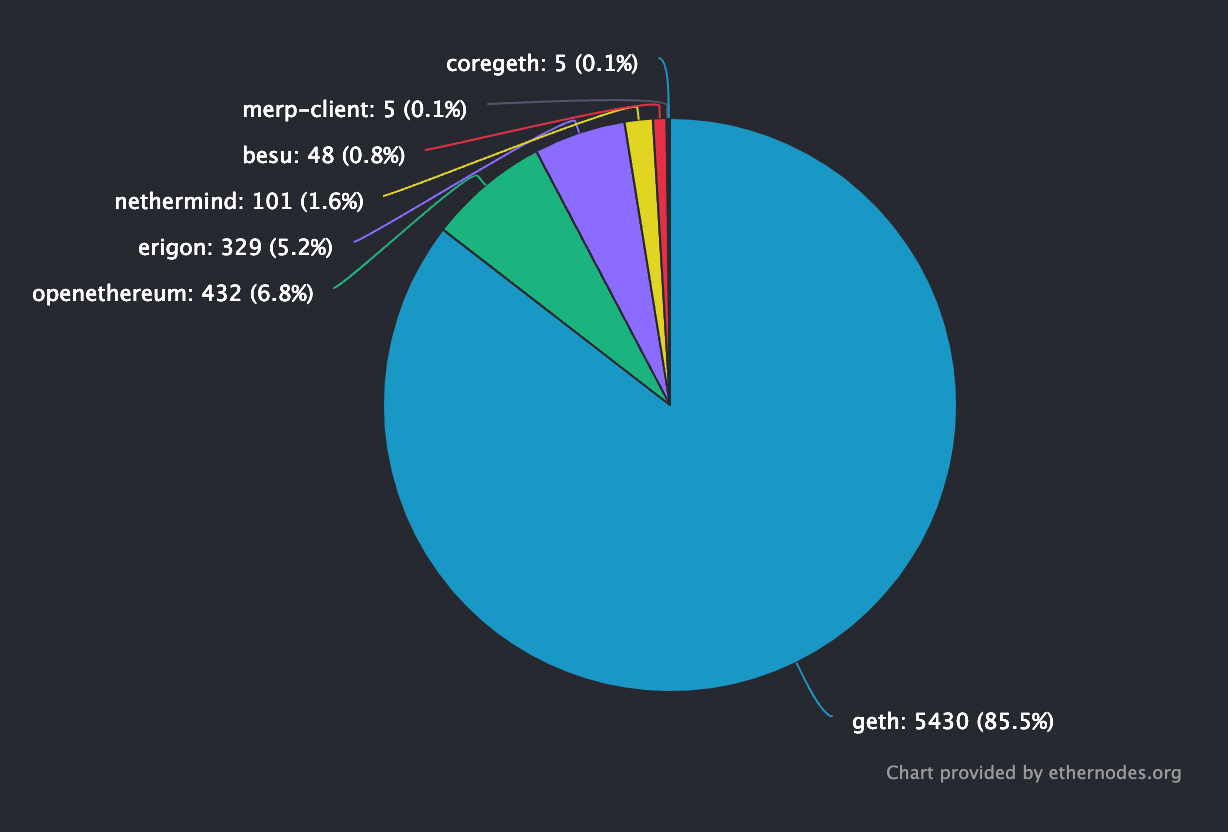
Marius van der Wijden, an Ethereum core developer specializing in the Geth (Go-Ethereum) client, attributes Prysm’s dominance to a "first-mover advantage." Prysm was the first client to provide a functional prototype for the Beacon Chain, allowing it to develop superior documentation, user interfaces, and integration tools long before its competitors. Furthermore, Prysm is written in the Go programming language (Golang), the same language used for Geth, which currently handles over 85% of the execution layer. This familiarity makes it the natural choice for developers and institutional stakers who are already comfortable with the Geth codebase.
The Role of Institutional Stakers and Exchanges
The concentration of client usage is not merely a result of individual "home stakers" choosing the most popular software. Rather, it is largely driven by major centralized exchanges and staking services. These entities manage tens of thousands of validator nodes on behalf of their users, and their choice of software has a disproportionate impact on network health.
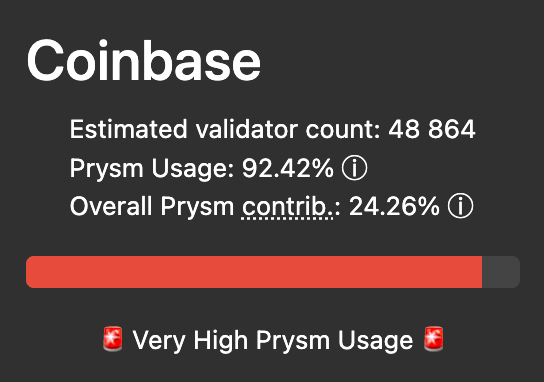
According to data tracking validator pools, three major entities—Coinbase, Kraken, and Binance—are significant contributors to the Prysm dominance.
- Coinbase: Operates approximately 48,864 validators (17.5% of the total network). Data suggests that 92.4% of these validators run on Prysm.
- Kraken: Operates roughly 30,847 validators (11% of the total), with a Prysm usage rate of 94.9%.
- Binance: Maintains 24,410 validators (8.7% of the total), with 76.6% running Prysm.
- Lido: As the largest decentralized staking protocol, Lido manages over 50,274 validators (18% of the total). While more diverse than the exchanges, Lido still utilizes Prysm for 42.8% of its operations.
In response to inquiries regarding this concentration, Coinbase pointed to security features as the primary motivator. The company noted that when they launched their staking services, Prysm was the only client that offered robust support for "remote signers." This technology allows validator keys to be stored in isolated, highly secure environments rather than on the validator server itself, a requirement for institutional-grade security.
Kraken’s Brian Hoffman, Senior Product Manager, echoed these sentiments, stating that Prysm was chosen for its maturity and stability. However, Hoffman confirmed that Kraken has begun working with the Ethereum Foundation to migrate some of its infrastructure to the Teku client to improve diversity.
Chronology of the Transition and Future Outlook
The road to The Merge has been a multi-year journey, marked by several key milestones:
- December 2020: The launch of the Beacon Chain, introducing the Proof-of-Stake consensus layer without yet affecting the main Ethereum network.
- October 2021: The Altair upgrade, the first scheduled update to the Beacon Chain.
- March 2022: The successful merger of the Kiln testnet, the final public testnet transition before the mainnet Merge.
- Mid-2022 (Target): The scheduled "Merge" where the execution layer officially couples with the consensus layer, and PoW is retired.
Despite the risks associated with client diversity, Ethereum core developers remain committed to the mid-2022 timeline. The consensus among the development team is that the risk of a failure, while real, is mitigated by extensive "fuzzing" and testing infrastructure designed to catch bugs before they reach production.
Furthermore, the community has established a "social contract" regarding the risks of running a majority client. Marius van der Wijden noted that there is a strong consensus that the network will not bail out stakers if a majority client fails. This means that if Coinbase or Kraken were to lose funds due to a bug in Prysm, the network would not perform a "hard fork" to return those funds, as was done following the DAO hack in 2016. This policy is intended to create a powerful financial incentive for large stakers to diversify their software choices immediately.
Implications for the Broader Ecosystem
The successful execution of The Merge is expected to reduce Ethereum’s energy consumption by more than 99.9%, addressing one of the primary criticisms of blockchain technology. It also introduces the "triple halving" narrative, where the reduction in ETH issuance combined with the existing fee-burn mechanism could lead to the asset becoming deflationary.
However, the client diversity issue serves as a reminder of the complexities inherent in decentralized governance. While the technology for a more secure, diverse network exists, the inertia of market leaders and the convenience of established tools have created a bottleneck. As the network moves toward its most significant upgrade to date, the focus remains on whether institutional players will act in the interest of long-term network stability by diversifying their infrastructure, or if Ethereum will enter its new era under the shadow of a potential "supermajority" failure.