admin
admin
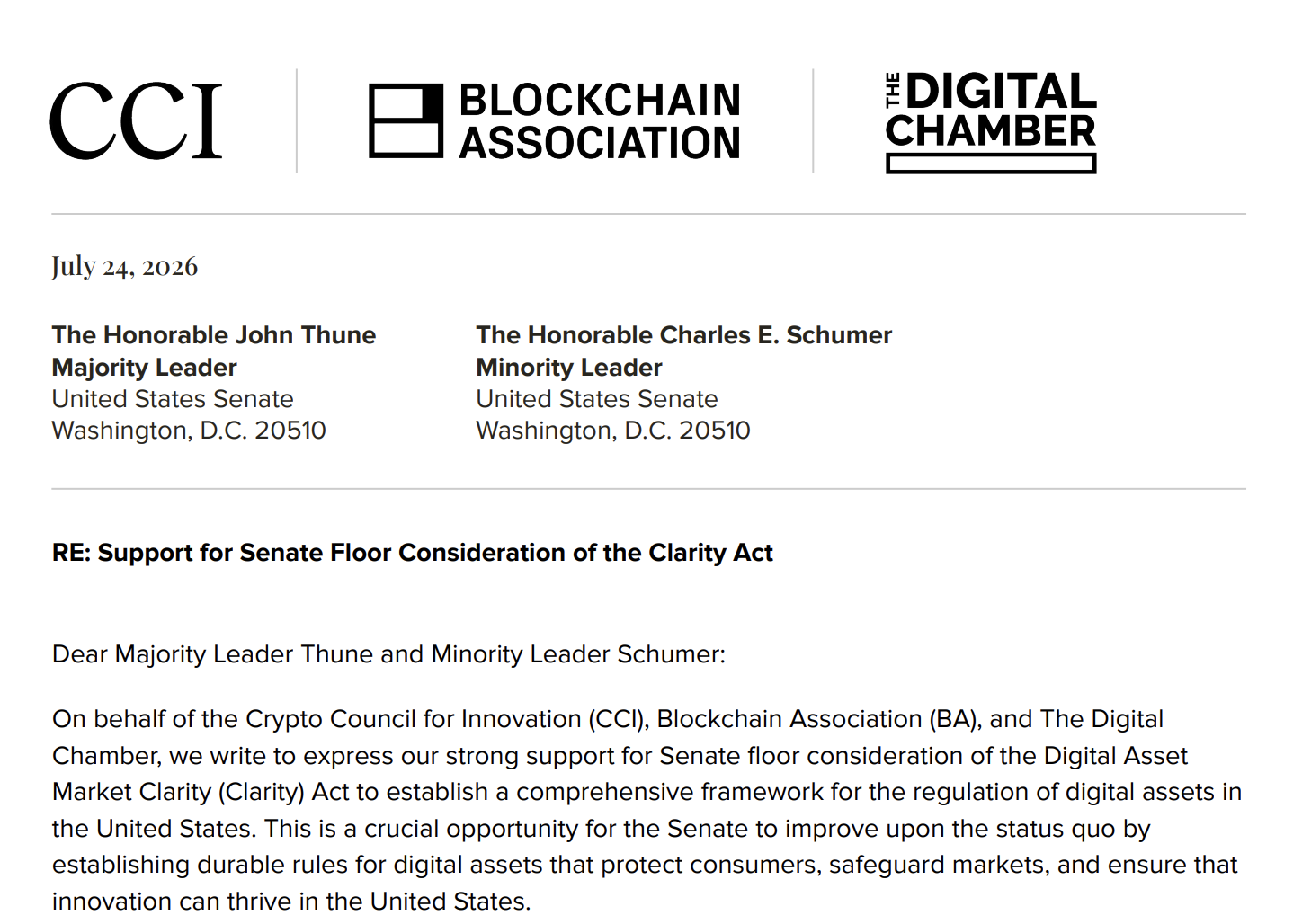
Three influential cryptocurrency advocacy groups – the Crypto Council for Innovation (CCI), the Digital Chamber, and the Blockchain Association – collectively appealed to US Senate leaders on Friday, pressing for "floor consideration" of the Digital Asset Market Clarity (CLARITY) Act. In a joint letter addressed to Senate Majority Leader John Thune (R-SD) and Minority Leader Chuck Schumer (D-NY), the organizations underscored the critical need for legislative clarity in the digital asset space and urged a vote on the bipartisan bill before the chamber adjourns for its annual August state work period. The push comes at a pivotal moment for the burgeoning crypto industry, which has long sought a comprehensive regulatory framework to foster innovation, protect consumers, and solidify the United States’ position as a global leader in financial technology.
Understanding the CLARITY Act: A Quest for Regulatory Certainty
The Digital Asset Market Clarity (CLARITY) Act is widely regarded as one of the most significant pieces of legislation to address the complex and often ambiguous regulatory landscape surrounding cryptocurrencies and other digital assets in the United States. Its primary objective is to establish clear definitions and jurisdictional boundaries for digital assets, aiming to resolve the ongoing regulatory disputes between federal agencies, most notably the Securities and Exchange Commission (SEC) and the Commodity Futures Trading Commission (CFTC).
Currently, the absence of a dedicated federal framework has led to a fragmented and often contradictory approach to digital asset regulation. The SEC, under Chairman Gary Gensler, has largely asserted that most cryptocurrencies are unregistered securities, leading to an enforcement-heavy strategy that the industry criticizes as "regulation by enforcement." Conversely, the CFTC has sought to classify certain digital assets, like Bitcoin and Ethereum, as commodities. This jurisdictional ambiguity has created significant uncertainty for innovators, investors, and businesses operating in the digital asset sector, often compelling them to navigate a patchwork of state and federal regulations or, in some cases, relocate offshore.
The CLARITY Act seeks to rectify this by proposing a clear market structure. While the full text of the bill includes numerous provisions, its core tenets revolve around:
- Defining Digital Assets: Establishing clear legal definitions for various types of digital assets, distinguishing between securities, commodities, and other classifications based on their inherent characteristics and how they are offered and sold. This distinction is crucial for determining which regulatory body has oversight.
- Jurisdictional Boundaries: Explicitly assigning oversight responsibilities to either the SEC or the CFTC based on the asset’s classification, thereby minimizing overlapping jurisdiction and inter-agency conflicts.
- Consumer Protection: Implementing robust consumer protection measures, including disclosure requirements, safeguards against fraud and manipulation, and mechanisms for investor recourse.
- Market Integrity: Laying out rules for trading platforms, custodians, and other intermediaries to ensure fair and orderly markets.
- Innovation: Creating a predictable regulatory environment that encourages technological advancement and economic growth within the digital asset ecosystem in the U.S.
For the crypto industry, the passage of the CLARITY Act represents a pathway out of the current regulatory quagmire, offering the predictability needed to invest, build, and operate within the U.S. without constant fear of legal challenge.
The Broader Context: A Fragmented Regulatory Landscape
The urgent call for the CLARITY Act is set against a backdrop of increasing global competition and domestic regulatory challenges. For years, the U.S. has lagged behind other major economies in establishing a coherent regulatory framework for digital assets. Countries like the European Union (with its Markets in Crypto-Assets, or MiCA, regulation), the UK, Japan, and Singapore have made significant strides in providing regulatory certainty, attracting innovation and investment.
The U.S. approach, characterized by a mix of existing securities laws, commodity regulations, banking laws, and anti-money laundering statutes, has often been described as ill-suited for the unique characteristics of blockchain technology and digital assets. This regulatory ambiguity has had tangible consequences:
- Capital Flight: Many innovative crypto companies and talented developers have chosen to establish operations outside the U.S., seeking jurisdictions with clearer and more welcoming regulatory environments. This "brain drain" and capital flight pose a threat to American competitiveness in a rapidly evolving technological sector.
- Investor Vulnerability: Without clear rules, retail investors remain vulnerable to scams, market manipulation, and the risks associated with unregulated platforms. The collapse of major entities like FTX, which operated largely outside robust U.S. regulatory oversight, starkly illustrated the dangers of the current "Wild West" environment.
- Enforcement Challenges: Even regulators face difficulties. The SEC and CFTC have brought numerous enforcement actions, but these often involve lengthy legal battles to establish jurisdiction or classify assets, consuming significant resources and contributing to market uncertainty rather than resolving it.
Industry leaders and bipartisan lawmakers alike have recognized the imperative to address these issues. The CLARITY Act is not the first attempt at comprehensive crypto legislation, but its advancement through key Senate committees signals a serious, albeit difficult, legislative effort to bring order to the digital asset markets. Previous legislative attempts, such as the Lummis-Gillibrand Responsible Financial Innovation Act, faced similar challenges in garnering sufficient bipartisan support, highlighting the inherent complexities and political sensitivities surrounding crypto policy.

A Legislative Journey Marked by Delays and Divisions
The CLARITY Act has been a focal point of congressional discussions for several months. While the specific introduction date and primary sponsors are critical details, the bill has gained momentum, successfully navigating through two influential Senate committees: the Senate Banking Committee and the Senate Agriculture Committee. This dual committee approval is significant, as both committees have legitimate claims to oversight depending on how digital assets are classified. The Banking Committee typically handles securities and financial services, while the Agriculture Committee oversees commodities markets.
However, its journey to the Senate floor has been anything but smooth. Despite Republican lawmakers pushing for a vote before the August recess, significant hurdles remain. The current Senate composition, with Republicans holding a narrow 52-47 majority (with one independent who typically caucuses with Democrats), means that any substantive legislation typically requires 60 votes to overcome a filibuster. This necessitates robust bipartisan cooperation, a commodity often scarce in Washington, especially on issues as novel and politically charged as cryptocurrency regulation.
The letter from the advocacy groups specifically acknowledges that "constructive bipartisan negotiations remain underway to secure and expand support for this critical piece of legislation." This language points to the ongoing efforts by lawmakers from both sides of the aisle to bridge their differences and find common ground. However, these negotiations have been fraught with challenges, particularly concerning the bill’s provisions on ethics and consumer protection.
The Ethics Conundrum: A Sticking Point for Bipartisan Consensus
One of the primary roadblocks to achieving broader bipartisan support for the CLARITY Act revolves around its ethics provisions. Earlier this week, Republican lawmakers released updated text for the market structure bill, which included measures aimed at addressing potential conflicts of interest for public officials. These provisions reportedly barred public officials from issuing or sponsoring cryptocurrencies. While a step towards transparency and accountability, many Democrats have vehemently argued that these measures do not go far enough to prevent corruption or ensure sufficient ethical standards.
Senator Ruben Gallego (D-AZ) epitomized this Democratic frustration, reportedly stating on Thursday, "Whatever piece of s— they sent back to us, that was not a serious effort." His strong language, as reported by Politico, underscored the depth of the divide. Gallego further articulated his dismay, adding, "[…] After all the work that we’ve done with our Republican colleagues, that they would take the months and months of work and somehow interpret that and turn around and think what they offered was even remotely close."
The Democratic critique likely stems from several concerns:
- Scope of Restrictions: Democrats may be pushing for broader restrictions, potentially including limitations on trading digital assets by public officials or their immediate families, more stringent disclosure requirements, or longer cooling-off periods for former officials entering the crypto industry. The current provisions, while prohibiting issuing or sponsoring, might not address concerns about profiting from policy decisions or insider knowledge.
- Enforcement Mechanisms: Questions might arise regarding the enforceability of these ethics rules and the penalties for violations.
- Perceived Lenience: Some Democrats may view the Republican-backed ethics provisions as too lenient, fearing that they could be interpreted as tacit approval of certain activities or as insufficient safeguards against undue influence from the crypto industry. Critics like Senator Elizabeth Warren (D-MA) have consistently voiced strong concerns about the crypto industry’s lobbying efforts and potential for illicit finance, setting a high bar for any ethics framework.
These disagreements highlight the delicate balance lawmakers must strike: crafting legislation that provides regulatory clarity without inadvertently creating loopholes for unethical behavior or undermining broader financial integrity. The outcome of these "good-faith efforts" to reconcile the ethics provisions will likely determine the CLARITY Act’s fate.
Industry Voices: A Unified Call for Action
Despite the political wrangling, the digital asset industry has largely rallied behind the CLARITY Act, viewing it as a crucial step forward for the U.S. ecosystem. The joint letter from the CCI, Digital Chamber, and Blockchain Association is a testament to this unified front, representing a broad spectrum of crypto businesses, from startups to established players.
Brian Armstrong, CEO of Coinbase, one of the largest cryptocurrency exchanges in the U.S., articulated the industry’s perspective in a Wednesday X post. He lamented the current situation, stating, "The status quo in the US isn’t working. There’s no federal framework, so bad actors like FTX can harm US customers and much of the industry has gone offshore totally outside US purview." Armstrong believes the CLARITY Act offers a comprehensive solution, asserting, "This bill fixes that with strong consumer protections, real tools for law enforcement, and a path for America to lead in this industry." His comments underscore the industry’s desire for not just deregulation, but smart regulation that provides guardrails while fostering innovation.
Orest Gavryliak, Chief Legal Officer of the DeFi platform 1inch, offered another critical perspective during an appearance on Cointelegraph’s Chain Reaction podcast. Gavryliak highlighted the particular challenges faced by decentralized finance (DeFi) protocols, which often operate without central custodians. He argued that CLARITY would help recognize a distinct framework for non-custodial protocols, rather than attempting to force them into existing "custodial frameworks" designed for traditional finance. "Some regulators, they try to be friendly to non-custodial protocols or projects, they still try to fit us in into the custodial frameworks and make us use custodial solutions to solve problems that they used to in this legacy custodial or traditional finance, which is wrong [and] doesn’t apply to us at all," Gavryliak explained. He concluded, "That’s why it’s very important for CLARITY to pass." His statement emphasizes the need for regulatory innovation that understands and accommodates new technological paradigms, rather than retrofitting old rules onto new systems.
Even traditional financial institutions are signaling a desire for clarity. The article mentions that the CEO of Goldman Sachs has backed a "not perfect" CLARITY Act, suggesting that even established players in the legacy financial system see the benefit of a clear regulatory environment for digital assets, despite potential imperfections. This support from a major Wall Street figure indicates a broader recognition of crypto’s growing importance and the necessity for a structured approach. The collective sentiment from the industry is that a flawed but clear framework is preferable to the current state of uncertainty and "regulation by enforcement."
Potential Ramifications: Innovation, Investor Protection, and Political Tides
The outcome of the CLARITY Act’s potential floor vote carries significant ramifications across several fronts:
- For the Digital Asset Market: Passage would likely inject a much-needed dose of certainty into the U.S. crypto market. This could lead to increased institutional investment, the return of companies that moved offshore, and a surge in innovation as developers operate under clear rules. Conversely, failure to pass the bill before the recess could prolong the regulatory limbo, potentially dampening market sentiment, discouraging investment, and accelerating the exodus of talent and capital.
- For US Competitiveness: The U.S. is at a critical juncture in the global race for leadership in digital assets. A clear regulatory framework is essential to maintaining its competitive edge against jurisdictions that have already moved forward. Delay or failure could cement the perception that the U.S. is hostile to crypto innovation, ceding leadership to other nations.
- For Consumers: While some Democrats argue the bill’s consumer protections are insufficient, any comprehensive framework would likely offer more safeguards than the current ad-hoc system. Clear definitions and jurisdictional lines would make it easier for consumers to understand the risks associated with different digital assets and to seek recourse in cases of fraud.
- Political Calculus: The debate over the CLARITY Act is unfolding in the shadow of the 2026 U.S. midterm elections. Crypto policy is becoming an increasingly salient issue for a growing segment of the electorate, particularly younger voters. How lawmakers handle this legislation could influence their standing with these voters. Pushing consideration into the weeks before the midterms could further complicate discussions, as political posturing often intensifies closer to elections, making bipartisan compromise even more elusive.
The Road Ahead: High Stakes and Uncertain Outcomes
The immediate future of the CLARITY Act hinges on the ability of Senate leaders to bring the bill to a floor vote before the chamber’s August recess. This tight timeline, coupled with the ongoing disagreements over key provisions, makes the path forward highly uncertain. The political odds marketplace Kalshi, for instance, reflected this uncertainty, offering users event contracts with a mere 40.3% chance that the bill would pass before the Senate’s August recess, as of Friday.
If lawmakers are unable to secure a vote in the coming weeks, the consideration of the CLARITY Act could be pushed into the latter half of 2026, potentially bringing it uncomfortably close to the midterm election cycle. Such a delay could intensify political maneuvering, making it even harder to forge the necessary bipartisan consensus. Negotiations might restart, potentially leading to further amendments or even a complete overhaul, prolonging the very regulatory uncertainty the industry is desperate to resolve.
The current juncture represents a critical moment for U.S. digital asset policy. The pleas from industry leaders, the bipartisan efforts in Congress, and the mounting pressure from a rapidly evolving global market all underscore the urgency of the situation. Whether the "good-faith efforts of Senators on both sides of the aisle" can successfully navigate the remaining obstacles and deliver a comprehensive regulatory framework remains to be seen, but the stakes for innovation, investor protection, and American leadership in the digital economy could not be higher.