admin
admin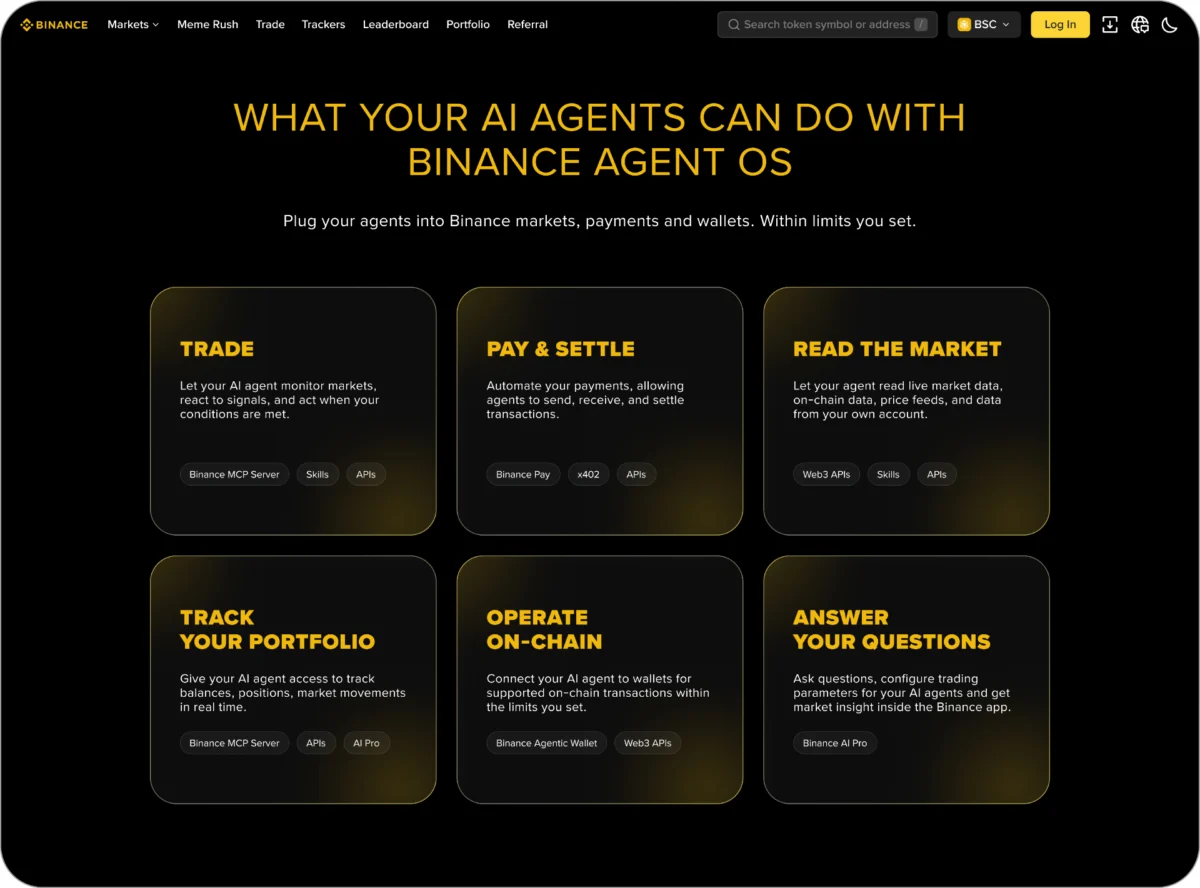
Binance, the world’s largest cryptocurrency exchange by trading volume, has officially announced the launch of Agent OS, a specialized infrastructure platform designed to bridge the gap between advanced artificial intelligence and real-world financial execution. By allowing AI agents to analyze market trends, access account data, and execute trades autonomously, the platform marks a significant transition in the digital asset industry from human-led manual trading to agentic, automated financial management. With a registered user base exceeding 300 million, Binance’s entry into the AI agent space represents one of the largest deployments of autonomous financial technology to date.
The Technical Architecture of Agent OS
Agent OS is not merely a single tool but a comprehensive ecosystem that integrates Binance’s existing financial infrastructure with modern AI development frameworks. The platform provides developers with the necessary hooks to connect AI models—including OpenAI’s ChatGPT and Codex, Anthropic’s Claude Code, and the AI-integrated code editor Cursor—directly to the exchange’s core services.
At the heart of this integration is the Model Context Protocol (MCP), an open standard that allows AI models to exchange data with external tools and services seamlessly. By supporting MCP, Binance enables developers to build "agentic" applications that can "read" the state of the market and "write" actions back to the blockchain or the exchange order book.
The suite of tools provided under Agent OS includes:
- Binance APIs: Traditional interfaces for market data and order execution.
- Binance Wallet Agentic Hub: A dedicated interface for managing on-chain interactions.
- Binance x402: A transaction verification and payment facilitator API designed specifically for machine-to-machine payments.
- Binance Skill Hub: A repository of pre-defined functions that agents can use to perform specific tasks, such as calculating technical indicators or checking account balances.
Governance and the Subaccount Sandbox
A primary concern in the deployment of autonomous AI agents is the risk of "hallucinations" or algorithmic errors leading to catastrophic financial loss. To mitigate these risks, Binance has structured Agent OS around a "granular access control" model. Jeff Li, Vice President of Product at Binance, emphasized in a recent interview that the platform is designed to keep the user in the driver’s seat regarding risk management.
The core of this safety architecture is the use of dedicated "subaccounts." When a user authorizes an AI agent, the agent is restricted to a subaccount rather than having access to the user’s primary treasury. These subaccounts act as a "sandbox," isolating the agent’s capital and activities. By default, withdrawals from these subaccounts are blocked, ensuring that even if an agent is compromised or malfunctions, it cannot drain the user’s entire portfolio to an external address.
Furthermore, users can customize the level of autonomy granted to an agent. Options range from a "manual approval" mode, where the agent suggests trades that the user must verify, to a "fully autonomous" mode, where the agent executes trades within predefined parameters. While Binance does not impose a global "stop-loss" for AI agents, the capital limit is effectively set by the amount of funds a user chooses to transfer into the designated subaccount.
The "Black Box" Challenge: Transparency and Security
One of the most complex aspects of AI-driven trading is the lack of transparency in the decision-making process. Because the "reasoning" of the AI occurs within the Large Language Model (LLM)—hosted either on a user’s local machine or by a third-party provider like OpenAI or Anthropic—Binance cannot see why a specific trade was made.
"We really cannot see the reasoning of what the user’s action is," Li noted, acknowledging that the exchange’s visibility is limited to the resulting trading activity. This creates a potential vulnerability: if an agent is influenced by faulty market data or a "prompt-injection" attack (where malicious instructions are hidden in data the AI reads), the exchange would only see the final, potentially harmful, trade request.
To counter this, Binance relies on its existing suite of security and risk-control protocols. All activities performed via Agent OS are subject to the same anti-money laundering (AML) and fraud detection systems that govern standard human trading. However, the ultimate responsibility for "guardrailing" the AI’s logic rests with the developer and the end-user.
Financial Limits and On-Chain Activity
Beyond simple exchange trading, Agent OS is designed to facilitate decentralized finance (DeFi) interactions and payments. Through the Binance x402 integration, agents can settle payments for services, such as paying for their own API usage or purchasing data sets.
Unlike spot trading within subaccounts—which is limited only by the account balance—Binance has implemented strict daily caps on other agentic activities to prevent high-velocity errors:
- Regular Swaps: Capped at $50,000 per day.
- DeFi Transactions: Default limit of $100,000 per day.
- x402 Payments: Limited to a conservative $20 per day.
These limits reflect a cautious approach to machine-to-machine commerce, providing a safety net as the technology matures and the industry gathers more data on agent behavior.

A Chronology of AI Integration in the Crypto Industry
The launch of Agent OS is the latest milestone in a rapidly accelerating trend of crypto-AI convergence. The timeline of institutional adoption reveals a competitive race to capture the "agentic" market:
- March 2024: Kraken launches an open-source command-line tool featuring a built-in MCP server. This allows developers to control Kraken accounts through AI models, focusing on spot and futures trading.
- June 2024: Coinbase introduces "Coinbase for Agents." The platform emphasizes giving AI agents a "bank account" (a crypto wallet) to enable them to perform financial workflows, including payments and USDC transfers.
- Late 2024: OKX releases its "Agent Trade Kit," an open-source toolkit designed to help developers integrate AI agents with its exchange liquidity.
- August 2024: Binance officially enters the fray with Agent OS, leveraging its massive user base and deep integration with both centralized and decentralized ecosystems.
This chronological progression suggests that the industry is moving away from simple "trading bots"—which follow rigid, if-then logic—toward "agents" that can interpret natural language, analyze sentiment, and adapt to changing market conditions without human intervention.
Market Implications and the Future of Trading
The shift toward agentic trading has profound implications for market dynamics. AI agents can process vast amounts of information—from social media sentiment to complex macroeconomic reports—at speeds unattainable by human traders. This could lead to increased market efficiency, as arbitrage opportunities are identified and closed faster than ever before.
However, it also raises concerns about market volatility. If a large number of agents are trained on similar data or use similar logic, they could trigger "flash crashes" or feedback loops. By delegating the "reasoning" to external LLMs, the industry is entering uncharted territory where the psychological triggers of the market are replaced by the algorithmic biases of neural networks.
For Binance, Agent OS is a strategic play to remain the central hub for the next generation of financial activity. As Jeff Li noted, this is the "first step" in a broader vision where AI-powered applications act across both crypto and traditional financial markets.
Conclusion: The Era of Autonomous Finance
Binance’s Agent OS represents a pivotal moment in the democratization of high-frequency and algorithmic trading. By providing the infrastructure for 300 million users to deploy AI agents, Binance is effectively moving the capabilities of sophisticated hedge funds into the hands of retail and professional developers.
While the technical hurdles of security, transparency, and risk management remain significant, the infrastructure is now in place for a new era of "Autonomous Finance." As AI agents become more sophisticated, the boundary between software and financial actor will continue to blur, fundamentally reshaping how capital is managed in the digital age. The success of Agent OS will likely depend on how well users navigate the balance between the efficiency of automation and the necessity of human oversight.