admin
admin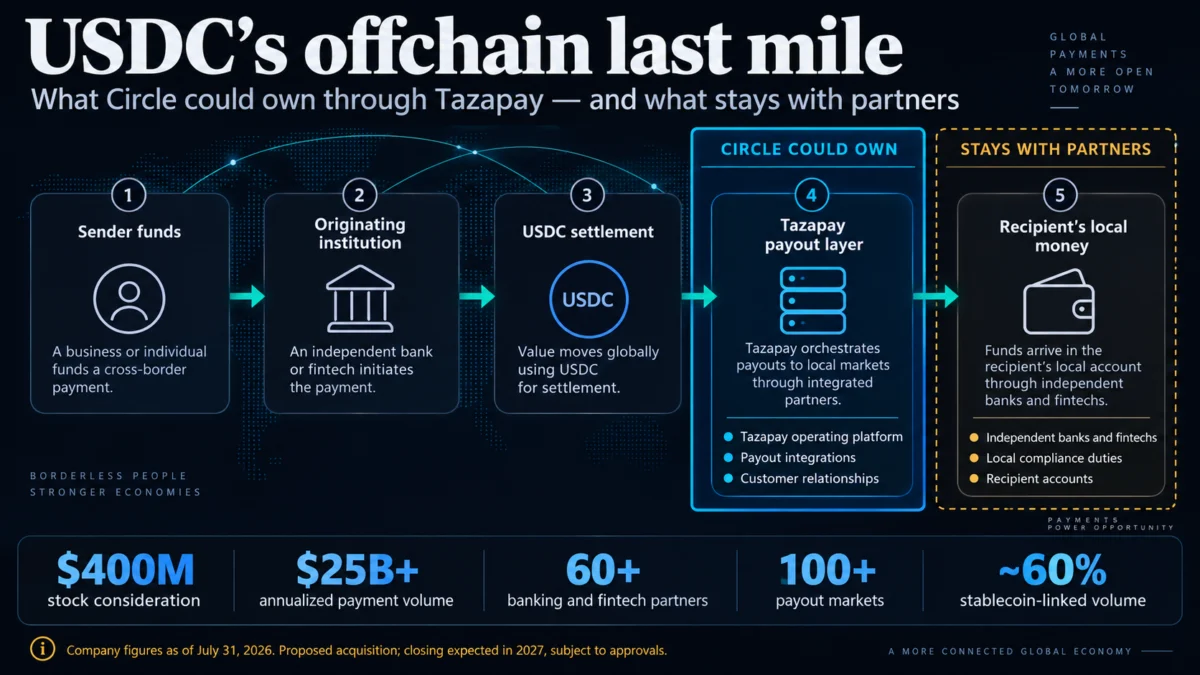
Circle, the issuer of the widely adopted USDC stablecoin, has announced its intention to acquire Singapore-based cross-border payments platform Tazapay for approximately $400 million in stock. This strategic move, revealed on September 8, 2026, signals Circle’s ambition to overcome a critical hurdle in the widespread adoption of stablecoins: the ability to seamlessly convert digital assets into usable local fiat currency for recipients worldwide. While blockchain technology facilitates near-instantaneous on-chain transfers, the complex journey of converting these digital dollars into the hands of end-users through local banking systems and regulatory compliance remains a significant challenge.
The proposed acquisition aims to integrate Tazapay’s extensive network of over 60 banking and fintech partners, along with its presence in more than 100 markets, directly into Circle’s existing infrastructure. This integration is designed to provide the essential elements that on-chain transfers alone cannot accomplish: local licensing, banking access, currency conversion, and the final delivery of fiat currency to recipients. The financial terms of the deal, as detailed in Circle’s Form 8-K filing with the U.S. Securities and Exchange Commission, stipulate that the aggregate consideration will be comprised of Circle Class A stock valued at $400 million. This figure is subject to adjustments for Tazapay’s debt, transaction expenses, and cash reserves. The final number of shares to be issued will ultimately depend on Circle’s volume-weighted average closing stock price over the 20 trading days preceding the transaction’s completion.
Addressing the Fiat On-Ramp and Off-Ramp Challenge
Circle’s core offering, the USDC stablecoin, already provides a robust dollar-denominated settlement asset for on-chain transactions. Complementing this is the Circle Payments Network (CPN), designed to offer rules, routing, and technical coordination among financial institutions. However, the critical missing piece has been a comprehensive operating company that can efficiently manage the "edge" of the payment flow – the crucial entry and exit points where fiat currency interacts with the digital asset ecosystem. Tazapay is poised to fill this void.
According to Circle’s acquisition announcement, Tazapay has demonstrated significant traction in the cross-border payments arena. As of July 31, 2026, the platform reported processing over $25 billion in annualized payment volume. Its established network includes over 60 banking and fintech partners, providing payout capabilities across more than 100 global markets. Notably, approximately 60% of Tazapay’s transaction volume reportedly involves stablecoins, indicating a strong existing synergy with Circle’s core business. While Circle has not specified how this annualized volume was calculated, nor whether it represents gross or net figures, the figures underscore Tazapay’s substantial operational scale. It is also important to note that the reported stablecoin share is a collective figure and does not exclusively represent USDC volume.
A Strategic Partnership Evolving into Acquisition
The strategic rationale behind this acquisition is further illuminated by Tazapay’s prior engagement with Circle. The companies revealed that Tazapay has been a design partner for CPN since 2025. This established working relationship has provided Circle with valuable insights into Tazapay’s capabilities and its potential to enhance the CPN ecosystem. Jeremy Allaire, co-founder and CEO of Circle, expressed optimism that the combination of USDC with Tazapay’s deep banking relationships, localized payout infrastructure, and existing institutional customer base will significantly accelerate the global adoption of digital dollar payments.
This forecast directly addresses the distribution problem that Circle seeks to solve. Issuing a stablecoin, however widely adopted, does not automatically grant access to every intricate local banking system. A dedicated payout operator, such as Tazapay, acts as the vital conduit, connecting stablecoins to regulated entities, facilitating foreign exchange conversions, and ensuring the final disbursement to recipient accounts. By acquiring Tazapay, Circle aims to gain a more direct and integrated approach to orchestrating these capabilities in tandem with USDC and CPN, pending regulatory approvals and the finalization of an integration plan that has yet to be disclosed.
Understanding Circle’s CPN Model and the Acquisition’s Boundaries
Circle’s existing CPN documentation outlines a distinction between network coordination and the regulated activities undertaken by participating financial institutions. In the "self-managed fiat-payout model" of CPN, an originating financial institution handles the sender’s onboarding, conducts necessary due diligence, and converts fiat currency into stablecoins. Subsequently, a beneficiary financial institution receives the stablecoins, converts them into local currency, and remits payment to the end recipient. CPN’s role is to facilitate the coordination of quotes, routing, and settlement between these parties.
Circle establishes the overarching rules for CPN, and Circle Technology Services manages the network’s operations. However, Circle’s governance framework emphasizes that the network operator does not hold customer funds, manage customer accounts, or directly participate in transactions between the financial institutions. These institutions transact at their own risk, retaining the responsibilities inherent in their respective roles.
The proposed acquisition of Tazapay operates within these established parameters, drawing a clear line around what Circle will gain and what will remain independent.

| Circle Could Gain If the Deal Closes | Circle Would Not Automatically Gain |
|---|---|
| Ownership of Tazapay’s operating company, technology, and customer relationships. | Ownership or control of Tazapay’s partner banks and fintech companies. |
| Enhanced capacity to integrate Tazapay payout routes with USDC and CPN. | Control over every fiat off-ramp available through the broader CPN network. |
| Direct influence over Tazapay’s platform and its licensed entities. | Automatic assumption of every CPN participant’s compliance and payout duties. |
The term "vertical integration" often implies a consolidation of all operational layers under a single legal and operational umbrella. However, the disclosed transaction does not represent such a complete integration. While Circle would own Tazapay upon successful completion of the purchase, Tazapay’s existing network of independent bank and fintech partners will likely remain as such.
Exploring Potential Integration Models
Circle’s CPN documentation also describes a "managed mode." In this model, Circle assumes responsibility for licensing, custody, compliance, treasury, and settlement for clients who desire stablecoin payment solutions without directly engaging with digital assets themselves. This contrasts with the "self-managed fiat-payouts" model, which relies on partner networks.
Tazapay’s capabilities could potentially support either of these architectural approaches. Its existing payout routes could expand the range of partner choices available for self-managed payments. Simultaneously, Tazapay’s operating entities and customer base could form the foundation for a more integrated managed service offering. Circle has not yet specified which path it intends to pursue or whether Tazapay will be leveraged for both models.
Tazapay’s own operational structure highlights the complexity involved in this integration. The company has stated that its stablecoin-related services are exclusively provided through Tazapay Canada, while its Singapore entity does not offer digital payment token services. Singaporean permissions govern distinct payment activities, underscoring that the "last mile" of payment delivery is a mosaic of licensed entities, contractual agreements, and localized capabilities, rather than a single, overarching global authorization. This intricate web of regulatory permissions and operational dependencies is precisely the scarce infrastructure that Circle appears keen to acquire. While blockchain settlement can be replicated through software, the establishment of regulated permissions, robust banking connectivity, reliable payout performance, and trusted institutional relationships are market-specific achievements that require significant time and effort to build.
Unresolved Questions and Future Implications
The acquisition remains subject to customary closing conditions, including regulatory approvals, notably from the Monetary Authority of Singapore. The 8-K filing also clearly indicates that the final consideration and share count are subject to adjustments related to closing particulars and Circle’s stock price in the period leading up to completion. Circle has not yet disclosed Tazapay’s revenue figures, its projected contribution to Circle’s financial performance, quantified synergies expected from the integration, integration costs, or its margin profile. Furthermore, it remains to be seen whether Tazapay’s existing payout routes will continue to be accessible on the same terms to companies that may compete with Circle or USDC. While the transaction can be assessed as a strategic maneuver, a definitive evaluation of its financial return is not yet possible.
The integration of Tazapay’s capabilities could offer enterprises a more unified payment pathway, seamlessly bridging stablecoin settlement with local currency payouts, provided Circle maintains openness in its network choices. Customers of Tazapay could gain access to the deep liquidity of USDC and benefit from Circle’s broader product distribution. For Circle, this acquisition presents an opportunity to capture a larger share of the payment workflow beyond merely providing the settlement asset and orchestration layer.
However, ownership also introduces a potential shift in the dynamics for existing CPN participants who value the network’s perceived neutrality. If Circle were to strategically direct volume towards its newly acquired subsidiary, independent beneficiary institutions might find themselves competing with an entity that also plays a role in setting network rules. While the disclosed documents do not explicitly state any intention for Circle to favor Tazapay, this presents a potential governance question that remains to be clarified by announced policy.
The successful integration of Tazapay will serve as a measurable test for Circle’s strategy. If Circle can expand payout coverage and achieve tighter integration while preserving participant choice, Tazapay could indeed deepen the CPN network’s reach and utility. Conversely, if Circle-owned routes receive preferential treatment, the network could evolve towards a more vertically integrated model, potentially diminishing its neutrality.
Ultimately, Circle is not acquiring every bank account that receives a USDC transfer. Instead, it is investing in the capability to orchestrate a more significant portion of the journey to those accounts. This strategic rationale extends beyond mere user adoption; it positions regulated conversion and local fiat delivery as critical infrastructure, rather than simply an ancillary service tied to the blockchain. The speed of settlement on the blockchain remains a foundational element, but the more profound challenge, and the one Circle appears to be addressing with this acquisition, lies in efficiently and reliably transforming digital dollars into the usable local currency that recipients can readily spend.