admin
admin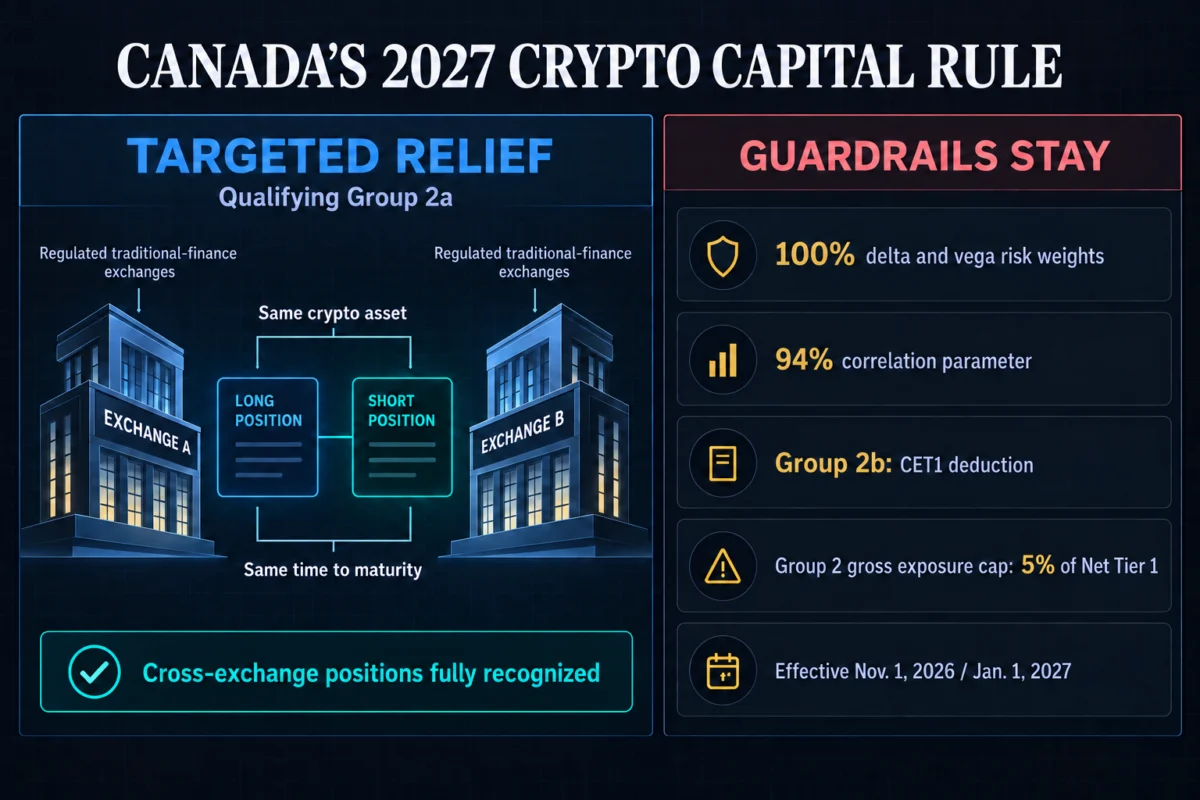
Canada’s banking regulator has finalized a narrowly defined adjustment to its capital rules concerning cryptocurrency exposures, aimed at rectifying a specific capital mismatch for certain market-neutral positions without broadly reducing the stringent capital requirements for digital assets. The Office of the Superintendent of Financial Institutions (OSFI) published its updated Guideline 2027 on September 10, introducing a change that treats regulated exchanges of traditional financial assets as a single entity for the purpose of calculating delta risk on qualifying Group 2a crypto exposures. This modification permits positions in the same cryptocurrency held on different, qualifying regulated exchanges to receive full capital recognition, provided they also possess identical maturities.
Refining Capital Calculations for Market-Neutral Crypto Strategies
The adjustment addresses a discrepancy between prevailing trading practices and the existing capital calculation methodologies. In its May consultation backgrounder, OSFI acknowledged that financial institutions primarily employ market-neutral strategies when managing crypto exposures. This approach assumes that prices for identical assets tend to move in near lockstep across major regulated exchanges. The prior approach, which treated each trading venue in isolation, could therefore inflate the perceived risk and, consequently, the capital reserves held against these positions beyond what the underlying risk profile warranted. By consolidating the view of these regulated exchanges, the new rule seeks to align capital requirements more closely with the actual economic risk of these tightly hedged crypto positions.
Key Provisions: What the New Rule Entails and What Remains Unchanged
The finalized rule, however, does not establish an unconditional offsetting mechanism. Its application is strictly limited to Group 2a exposures that successfully navigate the guideline’s comprehensive hedging-recognition tests. These tests encompass stringent criteria related to product structure, regulatory approval or qualifying clearing arrangements, liquidity provisions, and data-history requirements. Crucially, crypto positions linked to unregulated exchanges will not benefit from this cross-exchange recognition. Furthermore, any discrepancies in the time to maturity between matched positions will still factor into the capital calculation, preventing full recognition in such instances.
For clarity, Group 2a encompasses crypto exposures that are eligible for limited hedging recognition under the OSFI framework. In contrast, Group 2b pertains to Group 2 exposures that do not meet these qualifying criteria. The regulatory framework maintains a correlation parameter of 94% for the calculation of delta or vega capital within a Group 2a bucket. The risk weights for both delta and vega exposures remain at a substantial 100%. Moreover, the rule explicitly prohibits banks from recognizing diversification benefits across different Group 2a crypto assets, underscoring a cautious approach to inherent volatility.

Stringent Treatment for Non-Qualifying Assets
The treatment of Group 2b assets remains considerably more stringent. For each asset falling under this category, a bank is mandated to deduct from its Common Equity Tier 1 (CET1) capital the greater of its absolute aggregate long or short position. If the prescribed calculations for market risk and credit-valuation adjustment (CVA) yield a higher requirement, the institution must adhere to that elevated figure. This signifies a robust capital buffer against assets that do not meet the higher standards of Group 2a.
Exposure Limits and Overall Impact
OSFI has also maintained Canada’s aggregate gross exposure limit for Group 2 crypto assets at 5% of Net Tier 1 capital. An exclusion exists for certain client-clearing derivatives, offering a limited carve-out. However, any breach of this 5% threshold will subject all of an institution’s Group 2 exposures to the more rigorous Group 2b treatment.
The cumulative effect of these provisions is a targeted adjustment rather than a broad relaxation of capital requirements for crypto assets. Banks will experience relief by eliminating an exchange-specific penalty for well-matched hedges that satisfy the rule’s conditions. Nevertheless, they will continue to face high risk weights, conservative treatments for non-qualifying assets, and a firm cap on overall exposure.
Timeline for Implementation
The new guideline is set to take effect on November 1, 2026, for financial institutions with an October 31 fiscal year-end. For those with a December 31 fiscal year-end, the effective date is January 1, 2027. These implementation dates align precisely with those previously outlined when OSFI initiated its consultation period in May, providing institutions with a clear runway to adapt their systems and strategies.
Background and Broader Context
The cryptocurrency market has experienced significant growth and volatility since its inception. As institutional adoption has increased, so has the focus on regulatory frameworks to ensure financial stability. Regulators worldwide have been grappling with how to categorize and manage the risks associated with digital assets, which possess unique characteristics compared to traditional financial instruments. Canada, through OSFI, has been actively developing its approach, aiming to balance the potential benefits of innovation with the imperative of safeguarding the financial system.

The initial draft guideline in May signaled OSFI’s intent to address specific operational realities faced by banks. The consultation process allowed for feedback from industry participants, highlighting the practical challenges of capitalizing market-neutral crypto strategies under existing rules. The final rule reflects a considered response to these concerns, albeit within a carefully circumscribed scope. This measured approach underscores OSFI’s commitment to a principle-based regulatory framework that evolves alongside market developments while prioritizing prudential soundness. The distinction between Group 2a and Group 2b assets, along with the rigorous hedging tests, demonstrates a granular approach to risk management, acknowledging that not all crypto exposures warrant the same treatment. The continued 100% risk weight for delta and vega, and the absence of diversification recognition across different crypto assets, are clear indicators that OSFI views crypto exposures as inherently riskier than traditional assets, even when hedged within regulated environments.
Implications for Financial Institutions
The implications of this updated guideline are significant for Canadian banks engaged in cryptocurrency trading. The relief offered for tightly matched, qualifying Group 2a positions will likely reduce the capital burden for specific, well-managed hedging strategies. This could translate into improved capital efficiency and potentially more competitive offerings in the digital asset space for these institutions. However, the stringent requirements for Group 2b assets and the overall exposure limit mean that significant capital reserves will still be necessary for any substantial involvement in the crypto market.
Financial institutions will need to meticulously review their current crypto exposure management frameworks to ensure full compliance with the new rules by the effective dates. This includes robust systems for identifying qualifying Group 2a assets, verifying their adherence to hedging and maturity criteria, and accurately calculating capital requirements. The distinction between regulated and unregulated exchanges will also be a critical factor in their compliance efforts.
The OSFI’s decision to maintain high risk weights and strict limitations reflects a cautious yet adaptive regulatory stance. While acknowledging the realities of market-neutral trading strategies, the regulator remains steadfast in its commitment to robust capital adequacy, particularly in light of the nascent and evolving nature of the cryptocurrency market. This approach aims to foster responsible innovation while mitigating potential systemic risks. The updated guideline serves as a clear signal that while some operational efficiencies are being recognized, the fundamental risk profile of crypto assets continues to warrant a conservative capital treatment from Canadian banking regulators.