admin
admin
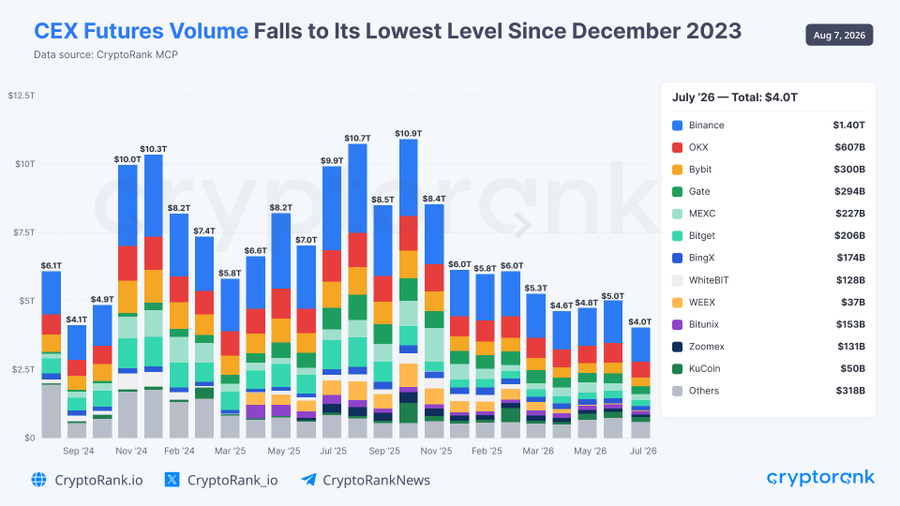
The global cryptocurrency market experienced a notable contraction in July, with the trading volume of perpetual futures on centralized cryptocurrency exchanges (CEXs) falling to an alarming $4 trillion. This figure represents a significant 31-month low, a level not witnessed since December 2023, and underscores a pervasive sentiment of caution among digital asset traders. The sharp decline across a key segment of the crypto derivatives market signals a potential cooling-off period following earlier periods of speculative fervor and sustained market activity. This downturn is not isolated to derivatives, as broader spot market trading also saw a substantial reduction in activity, painting a picture of a market grappling with reduced liquidity and investor engagement.
Perpetual futures, a type of derivative contract that allows traders to speculate on the future price of a cryptocurrency without an expiry date, have become a cornerstone of the crypto trading ecosystem. Their popularity stems from the ability to use leverage, hedge existing spot positions, and engage in continuous trading strategies. However, the latest data from analytics platform CryptoRank, released via an X post on Friday, reveals a significant pullback in this high-octane trading arena. Binance, a dominant force in the CEX landscape, continued to lead the market, processing $1.4 trillion in monthly perpetual futures volume. Despite its leading position, this figure represents a considerable reduction from its peak performances. Following Binance, OKX recorded $607 billion in volume, with Bybit securing the third position at $300 billion. The collective performance of these industry giants, alongside other major venues, illustrates a widespread reduction in derivatives trading across the centralized finance (CeFi) sector.
The decline in July followed a brief period of recovery experienced between April and June, where perpetual futures volumes had shown signs of resurgence. This earlier uptick was likely fueled by renewed market optimism, potentially driven by anticipation of regulatory developments, the performance of major assets like Bitcoin and Ethereum, or general macroeconomic indicators that temporarily boosted risk appetite. However, this recovery proved to be short-lived, with the subsequent drop in July erasing those gains and pushing volumes to multi-year lows. This cyclical pattern of brief recovery followed by sharp decline highlights the inherent volatility and sensitivity of the crypto derivatives market to shifting sentiment and external factors.
The 31-month low in perpetual futures activity did not occur in isolation. It was mirrored by a significant deceleration in the spot crypto trading market, indicating a broader withdrawal of capital and reduced trading interest across the board. According to analytics provider Coinglass, daily spot crypto trading volume plummeted by 23.6% over the course of July, shrinking from an average of $17.8 billion on July 1 to $13.6 billion by July 31. This parallel decline in both spot and derivatives markets suggests a systemic reduction in overall market liquidity and investor participation, rather than a mere shift between trading venues or strategies. The correlation between spot and derivatives volume is crucial, as derivatives often amplify trends seen in the underlying spot market. A weaker spot market naturally leads to reduced interest and activity in derivatives, particularly those heavily reliant on leveraged speculation.
Understanding Perpetual Futures and Their Market Impact
To fully appreciate the significance of this decline, it’s important to understand the role of perpetual futures in the crypto ecosystem. Unlike traditional futures contracts that have a predetermined expiry date, perpetual futures never expire. This unique feature, combined with a funding rate mechanism that helps anchor the contract price to the spot price, makes them incredibly popular among traders. They offer continuous exposure to an asset’s price movements and are often preferred for their flexibility and the ability to employ significant leverage. This leverage, while amplifying potential gains, also magnifies potential losses, making perpetual futures trading a high-risk, high-reward endeavor.
The rapid growth of perpetual futures trading over the past few years has been instrumental in increasing liquidity and price discovery in the crypto markets. They allow for more efficient capital allocation and provide tools for sophisticated trading strategies, including hedging, arbitrage, and directional speculation. However, their reliance on leverage means that market downturns can be exacerbated as positions are liquidated, creating cascading effects that can amplify price volatility and volume declines. The current slump suggests that traders are either deleveraging, reducing their speculative exposure, or simply exiting the market amidst uncertainty.
Chronology of a Market Downturn

The crypto market’s journey to this 31-month low in perpetual futures volume can be traced through several key periods. The last quarter of 2023 saw a significant surge in crypto asset prices, driven by renewed optimism surrounding potential spot Bitcoin ETF approvals in the United States and a general shift in investor sentiment. This bullish momentum carried into early 2024, maintaining robust trading volumes across both spot and derivatives markets.
The period between April and June 2024 offered a brief respite from this emerging bearish trend, with perpetual futures volumes experiencing a temporary recovery. This mini-resurgence was likely influenced by a confluence of factors:
- Anticipation of Macroeconomic Shifts: Hopes for interest rate cuts or a stabilizing global economy could have briefly encouraged risk-on behavior.
- Specific Asset Rallies: Certain altcoins or even Bitcoin itself might have seen temporary price surges that stimulated derivatives activity.
- Product Innovations: New offerings or features from exchanges could have temporarily boosted engagement.
However, July proved to be a turning point. Without significant bullish catalysts and potentially facing renewed regulatory scrutiny or macroeconomic headwinds, investor confidence waned. The lack of fresh capital inflows, coupled with profit-taking and deleveraging, led to a broad-based decline across all major CEXs. This rapid reversal underscores the fragile nature of market sentiment and its immediate impact on trading volumes, especially in high-leverage products like perpetual futures.
Decentralized Exchanges Face Similar Headwinds
The downturn was not limited to centralized platforms. Perpetual trading volume on decentralized exchanges (DEXs) also experienced a substantial drop, falling to $531 billion in July. This figure represents the lowest level since June 2025 and marks a significant 21% decline from the $676 billion recorded in June 2026, according to data aggregator DefiLlama. While the dates mentioned for DEX volume seem unusually far into the future in the source material, indicating a potential typo or future projection, the trend of decline is clear and consistent with the broader market. Assuming the intent was to reference recent past data, this reduction highlights that the factors driving down trading activity are systemic and affect both CeFi and DeFi derivatives markets.
The trend for DEX perps trading volume has been largely downward since October 2025, when it peaked at $1.36 trillion. This prolonged decline suggests deeper structural challenges or a sustained shift in trader preference away from highly speculative, leveraged trading on decentralized platforms. Furthermore, open interest (OI) on DEXs, a crucial metric that measures the total value of active, unsettled contracts, also fell from a peak of $19.4 billion in September 2025 to $17.9 billion in July. A decrease in open interest signals that new capital is not entering the market, or worse, existing capital is being withdrawn, reflecting a broader disengagement from leveraged positions. This metric is a key indicator of market health and liquidity, and its decline reinforces the narrative of a contracting derivatives market.
Hyperliquid’s RWA Strategy: A Counter-Trend Narrative
Amidst the general downturn, one decentralized exchange, Hyperliquid, presented a nuanced picture. Hyperliquid emerged as the leading DEX with $199 billion in reported trading volume over the past 30 days. More significantly, a growing proportion of Hyperliquid’s trading activity has pivoted towards tokenized real-world assets (RWAs). These assets, which can include anything from commodities and real estate to government bonds, are tokenized on a blockchain, offering new avenues for investment and trading within the DeFi space.
In the second quarter, RWA contracts accounted for 32% of Hyperliquid’s total trading activity, generating 6.6% of the protocol’s $169 million quarterly revenue. This trend accelerated into July, with tokenized assets becoming Hyperliquid’s largest trading category for the first time. Between July 13 and July 19, RWAs constituted an impressive 52% of its total weekly trading volume. This shift indicates a strategic diversification away from traditional crypto-native assets and towards a more stable, asset-backed trading environment.
The success of Hyperliquid’s RWA strategy offers a potential blueprint for other platforms struggling with declining volumes. By integrating assets with tangible underlying value, DEXs can attract a broader investor base, including those traditionally wary of the volatility associated with purely digital assets. This move towards RWAs could signify a maturing phase for DeFi, where the focus shifts from purely speculative crypto assets to tokenized representations of real-world economic value, potentially offering more stable and predictable returns, albeit with different risk profiles. This strategic pivot by Hyperliquid stands out as a significant development, suggesting that while speculative crypto derivatives may be waning, there are emerging niches within DeFi that continue to attract capital and innovation.
Broader Market Implications and Expert Analysis
The significant decline in perpetual futures trading volume carries substantial implications for the entire cryptocurrency ecosystem.
- Reduced Liquidity: Lower trading volumes inherently mean reduced market liquidity. This can lead to increased price volatility, wider bid-ask spreads, and greater difficulty in executing large trades without significantly impacting market prices.
- Impact on Exchanges: Centralized and decentralized exchanges alike rely heavily on trading fees for revenue. A sustained period of low volume will directly impact their profitability, potentially leading to reduced investment in infrastructure, product development, and even staff reductions.
- Investor Sentiment: The multi-month low reflects a prevailing sense of caution, if not outright bearishness, among traders. This can create a self-reinforcing cycle, where low volumes deter new investors, further dampening market activity.
- Regulatory Scrutiny: Periods of reduced activity might also be influenced by the ongoing global regulatory landscape. Uncertainty surrounding regulations, particularly in major markets like the U.S., can make institutions and even retail traders hesitant to engage in high-leverage derivatives trading. Recent enforcement actions against crypto entities and discussions around stablecoin regulations or broader market oversight contribute to this environment of caution.
- Macroeconomic Headwinds: Global macroeconomic factors, such as persistent inflation, rising interest rates in major economies, and geopolitical instability, continue to weigh on risk assets, including cryptocurrencies. When traditional markets face headwinds, investors typically reduce their exposure to more volatile assets, explaining the broader trend of deleveraging.
Market analysts suggest that July’s downturn could be attributed to a combination of these factors. "The market appears to be in a cooling-off period, consolidating after the enthusiasm of the first half of the year," noted one industry observer, who requested anonymity due to ongoing market sensitivities. "Without a clear bullish narrative or a significant influx of institutional capital, retail traders are naturally scaling back their leveraged positions. The upcoming Bitcoin halving next year is often cited as a potential catalyst, but until then, we might see continued periods of subdued activity."
The contrasting performance of Hyperliquid with its focus on RWAs highlights a potential bifurcation in the market. While highly speculative, crypto-native perpetual futures might be experiencing a lull, there’s a clear demand for tokenized assets that bridge the gap between traditional finance and blockchain technology. This suggests that future growth in the decentralized derivatives space might increasingly come from innovative product offerings that cater to a broader range of risk appetites and investment strategies.
Looking Ahead: Potential Catalysts and Challenges
The path forward for the crypto derivatives market will largely depend on several key developments. A significant turnaround could be triggered by:
- Regulatory Clarity: Clear and favorable regulatory frameworks in major jurisdictions would undoubtedly instill confidence and attract institutional capital.
- Macroeconomic Improvement: A more stable global economic environment, characterized by lower inflation and interest rates, would likely reignite risk appetite.
- Technological Innovation: Breakthroughs in blockchain technology or the emergence of compelling new use cases could spark renewed interest and investment.
- Bitcoin Halving Cycle: Historically, the Bitcoin halving event, which reduces the supply of new Bitcoin, has often preceded bull markets. The next halving is anticipated in 2024, and market participants will be closely watching for its potential impact.
However, challenges remain. The ongoing scrutiny from global regulators, the inherent volatility of crypto assets, and the competitive landscape among exchanges will continue to shape the market. The ability of both CEXs and DEXs to innovate, diversify their offerings, and adapt to evolving investor demands will be crucial for navigating these turbulent waters. The July figures serve as a stark reminder of the market’s dynamic nature and the need for constant vigilance and strategic adaptation. The decline in perpetual futures volume is more than just a statistical blip; it reflects a deeper recalibration of risk and reward in the volatile world of digital assets.