admin
admin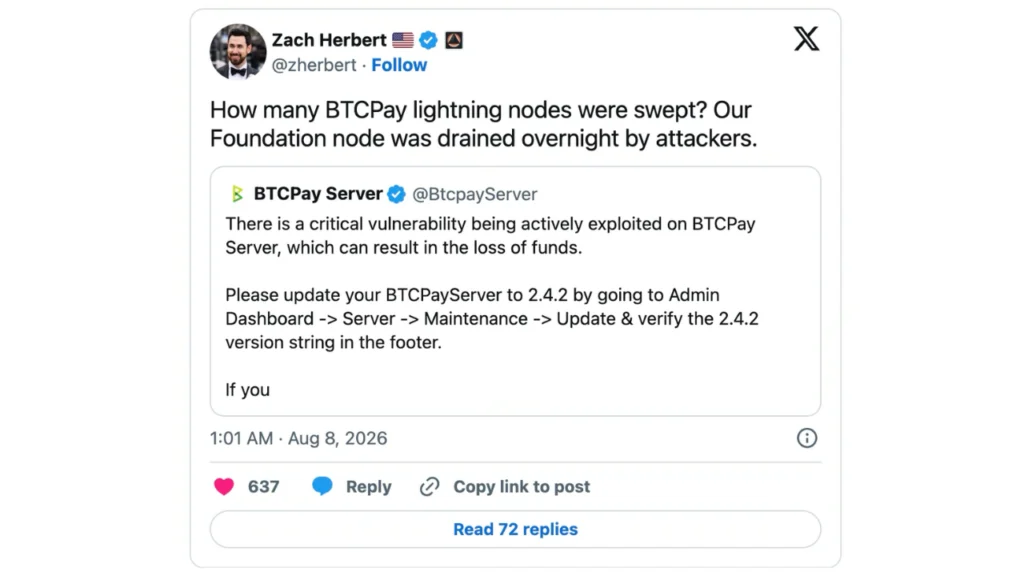
A severe security flaw within BTCPay Server, an open-source Bitcoin payment processor, is being actively exploited by malicious actors, resulting in the unauthorized draining of Bitcoin from Lightning Network nodes utilized by numerous merchants and businesses worldwide. The critical vulnerability specifically impacts BTCPay Server installations connected to LND, the most widely adopted software for operating Lightning nodes. BTCPay Server developers confirmed the ongoing attacks late Friday, issuing an urgent warning to operators to immediately update their systems to version 2.4.2 or, failing that, to take their vulnerable servers offline without delay to mitigate further financial losses. While the project has not yet disclosed the total number of affected users or the aggregate amount of Bitcoin stolen, at least two prominent organizations have publicly acknowledged succumbing to the exploit, reporting significant losses from their Lightning infrastructure. This incident compounds a challenging week for the broader Bitcoin infrastructure landscape, following recent revelations from security researchers who uncovered thousands of vulnerabilities across various Bitcoin-related projects through extensive, AI-assisted code reviews.
Understanding BTCPay Server and the Lightning Network Ecosystem
To fully grasp the gravity of the current situation, it is essential to understand the roles of BTCPay Server and the Lightning Network within the Bitcoin ecosystem. BTCPay Server stands as a cornerstone for many businesses seeking to integrate Bitcoin payments without relying on centralized third-party payment processors. As an open-source, self-hosted solution, it empowers merchants with complete control over their payment infrastructure, enhancing privacy and reducing transaction fees typically associated with traditional financial intermediaries. This decentralization ethos aligns perfectly with Bitcoin’s core principles of censorship resistance and financial sovereignty.
For many merchants, the utility of BTCPay Server is significantly enhanced by its integration with the Lightning Network. The Lightning Network is a second-layer scaling solution built atop the Bitcoin blockchain, designed to facilitate instant, low-cost, and high-volume transactions that the main Bitcoin chain cannot natively handle. It achieves this by establishing "payment channels" between users, allowing multiple transactions to occur off-chain before the final net balance is settled on the main blockchain. This architecture dramatically improves Bitcoin’s usability for everyday commerce, making it a viable alternative for point-of-sale transactions and micro-payments, often settling in milliseconds for fractions of a cent. LND (Lightning Network Daemon), developed by Lightning Labs, is the most prevalent implementation of Lightning Network software, powering a vast majority of the network’s nodes and channels. Its widespread adoption makes it a critical component of the Lightning infrastructure, and consequently, a high-value target for attackers when vulnerabilities emerge in interconnected systems. The synergy between BTCPay Server and LND has enabled countless businesses to accept Bitcoin payments efficiently, making the current exploit particularly disruptive to their operations and trust in the technology. According to data from 1ML.com, the Lightning Network currently boasts over 12,000 active nodes and more than 60,000 open channels, with a network capacity exceeding 5,000 BTC (approximately $300 million at current market rates), underscoring the significant value at stake.
The Mechanics of the Exploit: Unauthorized Access to Critical Credentials
The core of the BTCPay Server vulnerability lies in its interaction with LND nodes, specifically how it handles crucial authorization credentials. Attackers were able to remotely access sensitive .macaroon files without requiring any prior authentication to the affected server. Macaroons are a type of delegated authorization credential, functioning much like digital keys that grant specific permissions to interact with a Lightning node. These permissions can range from simply querying node information to more critical actions like managing payment channels, initiating transactions, and ultimately, sweeping funds. They are designed to be granular, allowing specific permissions to be granted without giving full control, but in this case, the vulnerability allowed access to those with broad permissions.
Once attackers gained control of these .macaroon files, they effectively seized operational control of the compromised Lightning node. According to BTCPay Server’s initial review of the attacks, the malicious actors exploited these credentials to close existing Lightning channels associated with the node and then sweep the Bitcoin held within those channels to their own addresses. This process bypasses the normal operational security measures, as the attackers are using legitimate, albeit stolen, credentials. The unauthenticated nature of the vulnerability is what made it particularly dangerous; an attacker did not need to guess passwords, exploit another flaw to gain initial access, or trick a user into clicking a malicious link. Instead, they could directly target and exploit the BTCPay Server installation to gain access to the LND node’s macaroons from an external network position. BTCPay Server has consciously withheld the full technical details of the vulnerability at this stage. This decision is a standard security practice, allowing affected operators sufficient time to patch their systems before full disclosure could potentially enable more widespread exploitation by other malicious entities. A comprehensive technical postmortem detailing the precise nature of the flaw is anticipated in the coming days, once the immediate threat is largely mitigated and a sufficient number of systems have been secured.

A Timeline of Discovery and Exploitation
The discovery of this critical vulnerability did not occur in isolation but emerged from a broader, ongoing initiative spearheaded by the Bitcoin Red Team. This collective of security researchers and developers is dedicated to rigorously reviewing Bitcoin-related software for weaknesses. The team, credited by BTCPay Server, includes prominent figures like Craig Raw, Rob Hamilton, Calle, and Evan Kaloudis, who played instrumental roles in reporting the vulnerability and assisting with the incident investigation. Their work is part of a wider trend in cybersecurity where specialized "red teams" simulate attacks to identify vulnerabilities before malicious actors do.
Their discovery was a direct outcome of a large-scale project utilizing artificial intelligence to conduct extensive code reviews across numerous Bitcoin codebases. This cutting-edge approach has already yielded substantial results, reportedly uncovering thousands of findings, identifying potential security weaknesses across hundreds of projects, underscoring the growing complexity and attack surface of the Bitcoin ecosystem. The use of AI in code auditing marks a significant shift, enabling faster and more comprehensive vulnerability detection than traditional manual reviews alone.
The BTCPay Server incident, however, highlights a persistent and difficult dilemma in the realm of cybersecurity: the delicate balance between vulnerability disclosure and active exploitation. According to the Red Team researchers, their strategy often involves publishing findings relatively quickly, partly driven by the pragmatic belief that other security researchers or even malicious actors could independently discover the same vulnerabilities. In this specific case, the race against time proved tragically close. By the time BTCPay Server issued its public warning and recommended patches on late Friday, attackers were already actively exploiting the flaw against live servers, indicating that the vulnerability had been independently discovered and operationalized by malicious actors. This simultaneous discovery by both defenders and malicious actors creates an incredibly challenging scenario for open-source projects, where the imperative to inform and protect users must be balanced against the risk of inadvertently providing more ammunition to attackers if full details are released prematurely. The rapid response from BTCPay Server, confirming the attacks late Friday and pushing out a patch (version 2.4.2) for LND-connected instances, demonstrates their commitment to mitigating the damage, even as the scale of pre-disclosure exploitation remained unclear. This swift action is crucial in open-source communities where trust and rapid response are paramount.
Confirmed Victims and the Unfolding Scale of Losses
While BTCPay Server has refrained from providing specific figures regarding the total number of compromised servers or the aggregate value of stolen Bitcoin, early reports from prominent entities within the Bitcoin space offer a sobering glimpse into the exploit’s reach. Among the first to publicly confirm losses was Foundation Devices, a reputable manufacturer of Bitcoin hardware wallets known for its focus on self-custody and security. Zach Herbert, CEO of Foundation, openly stated via social media that attackers successfully drained the company’s Lightning node overnight. The modus operandi aligned precisely with the vulnerability’s description: attackers closed the node’s Lightning channels and swept the funds held within. Crucially, Herbert also clarified that Foundation’s separate BTCPay on-chain hot wallet, which was not connected to LND, remained unaffected, providing an important distinction regarding the scope of the attack. "Our BTCPay Lightning node was drained overnight," Herbert tweeted, adding, "Our BTCPay on-chain hot wallet was not affected. Phew." This detail provides critical insight into the targeted nature of the exploit.
Another notable victim was Bitcoin publication Citadel21, operated by the pseudonymous commentator hodlonaut. Citadel21 also reported that its Lightning node had been swept clean of funds. Fortunately, in their case, the node contained only a "small amount of Bitcoin," minimizing their financial impact but still underscoring the pervasive nature of the exploit. "My Citadel21 Lightning node was swept," hodlonaut confirmed, emphasizing, "luckily it contained only a small amount." These early confirmations serve as critical indicators of the vulnerability’s effectiveness and reach. The actual financial damage across the broader ecosystem remains an open question, prompting widespread concern among BTCPay Server and Lightning Network users. The absence of a definitive total figure means that many more organizations or individuals may have suffered losses silently or are yet to discover them. The situation highlights the challenges of obtaining precise metrics in a decentralized and self-sovereign financial system, where individual entities bear the primary responsibility for reporting and managing their security incidents, making a comprehensive damage assessment a complex and potentially prolonged process.
Not All BTCPay Wallets Are Affected: A Crucial Distinction

In the wake of the incident, BTCPay Server promptly issued a crucial clarification to alleviate widespread panic and provide accurate guidance: not all BTCPay Server installations or associated wallets are affected by this vulnerability. The exposure is specifically and exclusively tied to deployments where BTCPay Server is configured to connect with an LND (Lightning Network Daemon) node. This distinction is paramount for operators and merchants, as BTCPay Server can be utilized in various configurations.
Many merchants operate BTCPay Server to manage multiple facets of their Bitcoin payment infrastructure. While some integrate it with a Lightning node (like LND) to process faster, cheaper Lightning payments, others may solely use BTCPay Server for its on-chain capabilities, generating and managing standard Bitcoin hot wallets directly within the server environment. These on-chain wallets, including those generated within BTCPay Server that are not linked to LND, have been explicitly confirmed as unaffected by this particular vulnerability. Foundation Devices’ experience, where their on-chain hot wallet remained secure while their LND-connected Lightning node was drained, serves as a real-world example of this distinction. This clarification helps to narrow the scope of the immediate threat, allowing users of BTCPay Server without LND integration to breathe a sigh of relief.
However, even for operators of LND-connected systems, a common misconception needed addressing: funds are not only at risk if they are currently locked in active Lightning channels. Because the attackers gained control of the LND node’s credentials via the compromised BTCPay Server, they could effectively control the node itself. This means they could initiate channel closures and sweep any Bitcoin held by the LND wallet, regardless of whether it was in an active channel or simply held as an on-chain balance managed by the LND software. Therefore, operators should not assume their funds are safe simply because they perceive them to be "out of channel" or in a "waiting" state within the LND node’s purview. This incident starkly underscores the inherent security risks associated with interconnecting multiple self-hosted components. A vulnerability in one layer—in this case, the payment server—can cascade, potentially exposing critical credentials that control underlying wallet software or Lightning nodes, leading to direct financial loss. This interconnectedness, while offering functionality, also introduces new attack vectors that require sophisticated understanding and rigorous security protocols.
The Broader Landscape of Bitcoin Security: A Challenging Week
The BTCPay Server exploit did not occur in a vacuum but against a backdrop of heightened security concerns within the broader Bitcoin infrastructure. The "difficult week for Bitcoin infrastructure" referenced in the initial warnings alludes to a significant security initiative undertaken by the Bitcoin Red Team. This team, comprising seasoned security researchers and developers, has been engaged in a large-scale, systematic review of various Bitcoin-related projects. Their innovative approach involves leveraging artificial intelligence to analyze vast swathes of codebases for security weaknesses. This ambitious effort has already yielded substantial results, reportedly uncovering thousands of vulnerabilities across hundreds of different projects within the Bitcoin ecosystem, painting a picture of an extensive, yet largely unknown, landscape of potential attack vectors.
This extensive discovery highlights the increasing complexity of Bitcoin’s software stack and the continuous need for rigorous security auditing. As the ecosystem matures and integrates more sophisticated scaling solutions, payment processors, and application layers, the attack surface naturally expands. The BTCPay Server incident serves as a stark, real-world manifestation of the types of vulnerabilities that can exist and the potential for severe financial consequences when they are exploited. The proactive use of AI in security auditing represents a significant step forward in identifying potential threats before they are leveraged by malicious actors. However, as demonstrated by the BTCPay Server exploit occurring simultaneously with its discovery, even advanced defensive measures cannot always guarantee pre-emptive protection. The constant cat-and-mouse game between security researchers and attackers is an inherent feature of high-value, open-source systems, necessitating a dynamic and adaptive security posture. This week’s events collectively underscore that while Bitcoin’s core protocol remains remarkably robust, the surrounding layers and applications require continuous vigilance, expert review, and rapid response mechanisms to maintain the integrity and security of the broader ecosystem. The incident reinforces the importance of a multi-layered security approach