admin
admin
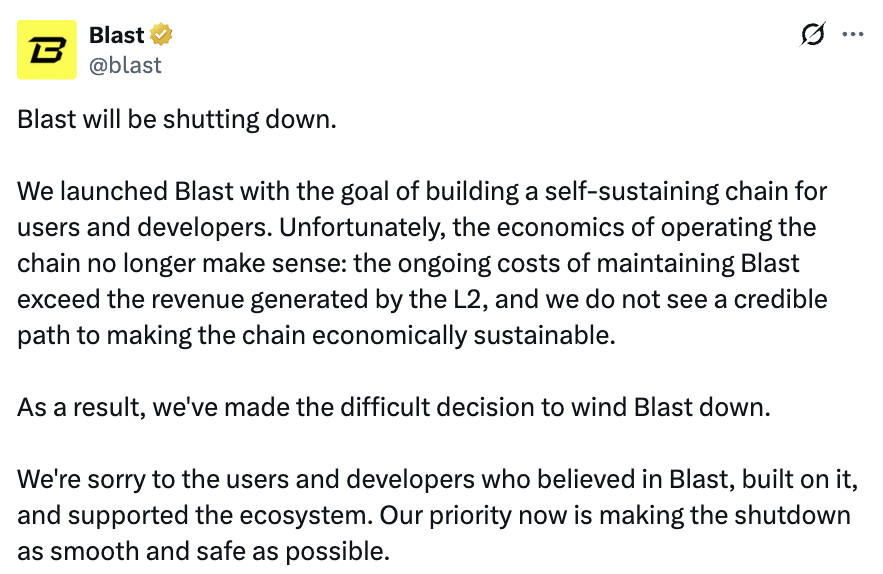
The Ethereum layer-2 scaling solution, Blast, has announced its imminent shutdown, citing an inability to achieve economic sustainability. The decision, communicated via an official post on the social media platform X on a recent Friday, revealed that the operational costs of maintaining the network had consistently outstripped the revenue it generated, leaving no "credible path" to long-term viability. This abrupt closure marks a significant event in the competitive landscape of Ethereum scaling solutions, prompting immediate action from users and developers within its ecosystem.
Users of the Blast network have been urged to promptly withdraw their digital assets back to the Ethereum mainnet. The platform stated, "We launched Blast with the goal of building a self-sustaining chain for users and developers. Unfortunately, the economics of operating the chain no longer make sense." This statement underscores the inherent challenges faced by nascent blockchain networks in balancing innovation, user acquisition, and financial solvency in a rapidly evolving market.
Withdrawal Protocols and Deadlines
In light of the shutdown, Blast has outlined a specific procedure for asset withdrawals to ensure a smooth transition for its user base. The network will reduce its standard withdrawal delay to 24 hours. However, users should anticipate a temporary unavailability of withdrawals while Blast undertakes the process of unwinding its Lido-staked assets. This crucial step, which involves converting staked Ether (stETH) back to native Ether, is projected to take approximately one week.
Following this initial period, users will have a defined window until October 26 to withdraw their assets directly through Blast’s official interface. After this cutoff date, while assets will remain accessible, the withdrawal process will become more technically involved, requiring users to interact directly with the Blast bridge smart contracts on the Ethereum mainnet. To assist users in this more complex procedure, Blast has committed to publishing detailed instructions for direct bridge contract interaction well in advance of the October 26 deadline, emphasizing the urgency for users to repatriate their funds proactively.
The Genesis of Blast: From NFT Boom to L2 Ambition
Blast emerged from the innovative vision of Tieshun "Pacman" Roquerre, a prominent figure in the Web3 space, best known as the founder of the highly successful NFT marketplace, Blur. Launched in October 2022, Blur rapidly ascended to prominence by directly challenging the then-dominant NFT marketplace, OpenSea. Its strategic focus on professional traders, coupled with generous token incentives and airdrop programs, allowed Blur to quickly capture market share. By the close of 2022, Blur had reportedly surpassed OpenSea in trading volume, consolidating its lead throughout early 2023, largely propelled by its lucrative token airdrop and ongoing trader rewards.
Leveraging the significant goodwill and user base cultivated through Blur, Roquerre unveiled Blast in November 2023. The new layer-2 network distinguished itself by offering native yield on both Ether (ETH) and stablecoins, a compelling proposition designed to attract liquidity. This unique feature, combined with a highly anticipated points program tied to a future token airdrop, proved immensely successful in its initial phase. Before its mainnet officially launched in February 2024, Blast had already managed to attract an impressive sum exceeding $2 billion in deposits, signaling strong market interest and investor confidence in its innovative economic model.
The Unraveling: A Decline in Total Value Locked (TVL)
Despite its promising start and substantial early deposits, Blast’s growth proved challenging to sustain, particularly against the backdrop of a broader downturn in the non-fungible token (NFT) market and increasing competition within the Layer-2 ecosystem. Data from DeFiLlama, a leading analytics platform for decentralized finance, illustrates a stark decline in Blast’s Total Value Locked (TVL). After peaking at approximately $2.2 billion in June 2024, the network’s TVL plummeted by more than 98% in the subsequent months. This dramatic contraction in locked assets served as a clear indicator of waning user engagement and liquidity, directly impacting the network’s ability to generate sufficient revenue to cover its operational overheads.
The struggles of Blast were mirrored by its progenitor, Blur. The NFT marketplace also experienced a significant decline from its peak, with its total value locked falling from over $200 million in early 2024 to approximately $27 million at the time of Blast’s shutdown announcement. This parallel decline suggests a potential correlation between the broader market sentiment for NFTs and the economic viability of projects heavily reliant on that ecosystem, or perhaps a shared challenge in maintaining long-term engagement once initial incentives dwindle.
Understanding the Economic Pressures on Layer-2 Networks
The shutdown of Blast highlights the intense economic pressures and inherent risks associated with operating a Layer-2 blockchain. While Layer-2 solutions are crucial for scaling Ethereum by processing transactions off-chain and then batching them back to the mainnet, their sustainability hinges on a delicate balance of factors:
- Transaction Fee Revenue: Layer-2s generate revenue primarily through transaction fees. For an L2 to be sustainable, it needs a high volume of transactions at a fee level that covers its operational costs. Intense competition among numerous L2s often drives transaction fees down, making it harder for individual networks to be profitable, especially those without significant network effects or unique value propositions.
- Operational Costs: Running an L2 involves considerable costs. These include:
- Sequencer Operations: Maintaining a robust and reliable sequencer that orders and batches transactions.
- Data Availability: Posting transaction data to the Ethereum mainnet, which incurs significant gas fees, especially during periods of high Ethereum network congestion.
- Security Audits and Development: Continuous investment in security, protocol upgrades, and developer tooling.
- Marketing and Business Development: Attracting and retaining users and dApps in a crowded market.
- Liquidity Incentives: Many new L2s, including Blast, rely heavily on liquidity incentives (like native yield and token airdrops) to bootstrap their ecosystems. While effective in the short term, these incentives are often costly and unsustainable in the long run. Once these incentives diminish or cease, liquidity can rapidly migrate to other, more lucrative opportunities, leading to a "race to the bottom" or a "vampire attack" scenario where projects compete fiercely for ephemeral capital.
- Network Effects: Sustainable blockchain networks thrive on strong network effects, where the value of the network increases with the number of users and applications built on it. Building these organic network effects takes time, significant developer adoption, and a compelling use case beyond mere financial incentives. Blast’s rapid TVL accumulation was largely incentive-driven, and without sufficient organic activity, it struggled to maintain momentum.
Timeline of Blast’s Lifecycle:
- October 2022: Tieshun "Pacman" Roquerre launches Blur, an NFT marketplace designed for professional traders, quickly gaining traction against OpenSea.
- Late 2022 / Early 2023: Blur surpasses OpenSea in trading volume, driven by token incentives and airdrops.
- November 2023: Blast is unveiled by Roquerre, promising native yield on ETH and stablecoins, alongside a points program for an upcoming token airdrop. It attracts over $2 billion in deposits in its pre-mainnet phase.
- February 2024: Blast mainnet officially launches, aiming to be a dominant player in the Ethereum Layer-2 ecosystem.
- June 2024: Blast’s DeFi Total Value Locked (TVL) reaches its peak, approximately $2.2 billion, showcasing strong initial adoption.
- July – September 2024: A steady and significant decline in Blast’s TVL begins, reflecting reduced user engagement and capital outflows, mirroring a broader slowdown in the NFT market and intensified L2 competition.
- October 2024 (Friday): Blast announces its immediate shutdown, citing unsustainable operating costs and a lack of economic viability, initiating user withdrawal procedures.
- October 2024 (Following week): Temporary suspension of withdrawals as Blast unwinds Lido-staked assets.
- October 26, 2024: Deadline for users to withdraw assets via the Blast official interface. After this date, direct interaction with bridge contracts on Ethereum mainnet will be required.
Broader Implications for the Layer-2 Ecosystem
The demise of Blast serves as a cautionary tale for the broader Layer-2 ecosystem. It underscores several critical implications:
- Sustainability Beyond Incentives: The incident highlights the imperative for Layer-2s to develop robust, long-term economic models that extend beyond initial liquidity mining and token airdrop schemes. While incentives are effective for bootstrapping, they are rarely sufficient for sustained growth and profitability.
- Market Consolidation: The sheer number of Ethereum Layer-2 solutions currently vying for market share suggests an inevitable period of consolidation. Networks that fail to differentiate themselves, attract a dedicated developer community, or achieve genuine product-market fit are likely to struggle or cease operations.
- User Trust and Risk Perception: Each project shutdown, particularly one that involved significant user deposits, can erode trust within the broader decentralized finance (DeFi) and Web3 communities. Users may become more cautious about depositing substantial funds into newer, unproven Layer-2s, prioritizing networks with established track records and transparent operational models.
- The Importance of Organic Growth: Blast’s rapid initial success, followed by an equally rapid decline, demonstrates the difference between "rented" liquidity (attracted by incentives) and "sticky" liquidity (driven by genuine utility and network activity). Future successful L2s will likely be those that foster organic growth through innovative applications, strong developer support, and a compelling user experience.
- Regulatory Scrutiny: Such events could also draw increased attention from regulators, who are already grappling with how to oversee the rapidly evolving crypto space. Issues of asset custody, withdrawal procedures, and the economic viability of decentralized projects may become areas of heightened focus.
Conclusion
The shutdown of Blast, an ambitious Ethereum Layer-2 network that once commanded billions in deposits, serves as a stark reminder of the volatile and highly competitive nature of the blockchain industry. While its innovative approach to native yield and aggressive incentive programs initially garnered significant attention and liquidity, the fundamental economics of operating the chain proved unsustainable. As the industry matures, the focus for Layer-2 solutions will increasingly shift from mere technological innovation and short-term incentives to long-term economic viability, robust network effects, and a clear path to self-sufficiency. For users, the episode reinforces the critical importance of due diligence and understanding the inherent risks associated with emerging blockchain platforms, even those backed by prominent figures and substantial initial funding. The call for users to withdraw their assets to the Ethereum mainnet marks the end of Blast’s journey, but its story will undoubtedly inform the strategies and caution the ambitions of future projects in the ever-evolving landscape of decentralized technology.