Dwi Wanna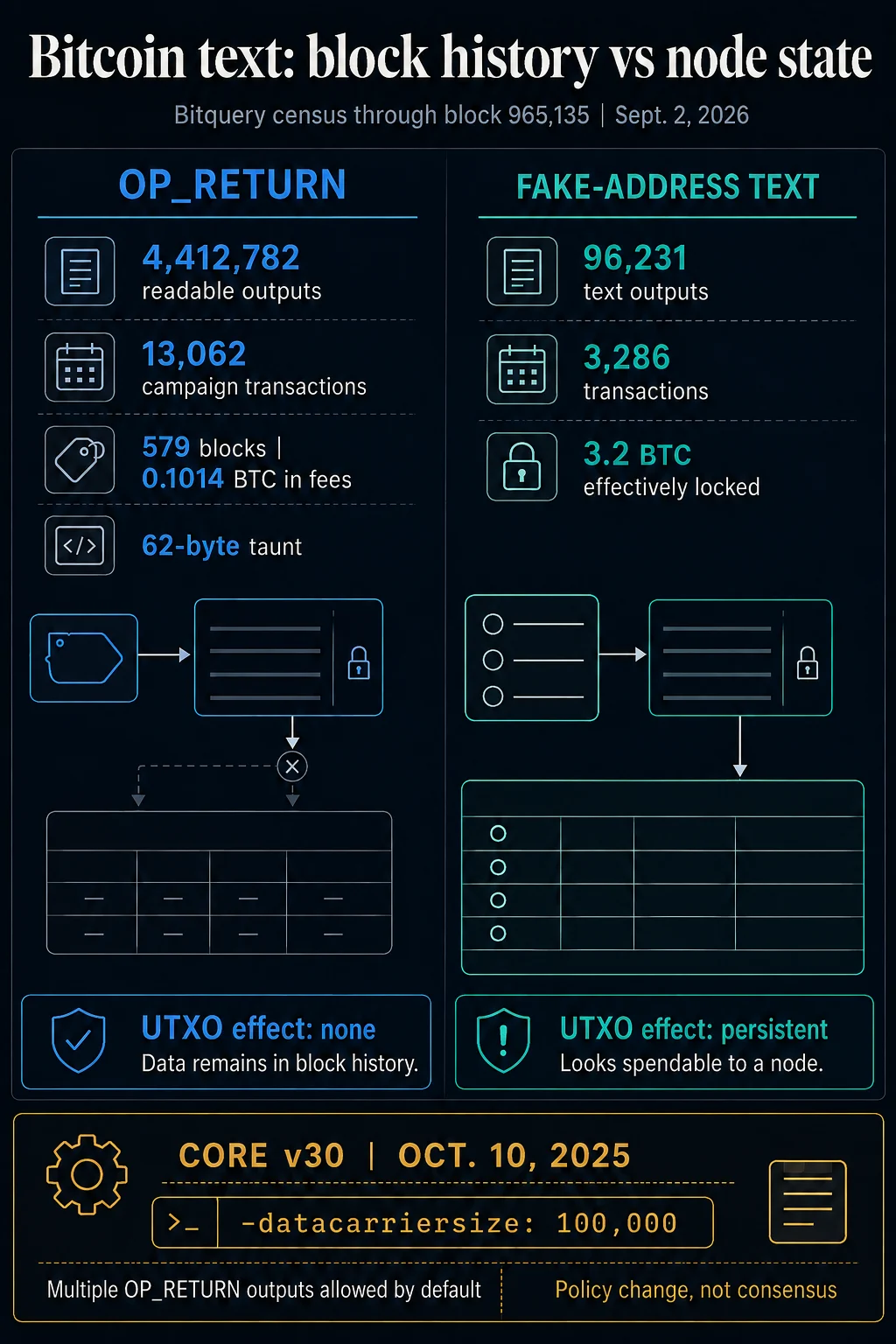
In a comprehensive census published on September 2, 2026, the blockchain data analytics firm Bitquery released a detailed investigation into the methods and consequences of embedding text within the Bitcoin blockchain. The study, which involved the scanning of 965,135 blocks, identifies four distinct mechanisms used to record messages on the world’s largest decentralized ledger. The findings underscore a critical technical distinction: while some methods of data embedding are relatively benign for the network’s infrastructure, others impose a permanent and "unspendable" burden on the global network of Bitcoin nodes. According to the report, Bitquery identified 96,231 "fake-address" text outputs that currently reside in the Unspent Transaction Output (UTXO) set, contrasting sharply with over 4.4 million OP_RETURN outputs that, while increasing the size of the block history, do not bloat the database required for transaction validation.
The Technical Divergence: OP_RETURN vs. Fake-Address Encodings
To understand the implications of the Bitquery report, it is necessary to distinguish between the two primary ways text is currently being written into the Bitcoin ledger. The first and most standard method is through the OP_RETURN script opcode. Introduced early in Bitcoin’s development as a compromise to keep the UTXO set clean, OP_RETURN allows a transaction to carry a small payload of arbitrary data. Crucially, any output beginning with OP_RETURN is explicitly marked as "provably unspendable." Because these outputs can never be spent, Bitcoin nodes are not required to keep them in the UTXO database—the high-speed index used to verify if a user has the funds they claim to have. While OP_RETURN data must be downloaded during the initial block download (IBD) and stored in the archival block history, it does not occupy the limited and expensive RAM or high-speed storage typically reserved for the UTXO set.
The second method, which Bitquery identifies as significantly more problematic, involves "fake-address" text. In this scenario, users place readable ASCII or hexadecimal text where a cryptographic public key hash would normally reside. To the Bitcoin protocol, these look like legitimate, spendable addresses. However, because the "address" is actually a string of text (such as a message or a name), there is no known private key capable of generating a valid digital signature to move those funds. These outputs effectively become "zombie" entries in the UTXO set. Every full node must track these 96,231 outputs indefinitely, as the protocol cannot distinguish them from legitimate funds that might be spent in the future. Bitquery estimates that these outputs currently lock up approximately 3.2 BTC, a sum that is effectively lost to the circulating supply but remains a permanent weight on node performance.
A Chronology of the March 2026 Taunt Campaign
The Bitquery study highlighted a specific surge in on-chain activity occurring between March 21 and March 26, 2026. During this five-day window, a coordinated campaign targeted Bitcoin Core developer Luke Dashjr with a repetitive two-sentence taunt. Dashjr has long been a vocal critic of using the Bitcoin blockchain for non-financial data storage, often referring to such practices as "spam."
Bitquery’s granular analysis of this event revealed a highly organized effort:

- Transaction Volume: 13,062 individual transactions were recorded.
- Unique Participants: The data suggests 13,062 distinct sending addresses were used, though these could potentially be controlled by a single entity or a small group.
- Network Spread: The messages were distributed across 579 blocks.
- Economic Cost: The organizers paid a total of 0.1014 BTC in aggregate transaction fees to ensure the messages were included in the blockchain.
Despite the visibility of the campaign, the Bitcoin protocol’s inherent privacy features mean that the author, payer, and specific motive remain anonymous. The campaign utilized the OP_RETURN method for 13,062 of these taunts, meaning that while they increased the historical data size of the chain, they did not contribute to the long-term "clogging" of the UTXO database that the "fake-address" method causes.
The Impact of Bitcoin Core 30.0 and Policy Shifts
The Bitquery report also provides a retrospective look at the impact of the Bitcoin Core 30.0 software release, which debuted in October 2025. This version of the software introduced a significant change to the default -datacarriersize setting. Historically, this limit was set at 80 bytes to discourage the use of Bitcoin as a general-purpose data store. However, with the rise of various Layer 2 protocols and legitimate use cases for data embedding, Bitcoin Core 30.0 raised the default limit to 100,000 bytes.
This policy change did not alter the consensus rules—meaning blocks with larger data payloads were always technically "valid"—but it did change the "standardness" rules. Standardness rules govern which transactions nodes will relay to one another and which transactions miners will easily see in their mempools. By increasing this limit, the Bitcoin development community effectively made it easier and cheaper for users to include larger text payloads and multiple OP_RETURN outputs in a single transaction.
Bitquery’s data shows a clear correlation: messages exceeding the old 80-byte ceiling were rare before late 2025, appearing only a few dozen times per month. Following the adoption of v30.0, these instances rose into the thousands by February 2026. This suggests that the market for on-chain data storage is highly sensitive to the relay policies set by the Bitcoin Core maintainers.
Implications for Node Operators and Decentralization
The primary concern raised by the Bitquery scan is the long-term health of the Bitcoin network. The strength of Bitcoin lies in its decentralization, which is dependent on the ability of individuals to run full nodes on consumer-grade hardware. As the UTXO set grows, the hardware requirements for running a node increase.
The 96,231 fake-address outputs identified by Bitquery represent a form of "state bloat." Unlike historical block data, which can be "pruned" (deleted) by nodes with limited storage space, the UTXO set cannot be pruned if a node wishes to remain fully functional and capable of validating new transactions. While 96,000 outputs may seem small compared to the millions of legitimate UTXOs, the trend of using "fake addresses" for permanent messaging creates a cumulative burden.

Furthermore, the 3.2 BTC trapped in these addresses represents a permanent economic inefficiency. These satoshis are removed from the economy, yet they require the same level of security and tracking as every other bitcoin in existence.
Broader Context: The Ongoing "Spam" Debate
The Bitquery study adds empirical weight to a debate that has fractured the Bitcoin community since the advent of Ordinals and Inscriptions in 2023. On one side, "purists" argue that Bitcoin should be used strictly for financial transactions and that any data embedding is an attack on the network’s scalability. On the other side, "extensionists" argue that as long as a user pays the required market fee, they should be allowed to use the block space for any purpose they choose.
The Bitquery data suggests a middle ground of sorts. By identifying that OP_RETURN is significantly less harmful than "fake-address" text, the study implies that the way users embed data matters as much as the amount of data they embed. The Bitcoin developer guide has long recommended OP_RETURN as the "preferable" method for data storage because it respects the resource constraints of the UTXO set.
Conclusion and Future Outlook
As the Bitcoin network continues to evolve into a multi-layered financial and data protocol, the tension between data storage and network efficiency is likely to persist. Bitquery’s scan serves as a vital health check for the network, providing node operators and developers with the data needed to assess the true cost of on-chain messaging.
The rise of OP_RETURN usage following Bitcoin Core 30.0 indicates a growing demand for data embedding that is now being handled in a more "node-friendly" manner. However, the persistent presence of nearly 100,000 fake-address outputs remains a reminder of the permanent nature of blockchain decisions. As the network approaches the next million blocks, the community will likely continue to monitor these "zombie" outputs, weighing the freedom of the fee market against the necessity of keeping the cost of node operation within reach of the average user.
For now, the Bitquery report stands as a definitive census of how text has permeated the Bitcoin ledger, revealing that while the words may be the same, the architectural cost of those words varies wildly depending on how they are written into the code.