admin
admin
Bitcoin (BTC) decisively breached the $80,000 threshold on Monday, August 24, 2026, following the opening of Wall Street, marking a significant psychological and technical milestone for the premier cryptocurrency. This robust upward movement built upon a strong rally observed in the preceding week, pushing BTC’s price to levels not seen since mid-May of the same year. While the rally has injected renewed optimism into the digital asset market, analysts are cautioning that sustained performance at higher levels is imperative to definitively challenge the prevailing bear-market thesis that has characterized much of the past year.
The $80,000 Breakthrough: A Resounding Return
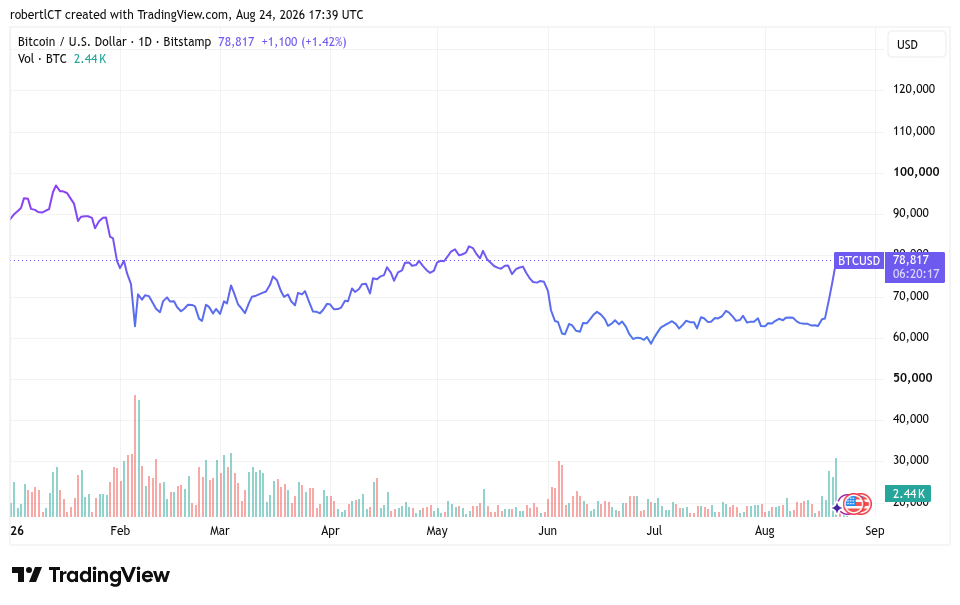
The ascent of Bitcoin past $80,000 represents a crucial moment for investors and market watchers. Data sourced from TradingView confirmed BTC/USD’s breach of this key resistance level, with the cryptocurrency posting an impressive intraday gain of approximately 3% before experiencing a slight pullback in the hours following the European market close. This marked the first instance of Bitcoin trading above $80,000 since May 15, 2026, ending a 100-day hiatus from this valuation. The immediate consequence of this rapid price appreciation was a substantial wave of liquidations across the derivatives market. According to data compiled by CoinGlass, crypto short liquidations surpassed $220 million within the 24-hour period leading up to the time of writing, indicating that a significant number of bearish bets were caught off guard by the strength and velocity of the rally. Such liquidation cascades often amplify price movements as forced buying by liquidating positions further fuels the upward momentum. Looking ahead, market depth charts revealed a discernible band of bid liquidity centered around the $76,700 mark, which could potentially act as a crucial support zone should the BTC price experience a downward reversal in the immediate future. This suggests a floor of buying interest that could absorb selling pressure.
A Century of Absence: The Path Back to $80k
The journey back to $80,000 has been punctuated by a period of considerable volatility and uncertainty for Bitcoin. After peaking in mid-May, the cryptocurrency entered a corrective phase, largely influenced by a confluence of macroeconomic factors, regulatory concerns, and broader risk-off sentiment in global financial markets. The 100 days since May 15 have been characterized by fluctuating sentiment, with Bitcoin largely consolidating within a range below the $80,000 mark. This period saw investors grappling with persistent inflation concerns, the Federal Reserve’s stance on interest rates, and a general tightening of global liquidity, all of which weighed heavily on risk assets, including cryptocurrencies. Minor rallies were often met with strong resistance, and the overall market narrative remained predominantly cautious, if not outright bearish.
The "snap rally" mentioned in the initial reports began to gather momentum in the preceding week, exhibiting increasing volume and conviction. This upward trajectory was fueled by a combination of factors, including a perceived easing of macroeconomic pressures, a slight shift in investor sentiment towards risk assets, and perhaps a degree of short covering as traders anticipated a potential breakout. The ability of Bitcoin to not only reclaim but also briefly sustain levels above $80,000 suggests a significant shift in market dynamics and potentially a renewed appetite for risk among a segment of investors.
Analyst Perspectives and the Enduring Bear Market Thesis
Despite the exhilaration surrounding Bitcoin’s return to $80,000, prominent market analysts are advocating for a cautious approach, emphasizing the need for sustained strength to definitively invalidate the long-standing bear market thesis. Bitcoin’s performance in August has been particularly noteworthy, with the cryptocurrency posting a month-to-date gain of approximately 25%. This marks its best August performance since 2017, a year remembered for its explosive bull run. Such robust monthly gains are increasingly diverging from the typical patterns observed during prolonged bear markets, where rallies are often short-lived and quickly retrace.
However, historical precedents serve as a stark reminder of market unpredictability. Earlier reports from Cointelegraph highlighted concerns among some traders that a bearish history could still repeat itself. Specifically, fears persist that any gains made in August could re-emerge as downside pressure from September onward, potentially sparking a final capitulation event to new macro lows. This perspective underscores the deep-seated skepticism that has characterized the market during its downturn.

Rekt Capital, a widely followed trader and analyst, encapsulated this sentiment in his latest market commentary on X (formerly Twitter): “Bitcoin has Weekly Closed at the highs. Now starts the real test.” He elaborated, “If this is a Bear Market Relief Rally, then Bitcoin could pullback as early as this week, or at least over the next few weeks. Now it’s all about Bitcoin proving sustained strength.”
Rekt Capital specifically pointed to the 50-week exponential moving average (EMA) as a critical indicator. At the time of his analysis, this key trend line was situated at $77,251. Bitcoin’s recent achievement of its first weekly close above the 50-week EMA since November 2025 is a technically significant development. However, Rekt Capital drew a parallel to Bitcoin’s 2022 bear market, during which BTC/USD managed to achieve two weekly closes above that same trend line before ultimately succumbing to further selling pressure and dropping to cycle lows. This historical context highlights that while breaking above key moving averages is bullish, sustained hold and further upward momentum are necessary to confirm a genuine trend reversal rather than a temporary "relief rally."
Other market strategists echo this cautious optimism. While acknowledging the positive momentum, many stress the importance of daily and weekly closes above the $80,000 mark. A failure to consolidate above this level, particularly if followed by increased selling volume, could signal a bull trap, leading to renewed downside pressure. Conversely, sustained trading above $80,000, coupled with increasing institutional interest and positive macroeconomic indicators, would significantly bolster the case for a broader market recovery.
Market Dynamics and Supporting Indicators
Beyond price action, several other market indicators offer a more comprehensive view of Bitcoin’s current standing. Trading volume, for instance, has seen a notable uptick alongside the price surge, lending credibility to the rally. High volume on upward moves suggests strong conviction from buyers, rather than a low-liquidity squeeze. Conversely, any subsequent price drop on low volume would be less concerning than one accompanied by heavy selling.
The cryptocurrency Fear & Greed Index, a composite metric that gauges overall market sentiment, has likely shifted from "Fear" or "Neutral" towards "Greed" in response to the $80,000 breach. While an elevated "Greed" reading can sometimes precede a correction, it also reflects a renewed interest and confidence among retail and institutional investors.
Open interest in Bitcoin futures contracts has also seen an increase, indicating more capital flowing into the derivatives market. While this can sometimes signal over-leverage and potential for sharp liquidations, it also reflects increased participation and belief in future price movements. The liquidation heatmap provided by CoinGlass, showing concentrated short liquidations, further illustrates the impact of rapid price movements on leveraged positions.
On-chain metrics, such as the number of active addresses, transaction volume, and miner behavior, also provide valuable insights. A sustained increase in active addresses and transaction volume would suggest growing organic usage and network adoption, which are fundamentally bullish signals. Miners, who are crucial stakeholders in the Bitcoin ecosystem, often adjust their selling behavior based on profitability. A higher Bitcoin price generally reduces selling pressure from miners, as their operational costs are covered more easily, potentially leading to less supply entering the market.
Macroeconomic Headwinds and Tailwinds
The broader macroeconomic environment continues to play a pivotal role in dictating the trajectory of risk assets, including Bitcoin. Persistent inflation, although showing signs of moderation in some economies, remains a concern for central banks globally. The Federal Reserve’s interest rate policy, specifically the path of future rate hikes or potential cuts, is a critical determinant of liquidity and investor appetite for risk. A dovish shift in central bank rhetoric, signaling an end to monetary tightening or even future rate reductions, could provide a significant tailwind for Bitcoin and other cryptocurrencies. Conversely, any hawkish surprises could dampen enthusiasm.
Global economic stability, geopolitical events, and the performance of traditional markets (like the S&P 500 or Nasdaq) also exert influence. As Bitcoin matures, its correlation with traditional financial assets tends to fluctuate. During periods of extreme market stress, Bitcoin can sometimes act as a safe-haven asset, but more often, it behaves as a risk-on asset, moving in tandem with technology stocks. The recent rally coinciding with Wall Street open suggests a continued interconnectedness with broader market sentiment.
Institutional Engagement and Regulatory Landscape
Institutional adoption remains a significant long-term driver for Bitcoin. The performance of Bitcoin Exchange-Traded Funds (ETFs) and the continued interest from corporate treasuries in holding Bitcoin on their balance sheets are key indicators. Positive net inflows into Bitcoin ETFs would signal sustained institutional demand, providing a solid foundation for price stability and growth. Reports of increased corporate interest in digital assets, even during periods of market downturn, suggest a growing acceptance of Bitcoin as a legitimate store of value and an uncorrelated asset in diversified portfolios.
The regulatory landscape also continues to evolve and impact market sentiment. Clarity from regulatory bodies like the U.S. Securities and Exchange Commission (SEC) on digital asset classifications, stablecoin regulations, and exchange oversight could reduce uncertainty and encourage further institutional participation. Conversely, any adverse regulatory actions or heightened scrutiny could trigger market corrections. Global efforts to establish comprehensive regulatory frameworks for cryptocurrencies are ongoing, and their outcomes will undoubtedly shape the future of the digital asset space.
The Road Ahead: Challenges and Opportunities
The immediate challenge for Bitcoin is to consolidate above the $80,000 level. Sustained weekly closes above this mark, coupled with strong buying interest, would transform $80,000 from a resistance point into a new support level. The next psychological and technical resistance levels could be at $85,000 and then potentially $90,000, as the market looks to test previous all-time highs and establish new price discovery zones.
For retail investors, this rally presents both opportunities and risks. While the allure of quick gains is strong, the volatility inherent in the crypto market necessitates caution. Dollar-cost averaging and a long-term investment horizon are often advised to mitigate the impact of short-term price swings. For institutional investors, the $80,000 breach might re-ignite discussions about Bitcoin’s role in diversified portfolios, potentially leading to increased allocations.
The long-term outlook for Bitcoin remains a subject of intense debate. Proponents point to its finite supply, increasing adoption, and its role as a hedge against inflation and currency debasement. Skeptics highlight its volatility, regulatory uncertainties, and environmental concerns. However, the consistent development of its underlying technology, including network upgrades and the proliferation of Layer-2 solutions, continues to enhance Bitcoin’s utility and scalability.
In conclusion, Bitcoin’s forceful return to the $80,000 mark is a powerful testament to its resilience and the enduring interest in digital assets. While the immediate excitement is palpable, the market now enters a critical phase where sustained strength and consolidation are paramount. The coming weeks will be crucial in determining whether this rally marks a genuine reversal of the bear market trend or merely a significant relief rally within a broader period of market caution. The eyes of the financial world, both traditional and digital, will remain firmly fixed on Bitcoin’s performance as it navigates this pivotal juncture.