admin
admin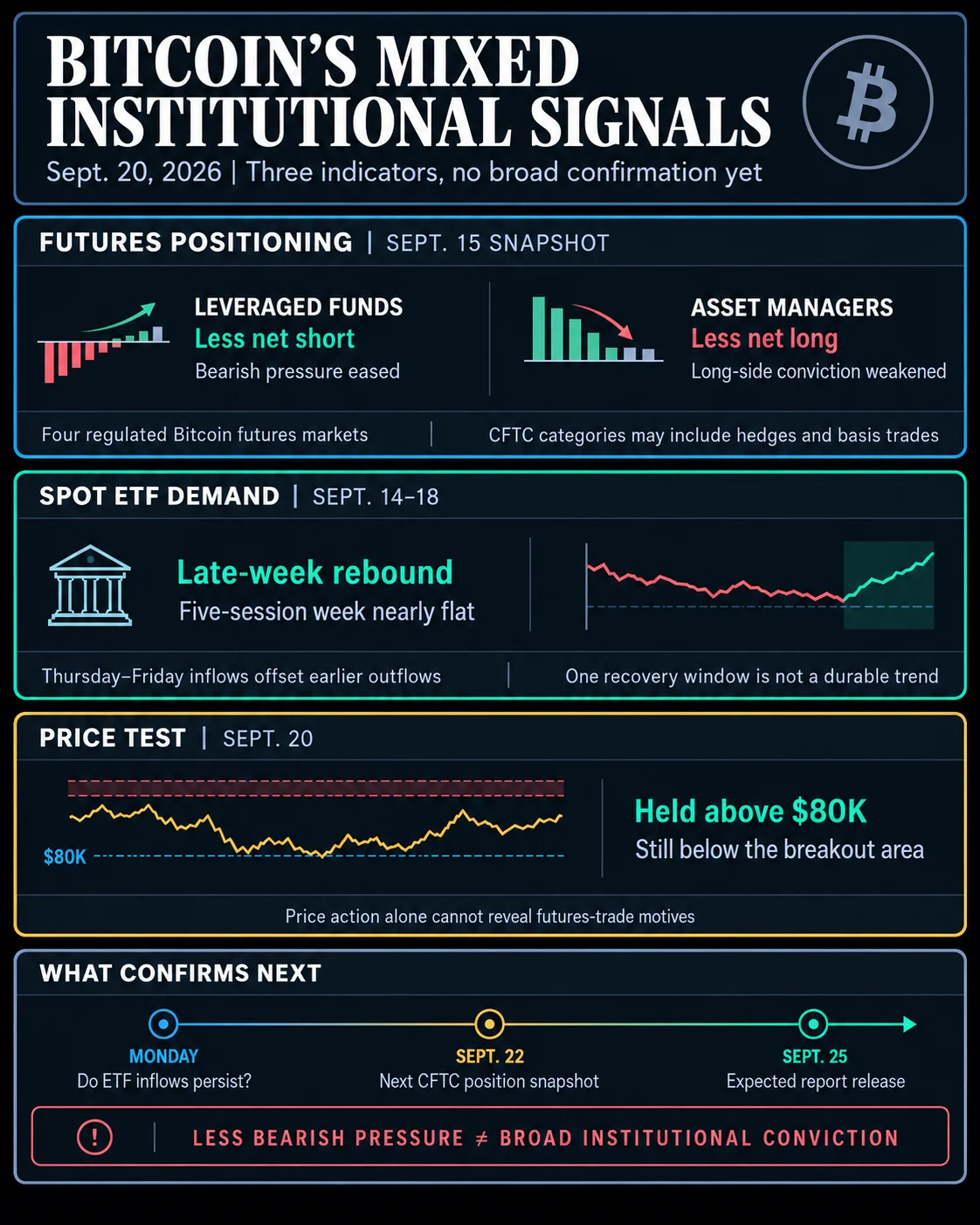
Bitcoin maintained its position above the significant psychological threshold of $80,000 over the weekend, a price point that has garnered considerable attention from market participants. This resilience, however, coincided with a complex picture emerging from key institutional indicators, which presented a mixed outlook on market sentiment and demand. Analysis of recent data from the Commodity Futures Trading Commission (CFTC) and spot Bitcoin Exchange-Traded Fund (ETF) flows reveals nuanced shifts in institutional positioning, suggesting a divergence in strategies and a lack of a unified bullish conviction despite the price action.
The latest snapshot from the CFTC, detailing positions as of September 15th, indicated a notable recalibration among leveraged funds. These entities, often characterized by their active participation in futures markets, reduced their aggregate net-short exposure across four regulated Bitcoin futures products by the equivalent of 7,275 BTC compared to the previous week. This reduction in bearish sentiment, while significant, was tempered by a concurrent decrease in net-long positions held by asset managers. These traditional institutional players scaled back their aggregate net-long holdings by approximately 4,733 BTC-equivalent. This dual movement suggests a complex interplay of strategies, with some reducing bearish bets while others tempered bullish enthusiasm.
Further complicating the institutional demand narrative, data tracking spot Bitcoin ETF flows presented a similarly bifurcated trend. While Farside Investors’ ETF table reported robust inflows of $592.5 million for the specific trading days of September 17th and 18th, the broader weekly picture for September 14th to 18th painted a much more subdued scenario. The entire five-session week concluded with a marginal net inflow of just $6.1 million, indicating that the strong performance at the end of the week largely offset significant outflows experienced earlier in the period. This suggests a potential late-week surge in demand, rather than a consistently building trend.
It is crucial to note that these indicators, while all pertaining to institutional activity, measure different aspects of the market across distinct timeframes. The CFTC data captures futures positions as of a specific Tuesday, reflecting a snapshot of derivative market sentiment. In contrast, the ETF data tracks daily flows into investment products directly holding Bitcoin, offering a view of spot market demand. The market reading, as of September 20th, confirmed Bitcoin trading at $80,338.71 with $22.38 billion in 24-hour volume, remaining below the identified resistance area between $82,000 and $82,200. This price action occurred after the CFTC data cutoff, making direct causal links between the reported futures changes and subsequent price movements challenging to establish definitively.
Navigating the Nuances of Futures Positioning
The intricacies of the CFTC’s Commitments of Traders (COT) report provide a deeper understanding of the institutional shifts. The report encompasses futures contracts traded on the CME (standard and micro Bitcoin futures) and Coinbase Derivatives (nano and nano-perpetual contracts). To accurately aggregate positions across these diverse contracts, which represent varying amounts of Bitcoin, the data is normalized into BTC-equivalent units. This methodology ensures a consistent comparison of exposure.
As of September 15th, leveraged funds held an aggregate net-short position equivalent to approximately 32,602 BTC. This represented a notable reduction from the 39,877 BTC-equivalent net-short exposure reported on September 8th. The 7,275 BTC-equivalent narrowing in net-shorting occurred due to a combination of increased aggregate long exposure and a decrease in aggregate short exposure among these funds. Despite this shift, leveraged funds continued to maintain a material net-short position, indicating that a significant portion of their strategy still involved betting against a price increase.
In contrast, asset managers, a category often associated with more conservative investment strategies and longer-term holdings, saw their aggregate net-long position diminish. Their holdings fell from approximately 18,866 BTC-equivalent on September 8th to 14,133 BTC-equivalent by September 15th, a reduction of about 4,733 BTC. This implies that traditional asset managers, while not necessarily becoming bearish, were reducing their bullish exposure in these futures contracts during the same period.
The implications of these shifts are multifaceted. The reduction in net-short positioning by leveraged funds can be interpreted as a decrease in a potential bearish overhang, theoretically creating a more favorable environment for price appreciation. However, the simultaneous decrease in asset manager longs suggests a less enthusiastic embrace of Bitcoin as an asset class by these more established players. This divergence means that while one potential source of selling pressure may have lessened, the additive force of increasing long-term institutional investment also appears to have moderated.
The CFTC’s classification of traders as "leveraged funds" or "asset managers" is based on their predominant business activity, not necessarily the specific purpose of each individual trade. Positions can be held for speculation, hedging, risk management, or cross-market arbitrage. Therefore, these labels represent reporting categories rather than uniform investment strategies. This nuance is critical when interpreting the data, as it highlights that movements within these categories may not always reflect a unified market sentiment or strategy.
Spot ETF Flows: A Tale of Two Halves
The performance of US spot Bitcoin ETFs offers a more direct measure of retail and institutional demand for direct Bitcoin exposure. Farside Investors’ data provides a granular view of these inflows and outflows. The period between September 14th and 18th showcased a stark contrast between the early and late parts of the trading week.
On September 17th, net inflows into US spot Bitcoin ETFs amounted to $159.5 million. This positive momentum accelerated significantly on September 18th, with net inflows reaching $433.0 million. The combined inflow for these two days totaled an impressive $592.5 million, highlighting a strong resurgence in investor appetite for these products.
However, this strong finish painted an incomplete picture of the week’s overall demand. When considering the entire five-session trading week from September 14th to September 18th, the net inflow was a mere $6.1 million. This near-flat result underscores the substantial outflows that occurred in the preceding sessions. The significant inflows on Thursday and Friday were essential to prevent a net negative outcome for the week, indicating that a significant portion of the week’s positive performance was concentrated in the final two trading days.

This pattern suggests a reactive demand rather than a consistent allocation trend. Investors appear to have responded positively to certain market developments, possibly including Bitcoin’s price action and broader market sentiment shifts, leading to a late-week surge in ETF buying. The crucial question moving forward is whether this demand will persist and translate into sustained inflows, or if it was a temporary reaction to specific market conditions. The upcoming US trading sessions will be critical in determining the sustainability of this renewed ETF interest.
It is important to distinguish ETF flows from CFTC positioning data. ETF creations and redemptions reflect net fund movements into or out of investment vehicles that hold actual Bitcoin. The CFTC reports, on the other hand, classify the long and short exposure within futures contracts. While both are indicators of institutional activity, they represent distinct market mechanisms and cannot be directly equated or used to infer matching investor behavior.
Chronology of Events and Market Context
To fully appreciate the current market dynamics, it is beneficial to consider the preceding events and the broader market context. The period leading up to the September 15th CFTC reporting date and the subsequent ETF flows occurred against a backdrop of ongoing macroeconomic uncertainty and evolving regulatory landscapes for digital assets.
In the weeks prior, Bitcoin had experienced significant price volatility. Market participants were closely watching for signals from central banks, particularly the US Federal Reserve, regarding monetary policy. Any indication of interest rate changes or shifts in quantitative easing policies can have a profound impact on risk assets like Bitcoin. The market’s reaction to these signals often dictates short-term price movements and influences institutional investment strategies.
Furthermore, the ongoing development and approval of spot Bitcoin ETFs in the United States have been a major catalyst for institutional interest. These products have opened new avenues for traditional investors to gain exposure to Bitcoin without the complexities of direct custody and trading. The initial launch of these ETFs saw substantial inflows, creating a bullish narrative. However, as the initial excitement waned, the market has been looking for signs of sustained institutional commitment.
The price action around the $80,000 mark has also been a focal point. This psychological level, along with the identified resistance zone between $82,000 and $82,200, represents key technical barriers that traders and analysts monitor closely. Breaking through and holding these levels can signal a continuation of an uptrend, while repeated rejections can indicate a potential for consolidation or a price pullback.
The CFTC report’s cutoff date of September 15th means it predates the significant market move that occurred later in the week, potentially including the post-Federal Reserve policy announcements or other economic data releases that might have influenced Bitcoin’s price. This temporal disconnect limits the ability to draw direct causal links between the reported futures positioning and the subsequent price action.
Implications and Future Outlook
The current landscape suggests that while Bitcoin has demonstrated resilience above $80,000, the underlying institutional conviction remains unconfirmed. The mixed signals from leveraged funds and asset managers, coupled with the uneven performance of spot ETFs, indicate a market that is still finding its footing.
A durable bullish case would be strengthened by several developments. Continued and consistent inflows into spot Bitcoin ETFs would provide compelling evidence of broadening institutional demand. Simultaneously, a shift in CFTC reporting data showing a renewed increase in net-long positions among asset managers, coupled with a further reduction in net-short exposure from leveraged funds, would offer a more robust confirmation of institutional confidence in the futures market.
Conversely, a reversal in ETF flows or a return to increased net-short positioning by leveraged funds would suggest that the current price stability might be fragile. Such a scenario could indicate that the recent price gains were driven by short-covering or other temporary factors, rather than a fundamental expansion of institutional commitment.
The upcoming CFTC report, covering positions as of September 22nd and expected on September 25th, will be particularly insightful. This report will be the first to capture the positioning of these key trader groups after the significant late-week ETF inflows and Bitcoin’s subsequent move back above the $80,000 level. Any changes in this report will provide crucial clarity on whether the institutional sentiment has shifted more decisively.
The immediate price action remains a critical indicator. Bitcoin’s ability to break through and sustain its position above the $82,000 to $82,200 resistance area will be a significant technical development. However, price alone cannot definitively resolve the underlying motives behind reported futures positions or the sustainability of ETF demand. A strong price breakout that coincides with continued positive ETF flows would carry more weight, suggesting a convergence of technical strength and fundamental demand.
In conclusion, while Bitcoin’s ability to hold above $80,000 is a positive sign, the current institutional picture is complex. Leveraged funds have reduced their bearish bets, but this has not been matched by a significant increase in bullish sentiment from asset managers, and the week’s ETF performance was largely driven by late-week surges. The market is at a pivotal juncture, and the coming weeks will be crucial in determining whether institutional conviction is truly returning or if the current price stability is built on less solid foundations. The next round of data from both the CFTC and ETF providers will be instrumental in shaping this outlook.