Dwi Wanna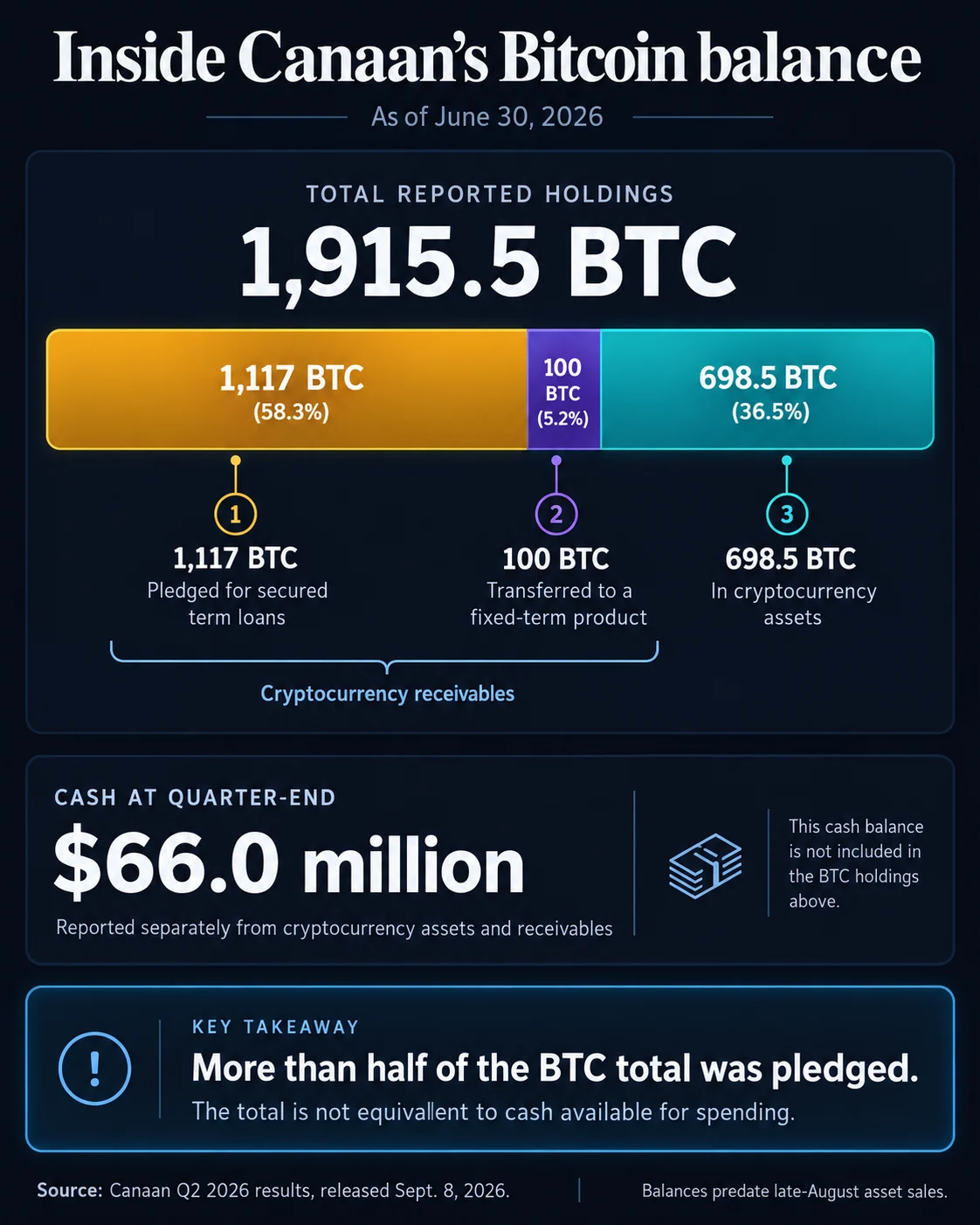
Canaan Inc., a pioneer in the Bitcoin mining hardware industry and the creator of the world’s first ASIC-powered miner, released its second-quarter 2026 financial results on September 8, revealing a challenging fiscal landscape characterized by a significant revenue miss and a deepening net loss. The company reported total revenue of $31.9 million for the quarter ending June 30, 2026, falling short of the $35 million to $45 million guidance range provided by management earlier in the year. This financial downturn has been primarily attributed to a sharp decline in demand for mining equipment and a subsequent compression in selling prices, forcing the firm to pivot its capital allocation strategy toward liquidation of digital assets to support its stock price through share repurchases.
The financial pressure on Canaan highlights a broader trend within the cryptocurrency infrastructure sector, where manufacturers are grappling with the dual challenges of a maturing market and high volatility in underlying asset prices. As hardware demand wanes, Canaan has increasingly relied on its proprietary mining operations and its crypto treasury to maintain liquidity. However, a detailed analysis of the company’s balance sheet suggests that its available "war chest" is more constrained than the headline figures might suggest, with a substantial portion of its Bitcoin holdings currently pledged as collateral for outstanding loans.
Financial Performance and Revenue Contraction
The $31.9 million revenue figure represents a stark decline from previous periods, particularly in the product sales segment. Revenue from the sale of mining machines plummeted to $13.6 million in the second quarter, down from $42.9 million in the first quarter of 2026. This contraction is indicative of a "wait-and-see" approach from major institutional miners, who may be delaying hardware refreshes in anticipation of more efficient next-generation chips or in response to fluctuating Bitcoin prices.
The company reported a staggering quarterly net loss of $97.6 million. While this figure is substantial, it is important to note that a significant portion of this loss is comprised of non-cash charges. Canaan recorded $25.3 million in inventory and prepayment write-downs, along with purchase-commitment provisions. Additionally, the company recognized $9.2 million in property and equipment impairment. These accounting adjustments reflect the declining market value of older hardware generations still held in inventory and the reduced utility of certain physical assets in a rapidly evolving technological landscape.
Despite the losses in the hardware division, Canaan’s self-mining operations provided a vital, albeit insufficient, revenue stream. The company produced 243 BTC during the quarter, generating $17.7 million in mining revenue. Management noted that these operations maintained a positive cash contribution before accounting for depreciation, suggesting that while the company is losing money on a GAAP basis, its active mining fleet remains operationally viable at current electricity and difficulty rates.
The Treasury Dilemma: Pledged Assets and Liquidity
Central to Canaan’s current fiscal narrative is the composition of its cryptocurrency treasury. As of June 30, 2026, the company reported a total holding of 1,915.5 BTC. However, the liquidity of this position is heavily restricted. Of the total balance, 1,117 BTC—or approximately 58%—were pledged as collateral for secured term loans. Furthermore, 100 BTC were locked in a fixed-term product, leaving only 698.5 BTC classified as unrestricted cryptocurrency assets.

This distinction is critical for investors and analysts assessing the company’s ability to meet short-term obligations. Pledged coins serve as security for debt and cannot be liquidated without either repaying the underlying loans or risking a margin call if the price of Bitcoin drops significantly. On the balance sheet, these pledged and fixed-term assets were recorded as "cryptocurrency receivables" valued at $70.9 million, separate from the $47 million in "cryptocurrency assets."
The company’s cash position showed a moderate recovery, rising to $66 million by the end of June, up from $43.5 million at the end of March. However, this remains below the $80.8 million held at the conclusion of 2025. The increase in cash during the second quarter, despite the net loss, suggests that Canaan has been successful in managing its working capital or drawing down on credit facilities, though the sustainability of this trend is in question given the revenue outlook for the remainder of the year.
Strategic Pivot: Selling Crypto to Fund Buybacks
In a move that has drawn significant attention from market observers, Canaan disclosed that it began liquidating portions of its cryptocurrency holdings after the quarter ended to fund its share repurchase program. In late August 2026, the company sold 3,952 ETH and 54 BTC, netting approximately $13.9 million in cash.
A significant portion of these proceeds was immediately redirected toward the company’s existing share buyback initiative. By September 8, Canaan had repurchased approximately 16.4 million American depositary shares (ADS) for a total of $7.4 million. Notably, $5.4 million of this expenditure occurred in the final weeks of August, coinciding with the crypto sales.
The decision to sell appreciating or yield-bearing digital assets to buy back depreciating equity in the midst of a $97 million loss is a controversial one. Proponents might argue that the buybacks signal management’s confidence that the stock is undervalued and serve to protect shareholders from further dilution or a total collapse in share price. Critics, however, may view the move as an inefficient use of scarce capital, suggesting that the funds would be better spent on Research and Development (R&D) for the next generation of Avalon miners or on securing more favorable energy contracts for its mining division.
Chronology of Key Events (2025–2026)
- December 31, 2025: Canaan concludes the fiscal year with $80.8 million in cash, reflecting a relatively stable period for hardware demand.
- March 31, 2026: Cash reserves drop to $43.5 million as product revenue begins to soften and the company invests in its mining fleet.
- May 2026: Management issues Q2 revenue guidance of $35 million to $45 million, anticipating a seasonal uptick in demand that fails to materialize.
- June 30, 2026: Q2 ends with $31.9 million in revenue and a $97.6 million net loss. Over half of the company’s Bitcoin is now pledged as collateral.
- Late August 2026: Canaan liquidates 3,952 ETH and 54 BTC to bolster cash reserves.
- September 8, 2026: The company officially reports its Q2 results and provides a bearish outlook for Q3, forecasting revenue as low as $11 million.
Industry Context and Competitive Pressures
Canaan’s struggles are not occurring in a vacuum. The Bitcoin mining hardware industry is currently undergoing a period of intense consolidation. Competitors such as Bitmain and MicroBT have continued to push the boundaries of energy efficiency with their latest models, forcing Canaan to engage in aggressive pricing strategies to clear its older inventory.
Furthermore, the global semiconductor supply chain has stabilized, removing the "scarcity premium" that manufacturers enjoyed during the 2021–2024 period. With more supply available and mining difficulty reaching all-time highs, the ROI (Return on Investment) calculations for miners have become much tighter. This has shifted the market from one driven by retail speculators to one dominated by sophisticated institutional players who demand high-performance machines at lower price points.

The "halving" cycles of Bitcoin also continue to play a psychological and financial role. If the market is in a post-halving phase where block rewards are reduced, miners are even more sensitive to hardware costs and efficiency, placing further pressure on manufacturers like Canaan to innovate or perish.
Broader Impact and Future Implications
The outlook for the third quarter of 2026 remains bleak. Management has forecast revenue in the range of $11 million to $15 million, which would represent a further 50% to 65% decline from the already disappointing second-quarter results. This projection suggests that the "crypto winter" for hardware manufacturers may be entering its coldest phase yet.
The implications for Canaan are twofold. First, the company must find a way to stabilize its hardware business. Without a significant technological breakthrough or a massive surge in Bitcoin’s price that incentivizes new mining deployments, Canaan may be forced to further downsize its manufacturing operations. Second, the company’s transition into a self-mining entity is becoming its primary identity. With mining revenue now exceeding product revenue, Canaan is effectively becoming a Bitcoin miner that happens to build its own tools, rather than a manufacturer that happens to mine.
For the broader market, Canaan’s situation serves as a cautionary tale regarding the use of Bitcoin as collateral. While pledging BTC for loans allows companies to avoid selling their "HODL" positions during price dips, it creates a layer of systemic risk. If Bitcoin prices were to see a sharp correction, Canaan could face a liquidity crisis as its pledged collateral becomes insufficient to cover its loans, potentially leading to forced liquidations that further depress the market.
As Canaan navigates the remainder of 2026, the success of its capital allocation strategy—specifically the balance between maintaining a crypto treasury, funding share buybacks, and sustaining operations—will determine whether the company can maintain its position as a pillar of the Bitcoin infrastructure or if it will be relegated to a niche player in an increasingly competitive field. Investors will be watching closely to see if the August crypto sales were a one-time emergency measure or the beginning of a sustained liquidation trend.