Dwi Wanna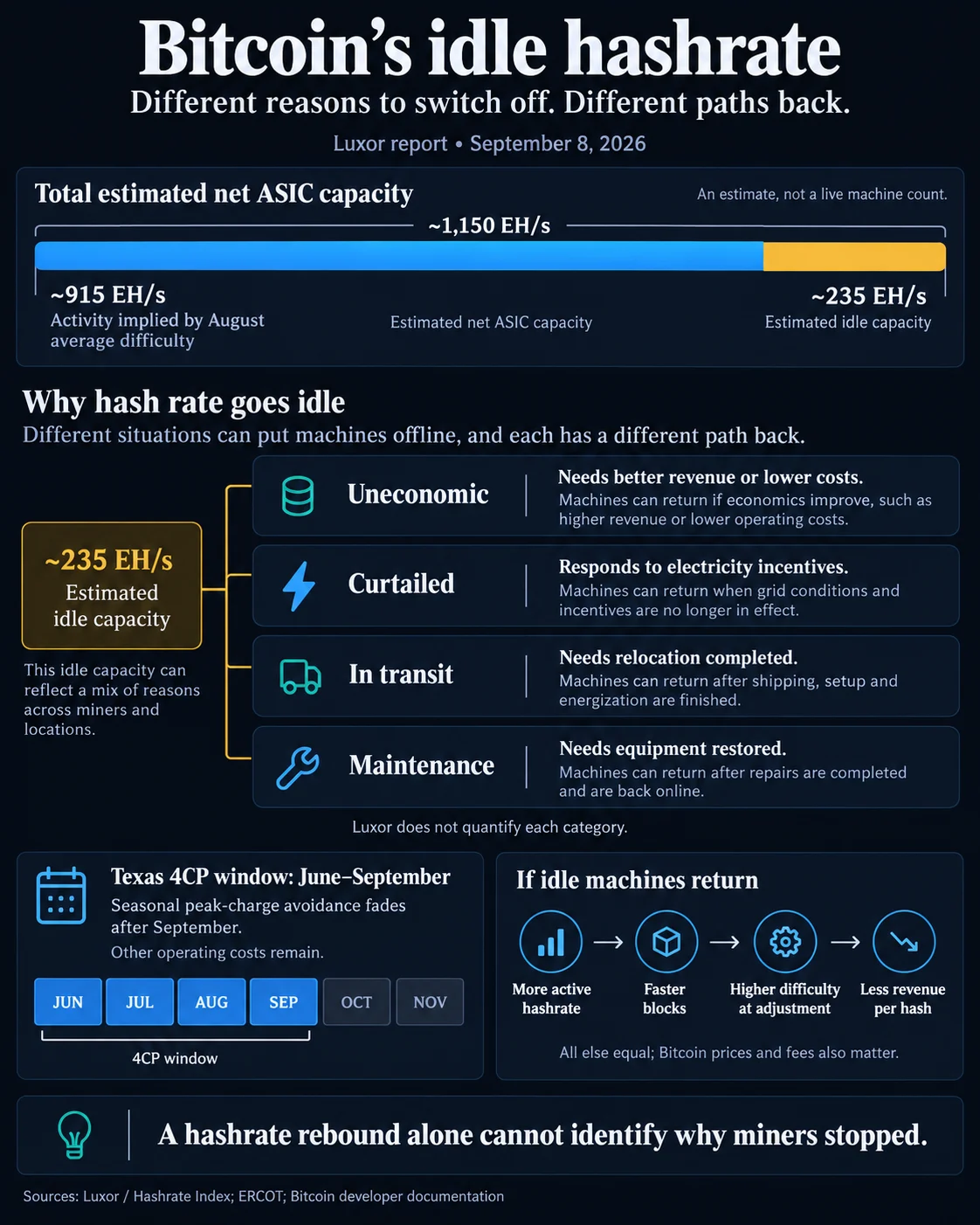
The global Bitcoin mining industry is currently navigating a complex period of transition, characterized by a significant discrepancy between total installed hardware capacity and actual network activity. According to a comprehensive report released on September 8 by mining services firm Luxor, an estimated 235 exahashes per second (EH/s) of specialized Bitcoin mining capacity is currently sitting idle. This figure represents a substantial portion of the global fleet, indicating that while the hardware exists and is physically present in data centers or warehouses, it is not actively contributing to the security or processing of the Bitcoin blockchain.
The idle capacity, which constitutes the gap between Luxor’s estimate of 1,150 EH/s in total net ASIC (Application-Specific Integrated Circuit) capacity and the 915 EH/s of activity implied by August’s average mining difficulty, highlights the multifaceted pressures facing operators. These pressures range from immediate economic unprofitability to strategic seasonal shutdowns and logistical delays. As the industry moves further into the second half of the year, the reactivation of this "dark" hashrate remains a pivotal variable for the network’s difficulty adjustments and the profit margins of active miners.
Categorizing the Sidelined Hashrate
Luxor’s analysis identifies several distinct categories for the 235 EH/s of inactive equipment. Understanding these categories is essential for interpreting whether a sudden surge in hashrate indicates a healthy market recovery or merely a seasonal shift.
The first category consists of uneconomic machines. These are typically older-generation miners, such as the Antminer S19 series or older MicroBT Whatsminers, which consume more electricity per unit of computing power than they generate in revenue at current Bitcoin prices and transaction fee levels. For these operators, the cost of power, cooling, and maintenance exceeds the value of the Bitcoin earned, leading to a rational decision to power down.
The second category is comprised of deliberately curtailed equipment. This is particularly prevalent in regions with sophisticated energy markets, most notably Texas. Miners in these jurisdictions often enter into "demand response" programs or power purchase agreements that incentivize them to shut down during periods of high grid stress or peak pricing. In these instances, the miner may actually generate more value by selling their contracted power back to the grid or avoiding high transmission fees than they would by mining Bitcoin.
The remaining idle capacity is attributed to machines in transit or under maintenance. This includes hardware being moved between facilities—often as miners seek out cheaper power jurisdictions—and machines undergoing repairs or firmware optimizations. Unlike uneconomic or curtailed machines, this capacity is expected to return to the network regardless of minor fluctuations in Bitcoin’s price, provided the underlying infrastructure is ready to receive them.
The August Revenue Rally and Hashprice Dynamics
The month of August provided a much-needed reprieve for the mining sector. Bitcoin’s price saw a notable increase of 24.5%, rising from $62,889 to $78,312 according to Luxor’s data set. This price appreciation directly translated into a recovery for "hashprice," a critical industry metric that measures the expected daily revenue a miner can expect from a specific unit of computing power (typically measured in dollars per petahash per second per day, or $/PH/s/day).
During August, the dollar-denominated hashprice rose 24.4%, climbing from $31.63 to $39.33. This improvement was significant because it pushed several "marginal" tiers of mining equipment closer to the break-even point. Specifically, Luxor’s data on fleet tiers consuming between 25 and 38 joules per terahash (J/TH) showed an average generation of approximately $45 per megawatt-hour (MWh) in August. While this was still slightly below the estimated network-average electricity cost of $48/MWh, the tier did exceed the benchmark on 11 separate days during the month.
The fact that blocks were found at an average rate of 9 minutes and 34 seconds in August—faster than the protocol’s 10-minute target—further indicates that hashrate was already beginning to creep back onto the network in response to better economics. This increased activity led to a 1.31% upward difficulty adjustment on September 5, a move that serves as a "margin headwind" by making it slightly more difficult for all miners to earn rewards.
The Texas Factor: Seasonal Curtailment and the 4CP Window
A significant driver of the current idle capacity is the seasonal behavior of miners operating within the Electric Reliability Council of Texas (ERCOT) grid. Texas has become a global hub for Bitcoin mining due to its deregulated energy market and abundance of renewable energy. However, the summer months in Texas present unique challenges in the form of Four Coincident Peaks (4CP).
The 4CP program is a method used by ERCOT to determine transmission cost allocations for large industrial users. The charges are based on a user’s average consumption during the single highest 15-minute load interval in each of the four summer months: June, July, August, and September. For Bitcoin miners, the financial penalty for being "on" during a 4CP event can be astronomical, often exceeding the total revenue generated by the machines for the entire month.

Consequently, many Texas-based miners implement aggressive curtailment strategies throughout the summer. As Luxor notes, the window for these peak-related transmission charges runs through the end of September. The conclusion of this window represents a clear seasonal boundary. As the threat of 4CP charges dissipates in October, a significant portion of the "curtailed" category of idle hashrate is expected to return to the network. This return is not necessarily a signal of improved Bitcoin fundamentals, but rather the conclusion of a seasonal risk-management cycle.
The "Margin Trap": Why Recovery is Self-Limiting
The return of idle hashrate creates a paradoxical environment for the mining industry. While a rising Bitcoin price encourages more machines to turn on, the decentralized nature of the network ensures that this recovery is, to some extent, self-limiting. This phenomenon is often referred to as a "margin trap."
Bitcoin’s difficulty adjustment algorithm is designed to ensure that blocks are found every 10 minutes on average, regardless of how much computing power is on the network. When idle machines return to the network, they increase the total hashrate, which causes blocks to be found faster. At the end of the 2,016-block cycle (roughly every two weeks), the network increases the difficulty to compensate.
If a large volume of the 235 EH/s currently sitting idle returns to the network simultaneously—either because of the end of the Texas summer or a sustained Bitcoin price rally—the resulting difficulty increase could be substantial. Historical data cited by Luxor shows that October difficulty has risen every year from 2022 through 2025 (projections), with an average monthly increase of roughly 10%.
For a miner who decides to turn their machines back on because the hashprice reached $39/PH/s, the subsequent increase in difficulty could quickly drive the hashprice back down toward $35/PH/s, assuming the Bitcoin price remains stagnant. This creates a scenario where only the most efficient operators—those with the lowest power costs and the newest hardware—can maintain sustainable margins.
The Emerging Influence of AI and High-Performance Computing
A new and increasingly influential factor in the Bitcoin mining equation is the reallocation of infrastructure toward Artificial Intelligence (AI) and High-Performance Computing (HPC). Over the past year, several major public mining companies have announced pivots or diversifications into hosting AI workloads, which often offer higher and more stable margins than Bitcoin mining.
This shift represents a structural constraint on the recovery of the Bitcoin hashrate. Some of the capacity that Luxor currently labels as "idle" or "maintenance" may, in fact, be in the process of being permanently decommissioned or repurposed for AI data centers. If a mining facility can earn more per kilowatt-hour by hosting Nvidia H100 GPUs than by running Bitmain Antminers, that power capacity may never return to the Bitcoin network.
The AI-related share of the 235 EH/s idle-capacity estimate remains unspecified, but its impact is undeniable. As AI demand continues to surge, the opportunity cost of mining Bitcoin increases. This suggests that the "bull case" for miners—where Bitcoin’s price rises faster than network difficulty—may be tempered by the fact that the most prime data center real estate is now being bid on by two different, multi-billion dollar industries.
Chronology of Recent and Upcoming Mining Milestones
To understand the current state of the market, it is helpful to look at the timeline of events that have shaped the current 235 EH/s gap:
- April 20, 2024: The fourth Bitcoin Halving occurs, reducing the block reward from 6.25 BTC to 3.125 BTC. This event immediately halves the revenue for all miners, forcing older, less efficient hardware into the "uneconomic" category.
- June – August 2024: Peak summer temperatures in the Northern Hemisphere, particularly in Texas, lead to frequent curtailment events as miners avoid high spot prices and 4CP transmission charges.
- August 2024: Bitcoin price rallies by over 24%, providing the first major post-halving boost to hashprice and allowing some mid-tier machines to operate profitably for short windows.
- September 5, 2024: The network difficulty increases by 1.31%, reflecting the absorption of some returning hashrate.
- September 30, 2024: The official end of the ERCOT 4CP window. This is widely viewed as the "starting gun" for curtailed Texas hashrate to return to full-time operation.
- October 2024 (Projected): Analysts expect a significant upward difficulty adjustment as seasonal capacity returns, potentially testing the profitability of miners who rely on marginal hashprice levels.
Broader Implications for the Network and Investors
The existence of 235 EH/s of idle capacity serves as a buffer for the Bitcoin network, but it also introduces volatility into the hashrate as a metric. For investors and analysts, a rising hashrate in the coming months should be viewed with caution. If the increase is driven primarily by the return of seasonal Texas capacity or the reactivation of marginal machines, it may lead to a sharp difficulty increase that compresses margins for the entire sector.
Furthermore, the "hashrate drought" and the subsequent slow recovery highlight the increasing professionalization of the industry. Mining is no longer just about finding the cheapest electricity; it is about sophisticated power trading, hardware lifecycle management, and, increasingly, competing with the global demand for AI compute.
For the miners themselves, the immediate future is a race for efficiency. Those operating with a fleet efficiency of sub-25 J/TH and secured power costs below $0.04/kWh remain well-positioned to weather the "margin trap." However, for those on the edge, the 235 EH/s of idle capacity represents a looming shadow—a reminder that in the world of Bitcoin mining, your competitors are always waiting for the right moment to turn the lights back on.