Dwi Wanna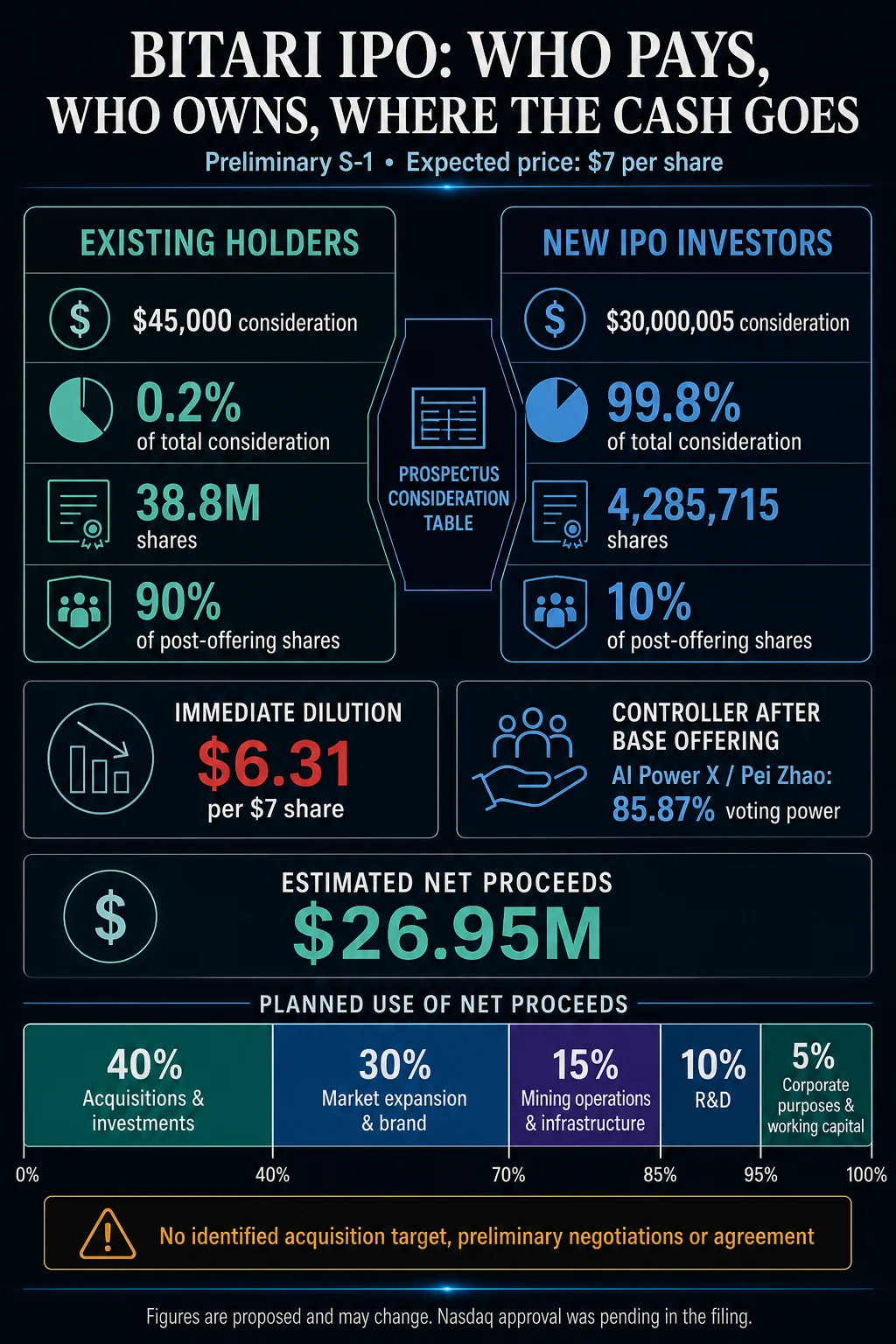
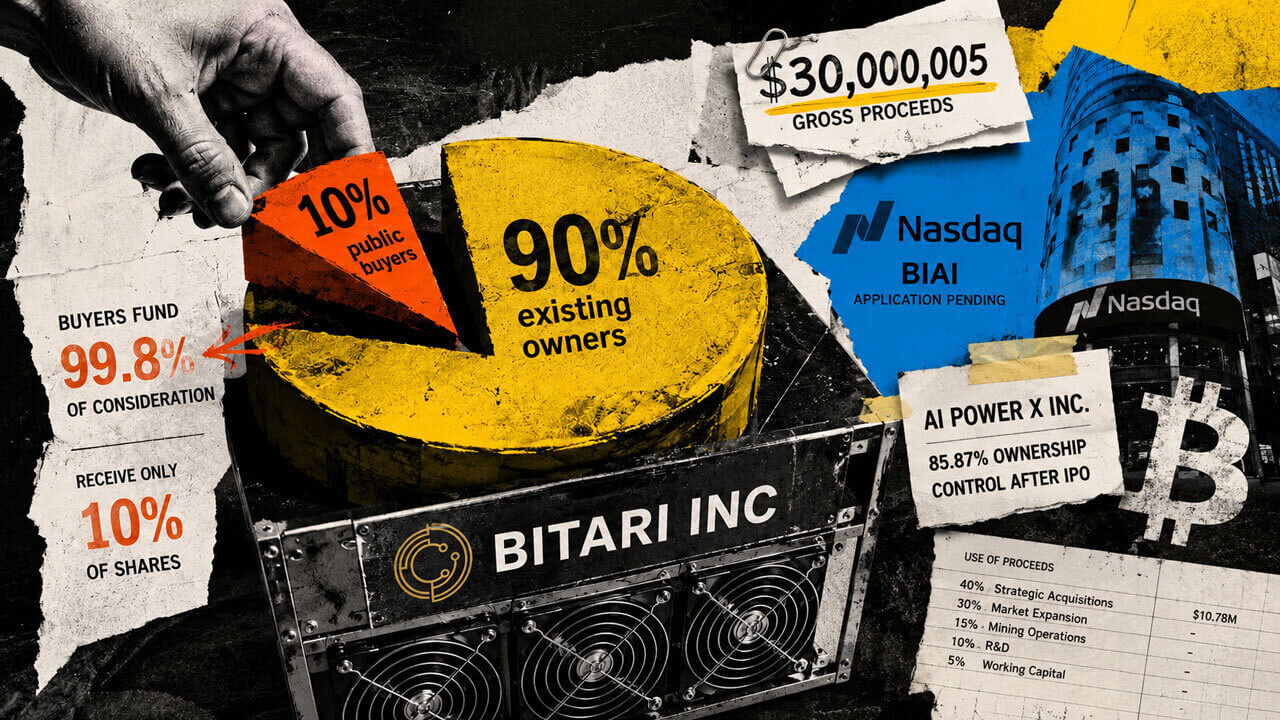
Bitari Inc., a specialized Bitcoin mining hosting provider, has filed a preliminary S-1 prospectus with the U.S. Securities and Exchange Commission (SEC) that outlines a highly atypical capital structure for its proposed initial public offering (IPO) on the Nasdaq Global Market. According to the filing, the company intends to raise approximately $30 million from public investors in exchange for a 10% ownership stake in the post-offering entity. This arrangement implies that while the public will provide nearly the entirety of the company’s fresh capital, existing shareholders—who contributed a fraction of that amount—will retain 90% of the equity and nearly total voting control.
The prospectus, filed under the reserved ticker symbol "BIAI," proposes the sale of 4,285,715 shares of common stock at an expected price of $7.00 per share. Upon the completion of the offering, Bitari expects to have 43,085,715 shares outstanding. The financial disparity highlighted in the filing’s "Consideration" table is stark: new public investors are expected to provide $30,000,005 (99.8% of the total consideration), while existing stockholders’ original investment is valued at just $45,000 (0.2% of the consideration).
Capital Structure and the Dilution Gap
The primary concern for prospective investors in the Bitari IPO is the immediate and significant dilution of value. Dilution in an IPO occurs when the price paid by the public for a share of stock is significantly higher than the net tangible book value per share immediately after the offering.
As of the current filing, Bitari’s net tangible book value is approximately $2.2 million, or roughly $0.06 per share. Following the successful completion of the $30 million raise (assuming net proceeds of roughly $26.95 million after underwriting discounts and offering expenses), the pro forma net tangible book value would rise to $0.69 per share. For a public investor purchasing a share at the $7.00 IPO price, this represents an immediate dilution of $6.31 per share.
In professional financial analysis, such a gap suggests that the valuation is predicated almost entirely on future growth prospects and the "control premium" retained by the founders, rather than existing physical assets or historical earnings. While high dilution is not uncommon in tech startups or speculative biotech firms, the ratio in the Bitari filing is particularly pronounced for a company operating in the capital-intensive Bitcoin mining hosting sector.
Governance and Voting Power: The "Controlled Company" Status
Beyond the financial dilution, the Bitari IPO is structured to ensure that existing management retains absolute authority over the firm’s direction. The filing identifies AI Power X Inc. as the majority shareholder, which will hold 85.87% of the outstanding stock following the base offering.
The beneficial owner of AI Power X Inc. is Pei Zhao, the Chair of Bitari Inc. With nearly 86% of the voting power concentrated in a single entity, Bitari will qualify as a "controlled company" under Nasdaq listing rules. This designation is significant because it exempts the company from certain corporate governance requirements, such as the mandate that a majority of the board of directors be independent or that the compensation and nominating committees be composed entirely of independent directors.
For minority shareholders, this structure means they will have virtually no influence over corporate elections, executive compensation, or major strategic pivots. In the context of the volatile cryptocurrency industry, where rapid shifts in strategy are common, this concentration of power places a high degree of reliance on the vision and execution of Pei Zhao.
Allocation of Proceeds and the "Blind Pool" Component
Bitari has outlined a specific but largely discretionary plan for the $26.95 million in estimated net proceeds. The largest single allocation—40%, or approximately $10.78 million—is earmarked for "strategic acquisitions and investments."
Critically, the company noted in its S-1 that it has not yet identified any specific targets for acquisition, nor has it entered into preliminary negotiations or signed any definitive agreements. In financial terms, this creates a "blind pool" element within the IPO. Investors are essentially providing the company with a discretionary fund to shop for other businesses or technologies without knowing the nature of those assets or the price that will be paid for them.
The remaining proceeds are allocated as follows:
- 30% ($8.09 million): Global market expansion and brand development.
- 15% ($4.04 million): New mining operations and infrastructure.
- 10% ($2.70 million): Research and development (R&D).
- 5% ($1.35 million): General corporate purposes and working capital.
The focus on "brand development" and "global expansion" over direct mining infrastructure (which receives only 15%) suggests that Bitari views its future more as a service and hosting platform rather than a direct owner of massive amounts of hashing power.
Financial Performance and Operational Headwinds
The IPO comes at a time when Bitari’s financial metrics show signs of contraction. For the nine-month period ending April 30, 2026 (as cited in the preliminary data), the company reported a revenue slip to $8.37 million, down from $8.59 million during the same period the previous year.
More concerning for value investors is the sharp decline in profitability. Net income for the nine-month period plummeted from $990,960 in the prior year to just $183,905—a decrease of more than 81%. Furthermore, the company’s cash flow from operations turned negative, using $689,760 of cash compared to a positive generation of $1.37 million in the year-ago period.
These figures suggest that Bitari is facing rising operational costs or narrowing margins, a common trend in the Bitcoin mining sector following "halving" events which reduce the rewards for mining blocks. By going public now, Bitari appears to be seeking a capital infusion to stabilize its balance sheet and pivot toward an acquisition-led growth strategy.

Contextualizing Bitari in the Bitcoin Mining Landscape
The Bitcoin mining industry has undergone a massive transformation since 2023. What was once a niche sector dominated by hobbyists and private firms is now a major segment of the public equity markets, featuring giants like Marathon Digital Holdings (MARA), Riot Platforms (RIOT), and CleanSpark (CLSK).
However, the "hosting" model employed by Bitari is distinct from "self-mining." As a host, Bitari provides the power, cooling, and physical space for other entities to run their machines. This model is generally considered lower-risk than self-mining because it generates steady service fees, but it also offers less "upside" during Bitcoin price surges.
Recently, many mining hosts have rebranded as "AI infrastructure" providers, leveraging their high-density power access to host GPU clusters for artificial intelligence training. Bitari’s choice of the ticker "BIAI" and the name of its majority owner, "AI Power X Inc.," suggests the company intends to market itself within this high-growth AI narrative, potentially to justify the high valuation and dilution levels presented in the S-1.
Industry Reactions and Market Sentiment
While Bitari has not issued a formal press release responding to the criticism of its equity split, industry analysts have noted that such structures are becoming more common among "micro-cap" IPOs in the crypto space. Financial consultants often point out that founders who have bootstrapped a company through the "crypto winter" feel entitled to retain the lion’s share of equity, viewing the IPO as a way to fund expansion without giving up control.
However, institutional investors typically shy away from deals where the "public-to-insider" contribution ratio is so lopsided. "When you see 99% of the cash coming from the public for 10% of the company, it raises red flags regarding the alignment of interests," says one veteran IPO researcher. "If the company succeeds, the insiders get 90% of the gains. If it fails, the public loses 100% of the capital."
Timeline and Next Steps
The Bitari IPO is currently in the "preliminary" stage. The S-1 filing is a declaration of intent, but several hurdles remain before shares begin trading on the Nasdaq:
- SEC Review: The SEC will likely issue "comment letters" questioning the valuation, the dilution, and the specifics of the acquisition fund. Bitari will need to file amended S-1s to address these concerns.
- Nasdaq Approval: While Bitari has applied for listing and reserved the BIAI symbol, the Nasdaq Global Market has not yet approved the application. The exchange has strict requirements regarding the number of round-lot shareholders and the minimum bid price.
- Roadshow: Management will typically meet with institutional investors to "pitch" the $7.00 price point. If demand is low, the company may be forced to lower the price or increase the equity percentage offered to the public.
- Effective Date: Once the SEC is satisfied and the exchange approves the listing, the registration statement will be declared "effective," and a firm date for the IPO will be set.
Conclusion: A High-Stakes Bet on Management
The proposed Bitari IPO represents a significant test of investor appetite for Bitcoin-related infrastructure. Prospective buyers are being asked to overlook massive immediate dilution and a lack of voting power in exchange for a stake in a company that is transitioning toward an undefined acquisition strategy.
For Bitari, the successful execution of this IPO would provide a war chest of nearly $27 million, allowing it to scale its operations or pivot into the AI hosting space. For the public, however, the deal structure places the entirety of the financial risk on their shoulders while reserving the vast majority of the equity-based rewards for the existing insiders. As the filing moves through the regulatory process, the market will be watching to see if Bitari maintains these aggressive terms or if the realities of investor demand force a more equitable redistribution of shares.