admin
admin
Bitcoin (BTC) market participants are exhibiting a notable increase in absorption capacity at the crucial $65,000 price level, a development coinciding with Binance, the world’s largest cryptocurrency exchange by trading volume, experiencing its most significant net outflow of BTC in approximately two years. This substantial movement of Bitcoin off the exchange, totaling over 9,000 BTC in a single day, has garnered considerable attention from on-chain analysts and market observers, prompting discussions about its potential implications for short-term supply dynamics and broader market sentiment.
The substantial withdrawal, which occurred on Tuesday, June 25, 2024, saw a net 9,030 BTC depart Binance, marking the largest single-day net outflow since a period approximately two years prior. While the original source cited "November 2024" as the last comparable event, this is understood to be a typographical error, as November 2024 is in the future. Market analysts interpret "nearly two years" as referencing an event around November 2022, a period characterized by heightened market volatility and significant shifts in investor behavior following major industry events. Such large-scale movements of assets off exchanges typically signal a preference for self-custody among holders, implying a reduced immediate intention to sell these assets on the open market. This phenomenon is critical for understanding the evolving supply-demand dynamics of Bitcoin.
Unpacking the Binance Outflow: A Deep Dive into On-Chain Metrics
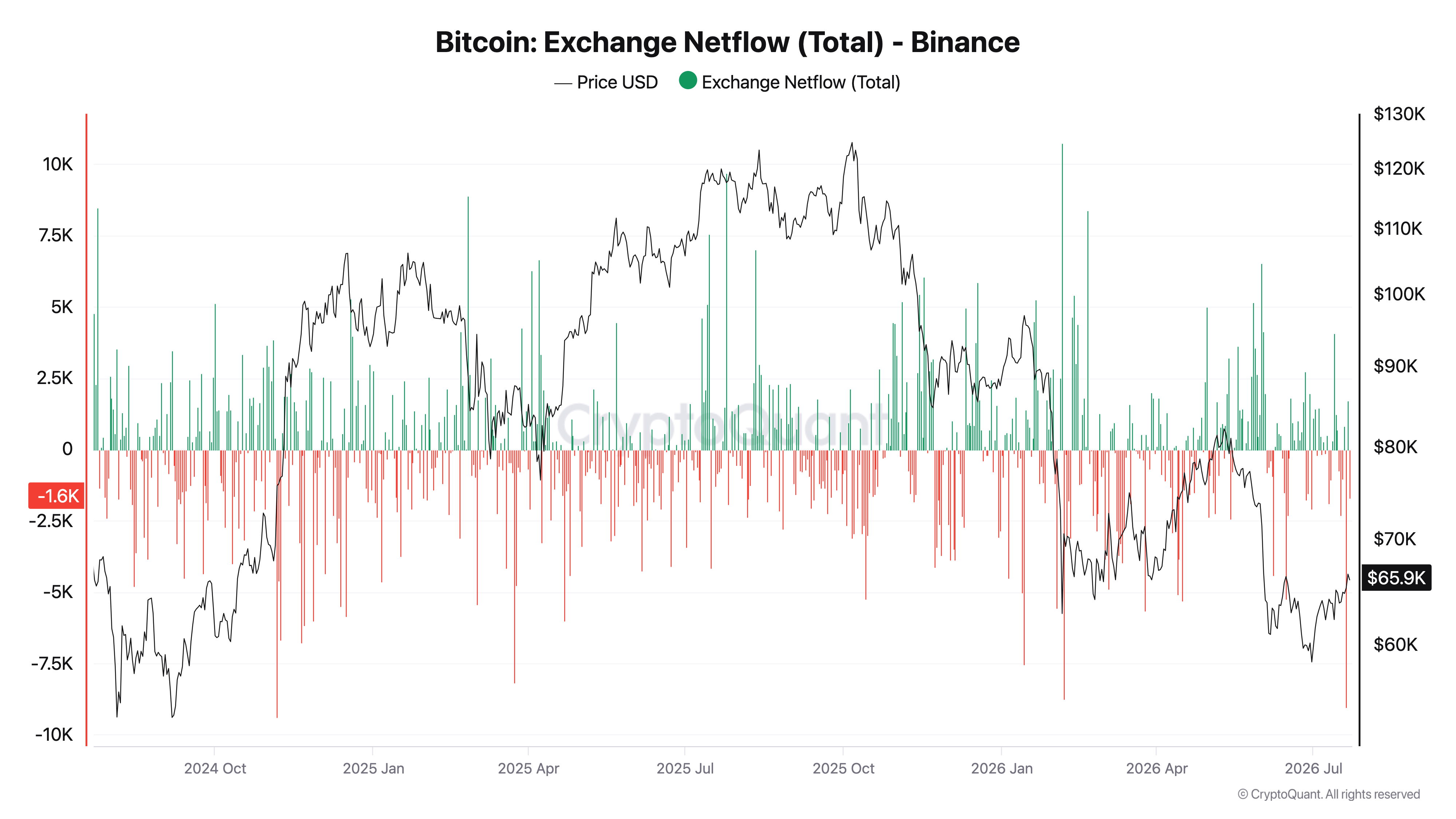
New research from the prominent on-chain analytics platform CryptoQuant, released on Wednesday, provided granular details regarding Binance’s netflows. The analysis confirmed a trend where daily BTC withdrawals from the exchange have begun to consistently outpace inflows. This shift represents a departure from a preceding period earlier in June, which saw a string of net positive inflow days.
Rei Researcher, a contributor to CryptoQuant, articulated the immediate implication of this trend: "This usually reflects that short-term supply pressure on Binance is easing to some extent, as $BTC is not being sent to the exchange aggressively for potential selling." The logic behind this assessment is straightforward: when Bitcoin is held on an exchange, it is readily available to be sold into the order book, contributing to potential downward price pressure. Conversely, when Bitcoin is withdrawn to personal wallets, often referred to as self-custody, it is removed from the immediate selling supply of the exchange, thereby alleviating some of that pressure.

The CryptoQuant data illustrates a fluctuating pattern in Binance’s daily netflows, toggling between positive and negative readings throughout June. However, the magnitude of Tuesday’s outflow dramatically stands out. The precise figure of 9,030 BTC removed from Binance represents a significant capital allocation decision by one or more large entities. To put this into perspective, at a price point of $65,000 per BTC, this outflow translates to approximately $587 million worth of Bitcoin.
Another CryptoQuant contributor, Ruga Research, underscored the importance of such substantial movements in a separate post. Ruga noted, "When outflows hit this size, someone is moving serious volume into self-custody. Coins off exchanges are coins that won’t be sold into the order book." This statement reinforces the prevailing market interpretation that large outflows are generally bullish or, at the very least, indicative of a reduction in potential selling pressure. Investors opting for self-custody are typically long-term holders or institutions that prefer to store their assets in private wallets, signaling a conviction in Bitcoin’s future value rather than an intent for short-term trading or liquidation.
Historical Context and Market Momentum
Analyzing exchange netflows in isolation can sometimes be misleading, thus it’s crucial to contextualize these movements within broader market trends and historical precedents. Historically, significant net outflows from major exchanges have often preceded periods of price appreciation or at least marked local bottoms, as the reduction in available supply on exchanges can create a supply shock if demand remains constant or increases.
Ruga Research further elaborated on the recurring nature of these fluctuations, observing that on rolling 30-day time frames, netflows often repeat patterns of oscillation. While acknowledging the potential for reversals in momentum, Ruga highlighted the historical significance of the current combination of factors. "Can this one fail? Absolutely. Momentum has been indecisive around the zero line for two weeks. It hasn’t committed. And what happens next, honestly, nobody knows," Ruga conceded, referring to the mixed daily inflow and outflow data. However, he concluded with a more optimistic note: "But someone just moved 9,030 BTC off the largest exchange while momentum recovers from extreme negative territory. That combination has historically resolved to the upside." This suggests that while immediate future movements remain uncertain, the confluence of a massive outflow and recovering momentum often portends a positive price trajectory based on past performance.
The Nuance of "Better Absorption" vs. a New Uptrend
Despite the positive implications often associated with large outflows, analysts are careful to temper expectations regarding an immediate and sustained uptrend. Rei Researcher explicitly cautioned against automatically assuming a major BTC price trend change solely based on these exchange flow dynamics.
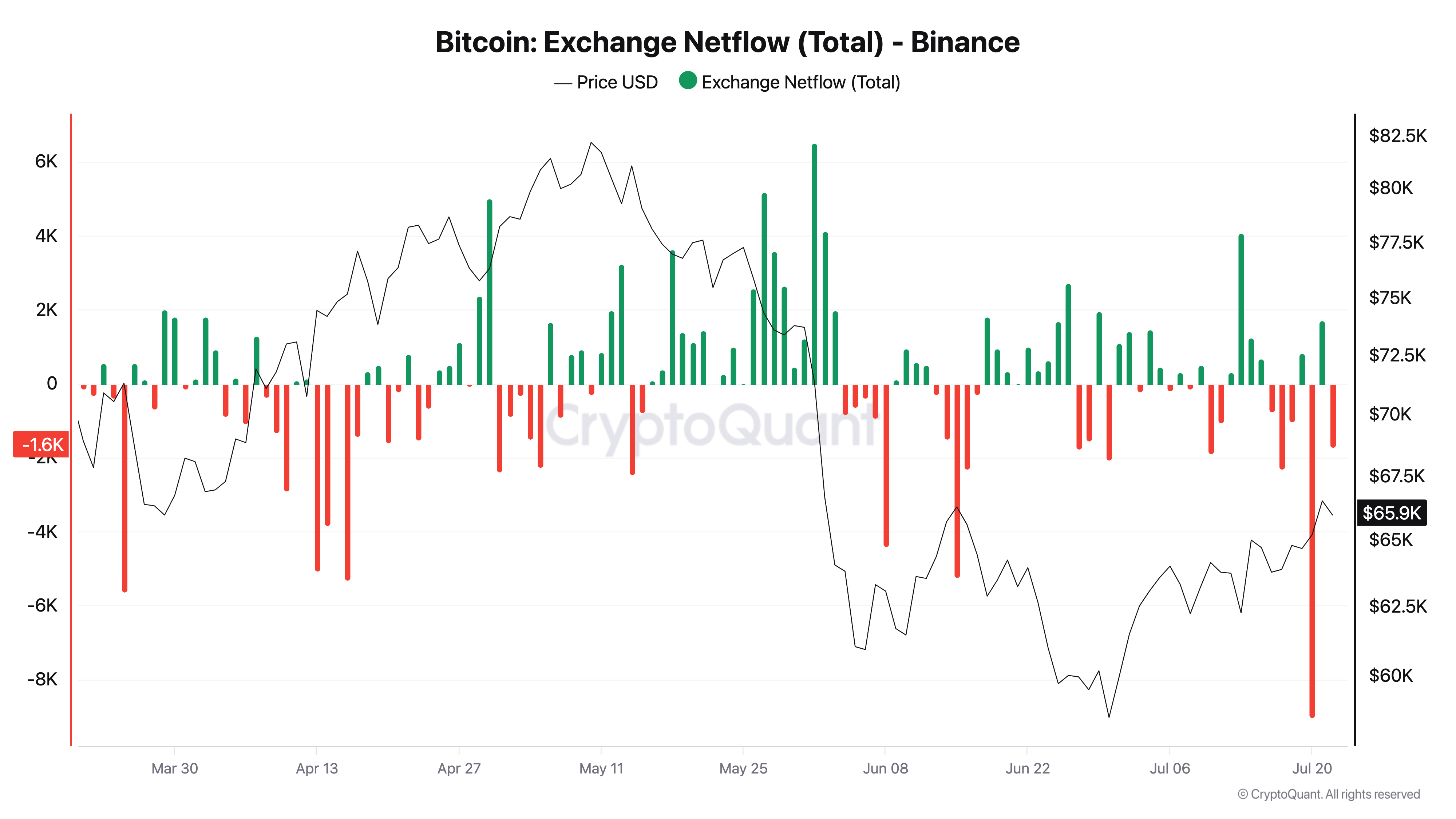
"The notable point is that negative netflow is appearing while $BTC price has recovered to around $65K–$66K. This suggests that the market is showing better absorption compared to the previous weak phase," Rei Researcher explained. The concept of "better absorption" implies that when selling pressure emerges, there is sufficient buying interest at the current price level to soak up the available supply without a significant price decline. This indicates underlying strength in demand, even if it’s not aggressive enough to drive prices dramatically higher. It suggests that the $65,000 psychological and technical level is finding robust support.
However, Rei Researcher emphasized a critical caveat: "However, negative netflow does not automatically confirm a new uptrend. It needs to be accompanied by spot demand, volume, and a more stable price structure." This highlights the complexity of market analysis, where multiple indicators must align to confirm a sustained trend reversal or continuation. While the reduction in potential selling supply from Binance is a positive sign, a robust uptrend requires broader market participation, particularly in the spot market, where actual assets are exchanged. High trading volumes confirm conviction, and a stable price structure indicates consolidation and strength rather than speculative volatility.
Broader Market Context: Spot ETFs and Derivatives Dynamics
The current market environment for Bitcoin is multifaceted, with various factors influencing its price action. The consensus among many analysts is that a full bull-market rebound has been somewhat hindered by a persistent lack of sufficient spot demand. This is a critical distinction, as demand can manifest in different forms.
The introduction of US spot Bitcoin Exchange-Traded Funds (ETFs) earlier this year was a landmark event, opening up Bitcoin exposure to a wider range of institutional and retail investors through traditional financial vehicles. Initially, these ETFs saw substantial inflows, driving Bitcoin to new all-time highs. However, in recent weeks, net inflows into these ETFs have fluctuated, at times even turning negative, suggesting a cooling of institutional appetite or profit-taking. As reported by Farside Investors, net flows into US spot Bitcoin ETFs have shown mixed signals, indicating that while institutional interest remains, it is not consistently aggressive enough to propel Bitcoin significantly higher on its own.
In contrast, the derivatives market, encompassing futures and options, has shown a relatively stronger turnaround compared to recent months. Increased activity and open interest in derivatives can signal growing speculative interest and leverage in the market. While derivatives can offer price discovery and liquidity, they also introduce higher volatility and are often viewed as less stable indicators of underlying asset demand compared to direct spot purchases. The divergence between derivatives market activity and the more subdued spot demand underscores the current market’s nuanced state: there’s engagement, but perhaps not the broad-based, high-conviction buying needed for a sustained parabolic rally.
The Path Forward: Supply Dynamics, Demand, and Macroeconomic Headwinds
The recent Binance outflow, while significant, is just one piece of a larger puzzle. The Bitcoin market operates under the influence of several macro and microeconomic factors. The halving event in April 2024, which reduced the supply of new Bitcoin entering the market, was a fundamental bullish catalyst. However, its full effects are often observed over several months as the supply shock plays out.
Macroeconomic conditions also cast a long shadow over the cryptocurrency market. Factors such as global inflation rates, central bank monetary policies (particularly interest rate decisions by the U.S. Federal Reserve), and geopolitical stability can significantly impact investor risk appetite. High interest rates, for instance, tend to make riskier assets like Bitcoin less attractive compared to safer, yield-bearing investments.
The current situation suggests a market in transition. The "better absorption" at $65,000, supported by large outflows indicating a move towards self-custody and reduced selling pressure, paints a picture of underlying resilience. It implies that a significant portion of holders believes in Bitcoin’s long-term value and is willing to accumulate or hold through periods of price consolidation. However, for Bitcoin to break decisively out of its current range and establish a new uptrend, it will likely require a resurgence of strong, sustained spot demand, particularly from institutional investors through ETFs, coupled with a clearer macroeconomic outlook that favors risk-on assets.
In conclusion, the substantial net outflow from Binance is a noteworthy on-chain event, suggesting a positive shift in short-term supply dynamics by reducing immediate selling pressure. While it indicates an improved capacity for the market to absorb selling at the $65,000 price level, analysts remain cautious about declaring a new uptrend without further confirmation from broad-based spot demand and sustained positive volume. The interplay between on-chain movements, institutional flows, and macroeconomic factors will continue to shape Bitcoin’s trajectory in the coming weeks and months, demanding careful observation from investors and market participants alike.