Dwi Wanna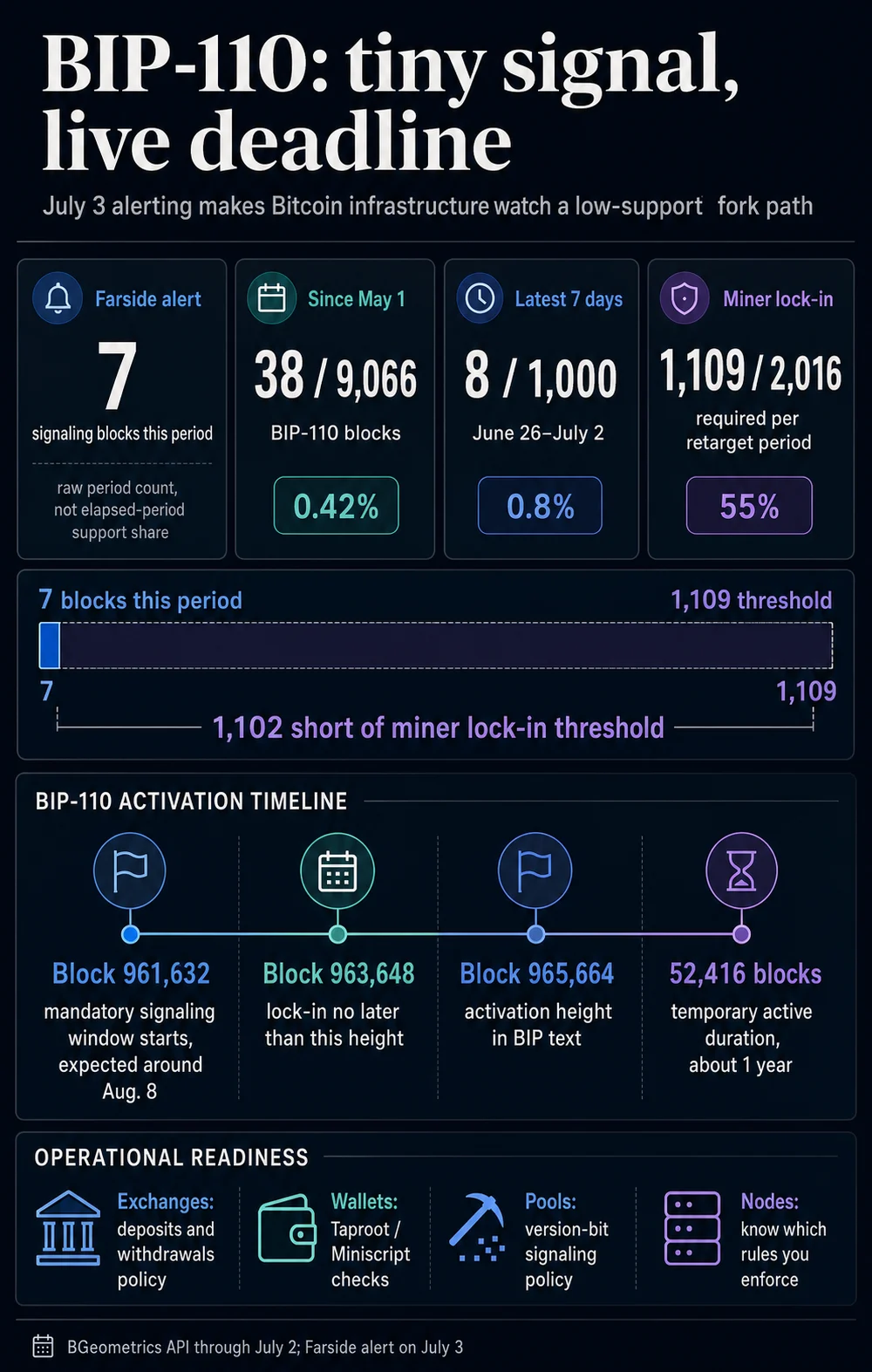
Farside Investors has launched a new BIP-110 signaling alert system that has effectively placed Bitcoin’s long-standing arbitrary-data dispute on a firm chronological deadline, compelling exchanges, wallet providers, miners, and node operators to accelerate their operational planning for a critical August window. Despite the current lack of widespread miner support, the activation design of Bitcoin Improvement Proposal 110 (BIP-110) ensures that the network faces a mandatory signaling period, transitioning the debate from the realm of developer forums into the practical sphere of infrastructure management.
On July 3, Farside Investors reported a new BIP-110 signaling block, noting that seven such blocks had been produced within the current retarget period. According to Farside’s technical documentation, their X (formerly Twitter) account is now configured to post automated updates every time a block is mined that signals support for the proposal. This public transparency brings a new level of scrutiny to a proposal that seeks to fundamentally alter how the Bitcoin network handles non-financial data.
Understanding the Technical Impetus Behind BIP-110
BIP-110, often referred to in technical circles as the "reduced_data" proposal, is a response to the proliferation of arbitrary data on the Bitcoin blockchain. Over the past two years, the emergence of protocols such as Ordinals and BRC-20 tokens has sparked an intense debate within the community regarding "blockchain bloat" and the definition of "spam." Proponents of BIP-110 argue that the primary purpose of Bitcoin is to serve as a peer-to-peer electronic cash system and a store of value, and that the use of the blockchain for inscriptions and other forms of arbitrary data storage threatens the long-term decentralization of the network by increasing the costs of running a full node.
The proposal utilizes version bit 4 to allow miners to signal their support. If activated, the rules would introduce stricter limits on the types of data that can be included in Bitcoin transactions, effectively curtailing the current methods used by Ordinals and similar protocols to embed data in the "witness" portion of a transaction.
Statistical Breakdown of Current Miner Signaling
Data retrieved on July 3 from BGeometrics’ daily API provides a granular look at the current levels of support for BIP-110. From May 1 through July 2, the network recorded only 38 signaling blocks out of a total of 9,066 blocks produced. This represents a support level of a mere 0.42%. Even when focusing on the most recent seven-day window—from June 26 through July 2—the numbers remain remarkably low, with only 8 signaling blocks out of 1,000, or 0.8%.
Daily fluctuations offer little indication of a massive shift in sentiment. On July 1, only one signaling block was recorded out of 143 (0.70%), and on July 2, the count rose slightly to two blocks out of 131 (1.53%). These figures stand in stark contrast to the 55% threshold required for miner-driven lock-in. To achieve lock-in during a standard 2,016-block difficulty adjustment period, 1,109 blocks must signal support. At current rates, the network is missing this target by over a thousand blocks per period.
BGeometrics noted in a June 10 background report that the initial signaling activity, which began around May 21, appeared consistent with individual miners or smaller, independent mining operations rather than a coordinated effort by major mining pools. The report specifically highlighted that without the participation of "kingmaker" pools like Foundry USA or Antpool, the signaling remains a symbolic gesture rather than a viable path to activation.
The August Mandatory Signaling Window
The primary reason for the heightened sense of urgency among infrastructure providers is the specific activation path defined in the BIP-110 text. Unlike a traditional "Speedy Trial" activation, BIP-110 includes a mandatory-signaling fallback mechanism. The proposal defines a critical window between block heights 961,632 and 963,647.
During this window, which is projected to occur in August, the proposal mandates that all blocks must signal support for bit 4. According to the BIP text, any block that fails to signal during this specific period will be rejected as invalid by nodes enforcing the BIP-110 rules. This creates a potential for a chain split: if a significant portion of the network’s hash power continues to mine non-signaling blocks while a significant portion of the network’s economic nodes enforces the new rules, two separate versions of the Bitcoin blockchain could emerge.

Following the mandatory signaling window, the BIP specifies that lock-in occurs no later than height 963,648, with full activation taking place one retarget period later at height 965,664. Once active, the restrictions would remain in place for a duration of 52,416 blocks—approximately one year—before the rules expire.
Operational Risks for Exchanges and Wallets
For cryptocurrency exchanges and custodial services, a contentious soft fork represents a significant operational risk. If a chain split occurs, exchanges must decide which version of the chain to recognize as "Bitcoin." This requires the implementation of complex deposit and withdrawal policies, increased confirmation requirements to guard against reorganization (reorg) attacks, and clear communication with customers regarding the safety of their assets.
Wallet developers face a different set of challenges. The BIP-110 text acknowledges that the proposal could interact negatively with advanced Bitcoin scripting tools. Specifically, it notes that the Miniscript compiler would require updates to remain compatible with the new data restrictions. In extreme and unlikely scenarios, the BIP text even admits that certain complex scripts could result in funds being temporarily frozen or lost if the rules are applied without proper software adjustments. Consequently, wallet teams must conduct thorough compatibility checks for Taproot and Miniscript implementations to ensure user funds remain accessible under any activation outcome.
The Role of Node Operators and Mining Pools
Node operators sit at the center of this dispute. The strength of a "User Activated Soft Fork" (UASF) style path depends on the number of economic nodes—those run by exchanges, payment processors, and large holders—that choose to enforce the rules. If node operators do not update their software to enforce BIP-110, the mandatory signaling window will pass without effect. However, if a critical mass of nodes adopts the software, miners will be forced to comply or risk having their blocks rejected, leading to a loss of block rewards and transaction fees.
Mining pools, meanwhile, must weigh the political pressure of the "anti-spam" movement against the economic reality of transaction fees. Ordinals and BRC-20 transactions have significantly increased the fee revenue for miners over the past year. By signaling for BIP-110, pools would essentially be voting to reduce their own income. This economic misalignment is likely the primary reason for the current sub-1% signaling rate.
Historical Context and Broader Implications
The current situation surrounding BIP-110 mirrors the "Block Size War" of 2017, where the Bitcoin community was split over how to scale the network. That conflict eventually led to the activation of SegWit via a UASF (BIP-148) and the creation of the Bitcoin Cash fork. The BIP-110 dispute represents a new chapter in this ongoing struggle over Bitcoin’s soul: is it a rigid, minimal protocol for money, or a flexible platform for various types of data?
The introduction of live public alerting by Farside Investors shifts the dynamic of this struggle. By providing a real-time record of signaling, Farside has moved the conversation from theoretical "what-if" scenarios into a data-driven monitoring phase. Infrastructure teams no longer have the luxury of ignoring the proposal as a fringe idea; they must now monitor the signaling thresholds as part of their standard risk management procedures.
If signaling remains at its current negligible levels as the August window approaches, the risk of a successful activation remains low. However, the "tail risk" of a sudden shift by a major mining pool or a sudden surge in node adoption means that readiness costs are rising for everyone involved in the Bitcoin ecosystem.
Conclusion and Outlook
As the Bitcoin network approaches the 960,000 block height mark, the BIP-110 signaling data will be the most watched metric in the industry. While the numbers currently point to a weak activation campaign, the rigid calendar of the proposal’s design ensures that the tension will peak in August.
The next few weeks will be telling. If major mining pools like Foundry USA or Antpool continue to remain silent, BIP-110 may join the list of failed proposals that couldn’t achieve consensus. However, if even one major pool begins to signal bit 4, the path to the 1,109-block threshold becomes much more plausible, and the possibility of a contentious network event becomes a primary market concern. For now, the Bitcoin infrastructure community is on high alert, watching the Farside feed and the BGeometrics API for any sign of a shift in the status quo.