admin
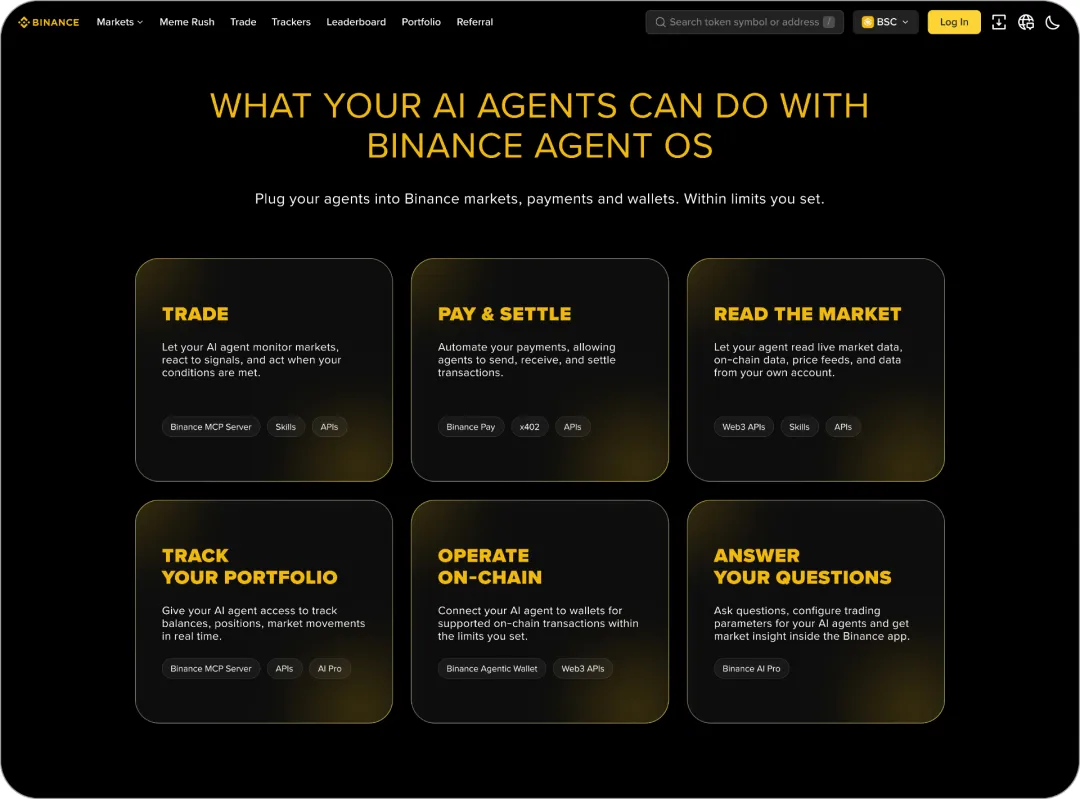
Binance, the world’s largest cryptocurrency exchange by trading volume, has officially entered the era of autonomous finance with the launch of Agent OS, a specialized platform designed to allow artificial intelligence agents to analyze market data and execute trades on behalf of users. The platform, unveiled on Thursday, represents a significant shift in the cryptocurrency ecosystem, moving beyond simple automated trading bots toward sophisticated, LLM-driven (Large Language Model) agents capable of managing real-world assets within a structured financial environment. By integrating its vast financial infrastructure with the latest advancements in generative AI, Binance aims to provide its more than 300 million registered users with tools that can autonomously navigate the complexities of the digital asset markets.
The Architecture of Agent OS and Developer Integration
At its core, Agent OS is a bridge between the decentralized world of crypto and the rapidly evolving field of artificial intelligence. The platform is designed specifically for developers, providing them with a suite of tools to connect AI applications directly to Binance’s liquidity and execution engines. This integration is made possible through a combination of existing and newly developed technologies, including the Binance Wallet Agentic Hub, the Binance Skill Hub, and various proprietary APIs.
One of the most notable technical additions is support for the Model Context Protocol (MCP). Developed as an open standard, MCP allows AI models to seamlessly connect to external data sources and tools. By adopting this protocol, Binance ensures that Agent OS is compatible with industry-leading AI tools, such as OpenAI’s ChatGPT and Codex, Anthropic’s Claude Code, and the AI-powered code editor Cursor. This compatibility allows developers to build agents that can not only read market data but also interpret account information and execute high-frequency or long-term trading strategies with minimal human intervention.
The platform also integrates the Binance x402 transaction verification system and payment facilitator API. This specific infrastructure allows AI agents to handle the logistical aspects of finance, such as settling payments and verifying transactions on-chain, effectively turning a software agent into a functional economic actor.
Security Framework: The Subaccount Sandbox Model
As the industry moves from "chatbots" that simply answer questions to "agents" that take actions, the risks associated with automation have increased exponentially. To mitigate these risks, Binance has implemented a security framework centered on user-controlled "subaccounts." Jeff Li, Vice President of Product at Binance, emphasized in a recent briefing that the platform is designed to keep the ultimate authority in the hands of the human user.
"Instead of total freedom, we put the power in users’ hands to give them the granular access control of what they can do through the agent," Li stated. "We put the control at the account level to protect the users’ funds."
Under this model, users do not grant an AI agent access to their entire portfolio. Instead, they create dedicated subaccounts that act as a "sandbox." These subaccounts can be restricted to specific activities, such as spot trading or futures contracts, while withdrawals are blocked by default. This ensures that even if an agent malfunctions or is compromised, the potential damage is limited to the assets specifically allocated to that subaccount. Furthermore, users can toggle between "manual approval" mode—where the agent must ask for permission before every trade—and "autonomous" mode, where the agent operates freely within its predefined limits.
Financial Limits and Operational Capabilities
While Binance does not impose a global cap on how much an AI agent can trade or lose within a subaccount—leaving that decision to the user’s funding choices—it has established strict daily limits for other financial activities. These limits are particularly relevant for the Agentic Wallet, which allows agents to interact with decentralized finance (DeFi) protocols and execute token swaps.
According to Binance’s official documentation, the following limits apply at launch:
- Token Swaps: Capped at $50,000 per day.
- DeFi Transactions: Default limit of $100,000 per day.
- x402 Payments: Limited to a conservative $20 per day.
These tiered limits reflect the experimental nature of autonomous agents in finance. While trading within the exchange’s internal ecosystem is relatively controlled, interactions with external DeFi protocols and real-world payment systems carry higher risks of smart contract vulnerabilities or external manipulation, necessitating stricter guardrails.
The Challenge of AI Transparency and Prompt Injection
A significant point of concern for industry analysts is the "black box" nature of AI decision-making. During the platform’s unveiling, Jeff Li acknowledged that Binance cannot see the underlying reasoning that leads an agent to make a specific trade. Because the processing occurs either on the user’s local hardware or within the infrastructure of an AI provider like OpenAI or Anthropic, Binance only sees the resulting API call to execute a trade.
"We really cannot see the reasoning of what the user’s action is," Li remarked. This lack of visibility means that if an agent is influenced by faulty data, "hallucinations," or a prompt-injection attack—where a malicious actor tricks the AI into performing unauthorized actions through cleverly worded inputs—Binance’s internal systems would be unable to detect the motive.
To counter this, the exchange relies on its existing security, risk-control, and anti-money-laundering (AML) policies. Every transaction executed by an agent is still subject to the same scrutiny as a human-initiated trade, ensuring that the platform remains compliant with global financial regulations.
A Chronology of AI Integration in the Crypto Sector
The launch of Agent OS does not happen in a vacuum. It is the latest move in a broader trend of "Agentic Finance" that has seen major exchanges racing to integrate LLM capabilities.
- March 2024: Kraken launched an open-source command-line tool with a built-in MCP server, allowing developers to script AI agents for spot and futures trading.
- June 2024: Coinbase introduced "Coinbase for Agents," a platform specifically designed to give AI agents "wallets" and the ability to perform financial workflows, such as paying for their own cloud computing costs or trading assets.
- Late 2024: OKX released its "Agent Trade Kit," an open-source toolkit leveraging the Model Context Protocol to facilitate autonomous trading.
Binance’s entry into this space is significant due to its massive user base and deep liquidity. While its competitors have focused on developer-centric tools, Binance is positioning Agent OS as a foundational layer that could eventually serve both retail and institutional clients.

Market Context and Data-Driven Insights
The intersection of AI and blockchain technology has become one of the most dominant narratives in the 2024 crypto market. According to market data from CoinGecko, the total market capitalization of AI-related cryptocurrencies surged in the first half of the year, reflecting investor interest in decentralized compute and AI-agent ecosystems.
Industry analysts suggest that the move toward agent-based trading is a natural evolution of algorithmic trading. Traditionally, "algo-trading" required deep programming knowledge and rigid rule sets. AI agents, however, can process unstructured data—such as news headlines, social media sentiment, and complex whitepapers—to make qualitative judgments that were previously impossible for software to handle. By lowering the barrier to entry for complex trading strategies, Binance may see an increase in platform activity and liquidity.
Strategic Implications and Future Outlook
The introduction of Agent OS is described by Binance as a "first step" toward a more comprehensive AI-powered ecosystem. The long-term goal appears to be the creation of an environment where AI agents can operate seamlessly across different financial domains, including both crypto-native protocols and traditional markets.
For the broader financial industry, this move signals the beginning of a transition where the primary "users" of financial services may no longer be humans, but software entities acting on their behalf. This shift raises profound questions for regulators regarding liability and market stability. If a large number of AI agents react simultaneously to the same market signal, it could lead to increased volatility or "flash crashes."
However, the potential benefits are equally significant. Autonomous agents can provide 24/7 market monitoring, execute complex arbitrage strategies that reduce market inefficiencies, and provide sophisticated risk management for individual investors who lack the time to manage their portfolios manually.
As Binance continues to iterate on Agent OS, the focus will likely shift toward improving the "reasoning" capabilities of these agents and enhancing the security measures that prevent automated exploitation. For now, the platform stands as a bold experiment in the future of autonomous wealth management, placing the world’s largest crypto exchange at the forefront of the AI revolution in finance.