admin
admin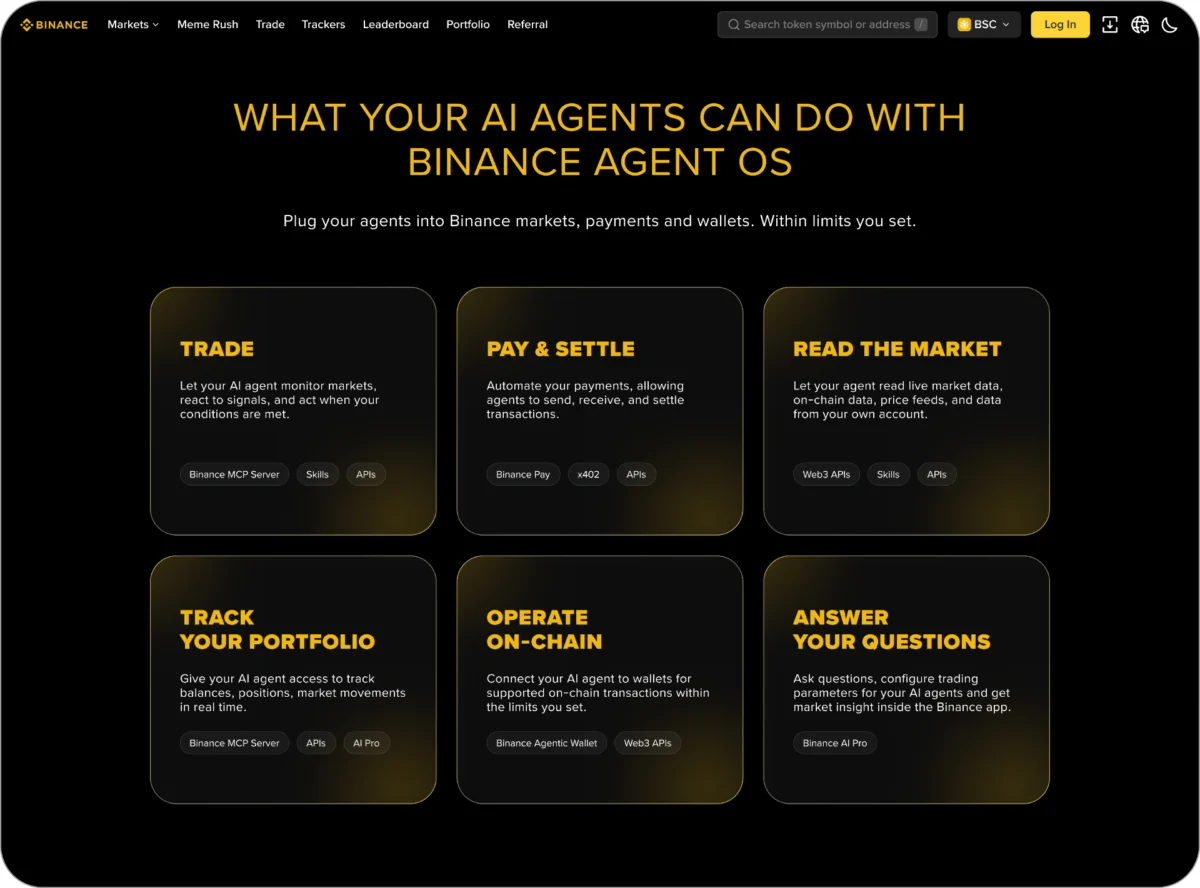
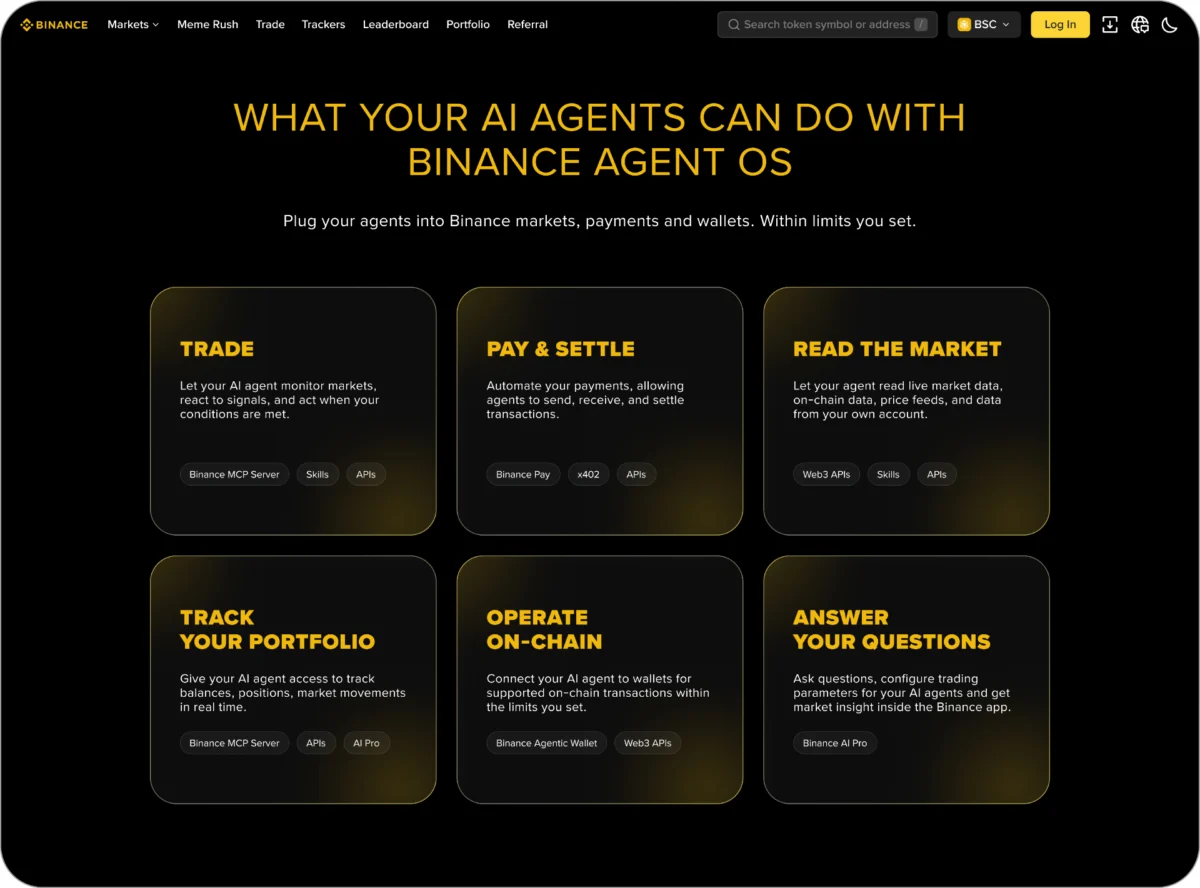
Binance, the world’s largest cryptocurrency exchange by trading volume and registered user base, has officially announced the launch of Agent OS, a specialized platform designed to integrate autonomous artificial intelligence (AI) agents directly into its vast financial infrastructure. By enabling AI agents to analyze market trends, access real-time data, and execute complex trading strategies on behalf of users, the initiative marks a significant pivot in the digital asset industry—moving from human-operated trading bots toward fully autonomous entities capable of managing real-capital portfolios. With more than 300 million registered users globally, Binance’s entry into the AI-agentic space signals a broader shift in how retail and institutional investors interact with blockchain-based markets.
The Agent OS platform functions as a bridge between high-level AI models and the exchange’s internal financial tools. It offers developers a suite of integrations, including the Binance API, the Binance Wallet Agentic Hub, the Binance Skill Hub, and the Binance x402 transaction verification and payment facilitator API. Crucially, the platform introduces native support for the Model Context Protocol (MCP), an open standard that allows AI models to seamlessly connect with external data sources and tools. By leveraging MCP, Agent OS permits agents powered by industry-leading models—such as OpenAI’s ChatGPT and Codex, Anthropic’s Claude Code, and the Cursor development environment—to interact with Binance’s ecosystem with unprecedented fluidity.
Technical Infrastructure and the Role of MCP
At the heart of Agent OS is the goal of reducing the friction between sophisticated AI reasoning and execution. Historically, algorithmic trading relied on rigid "if-this-then-that" logic. In contrast, AI agents utilize large language models (LLMs) to interpret unstructured data, such as news sentiment or complex technical charts, and derive actionable conclusions. The integration of the Model Context Protocol (MCP) is a strategic move by Binance to standardize how these agents "see" the financial world.
MCP serves as a universal interface, allowing developers to provide AI agents with secure access to market depth, account balances, and historical price action without rebuilding custom integrations for every specific AI model. This interoperability ensures that an agent built on Anthropic’s Claude can theoretically utilize the same Binance data hooks as one built on OpenAI’s GPT-4o. The platform also utilizes the "Binance Skill Hub," a repository of pre-configured functions that agents can call upon to perform specific tasks, such as calculating the Relative Strength Index (RSI) or executing a limit order across multiple trading pairs.
A Chronology of AI Integration in Digital Finance
The launch of Agent OS is the latest milestone in a rapidly accelerating timeline of AI adoption within the fintech and crypto sectors. The journey began in late 2022 with the explosion of generative AI, which initially served as an educational tool for traders. By 2023, exchanges began integrating AI-powered chatbots to assist with customer service and basic market research.
However, 2024 has emerged as the year of the "Agentic Turn." In March, Kraken introduced an open-source command-line tool with a built-in MCP server, enabling AI to execute spot and futures trades. In June, Coinbase followed suit with "Coinbase for Agents," a platform designed to let AI entities conduct financial workflows, including payments and swaps. OKX similarly released its "Agent Trade Kit" earlier this year. Binance’s introduction of Agent OS represents the most expansive version of this trend to date, given the exchange’s massive liquidity and its role as the primary hub for global crypto trading.
Security Framework: The Subaccount "Sandbox"
One of the primary concerns regarding autonomous AI trading is the risk of catastrophic loss due to "hallucinations," faulty logic, or malicious exploitation such as prompt-injection attacks. To mitigate these risks, Binance has engineered a security framework centered on the use of dedicated subaccounts. This structural choice creates a "sandbox" environment where an AI agent’s reach is strictly limited.
According to Jeff Li, Vice President of Product at Binance, the philosophy behind Agent OS is to shift the burden of control to the user while providing the tools to enforce those limits. "Instead of total freedom, we put the power in users’ hands to give them the granular access control of what they can do through the agent," Li stated. "We put [the control] at the account level to protect the users’ funds."
In practice, this means that when a user authorizes an AI agent, they do not grant it access to their entire Binance portfolio. Instead, they transfer a specific amount of capital into a subaccount. By default, withdrawals from these subaccounts are blocked, ensuring that even if an agent is compromised or malfunctions, it cannot drain the user’s primary wallet. Furthermore, users can toggle between "Approval Mode," where every trade requires a human signature, and "Autonomous Mode," where the agent can trade freely within the confines of its allocated capital.
Supporting Data and Financial Constraints
To ensure market stability and user protection, Binance has implemented tiered transaction limits for various types of agentic activity. While there is no hard cap on the total volume an agent can trade within a subaccount—effectively making the subaccount balance the limit—other functionalities carry specific daily restrictions:
- Standard Token Swaps: Capped at $50,000 per day.
- DeFi Protocol Interactions: Limited to a default of $100,000 per day via the Agentic Wallet.
- x402 Micro-payments: Restricted to $20 per day to facilitate machine-to-machine settlements without risking significant capital.
These limits reflect the experimental nature of the current AI landscape. As agents become more reliable and their underlying models more robust, these caps are expected to be adjusted. The x402 integration is particularly noteworthy, as it allows AI agents to "pay" each other for services, such as one agent purchasing a specialized data set from another, creating a micro-economy of autonomous entities.
The Black Box Problem: Transparency and Accountability
A significant challenge highlighted by Binance leadership is the "black box" nature of AI reasoning. Because the actual decision-making process occurs within the AI model—often hosted on a user’s local machine or a third-party cloud service like OpenAI or Anthropic—Binance cannot see why an agent decided to buy or sell a particular asset.
"We really cannot see the reasoning of what the user’s action is," Li admitted. This lack of visibility means that if an agent is manipulated via a prompt-injection attack—where a malicious actor feeds the AI hidden instructions to execute a bad trade—the exchange only sees a validly signed order coming from an authorized subaccount. This underscores the importance of the subaccount’s withdrawal blocks and the user’s responsibility in selecting reputable AI models and developers.

Industry Reactions and Market Implications
The launch of Agent OS has drawn reactions from across the technology and finance sectors. Proponents of decentralized finance (DeFi) view this as a major step toward "Intelligent Finance," where AI can navigate the complexities of yield farming, arbitrage, and liquidity provisioning more efficiently than human traders.
Market analysts suggest that the rise of AI agents could lead to increased market liquidity but also higher volatility. If thousands of agents are programmed to react to the same news events or technical signals, it could lead to "flash" movements in price. However, the diversification of AI models—ranging from OpenAI to open-source models like Meta’s Llama—may provide enough variety in "thinking" to prevent a monolithic market reaction.
Furthermore, the move places Binance in direct competition not just with other crypto exchanges, but with traditional fintech giants who are also exploring agentic workflows. By providing a platform where agents can act across both crypto and, eventually, traditional markets via tokenized assets, Binance is positioning itself as the foundational layer for the next generation of automated wealth management.
Future Outlook: Toward a Machine-to-Machine Economy
Binance describes Agent OS as a "first step" in a long-term strategy. The broader vision involves a shift where the majority of financial transactions are not initiated by humans clicking buttons, but by agents executing high-level goals. For example, a user might give an agent a goal to "maintain a portfolio that yields 5% annually with low volatility," and the agent would autonomously move funds between spot assets, lending protocols, and futures hedges to achieve that outcome.
As the AI race moves away from simple chatbots toward agents capable of taking meaningful action in the physical and financial worlds, the infrastructure provided by Agent OS will likely serve as a blueprint for other financial institutions. For now, Binance is prioritizing developer adoption and the refinement of security protocols.
In conclusion, the launch of Agent OS represents a high-stakes bet on the convergence of AI and blockchain technology. By bridging the gap between autonomous reasoning and financial execution, Binance is not just providing a new tool for traders; it is defining the parameters of a new era in which the "users" of financial platforms may increasingly be lines of code rather than human beings. The success of this transition will depend on the robustness of the subaccount security model and the ability of the developer community to build agents that are as prudent as they are powerful.