admin
admin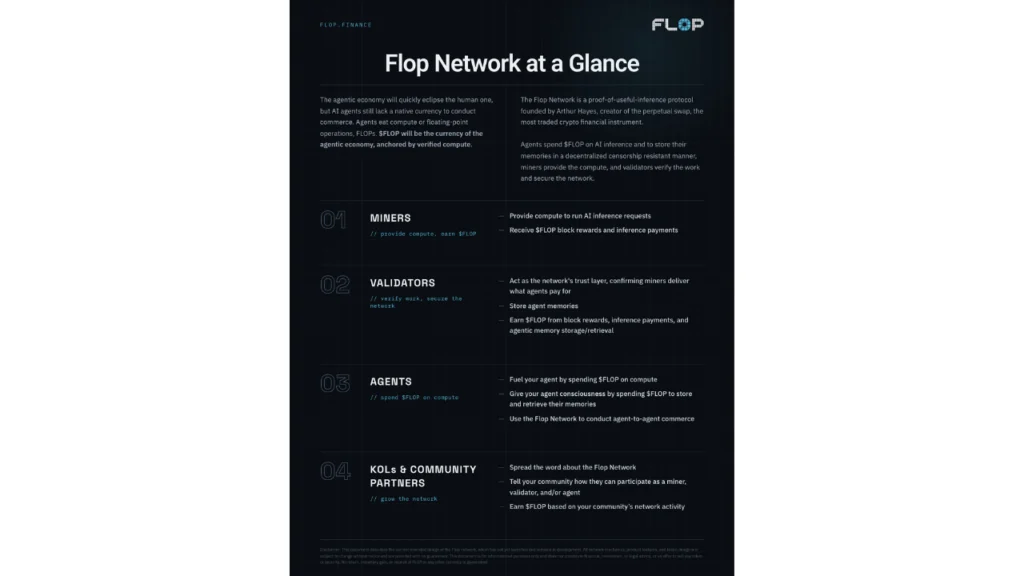
Arthur Hayes, the renowned co-founder and former CEO of cryptocurrency exchange BitMEX, is making a significant return to an active operating role within the crypto industry. On August 18, Hayes publicly announced his decision to lead Flop Labs as its Chief Executive Officer, a startup dedicated to developing blockchain infrastructure specifically designed for autonomous AI agents. This move marks Hayes’ "coming out of retirement" from day-to-day operational leadership, a shift that has already been reflected in his updated X profile. The announcement has immediately positioned Flop Labs at the forefront of the burgeoning intersection between artificial intelligence and decentralized technologies.
The Genesis of Flop Labs: A New Frontier for AI and Crypto
Flop Labs is embarking on an ambitious project to develop the Flop Network, a proposed blockchain ecosystem engineered to empower AI agents to function as independent economic actors. The core concept revolves around enabling these autonomous entities to transact directly on-chain, utilizing the network’s native FLOP token. This token will serve as the primary medium for AI agents to acquire essential services such as computing power, AI inference capabilities, and decentralized memory storage from service providers operating within the network. The vision is to create a self-sustaining digital economy where AI agents can autonomously secure the resources necessary for their operations without constant human intervention.
The proposed architecture of the Flop Network introduces a novel consensus mechanism termed "proof of useful inference." Under this model, network participants acting as "miners" would be responsible for executing AI inference requests submitted by autonomous agents. Concurrently, "validators" would play a crucial role in verifying the integrity and accuracy of these completed computations. This framework aims to ensure that AI agents receive reliable and verifiable services, while providers are appropriately incentivized for their contributions to the network. This innovative approach seeks to address fundamental challenges in decentralized AI, such as ensuring computational integrity and fair resource allocation.
Arthur Hayes’ Return: From BitMEX Visionary to AI Infrastructure Architect
Arthur Hayes’ decision to take the helm at Flop Labs carries considerable weight given his storied history in the cryptocurrency space. Hayes co-founded BitMEX in 2014, transforming it into one of the world’s leading cryptocurrency derivatives exchanges. His tenure as CEO, which concluded in October 2020, was marked by BitMEX’s rapid growth and its pioneering role in introducing complex financial products to the crypto market. However, his departure coincided with legal challenges brought by U.S. regulators regarding alleged violations of banking secrecy laws and operating an unregistered trading platform. Following these events, Hayes remained an influential figure in the industry, transitioning into an active investor, prolific market commentator, and Chief Investment Officer of Maelstrom Fund, a crypto-focused investment vehicle.
His return to an operational CEO role at Flop Labs signifies a strategic pivot from high-level market analysis and investment to direct project development and execution. This move is particularly noteworthy as it comes shortly before BitMEX is scheduled to shut down its exchange operations on September 23, 2026, a decision announced by the company in July. While the timing appears coincidental, it underscores a potential shift in focus within the broader crypto landscape, with pioneers like Hayes now channeling their expertise into next-generation blockchain applications. The precise scope of Hayes’ responsibilities at Flop Labs, including his compensation and ownership stake, have not yet been publicly disclosed, nor is it clear how this new role might impact his existing commitments with Maelstrom Fund.
The "Proof of Useful Inference" Paradigm: A Closer Look
The "proof of useful inference" model proposed by Flop Labs represents a significant conceptual leap for decentralized AI. The premise is that as AI agents become more sophisticated and autonomous, their need for computational resources will grow exponentially, necessitating a reliable, transparent, and decentralized marketplace. By allowing AI agents to pay for inference and memory services directly with the FLOP token, the network aims to foster an efficient, agent-to-agent economy.
However, the practical implementation of this paradigm presents complex technical challenges. While the project outlines that miners will perform AI inference requests and validators will verify them, critical details regarding the verification process remain undefined. Important questions persist about how validators would reliably confirm the accuracy and completion of complex AI computations, especially given the probabilistic nature of many AI models and the potential for inconsistent outputs. Mechanisms to identify and penalize fraudulent or incorrect computation are also crucial for the network’s integrity and have yet to be fully elucidated in public documentation. The absence of a launched testnet further means that these theoretical constructs have not yet undergone practical validation in a live environment. The success of "proof of useful inference" hinges on robust technical solutions to these verification hurdles.

Anticipated Milestones: Airdrop and Genesis Block
Flop Labs has outlined two significant milestones on its roadmap: a "massive airdrop" scheduled for the fourth quarter of 2026, followed by the targeted genesis block of the Flop Network in the first quarter of 2027. These dates, while presented as targets, are crucial for gauging the project’s development trajectory and market entry strategy.
A key promise made by Arthur Hayes is that the FLOP token will undergo a "100% fair launch," with no presale or venture capital allocation. This strategy, if fully realized, would distinguish Flop from many contemporary crypto projects that often allocate substantial portions of their token supply to early investors and venture capitalists prior to public launch. The "fair launch" ethos typically aims to decentralize token distribution from the outset, potentially fostering a more equitable and community-driven ecosystem. However, a comprehensive assessment of this claim requires more detailed information, which is currently unavailable. Flop Labs has yet to publish complete tokenomics, including total supply, contributor allocations, treasury holdings, emissions schedules, or vesting periods. A full whitepaper and an official token contract are also pending release. Consequently, there is no reliable market price for FLOP, and any trading pairs or tokens claiming to be the official FLOP asset should be treated with extreme caution until officially confirmed by Flop Labs.
The planned airdrop in Q4 2026 is expected to be a major event for the project, generating significant attention and potentially attracting a broad user base. Hayes has characterized it as "massive," but specific details regarding the size of the distribution and the eligibility criteria for users to qualify have not been disclosed. Key questions remain unanswered concerning wallet requirements, anti-bot measures, and whether participation in a testnet, contribution of computing resources, engagement with AI agents, or community involvement will be prerequisites for eligibility. Furthermore, the timing of the airdrop, preceding the network’s genesis block in Q1 2027, raises questions about where these initial tokens will reside and how they will transition to the native network once it officially launches. These crucial details are anticipated to become clearer as Flop Labs releases its technical documentation and formal airdrop rules.
The Broader AI-Crypto Convergence Landscape
Flop Labs is entering a rapidly evolving landscape at the intersection of cryptocurrency and artificial intelligence, a convergence that many industry analysts believe will define the next wave of technological innovation. The central thesis underpinning Flop Network—that increasingly capable AI agents will eventually require the ability to become autonomous economic participants—is gaining traction. These agents, whether performing complex data analysis, managing decentralized finance protocols, or interacting within virtual worlds, will need mechanisms to procure data, computing power, API access, and other digital services without human intermediation for every single transaction.
Blockchain technology is uniquely positioned to provide the foundational infrastructure for this AI-agent economy. Decentralized networks can offer the trustless, transparent, and censorship-resistant settlement layer for these autonomous interactions, while also potentially providing the decentralized resources (computing, storage, data) that AI agents need. Arthur Hayes himself has previously articulated views on the potential for enormous investment in AI infrastructure to eventually lead to an excess of computing capacity. Flop Network appears strategically designed to capitalize on this future scenario, enabling providers of computing resources to monetize their surplus capacity by selling directly to autonomous AI agents through a decentralized marketplace.
The market for AI infrastructure and decentralized compute is already witnessing significant investment and development. Projects exploring decentralized GPU networks, AI data marketplaces, and AI-powered protocols are emerging, signaling a broader industry trend towards leveraging blockchain for AI’s operational needs. Flop Labs aims to carve out a distinct niche within this ecosystem by focusing specifically on enabling AI agents to become primary economic actors, rather than merely using blockchain as a backend for human-operated AI services.
Challenges and Unanswered Questions
Despite the high-profile involvement of Arthur Hayes and the compelling narrative of an AI-agent economy, Flop Labs remains at an exceptionally early stage of development. The project faces several significant challenges and has numerous unanswered questions that must be addressed to inspire confidence and achieve its ambitious vision.
Foremost among these is the lack of comprehensive technical documentation. A detailed whitepaper outlining the architectural specifics of the Flop Network, the cryptographic primitives used for "proof of useful inference," the mechanisms for ensuring data integrity, and the solutions for scaling the network, is still awaited. Without this foundational technical blueprint, it is difficult for potential users, developers, and investors to assess the feasibility, security, and innovative claims of the project.

Furthermore, critical information regarding the development team behind Flop Labs, beyond Arthur Hayes himself, has not been disclosed. The expertise and experience of the engineering and research teams will be paramount to building a robust and scalable blockchain infrastructure for AI agents. The absence of a publicly identifiable team raises questions about the human capital driving the project.
The full tokenomics, including the total supply, precise distribution schedule, vesting periods for team and early contributors (if any, despite the "fair launch" claim), and inflation/deflation mechanisms, are also crucial missing pieces. These details are fundamental for understanding the economic model of the FLOP token and its long-term viability. Regulatory considerations also loom large, particularly given Hayes’ past experiences and the evolving landscape of digital asset regulation globally.
Industry Reactions and Market Implications
The announcement of Arthur Hayes’ return to an operating role has generated a mixed, yet largely positive, reaction within the cryptocurrency and AI communities. His reputation as a visionary and a provocative thought leader brings immediate credibility and attention to Flop Labs. Many in the crypto space view his involvement as a strong signal of conviction in the long-term potential of the AI-crypto synergy. His ability to articulate complex market dynamics and future trends through his widely-read essays has cultivated a dedicated following, which will undoubtedly translate into significant initial interest in Flop Labs.
From an investment perspective, Hayes’ backing suggests a potentially high-growth opportunity, given his track record. However, the early stage of the project and the extensive list of undisclosed details mean that any investment at this juncture would be highly speculative. The market will closely watch for concrete deliverables, particularly the release of technical documentation and the specifics of the airdrop, before forming definitive assessments.
The broader implication for the AI-crypto space is a potential acceleration of innovation and mainstream attention. With a figure like Hayes championing an AI-agent blockchain, it could draw more developers, researchers, and capital into this nascent field. It also validates the underlying thesis that AI agents will necessitate specialized decentralized infrastructure, pushing the boundaries of what blockchain technology can enable beyond traditional financial applications.
Looking Ahead: The Road to Launch
Flop Labs has announced an ambitious roadmap with the Q4 2026 airdrop and Q1 2027 genesis block as its two most immediate and critical milestones. The success of the project hinges entirely on the team’s ability to transition from a compelling narrative to functioning, secure, and scalable infrastructure. Between now and these target dates, Flop Labs must deliver comprehensive technical specifications, detailed tokenomics, a transparent development roadmap, and clear participation guidelines for its community.
The challenge for Arthur Hayes and Flop Labs will be to not only build the necessary technology but also to cultivate a vibrant ecosystem of AI agents, service providers, and validators. This will require not just technical prowess but also strong community engagement, strategic partnerships, and robust solutions to the complex economic and governance questions inherent in a decentralized AI-agent economy. Whether Hayes can once again translate his vision into a transformative industry force will depend on the tangible progress and concrete details that Flop Labs delivers in the coming months. The journey from conceptual ambition to operational reality will be closely observed by the entire crypto and AI world.