Dwi Wanna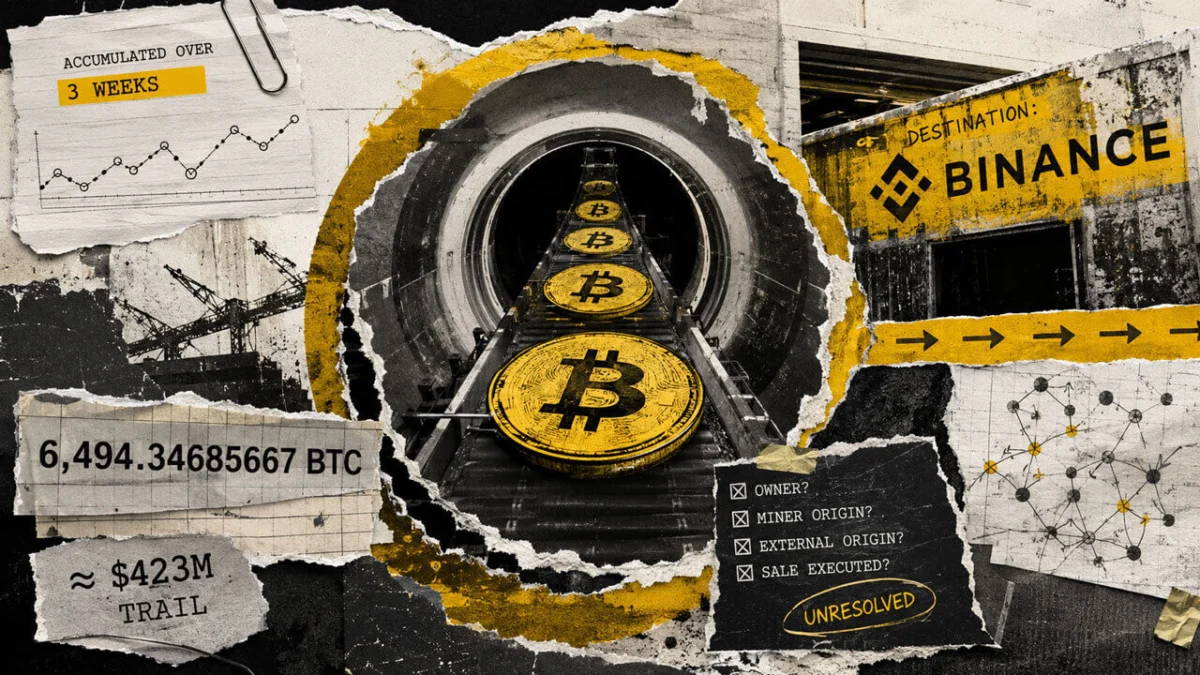
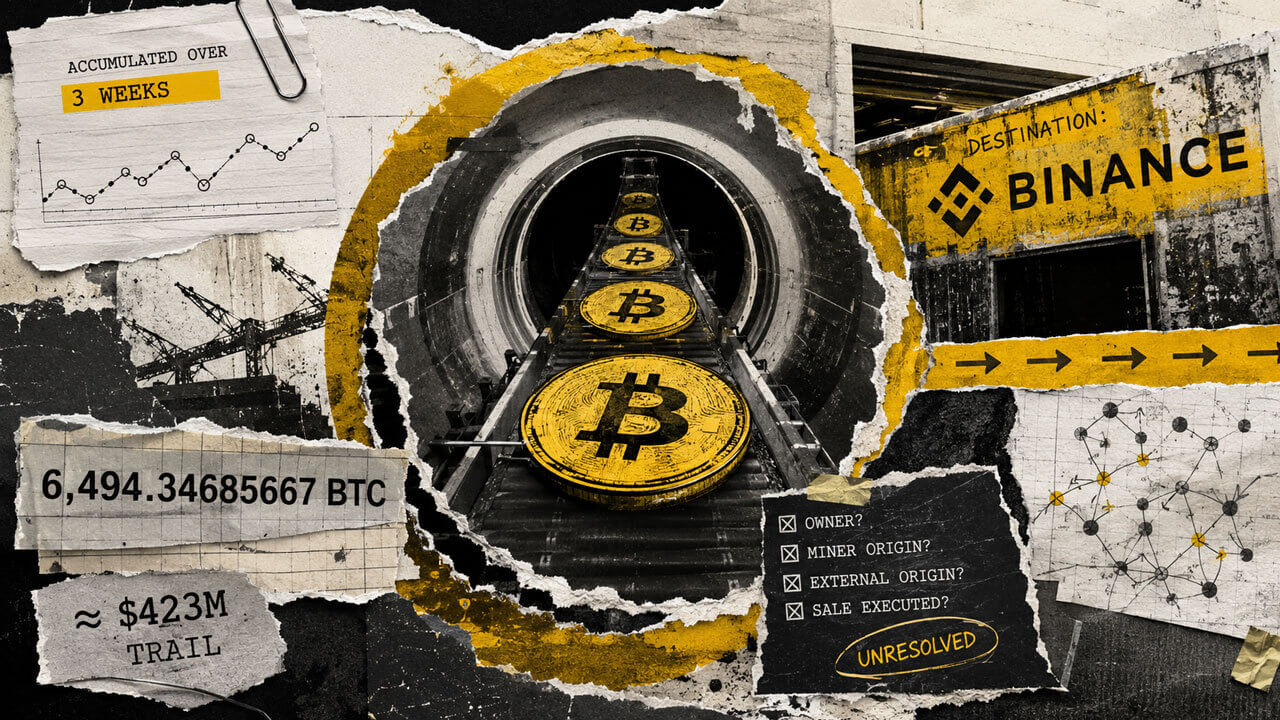
The digital asset market was placed on high alert over the weekend as blockchain tracking services identified a series of massive Bitcoin transfers originating from a single, previously low-profile address. Between July 19 and August 8, 2026, a specific Bitcoin wallet accumulated and subsequently liquidated its entire balance of 6,494.34 BTC, valued at approximately $423 million based on prevailing market rates. The precision and scale of these movements have ignited intense speculation regarding the identity of the holder and the potential for a significant market correction. On-chain data indicates that nearly the entirety of these funds was funneled through transactions that interacted with a wallet historically linked to Binance, the world’s largest cryptocurrency exchange by trading volume.
The movements were first brought to public attention by the blockchain analytics platform Lookonchain, which categorized the entity as a "mysterious whale" and suggested the possibility that the source could be a large-scale mining operation. This theory stems from the pattern of incoming transactions, though forensic analysts emphasize that the ledger provides no definitive proof of ownership. While the destination address has been identified in historical regulatory filings and corporate transparency reports as belonging to Binance, the nature of the current transfer remains obscured by the inherent pseudonymity of the Bitcoin network.
Detailed Chronology of the $423 Million Transfer
The activity surrounding the subject address began in earnest on July 19, 2026. Over the following three weeks, the wallet received 45 confirmed incoming outputs. These transfers were not consolidated into a single lump sum but were instead layered into the address through a series of mid-sized deposits. By the time the accumulation phase concluded on August 8, the address had processed a total of 6,494.34685667 BTC.
The liquidation or "sweep" phase occurred almost in tandem with the final deposits. According to the public ledger, the address engaged in 70 confirmed transactions during this brief window. Of the 25 transactions that moved coins out of the wallet, 23 were directed toward the address bc1qm34lsc65zpw79lxes69zkqmk6ee3ewf0j77s3h. This specific destination consumed 6,494.33835675 BTC of the total volume, leaving only a negligible amount—roughly 0.00849992 BTC—to be accounted for in two unrelated transactions.
The final major movement was recorded on August 8, when a receipt of 1,000.00882659 BTC was delivered to the address. In a display of high-velocity movement characteristic of institutional or exchange-level operations, these coins were spent within two and a half hours, following the established route to the Binance-attributed destination. As of the latest reporting snapshot, the source address holds a confirmed balance of zero, indicating a complete exit or reorganization of the assets.
The Binance Connection and Regulatory Context
The destination address, bc1qm34lsc65zpw79lxes69zkqmk6ee3ewf0j77s3h, is well-known to blockchain forensic experts and regulatory bodies. In a December 2022 proof-of-reserves report issued by Binance, this address was explicitly listed as part of the exchange’s controlled infrastructure. Furthermore, the address appeared in United States federal court records (specifically Case 2:23-cv-01317) as a confirmed Binance-controlled entity on the Bitcoin network.
Despite these historical attributions, analysts urge caution. While the address was under Binance’s control in 2022 and 2023, the fluid nature of exchange wallet management means that internal protocols may have shifted by August 2026. However, the pattern of the transactions strongly resembles a "deposit-and-sweep" operation. This is a standard procedure used by centralized exchanges to consolidate customer deposits from unique, one-time-use addresses into larger, centralized "hot" or "warm" wallets for liquidity management.
The ambiguity of the move presents two primary scenarios. The first is that a high-net-worth individual or a mining pool is preparing to sell their holdings, moving the BTC to Binance to access the exchange’s deep liquidity. The second scenario is that Binance is simply performing internal wallet maintenance, moving its own reserves or "staging" assets for operational reasons. Each scenario carries vastly different implications for the Bitcoin spot price.
Market Reaction and Volatility Indicators
The revelation of the $423 million transfer coincided with a period of heightened sensitivity in the crypto markets. At the time the analysis was published, Bitcoin was trading at approximately $65,178, representing a 2.03% decline over a 24-hour period. While a 2% fluctuation is relatively standard for the digital asset class, the underlying data suggested a growing sense of unease among traders.
Trading volume for Bitcoin surged by 75.20% within the same 24-hour window, reaching $21.92 billion. Such a spike in volume during a price dip often indicates "sell-side pressure," where the market is attempting to absorb a large influx of supply. The total crypto market capitalization stood at $2.18 trillion, with Bitcoin maintaining a dominance of 58.67%.
The psychological impact of "whale watching" cannot be understated in the cryptocurrency ecosystem. When a single entity moves nearly 6,500 BTC toward an exchange, it creates what analysts call "sell-side optionality." Even if the owner of the coins does not intend to sell immediately, the mere fact that the assets are positioned on an exchange—ready to be traded at a moment’s notice—often prompts smaller investors to sell in anticipation of a price crash.
Technical Analysis of "Deposit and Sweep" Activity
To understand the mechanics of this event, it is necessary to examine the technical behavior of the transactions. In a typical "deposit and sweep," an exchange provides a user with a fresh Bitcoin address. Once the user sends funds to that address, the exchange’s automated systems "sweep" those funds into a larger pool.
In this instance, the source address’s contribution to the transactions was 6,494 BTC, but some of the outgoing transactions combined coins from other, unrelated addresses. This "mixing" is a common feature of exchange transactions, as it allows the platform to batch multiple transfers into a single block, thereby reducing transaction fees (sats/vB).
The speed at which the final 1,000 BTC was moved—less than 150 minutes after receipt—suggests an automated or highly coordinated process. If the address belonged to a private individual, such rapid movement would suggest an urgent need for liquidity. If the address is part of an exchange’s internal architecture, it represents routine maintenance. The inability of the blockchain to distinguish between these two motives is what keeps the market in a state of speculative tension.
Broader Implications for the Bitcoin Supply
The movement of 6,494 BTC represents a significant portion of the active circulating supply. With only 20.07 million BTC in existence and a large portion held in long-term "lost" wallets or institutional "HODL" accounts, the sudden appearance of $423 million in "mobile" Bitcoin can shift market sentiment instantly.
The current market cap of Bitcoin is roughly $1.28 trillion. While $423 million is a fraction of a percent of the total market cap, it is substantial relative to daily spot volume on any single exchange. If the entire 6,494 BTC were to be sold in a single market order, it could potentially wipe out the "buy-side" depth of the order book, leading to a "flash crash" or a sharp, localized price drop on Binance that could then spread to other exchanges through arbitrage bots.
Market observers are now closely monitoring "exchange balance" metrics. If the overall amount of BTC held on exchanges continues to rise following this transfer, it would confirm that supply is entering the market, likely leading to further price suppression. Conversely, if exchange balances remain stable, it may indicate that this was an internal reshuffling by Binance, posing no immediate threat to the spot price.
Future Outlook and On-Chain Transparency
As the cryptocurrency industry matures, the role of on-chain forensics becomes increasingly vital. The ability for platforms like Lookonchain and CryptoSlate to track $423 million in real-time provides a level of transparency that is nonexistent in traditional finance. However, this transparency is a double-edged sword; it provides data but lacks the context of intent.
The next few days will be critical for Bitcoin’s price action. Analysts will be looking for additional confirmed flows involving the subject address and monitoring whether the $65,000 support level holds. Should Bitcoin fail to maintain this level, the "whale" transfer may be cited as the catalyst that broke the market’s momentum.
For now, the identity of the 6,494 BTC owner remains a mystery. Whether it is a miner capitulating after a period of high difficulty, an early adopter taking profits, or simply the world’s largest exchange moving its own capital, the event serves as a stark reminder of the influence held by the market’s largest stakeholders. In the world of decentralized finance, the actions of a single "whale" can still reverberate through the portfolios of millions of retail investors worldwide.