
 admin
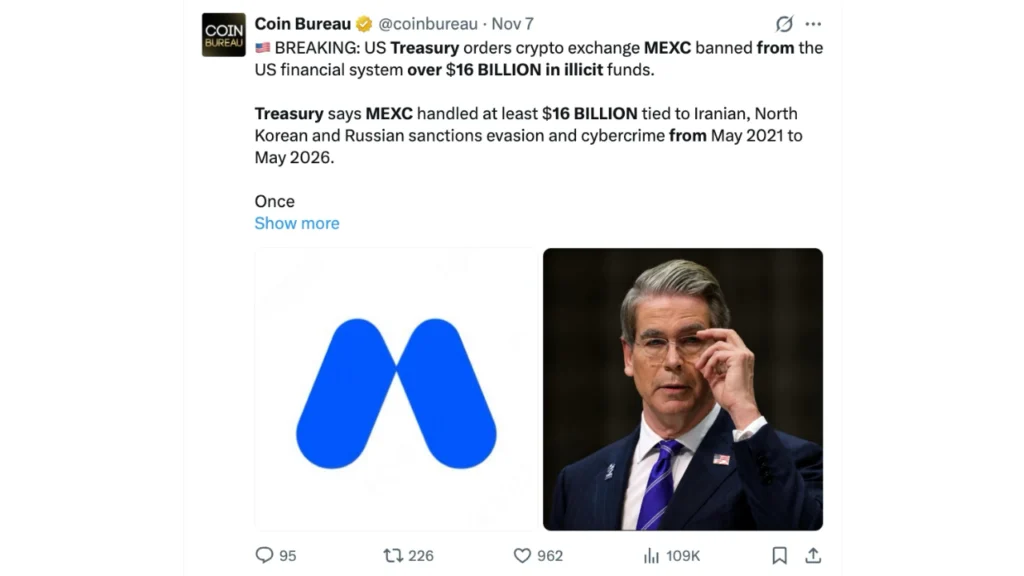
The United States Treasury Department has taken decisive action to sever one of the world’s largest cryptocurrency exchanges, MEXC Global, from the American financial system. On Friday, November 6, 2026, the Treasury’s Financial Crimes Enforcement Network (FinCEN) issued an order explicitly prohibiting U.S. financial institutions from processing any funds transfers to or from MEXC Global. This unprecedented move comes amidst accusations that the Seychelles-registered exchange has facilitated the movement of at least $16.7 billion in illicit money, with significant ties to sanctioned regimes in Iran, North Korea, and Russia.
The ban is slated to take effect 30 days following the official publication of the order in the Federal Register. Once active, any U.S. institution found to be continuing financial transactions with MEXC Global will face the risk of severe civil or criminal penalties. This measure underscores a growing resolve within the U.S. government to combat the use of digital assets for sanctions evasion and illicit finance.
Treasury Secretary Scott Bessent articulated the department’s firm stance, stating, "Financial institutions cannot have it both ways: Either you support the Iranian regime, or you have access to the U.S. financial system." He further emphasized the Treasury’s commitment to systematically dismantling the economic lifelines of sanctioned entities and thwarting their attempts to leverage digital assets to circumvent international sanctions. The action against MEXC Global is not an isolated incident but a critical component of a broader, aggressive campaign by the U.S. government to safeguard the integrity of the global financial system.
A Deep Dive into FinCEN’s Findings Against MEXC Global
MEXC Global, founded in 2018, is far from a niche player in the rapidly evolving cryptocurrency landscape. It ranks among the top 20 largest crypto exchanges globally, commanding a substantial presence. According to FinCEN’s detailed 24-page order, the platform processes an astonishing average of over $1 billion in trades daily, holds approximately $5 billion in reserves, and boasts a listing of more than 3,000 distinct tokens. As of December 2025, MEXC accounted for roughly 9% of the global centralized crypto exchange market, operating in over 170 countries without holding a virtual asset service provider license. This significant market penetration and global reach make the U.S. Treasury’s action particularly impactful.
FinCEN’s extensive investigation, spanning from May 2021 to May 2026, revealed that an estimated $16.7 billion linked to various illicit activities flowed through the MEXC platform. The breakdown of this staggering figure illustrates the breadth and depth of the exchange’s alleged complicity:
- Sanctions Evasion: A substantial portion of the illicit funds, amounting to billions, was allegedly tied to entities and individuals operating under U.S. and international sanctions, primarily benefiting Iran, North Korea, and Russia.
- Cybercrime: Funds associated with sophisticated cybercriminal enterprises, including ransomware attacks and data breaches, were reportedly laundered through MEXC. North Korean state-sponsored hacking groups, known for their prolific crypto thefts, are a particular focus of U.S. enforcement agencies.
- Drug Trafficking: Proceeds from international drug trafficking operations were also identified as having moved through the exchange, enabling criminal networks to convert illicit gains into digital assets and obfuscate their origins.
- Terror Financing: While not explicitly detailed in the same way as other categories, the general nature of sanctions evasion, particularly involving state sponsors of terrorism, implies a potential nexus with terror financing networks.
- Other High-Risk Activities: The order cited more than $13 billion in transactions involving at least four high-risk exchangers that had previously been sanctioned by the United Kingdom, indicating a systemic failure to screen high-risk counterparties.
Perhaps the most damning revelation from FinCEN’s investigation involves MEXC’s continued dealings with Garantex, a Russian exchange sanctioned by the U.S. in 2022. Despite the explicit designation, FinCEN found that MEXC continued to trade with Garantex and its successor entity, Grinex, as recently as June 2026 – more than four years after the initial sanction. This persistent engagement with a designated entity, in direct contravention of international financial regulations, led FinCEN to label MEXC Global a "primary money laundering concern" in connection with Russian illicit finance.
Despite purportedly having anti-money laundering (AML) policies in place and barring users from sanctioned jurisdictions like Iran and North Korea on paper, FinCEN concluded that MEXC’s compliance program suffered from "severe deficiencies." These systemic failures effectively rendered its stated AML controls inert, allowing a vast network of illicit financial activity to flourish unchecked on its platform.
The Regulatory Hammer: Section 9714(a) of the Combating Russian Money Laundering Act
Crucially, the action against MEXC Global does not originate from the Office of Foreign Assets Control’s (OFAC) standard sanctions list, which typically involves a worldwide asset freeze. Instead, FinCEN issued the order under the authority granted by Section 9714(a) of the Combating Russian Money Laundering Act. This distinction carries significant weight and highlights an evolving strategy by U.S. regulators.
Section 9714(a) empowers FinCEN to prohibit U.S. financial institutions from engaging in specific transactions with entities deemed to be primary money laundering concerns. While it effectively cuts off U.S. institutions from transfers involving MEXC, it is not a global asset freeze, nor does it automatically trigger worldwide sanctions against the exchange. However, its impact is profound, as it denies the targeted entity access to the dominant U.S. dollar-denominated financial system, a critical lifeline for any globally operating financial enterprise.
FinCEN has increasingly leveraged this particular authority to target cryptocurrency platforms that operate outside the traditional correspondent banking system. Traditional sanctions often have less immediate bite in the decentralized and pseudonymous world of crypto. By directly severing access to U.S. financial institutions, FinCEN can impose significant pressure on exchanges that might otherwise attempt to circumvent standard sanctions. A precedent for this approach was set in 2024 when FinCEN employed the same provision against the Russian exchanger PM2BTC, signaling a clear pattern of enforcement against crypto entities facilitating illicit Russian finance.

Operation Economic Outcast: A Broader Campaign Against Illicit Networks
The action against MEXC Global is not an isolated regulatory strike but an integral component of "Operation Economic Outcast," a comprehensive, whole-of-Treasury effort launched on August 24, 2026. This ambitious initiative aims to systematically dismantle Iran’s global financial, trade, and logistics connections, which have historically relied on complex networks to evade sanctions.
MEXC’s alleged ties to Garantex, Grinex, and the A7 Network place it squarely within a sophisticated sanctions-evasion apparatus that the Treasury Department has been meticulously unraveling. Last month, the Treasury designated Russia’s A7 Network as a transnational criminal organization and proposed measures to cut its various front companies off from U.S. finance. Investigations revealed that over $179 billion in transactions, largely routed through the A7A5 token, flowed through Garantex and Grinex, highlighting the scale of the illicit network.
The campaign has also aggressively targeted Iran’s crypto sector. Treasury recently gained broad authority to sanction anyone operating within this sector and has already blacklisted the Iranian exchange Nobitex for funneling cryptocurrency to the Islamic Revolutionary Guard Corps (IRGC), a designated terrorist organization. Alongside the MEXC order, Treasury simultaneously sanctioned eight Canadian companies it accused of aiding Iran, Russia, and North Korea in evading sanctions and moving funds linked to cybercrime and drug trafficking, underscoring the global reach and interconnectedness of these illicit financial networks.
North Korea remains a persistent and central concern for U.S. authorities. Its state-sponsored hackers have become notorious for their sophisticated crypto thefts, which serve as a crucial funding mechanism for the regime’s weapons programs. Industry tallies indicate that North Korean hackers have stolen over $6.7 billion in cryptocurrency since 2016, with approximately $2 billion pilfered in 2025 alone. In the first four months of 2026, these actors were responsible for $577 million in crypto losses, representing roughly 76% of all crypto-related thefts during that period. Exchanges like MEXC, with lax AML/KYC protocols, often become unwitting or complicit conduits for laundering these stolen assets.
MEXC’s Response and Immediate Market Reactions
In the immediate aftermath of FinCEN’s announcement, MEXC Global issued a public statement acknowledging the November 6 order. The exchange affirmed that it was reviewing the directive closely with its legal and compliance teams. MEXC reassured its user base that operations were continuing normally, user assets remained secure, and expressed its intention to engage constructively with FinCEN. Furthermore, the exchange announced that it had initiated an independent review of its existing anti-money laundering and sanctions controls, signaling an intent to address the severe deficiencies highlighted by the U.S. Treasury.
However, the market’s response was swift and indicative of investor apprehension. On-chain data revealed significant net outflows from MEXC in the 24 hours surrounding the announcement, totaling approximately $126 million. This immediate withdrawal of funds by users reflects a common reaction to regulatory actions against major exchanges, as individuals seek to de-risk their holdings. Beyond individual users, at least one token issuer, NatGold Digital, took prompt action by requesting the immediate delisting of its NATG token from MEXC following the publication of the FinCEN order, further illustrating the ripple effect of such regulatory interventions.
What Comes Next: Implications for MEXC and the Broader Crypto Industry
While the 30-day clock for the ban’s implementation has not officially begun—it commences only upon the order’s appearance in the Federal Register—the practical effects are likely to manifest much sooner. Payment processors, wallet providers, and other cryptocurrency exchanges with exposure to the U.S. financial system are expected to proactively begin screening or outright rejecting MEXC-linked funds well in advance of the legal deadline to mitigate their own regulatory risks.
For MEXC Global, the implications are profound. Losing access to the U.S. financial system, particularly U.S. dollar transfers, will severely hamper its ability to facilitate fiat-to-crypto and crypto-to-fiat transactions for a significant portion of the global market. While not a global freeze, the reputational damage and the operational hurdles will be substantial. The exchange will likely face increased scrutiny from other international regulators and financial institutions, potentially impacting its ability to maintain banking relationships worldwide. The independent review of its AML/sanctions controls is a necessary step, but regaining trust will be a long and arduous process.
For the wider cryptocurrency industry, the message emanating from Washington is stark and unambiguous. The U.S. Treasury has signaled that an exchange’s size, global reach, or perceived decentralization will not shield it from aggressive regulatory action if it is found to be facilitating illicit finance, especially with sanctioned networks. The clear implication is that any platform whose money flows lead back to Tehran, Moscow, or Pyongyang faces the very real threat of being entirely cut off from access to the dollar-denominated financial system.
This action underscores a persistent theme in U.S. financial enforcement: regulators are increasingly adept at tracing illicit funds across blockchain networks and are willing to employ a range of tools, including those specifically designed for combating money laundering in non-traditional financial sectors, to achieve their objectives. It reinforces the imperative for all centralized crypto exchanges to implement robust, effective, and continuously updated anti-money laundering (AML) and know-your-customer (KYC) compliance programs. Failure to do so will not only invite severe penalties but also risk existential threats to their operations and their standing within the legitimate global financial ecosystem. The era of permissive non-compliance for large crypto platforms is definitively drawing to a close.