admin
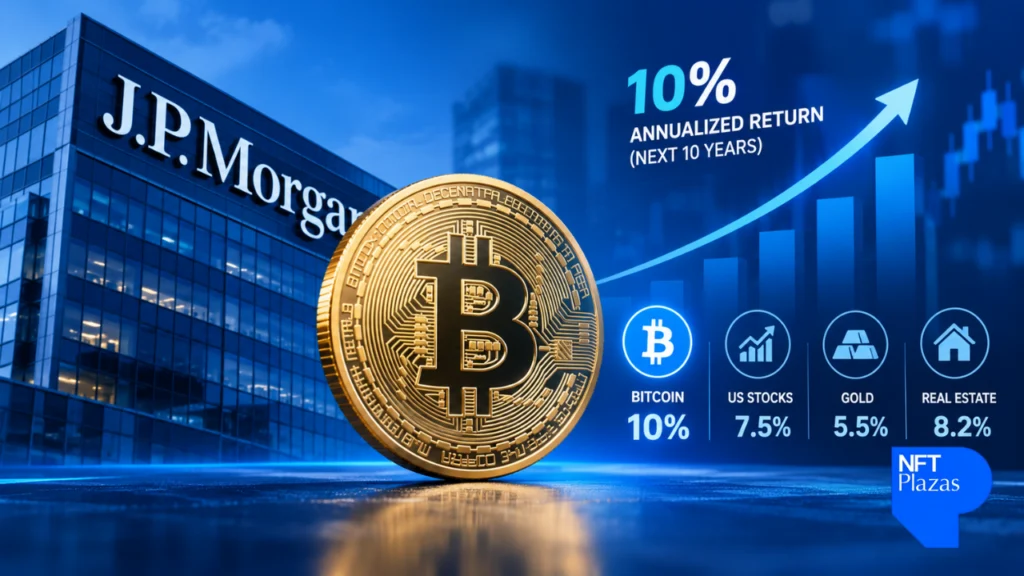
JPMorgan Asset Management, a prominent division of one of the world’s leading financial institutions, has issued a striking forecast, projecting that Bitcoin (BTC) is poised to deliver stronger long-term returns than conventional asset classes such as US large-cap stocks, gold, and real estate investment trusts (REITs). This pronouncement, detailed in the firm’s comprehensive 2027 Long-Term Capital Market Assumptions report, underscores a significant evolution in the recognition of cryptocurrencies within mainstream finance, even as persistent concerns regarding Bitcoin’s inherent volatility continue to be highlighted.
The groundbreaking report anticipates Bitcoin generating an impressive 10% annualized compound return over the next 10 to 15 years. This projection places the digital asset comfortably ahead of its traditional counterparts: US real estate investment trusts (REITs) are forecast at 8.2%, US large-cap equities at 7.5%, and gold at 5.5%. Such an endorsement from a financial titan, historically associated with skepticism towards digital currencies, represents a pivotal moment for cryptocurrency investors and the broader digital asset landscape. However, JPMorgan’s analysis simultaneously emphasizes the substantial risks that inherently distinguish Bitcoin from more established investment vehicles, particularly its pronounced price fluctuations.
A Deeper Dive into JPMorgan’s Long-Term Projections
The firm’s long-term capital market assumptions (LTCMA) are a crucial framework for institutional investors, guiding strategic asset allocation decisions over multi-year horizons rather than predicting short-term market movements. By placing Bitcoin at the apex of its expected compound returns for these four asset classes, JPMorgan Asset Management signals a recognition of the cryptocurrency’s potential for significant long-term growth, despite its nascent stage compared to traditional alternatives that have centuries of market history.
For investors considering an allocation over a decade or more, the differences in projected returns are substantial. Bitcoin’s anticipated annual return surpasses that of US large-cap stocks by 2.5 percentage points and gold by a considerable 4.5 percentage points. Furthermore, it holds an 1.8 percentage point advantage over US REITs. The power of compounding magnifies these seemingly modest annual differences into substantial wealth accumulation disparities over extended periods. For instance, a hypothetical investment growing at a 10% compound annual rate would approximately multiply its value by 2.59 times over a decade, before accounting for fees, taxes, or other costs. A $10,000 investment, under this assumption, would grow to roughly $25,937. This illustrates the potential impact of Bitcoin’s projected outperformance, although it is critical to note that these are projections, not guarantees, and market conditions can significantly alter outcomes.
It is also important to differentiate between compound and arithmetic average returns. JPMorgan estimates Bitcoin’s arithmetic average annual return at 20.9%, considerably higher than its 10% compound return. This substantial gap is a direct reflection of Bitcoin’s extreme price volatility. While arithmetic averages simply sum annual returns and divide by the number of years, compound returns (also known as geometric returns) account for the effect of volatility on the actual growth of an investment over time. Substantial gains in some periods can be offset by steep losses in others, diminishing the overall compounded growth, even if the average annual gain appears high. This nuance is crucial for understanding the true long-term wealth creation potential and inherent risks.
The Elephant in the Room: Bitcoin’s Persistent Volatility
The most significant caveat accompanying JPMorgan’s optimistic long-term outlook for Bitcoin is its projected annualized volatility of 55%. This figure dwarfs the volatility typically associated with major equity markets or even gold, which historically exhibit annualized volatilities in the low to mid-teens. Such high volatility implies that Bitcoin investors should brace for sharp price swings and potentially substantial drawdowns, even if the asset ultimately achieves its projected long-term return trajectory.
This level of volatility presents considerable challenges for institutional investors, who are typically bound by strict risk management mandates and portfolio construction principles. JPMorgan Asset Management explicitly states that it has not incorporated Bitcoin into its main covariance matrices, which are mathematical tools used to evaluate how different assets move in relation to one another. The firm elaborated on this stance, stating, "The volatility and unstable correlation of assets like bitcoin (BTC) remain an obstacle to their widespread inclusion in portfolios."
For sophisticated portfolio managers, the inability to reliably model Bitcoin’s correlation with other assets complicates diversification strategies. An asset might offer attractive expected returns, but if its price movements are unpredictable or wildly divergent from the rest of the portfolio, it can introduce unacceptable levels of risk. This distinction highlights that while Bitcoin’s return potential is recognized, its current characteristics make it challenging to integrate seamlessly into traditional, diversified institutional portfolios, impacting risk-adjusted returns and capital preservation goals. For individual investors, the message is equally clear: higher potential returns in the cryptocurrency market are inextricably linked with greater uncertainty and heightened risk. Bitcoin’s long-term performance will be contingent upon a confluence of factors, including sustained market demand, evolving regulatory frameworks, increasing institutional participation, and broader macroeconomic conditions.
A Timeline of Shifting Institutional Perspectives on Bitcoin
JPMorgan’s latest forecast is not an isolated event but rather a significant milestone in a protracted journey of institutional finance grappling with the rise of digital assets. The chronology of this evolving relationship provides crucial context:

- Early 2010s: Bitcoin was largely dismissed by traditional finance as an obscure niche, often associated with illicit activities. Jamie Dimon, JPMorgan’s CEO, famously called it a "fraud" in 2017, predicting its eventual demise.
- 2017: The launch of Bitcoin futures contracts by the CME Group and CBOE marked the first foray of regulated financial derivatives into the crypto space, signaling a nascent institutional interest in hedging and speculative opportunities.
- 2020-2021: Major corporations like MicroStrategy and Tesla began allocating significant portions of their treasury reserves to Bitcoin, validating its potential as a store of value and inflation hedge in the eyes of some corporate strategists. During this period, Grayscale Bitcoin Trust (GBTC) emerged as a popular, albeit imperfect, vehicle for institutional exposure.
- 2023: Several prominent asset managers, including BlackRock, filed applications for spot Bitcoin Exchange-Traded Funds (ETFs) in the US, indicating a strong belief in client demand for more accessible and regulated investment products.
- January 2024: The U.S. Securities and Exchange Commission (SEC) approved nearly a dozen spot Bitcoin ETFs, a watershed moment that opened the floodgates for a broader range of institutional and retail investors to gain direct exposure to Bitcoin through traditional brokerage accounts. This development significantly enhanced liquidity and accessibility.
- Present: JPMorgan’s forecast, following the ETF approvals, represents a new phase of formal integration. While the firm has also been active in blockchain technology through its JPM Coin and Onyx initiatives, this explicit long-term return projection for Bitcoin as an investable asset class demonstrates a deeper analytical engagement.
This progression illustrates a gradual but undeniable shift from outright dismissal to cautious acceptance and now, for some, a strategic evaluation within formal investment frameworks.
Reactions and Broader Implications
Matt Hougan, Chief Investment Officer at Bitwise, a prominent crypto asset manager, welcomed JPMorgan’s projections as further evidence of Bitcoin’s accelerating integration into traditional finance. In a public statement on social media, Hougan underscored the stark contrast between Bitcoin’s initial reception as a fringe asset and its current inclusion in a major asset manager’s long-term capital market assumptions. He acknowledged the caveats regarding volatility and maturity but emphasized the significance of its mere presence in such a report.
The broader cryptocurrency community views this forecast as a powerful validation, particularly given JPMorgan’s historical stance. It reinforces the narrative that digital assets, especially Bitcoin, are maturing beyond speculative instruments into legitimate, albeit high-risk, components of a diversified investment portfolio. However, traditional finance skeptics might still point to the high volatility and lack of intrinsic value as insurmountable hurdles, suggesting that the forecast merely acknowledges a speculative trend rather than fundamental investment merit.
The distinction between CEO Jamie Dimon’s personal reservations and JPMorgan Asset Management’s analytical forecast is also crucial. Dimon has consistently voiced strong criticism of Bitcoin, labeling it a "fraud" in 2017 and later comparing it to a "Ponzi scheme" and a "pet rock." While his stance softened slightly in May 2025 to allow clients to buy Bitcoin despite his personal opposition, the asset management division’s long-term projection is a purely analytical exercise based on quantitative models and market assumptions, not a declaration of support or a universal recommendation. This highlights the complex internal dynamics within large financial conglomerates, where different divisions may hold distinct perspectives based on their specific roles and analytical frameworks.
Contextualizing Fund Holdings and Future Demand
Separate data from Santiment indicates that investment funds have maintained holdings of over 1 million BTC for several months. While this figure demonstrates a substantial and consistent institutional presence in the Bitcoin market, it is vital to interpret it correctly. Stable holdings do not automatically signify new money entering the market or an increase in institutional buying pressure. To gauge fresh demand, investors must examine metrics like net inflows and outflows into Bitcoin-related investment products, changes in fund balances, and other indicators of active buying activity.
For instance, the significant inflows into spot Bitcoin ETFs post-January 2024 approvals provided clear evidence of new demand, driving Bitcoin’s price appreciation. However, if those inflows were to stabilize or reverse, mere stable holdings by existing funds would not indicate continued upward price pressure. This distinction is critical for investors attempting to infer future price movements from past or static data. Persistent fund holdings offer valuable context regarding the existing institutional footprint but do not independently dictate the direction of future prices.
Strategic Implications for Diverse Investor Profiles
JPMorgan’s forecast, while framed for institutional investors, carries significant implications for a wide spectrum of market participants. For institutional investors, the report necessitates a re-evaluation of Bitcoin’s role in strategic asset allocation. While the 55% projected volatility makes full integration into covariance matrices challenging, the potential for outsized returns suggests that a thoughtful, risk-managed allocation might be considered for a small portion of a diversified portfolio, particularly for those with longer investment horizons and a higher risk tolerance. The challenge lies in constructing portfolios that can capture Bitcoin’s upside potential without being disproportionately exposed to its downside risks. This might involve strict position sizing, dynamic rebalancing strategies, or employing derivatives for hedging.
For individual investors, the forecast serves as a stark reminder that the pursuit of higher potential returns often entails accepting greater uncertainty and volatility. Bitcoin could indeed deliver on JPMorgan’s optimistic forecast if factors like broader adoption, favorable regulatory developments, and sustained institutional demand materialize. However, it could also fall short if market confidence deteriorates, regulatory environments become more restrictive, or competing investment opportunities (such as those offering higher income yields in a rising interest rate environment) become more attractive. The emergence of Bitcoin ETFs has democratized access, but it has not diminished the inherent risks.
In essence, JPMorgan Asset Management’s central message is not that Bitcoin has transformed into a low-risk investment. Far from it. Instead, the firm posits that Bitcoin’s projected long-term returns may justify closer consideration within a sophisticated investment framework. The clear trade-off between its significant growth potential (10% compound return) and its pronounced risk (55% annualized volatility) demands a disciplined and informed approach from any investor. The ultimate success of this trade-off will depend entirely on how the rapidly evolving digital asset market matures and integrates into the broader financial ecosystem over the coming decade and beyond. This forecast solidifies Bitcoin’s position as a permanent fixture in investment discourse, moving beyond mere speculation into the realm of serious, albeit complex, long-term asset allocation considerations.