Dwi Wanna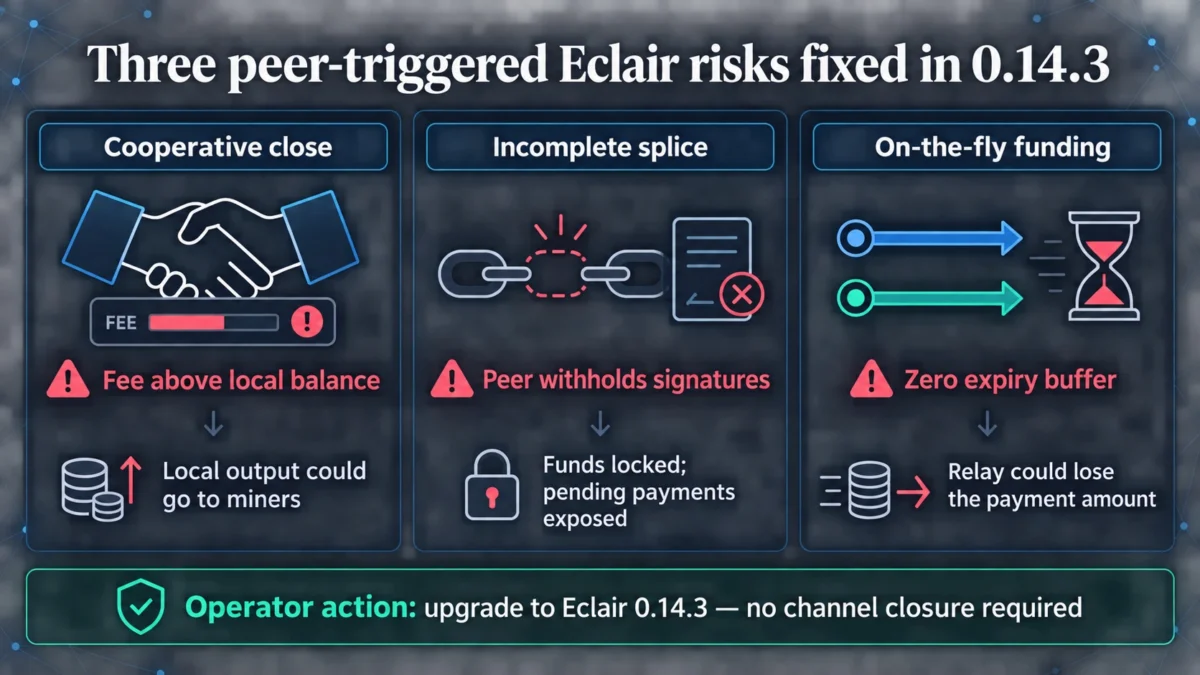
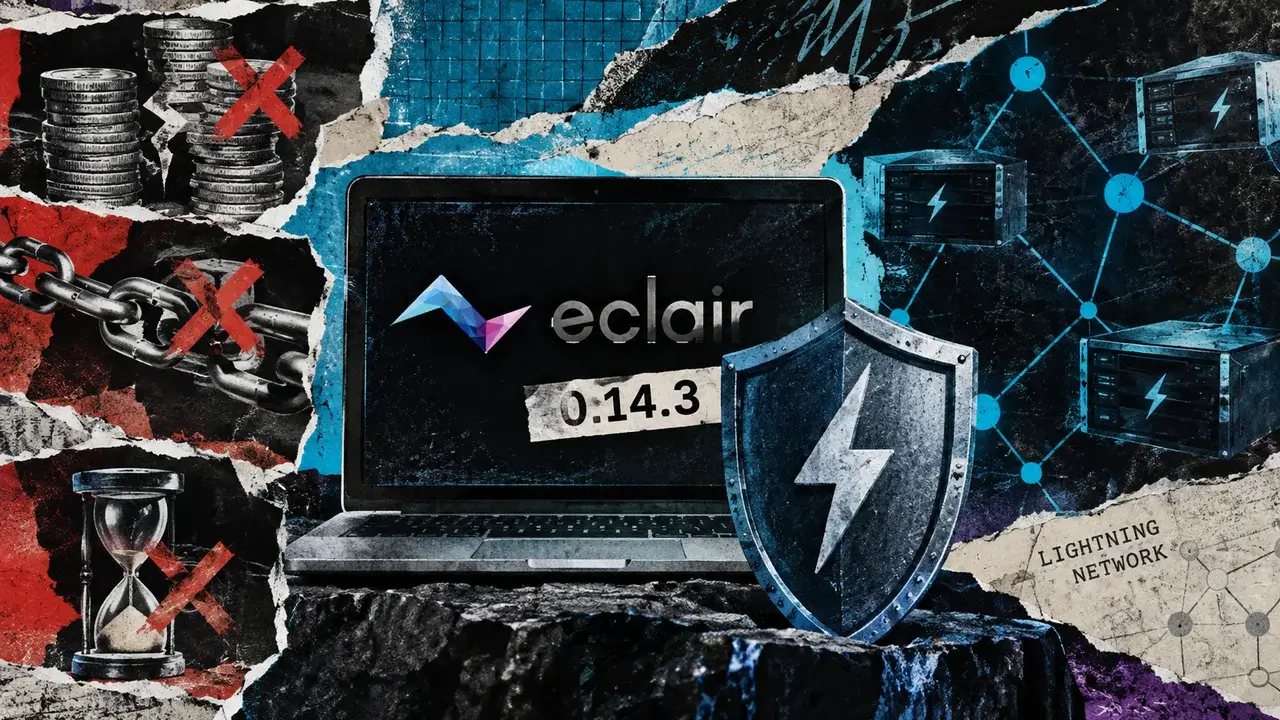
The Bitcoin Lightning Network, a Layer 2 scaling solution designed to facilitate near-instant and low-cost transactions, has recently come under intense scrutiny following the discovery of critical vulnerabilities in one of its primary software implementations. ACINQ, the Paris-based development firm behind the Eclair implementation and the popular Phoenix Wallet, officially released Eclair version 0.14.3 on September 14, 2026. This security-centric update was designed to mitigate three specific peer-triggered vulnerabilities that, if left unpatched, could allow malicious actors to induce significant financial losses or indefinitely lock the funds of unsuspecting node operators. The most alarming of these flaws involves a mechanism where a node’s entire local channel balance could be inadvertently diverted to Bitcoin miners in the form of transaction fees during a routine channel closure.
The release of Eclair 0.14.3 marks a pivotal moment in the ongoing evolution of Lightning Network security. As the network grows in both total value locked (TVL) and the number of active nodes, the incentive for sophisticated attackers to probe for software weaknesses has increased proportionally. ACINQ’s proactive disclosure and patching of these issues underscore the complexities inherent in maintaining a stateful, off-chain payment network where every transaction must ultimately be resolvable on the Bitcoin base layer. The company has issued a strong recommendation for all Eclair operators to upgrade their infrastructure immediately, emphasizing that the risks are not merely theoretical but represent actionable exploits that could be utilized by adversarial peers.
Detailed Analysis of the Patched Vulnerabilities
The vulnerabilities addressed in the 0.14.3 release vary in their execution but share a common theme: they exploit the trust and negotiation protocols required between two peers in a Lightning channel. In the Lightning Network, a channel is essentially a multi-signature wallet where two parties hold a balance. Most operations require both parties to agree on a new state or a specific transaction format before it is broadcast to the blockchain.
The Cooperative Closure Fee Exploit
The most direct and devastating attack vector identified by ACINQ involves the "cooperative closure" process. Under normal circumstances, when two peers decide to close a channel, they negotiate a transaction fee that is acceptable to both parties and reflective of current on-chain market conditions. The fee is typically deducted from the balance of the party that initiated the closure or as per the protocol rules established when the channel was opened.
The flaw in previous versions of Eclair occurred when the software was responsible for paying the closing fee. An adversarial peer could propose a transaction fee that was intentionally set to an exorbitant level—specifically, a fee equal to or greater than the victim’s entire local balance. Due to a lack of rigorous validation in Eclair’s fallback negotiation logic, the software could inadvertently accept these predatory fee proposals. Once the transaction was signed and broadcast, the victim’s entire output would be consumed by the fee, effectively sending their funds to Bitcoin miners. Because the transaction is valid according to Bitcoin’s consensus rules, the funds are unrecoverable once the block is mined.
To resolve this, Eclair 0.14.3 introduces a strict ceiling on closing-fee proposals. The software now cross-references any fee proposal against the operator’s configured maximum and the actual balance available, rejecting any negotiation that would result in an irrational or catastrophic loss of funds.
Risks Associated with Splicing and Signature Withholding
The second vulnerability pertains to "splicing," a relatively new and advanced feature in the Lightning ecosystem. Splicing allows users to add or remove funds from an existing Lightning channel without having to close and reopen it. This is achieved by creating a transaction that spends the current channel funding output and creates a new one, all while keeping the off-chain state continuous.
The weakness identified involved a scenario where Eclair acted as the first party to sign the splice transaction. If the peer—acting maliciously—withheld their signature after receiving the victim’s signature, the channel could enter a "limbo" state. In this state, the latest channel balance would depend on a transaction that the victim does not have the full power to publish. This "incomplete splice" could strand funds or, more dangerously, create a path for losses on payments currently in flight (HTLCs).
An attacker could exploit this by allowing the incoming side of a relayed payment to expire while publishing an older, valid channel state. By using the payment secret to collect the outgoing leg of the payment on the new (but unconfirmed) state, the attacker could effectively double-spend or redirect funds. The Eclair 0.14.3 patch addresses this by ensuring the node will only commit to states backed by fully signed funding transactions and will force-close the channel using the most secure state if a peer attempts to manipulate the signature process.
On-the-Fly Funding and Expiry Manipulation
The third vulnerability targets "on-the-fly funding," a feature designed for user convenience. This allows a node to open a new channel to a recipient at the exact moment a payment is being forwarded to them, ensuring that the payment can be delivered even if no prior liquidity existed.
A malicious wallet or peer could manipulate the timing of payment-expiry (the CLTV delta). By carefully timing when a payment expires, an attacker could collect an outgoing payment on-chain while the incoming payment expired on the other side of the relay. In this scenario, the relay operator (the Eclair node) would be left to absorb the loss of the outgoing payment without being able to claim the incoming one. The updated software now implements more rigorous checks on relay fees and expiry buffers, ensuring that the node does not commit funds unless the timing parameters provide a sufficient safety margin.
Chronology of Security Events and Responses
The discovery and subsequent patching of these vulnerabilities followed a structured timeline consistent with responsible disclosure practices in the cybersecurity industry.
- Late August 2026: Security researchers and contributors to the Eclair project identified edge cases in fee negotiation and splicing protocols that did not align with expected safety parameters.
- Early September 2026: Internal testing at ACINQ confirmed that these edge cases could be weaponized by a malicious peer. Development of the 0.14.3 patch began immediately, focusing on implementing fee caps and more robust state validation.
- September 14, 2026: ACINQ officially released Eclair 0.14.3. The release notes categorized the update as a high-priority security release.
- September 18, 2026: Bitcoin Optech, a prominent technical newsletter for the Bitcoin community, published a summary of the vulnerabilities, further urging node operators to update their software.
- Late September 2026: Major Lightning Network service providers and routing nodes began reporting successful migrations to the new version, with no reported instances of the exploits being used in the wild prior to the patch.
Supporting Data and Technical Context
The significance of these patches is highlighted by the technical constraints of the Lightning Network. Unlike the base layer, where a transaction is either valid or invalid, Lightning relies on "game theory" and the ability of a node to broadcast a "justice" transaction if a peer attempts to cheat. However, in the case of the fee-drain exploit, the peer isn’t necessarily "cheating" in a way that triggers a justice transaction; they are simply proposing a high fee that the victim’s software was previously willing to pay.

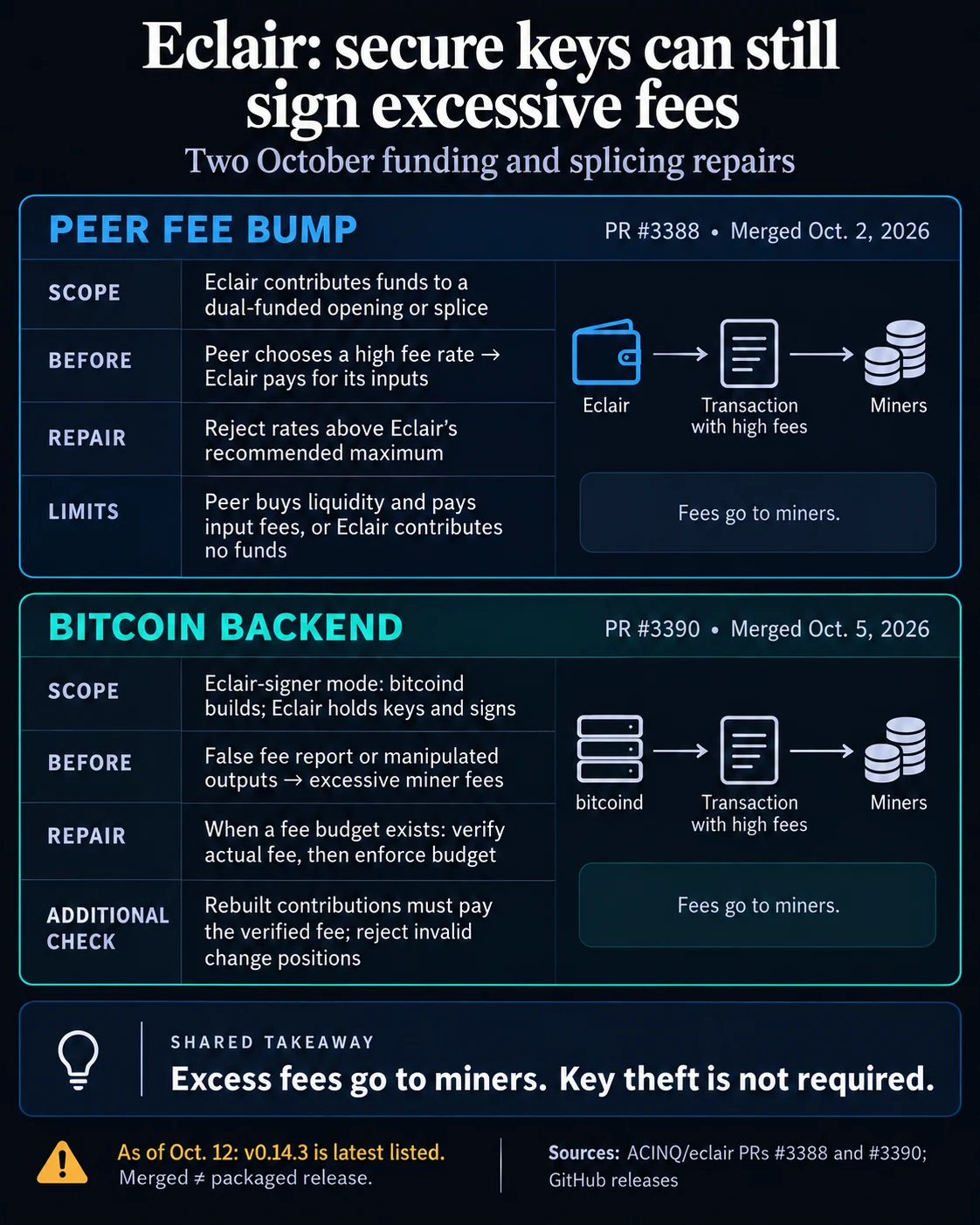
Data from the Bitcoin blockchain shows that during periods of high congestion, transaction fees can fluctuate wildly. The Eclair update now includes a default ceiling of 50 satoshis-per-vByte (sats/vB) for automatically estimated channel-opening and splice fees. This ceiling acts as a "circuit breaker" against bad external fee data or malicious proposals, protecting the node operator from spending excessive amounts on on-chain transactions.
Broader Ecosystem Security Pressure
The vulnerabilities in Eclair do not exist in a vacuum. They are part of a broader trend of increased security pressure on the Lightning Network. Earlier in September 2026, BTCPay Server, a leading open-source Bitcoin payment processor, reported that malicious bots were actively probing servers running LND (Lightning Network Daemon), another popular implementation.
The attackers in that instance targeted an unauthenticated password-change endpoint. This exploit was only possible during a specific window when the LND wallet was locked. If successful, the bots could change the wallet password and acquire administrative macaroons (authentication tokens), granting them full control over the node’s funds. BTCPay Server responded by blocking these unauthenticated routes at the network edge and introducing unique, auto-generated passwords for LND wallets.
These concurrent issues across different implementations (Eclair and LND) suggest that the Lightning Network has entered a "mature" phase of its lifecycle. It is no longer just a playground for developers; it is a high-value target for automated and manual exploitation attempts.
Implications for the Future of Layer 2
The successful mitigation of the Eclair vulnerabilities is a testament to the robustness of the Bitcoin development community. However, it also serves as a reminder of the "user-responsibility" model inherent in decentralized finance. Node operators are essentially their own bank and security officers.
The implications of these flaws are twofold:
- Standardization of Safety Margins: There is an increasing call within the developer community to standardize fee caps and expiry buffers across all Lightning implementations (BOLT specifications) to prevent "implementation-specific" risks.
- Automated Security Monitoring: The industry is likely to see a rise in third-party security auditing tools and "watchtower" services that not only monitor for old state broadcasts but also for suspicious negotiation patterns during channel closures and splices.
As Bitcoin continues to scale through Layer 2 solutions, the security of software like Eclair remains paramount. The 0.14.3 release effectively closes a dangerous chapter where a node’s entire balance could be legally "stolen" by a miner through a software oversight. For now, the message from ACINQ and the wider Bitcoin community is clear: the price of financial sovereignty is eternal vigilance and timely software updates.