Dwi Wanna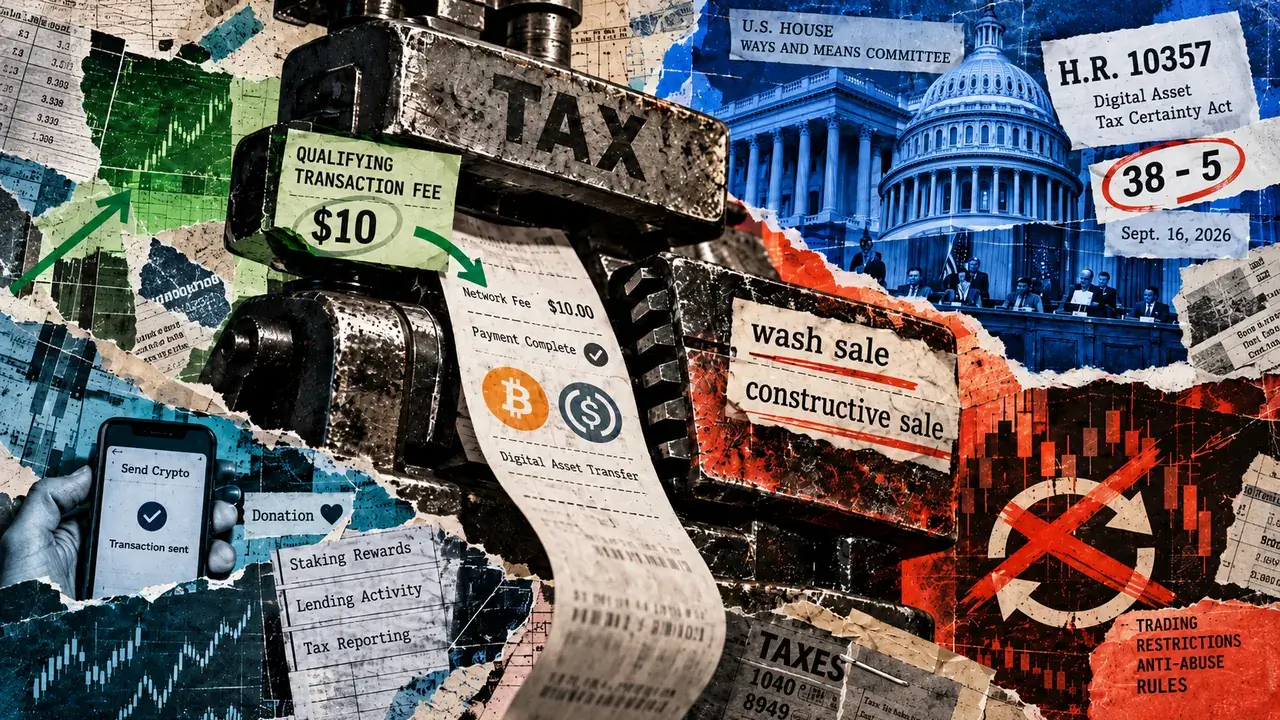
The House Ways and Means Committee has moved a significant piece of digital asset legislation toward a full House vote, marking a pivotal moment in the ongoing effort to integrate cryptocurrencies into the federal tax code. On September 16, the committee approved H.R. 10357, known as the Digital Asset Tax Certainty Act, with an overwhelming bipartisan vote of 38-5. The bill, which was advanced after the adoption of a substitute amendment by Chairman Jason Smith (R-MO), seeks to establish a comprehensive federal framework for the taxation of crypto payments, stablecoins, trading, lending, staking, and mining. While industry leaders have hailed the move as a "historic step," they are simultaneously intensifying their lobbying efforts to secure broader concessions, particularly regarding the taxation of everyday transactions and the timing of income recognition for network validators.
The Evolution of Crypto Taxation: A Chronology of Policy Development
The passage of H.R. 10357 represents the culmination of years of friction between the digital asset industry and the Internal Revenue Service (IRS). For over a decade, the tax treatment of cryptocurrencies has been governed by a patchwork of guidance that many practitioners found insufficient for the complexities of blockchain technology.
In 2014, the IRS issued Notice 2014-21, which remains the foundational pillar of crypto tax law. It established that virtual currency is treated as property for federal tax purposes, rather than currency. This designation meant that every use of cryptocurrency—whether trading it for another token or using it to buy a cup of coffee—triggered a realization event, requiring the calculation of capital gains or losses. By 2019, the IRS expanded this guidance to address hard forks and airdrops, but left significant questions regarding liquidity providing and decentralized finance (DeFi).
The Infrastructure Investment and Jobs Act of 2021 further complicated the landscape by introducing new reporting requirements for "brokers," a term defined so broadly that it initially threatened to include software developers and miners. This sparked a wave of industry pushback, leading to the current legislative push for "tax certainty." The introduction and subsequent committee approval of H.R. 10357 is the House’s direct response to these long-standing ambiguities, aiming to provide a statutory bedrock that prevents the IRS from making major policy shifts through administrative guidance alone.
Core Provisions of H.R. 10357: Balancing Relief and Regulation
The Digital Asset Tax Certainty Act is designed as a "leveling" bill, intended to bring digital asset rules into closer alignment with traditional financial instruments while offering targeted relief for specific blockchain-native activities.
Transaction Fee Exemptions
One of the most immediate reliefs provided by the bill concerns the "tax-on-tax" problem. Currently, if a user pays a blockchain transaction fee (gas fee) using a digital asset that has appreciated in value, that payment is technically a taxable disposition of property. H.R. 10357 would eliminate gain-or-loss recognition for digital assets used to pay qualifying network and transaction fees, provided those fees do not exceed $10. This provision is set to take effect for dispositions after December 31, 2027. To qualify, the asset used for the fee must generally match the asset involved in the underlying transaction.
Stablecoin and Accounting Modernization
The bill introduces special treatment for "qualifying US dollar stablecoins," recognizing their role as a medium of exchange rather than a speculative investment. Furthermore, it creates a simplified accounting election for widely traded digital assets, allowing taxpayers to use more streamlined methods for tracking basis and gains, similar to the rules governing securities.
Closing the Wash-Sale Loophole
In exchange for these concessions, the bill closes a major tax strategy frequently utilized by crypto investors. Currently, cryptocurrencies are not subject to "wash-sale" rules, which prevent taxpayers from claiming a loss on the sale of a security if they purchase a "substantially identical" security within 30 days. Because the IRS treats crypto as property and not a security, investors have historically been able to sell tokens at a loss to offset other gains and immediately buy them back. H.R. 10357 would extend wash-sale and constructive-sale provisions to digital assets, ending this practice and bringing crypto in line with stocks and bonds.
The Industry’s Unfinished Business: Staking and Mining Rewards
Despite the progress made in the committee, the Crypto Council for Innovation (CCI) and other advocacy groups argue that the bill leaves critical issues unresolved—most notably the timing of income recognition for miners and stakers.
Under the current version of the bill, income from digital asset validation activities is explicitly classified as ordinary income. It also establishes sourcing rules based on the location of the taxpayer or the business operation. However, the legislation does not include an "optional deferral" mechanism. Industry advocates have long argued that tokens earned through staking or mining should be treated like "created property"—similar to a farmer growing crops or an author writing a book—where income is only recognized when the property is sold, not when it is first created or received.
Alison Mangiero, head of US policy at the CCI, emphasized that immediate recognition creates a "dry tax" problem. Validators may receive token rewards but lack the cash to pay the resulting tax liability. This often forces them to sell a portion of their rewards immediately, which can create downward price pressure and expose the operator to significant market volatility between the time of receipt and the time of liquidation.
"The committee vote is a historic step, but there is still room to refine the timing of income recognition," Mangiero stated. "Ensuring that validators are not taxed until they actually realize the value of their rewards is essential for the long-term health of decentralized networks."
Expanding the De Minimis Threshold for Everyday Payments
Another point of contention is the scope of the "de minimis" relief. While the bill provides an exemption for transaction fees up to $10, it does not provide a general exemption for small, everyday purchases made with cryptocurrency.
Industry groups are pushing for a broader "personal use" exemption, similar to the rules for foreign currency. If a traveler buys a souvenir in London using British Pounds, they are not required to calculate the capital gain on the currency fluctuation. Crypto advocates argue that for digital assets to ever function as a true medium of exchange, a similar threshold—perhaps $200 or $500—must be established for small purchases. Without this, the administrative burden of tracking the cost basis for a $5 cup of coffee remains a total barrier to adoption.
Bringing Innovation Home: Provisions for DAOs and Foreign Entities
A notable inclusion in the bill is a directive aimed at Decentralized Autonomous Organizations (DAOs) and foreign foundations. For years, many US-led crypto projects have established "foundations" in jurisdictions like Switzerland, Singapore, or the Cayman Islands to avoid the regulatory and tax uncertainty of the US.
H.R. 10357 directs the Treasury Department to issue guidance within 12 months on the tax treatment of foreign entities associated with DAOs. Crucially, it outlines methods for these foundations to reorganize as domestic corporations and provides temporary safe harbors for entities formed before September 14.
Miles Jennings, general counsel at a16z crypto, noted that this could be a "game-changer" for the US tech economy. By providing a clear path for crypto foundations to return to the US, the bill could help repatriate billions of dollars in capital and thousands of high-tech jobs. The goal is to move the industry away from "offshore-by-default" structures toward a domestic framework that provides legal clarity and tax compliance.
Supporting Data: The Economic Context of Crypto Tax Reform
The push for legislative clarity comes at a time when the digital asset market has reached a maturity that the IRS can no longer ignore. According to data from various market analysts, the total market capitalization of digital assets frequently exceeds $2 trillion. Meanwhile, the "tax gap"—the difference between taxes owed and taxes paid—remains a major concern for the Treasury.
A 2023 report from the Government Accountability Office (GAO) highlighted that while the IRS has made strides in enforcement, the lack of clear statutory definitions for many crypto activities hampers both compliance and collection. Proponents of H.R. 10357 argue that by providing "certainty," the bill will actually increase tax revenue by encouraging voluntary compliance and reducing the number of taxpayers who inadvertently run afoul of complex, unwritten rules.
Furthermore, the 38-5 vote in the Ways and Means Committee suggests a rare moment of bipartisan consensus. Lawmakers on both sides of the aisle are beginning to view crypto not just as a niche financial product, but as a critical component of the future financial infrastructure. The inclusion of wash-sale rules is seen as a "pay-for" that makes the bill more palatable to fiscal hawks and those concerned about tax fairness.
Analysis of Implications: What Lies Ahead
If H.R. 10357 passes the full House and survives the Senate, it will represent the most significant update to the US tax code regarding technology since the late 1990s.
For the average investor, the impact will be twofold: the loss of the wash-sale loophole will require more disciplined portfolio management, but the standardization of accounting methods will make tax season significantly less stressful. For the broader industry, the bill signals that the United States is serious about remaining the "crypto capital of the world," a phrase used by Chairman Jason Smith during the markup.
However, the "technical changes" requested by the CCI and other groups will be the focus of the next phase of the legislative process. If the industry can successfully argue that staking rewards are "created property," it could set a global precedent for how Proof-of-Stake networks are taxed. Conversely, if the bill remains as is, the US may see a continued bifurcation: a compliant, regulated domestic market for trading, while the more technical aspects of network validation and DAO governance remain at risk of migrating to more tax-friendly jurisdictions.
As the bill moves toward the House floor, the debate will likely shift from whether crypto should be taxed to the finer points of how and when. The 38-5 committee vote indicates strong momentum, but in the world of federal tax policy, the details are where the true impact—and the true controversy—resides. For now, the digital asset industry has secured a significant victory in the halls of Congress, even as it prepares for the next round of negotiations to ensure the final law reflects the unique nature of blockchain technology.