Dwi Wanna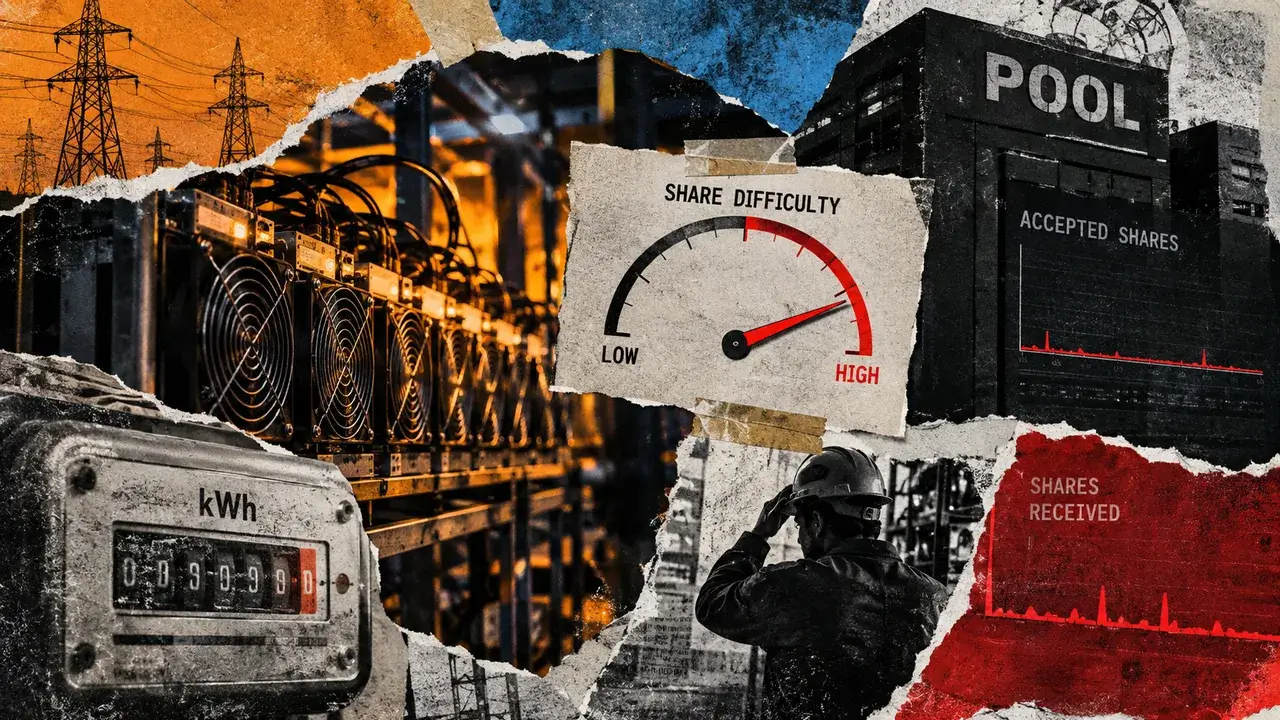
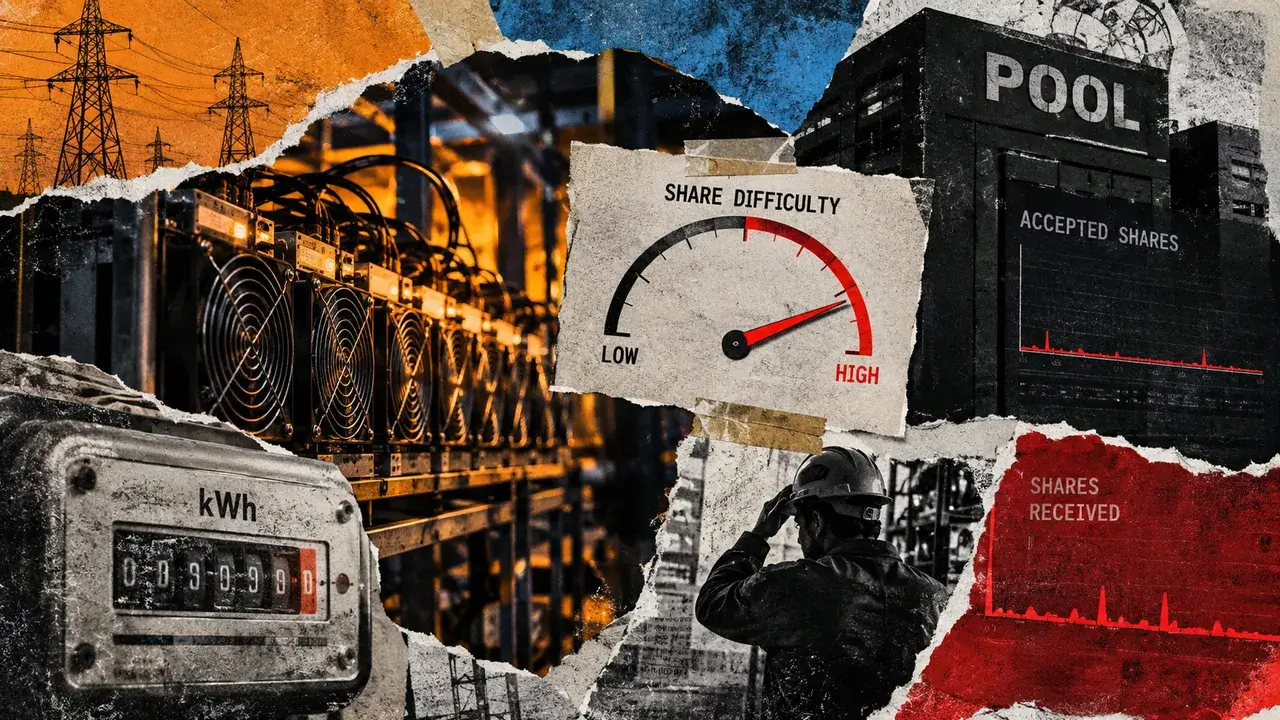
A critical technical vulnerability in certain Bitcoin mining pool controllers has been identified, revealing a scenario where mining hardware continues to consume electricity while failing to receive credit for the work performed. This phenomenon, primarily affecting systems utilizing specific variable difficulty (vardiff) algorithms, creates a paradoxical situation: when a miner attempts to reduce power consumption or slow down operations—often in response to grid demands or economic incentives—the mining pool may fail to adjust its work assignments. Consequently, the miner continues to hash at a lower speed while the pool continues to demand results based on the previous, higher speed, leading to a "share drought" where accepted shares become nearly non-existent despite ongoing energy expenditure.
This technical failure mode was recently highlighted by Bitcoin Optech on September 18, 2026, drawing significant industry attention to a detailed analysis originally published in July by mining engineer Eric Price. The research underscores a specific weakness in pool-assigned share difficulty rather than the global Bitcoin network difficulty. While the global difficulty adjusts approximately every two weeks to maintain a 10-minute block interval, mining pools use localized difficulty settings to track the individual contributions of connected machines. When these localized controllers fail to synchronize with the actual output of the hardware, the result is a total loss of efficiency for the operator and a waste of energy for the grid.
The Mechanics of Variable Difficulty and Share Accounting
To understand how this "trap" occurs, one must first examine the relationship between a mining pool and its participants. Because the probability of an individual miner finding a valid Bitcoin block is extremely low, miners aggregate their computational power into pools. To distribute rewards fairly, pools require miners to submit "shares"—hashes that do not necessarily meet the network’s strict difficulty requirement for a block but do meet a lower, pool-defined threshold. These shares serve as proof of work, allowing the pool to estimate the miner’s hashrate and allocate rewards accordingly.
The vardiff controller is the software mechanism responsible for adjusting this share difficulty in real-time. If a miner has a very high hashrate, the pool assigns a higher share difficulty to prevent the network connection from being overwhelmed by a constant stream of low-value shares. Conversely, if a miner is slower, the difficulty is lowered so that shares arrive at a manageable and useful frequency, typically every few seconds.
The vulnerability identified by Eric Price occurs when a vardiff controller is "share-triggered" rather than "timer-triggered." In a share-triggered system, the controller only recalculates the required difficulty when it receives a new share from the miner. If a miner suddenly curtails its power—perhaps dropping from 100 terahashes per second (TH/s) to 5 TH/s—the pool may still be waiting for a share calibrated for the 100 TH/s speed. At the lower speed, the probability of the miner finding a share that meets the old, high-difficulty target becomes statistically improbable. Because the miner cannot find a share, the controller never receives the signal to lower the difficulty. This creates a feedback loop where the miner is "stranded," hashing indefinitely without ever providing the pool with the proof needed to trigger a difficulty reduction.
Real-World Context: The Impact of Power Curtailment
The practical implications of this research are most visible during periods of grid instability. Bitcoin miners are increasingly integrated into demand-response programs, where they agree to reduce their energy consumption during peak demand or extreme weather events to ensure the stability of the electrical grid. For instance, during a severe winter storm in January 2026, the Bitcoin network saw a significant, abrupt drop in hashrate as major mining operations in the United States curtailed their power usage to divert electricity to residential heating and critical infrastructure.
While these curtailment events are intended to be environmentally and socially responsible, the vardiff "trap" suggests that some of that curtailed energy may still be wasted. If a miner reduces its power to 10% but the pool controller gets stuck at the 100% difficulty level, that 10% of energy is effectively burned for zero return. The miner receives no payment for the work, and the energy does not contribute to the security of the Bitcoin network because the pool never "sees" the work.
This issue is particularly relevant for miners operating on a Pay-Per-Share (PPS) or Full Pay-Per-Share (FPPS) model. In these systems, miners are paid for every valid share they submit. If a share drought occurs, the miner’s revenue drops to zero instantly, even if they are still consuming megawatts of power. In proportional reward systems, the impact is slightly different but equally problematic, as the lack of shares can cause the miner to lose their "weight" in the reward window, effectively giving their share of the block reward to other participants in the pool.
Chronology of the Discovery and Industry Response
The timeline of this discovery highlights the evolving nature of Bitcoin’s infrastructure and the ongoing shift toward more robust protocols:
- July 2026: Mining engineer Eric Price publishes his initial research on "clockless vardiff" on the Delving Bitcoin research forum. The analysis identifies the specific mathematical conditions under which a slowing miner becomes stranded.
- August 2026: Developers within the Stratum V2 project begin reviewing the findings to ensure the new protocol implementation addresses these edge cases.
- September 18, 2026: Bitcoin Optech, a prominent technical newsletter, features Price’s analysis, bringing the issue to the attention of the broader mining community and pool operators.
- Late September 2026: The MARA Foundation (the non-profit arm of MARA, formerly Marathon Digital Holdings) releases updated testing tools, including "shape-proxy," allowing operators to simulate hashrate drops and observe how their pools respond.
The industry response has focused on the adoption of Stratum V2, the next-generation mining protocol designed to replace the aging Stratum V1. The reference implementation of Stratum V2 includes a timer-based recalculation feature. Unlike the vulnerable share-triggered systems, Stratum V2 can detect a "drought" of shares over a specific time interval and automatically lower the difficulty, even if no shares have been submitted. This ensures that a miner can "recover" from a power curtailment and begin receiving credit for their work again within a reasonable timeframe.
Data and Technical Analysis of Pool Behavior
The prevalence of this issue across the global mining landscape remains difficult to quantify precisely, as pool software is often proprietary. However, the open-source "ckpool" has been identified as an example of a system that employs share-triggered updates. While ckpool is highly regarded for its efficiency and role in solo mining, the research suggests that its specific vardiff implementation could lead to the stranding of miners during abrupt speed changes.

To mitigate these risks, the MARA Foundation’s "shape-proxy" tool has become a vital asset for mining farm operators. The tool acts as a middleman between the mining hardware and the pool. It can be programmed to "shape" the reported hashrate—for example, by locally acknowledging shares but only forwarding a small fraction to the pool. This allows operators to test whether their pool’s controller will correctly "ramp down" the difficulty or if it will stay "pinned" at a high level.
Initial tests using such tools have shown varying results. Some pools recover within minutes, while others may leave a miner stranded for hours or until the connection is manually reset. The "age" of the mining channel also plays a role; long-lived connections that have established a very high difficulty level are statistically more likely to suffer from a prolonged drought than newer connections with more frequent updates.
Broader Implications for the Mining Industry
The revelation of the vardiff vulnerability has broader implications for the narrative of Bitcoin mining as a flexible grid load. If Bitcoin miners are to be seen as a reliable tool for grid balancing, the software layers connecting the hardware to the financial incentives must be flawless. A failure in the vardiff controller represents a breakdown in the economic signal: the grid wants the miner to slow down, and the miner complies, but the pool software fails to acknowledge the remaining work, leading to a loss of economic viability for the operator.
Furthermore, this issue highlights the technical debt inherent in the original Stratum V1 protocol, which has served the industry for over a decade. Stratum V1 lacks many of the security and efficiency features required for the modern, multi-billion-dollar mining industry. The push toward Stratum V2 is not merely about privacy or decentralization—it is increasingly about the fundamental operational reliability of mining as an industrial process.
From an environmental perspective, the "burn" of energy without result is a direct contradiction of the industry’s goals to improve efficiency. As Bitcoin’s energy consumption remains a point of intense public and regulatory scrutiny, ensuring that every watt-hour consumed translates into verifiable network security is paramount. The discovery of the vardiff trap provides a clear roadmap for pool operators to improve their software and for miners to demand better standards from their service providers.
As the network continues to grow—with Bitcoin currently maintaining a massive market capitalization of approximately $1.67 trillion and a circulating supply of over 20 million BTC—the stability of its underlying infrastructure is more important than ever. The transition to more intelligent, timer-triggered difficulty controllers is expected to become a standard requirement for industrial-scale mining operations moving forward, ensuring that even when the power is cut, the energy that remains is never wasted.