Dwi Wanna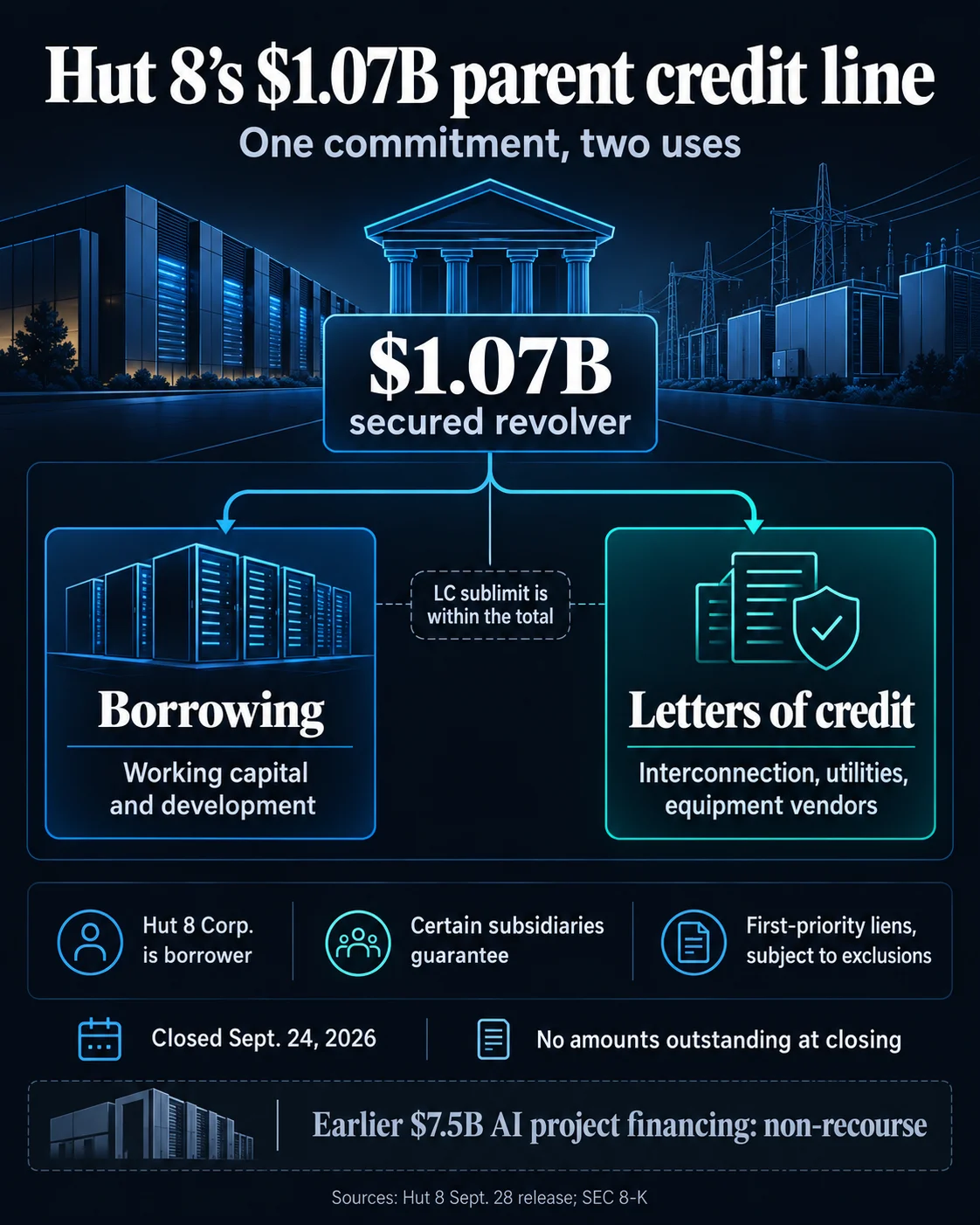
Bitcoin mining powerhouse Hut 8 Corp. has finalized a four-year, $1.07 billion senior secured revolving credit facility, marking a significant milestone in the company’s transition from a pure-play cryptocurrency miner to a diversified digital infrastructure and artificial intelligence (AI) service provider. The deal, which closed on September 24 and was publicly disclosed on September 28, provides the parent company with a massive capital reservoir to fund its ambitious expansion into high-performance computing (HPC) and energy-intensive data center development.
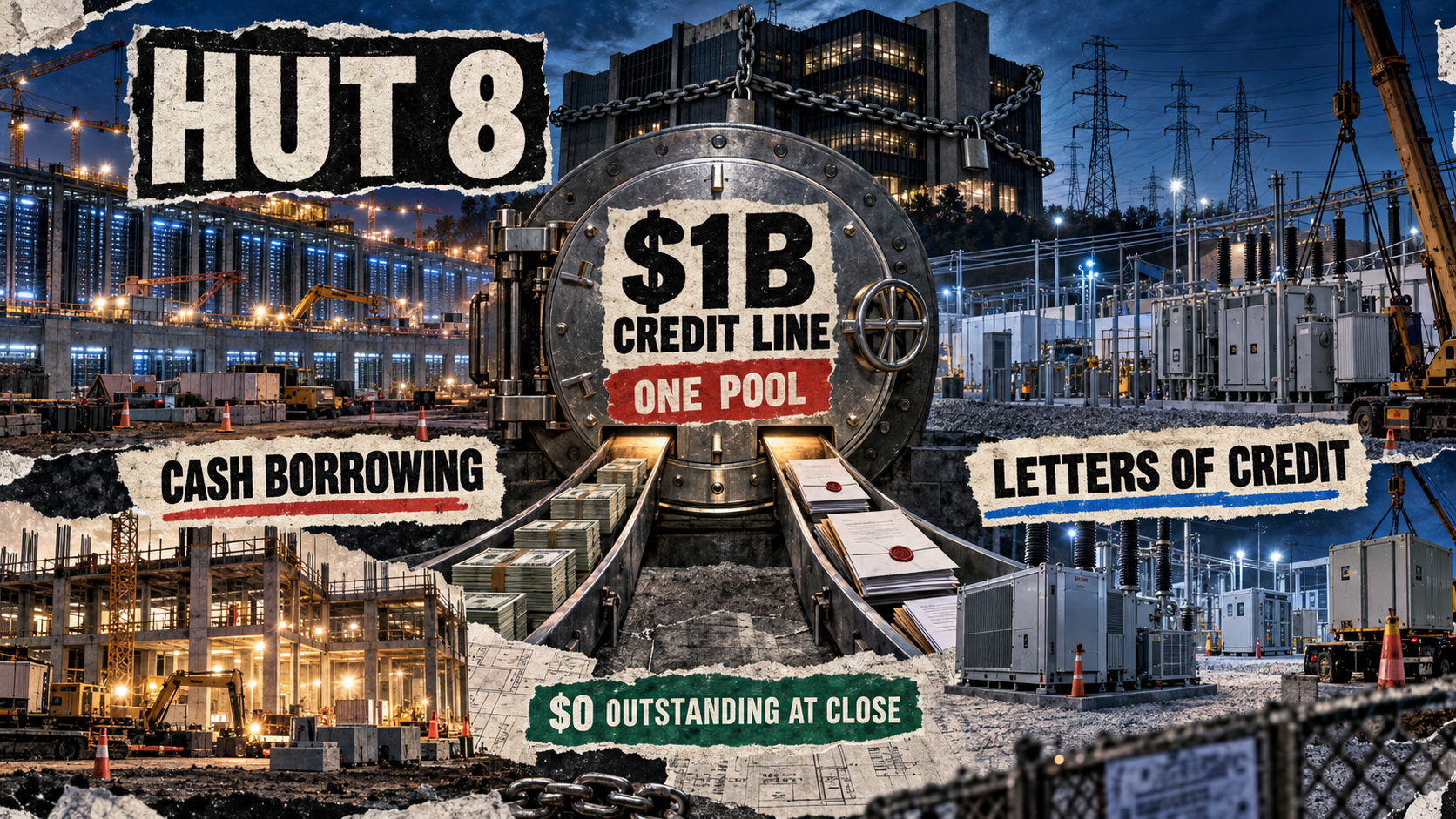
The credit facility is structured to offer Hut 8 maximum operational flexibility, allowing the firm to toggle between direct cash borrowing and the issuance of letters of credit. According to a Securities and Exchange Commission (SEC) filing, no funds were outstanding at the time of the agreement’s closing, suggesting the facility serves as a strategic "war chest" rather than an immediate debt burden. This financial maneuver comes at a critical juncture for the digital asset industry, where miners are increasingly seeking to leverage their power assets and electrical infrastructure to serve the burgeoning AI market.
Strategic Architecture of the $1.07 Billion Facility
The newly established credit line is a senior secured revolving facility, meaning it is backed by the company’s assets and sits at the top of the capital structure for repayment priority. The $1.07 billion commitment includes a specific sublimit of $1 billion for letters of credit. These instruments are essential for large-scale infrastructure projects, as they allow Hut 8 to support interconnection deposits and meet obligations to utility providers and hardware vendors without immediately exhausting its cash reserves.
By utilizing letters of credit, Hut 8 can significantly reduce the amount of "dead" cash held as collateral for energy contracts. In the power-hungry world of Bitcoin mining and AI data centers, utility companies often require substantial financial guarantees before energizing a site. The ability to issue letters of credit under this facility provides Hut 8 with a capital-efficient method to secure these power agreements, which are increasingly difficult to obtain as electrical grids face rising demand.
The interest rate on the facility is tied to the Term Secured Overnight Financing Rate (SOFR), the modern benchmark that replaced LIBOR. Hut 8 will initially pay a margin of 1.75 percentage points above the SOFR benchmark. However, this margin is dynamic, ranging from 1.50 to 2.00 percentage points based on the company’s debt-to-market-capitalization ratio. This structure incentivizes the company to maintain a healthy balance sheet, as a stronger market valuation relative to its debt will lead to lower borrowing costs.
Chronology and Financial Context
The path to this billion-dollar credit line has been paved by a series of strategic consolidations and capital raises. To understand the scale of this facility, one must look at Hut 8’s recent financial trajectory:
- June 30, 2026: Hut 8’s quarterly balance sheet reported approximately $233.6 million in cash and cash equivalents. While substantial, this amount was deemed insufficient to cover the multi-billion-dollar capital expenditures required for Tier 3 and Tier 4 data center construction.
- The AI Pivot: Earlier in the year, Hut 8 secured $7.5 billion in non-recourse project financing specifically for its River Bend and Beacon Point AI campuses. Unlike the new $1.07 billion facility, that financing was "non-recourse," meaning the lenders’ claims are limited to the specific assets of those projects rather than the parent company’s entire balance sheet.
- September 24, 2026: The $1.07 billion senior secured credit agreement was officially signed, naming Hut 8 Corp. as the primary borrower.
- September 28, 2026: The company issued a formal announcement to the markets, detailing the expanded corporate liquidity.
The introduction of the new credit line creates a dual-layered financing strategy. While the $7.5 billion project financing handles the heavy lifting for specific site builds, the $1.07 billion parent-level facility provides the bridge financing and general corporate liquidity needed to move projects through early stages of development before they qualify for dedicated project-level loans.
Rigorous Covenants and Liquidity Rules
While the credit facility provides immense liquidity, it comes with stringent requirements designed to protect lenders. One of the most notable features of the agreement is the minimum liquidity covenant, which is set to take effect for the fiscal quarter ending March 31, 2027.
The agreement mandates that Hut 8 maintain a liquidity threshold of 40% of the total commitment before a "stabilization date"—a defined milestone likely linked to the operational status of its new data centers. Once this stabilization date is reached, the requirement drops to 25%. Measured against a $1.07 billion commitment, a 40% liquidity requirement equates to roughly $428 million.
This covenant is particularly significant because Hut 8 reported only $233.6 million in cash at the end of June. The gap suggests that the company anticipates significant cash flow generation from its mining operations or additional equity/debt raises before the 2027 deadline. The agreement does include "equity cure rights," a standard clause that allows the company to rectify a potential covenant breach by raising additional capital through the sale of stock.
Furthermore, the agreement places restrictions on the company’s ability to take on additional debt or place liens on its assets. The parent company and certain restricted subsidiaries act as guarantors, with first-priority liens covering nearly all assets. This effectively pledges the company’s mining rigs, real estate, and intellectual property as collateral, underscoring the "senior secured" nature of the deal.
The Broader Shift: From Hashing to High-Performance Computing
Hut 8’s massive credit facility is a bellwether for a broader trend in the cryptocurrency mining industry. Following the most recent Bitcoin halving, which slashed the rewards for mining a block by 50%, many miners have found their profit margins squeezed. This has led to a strategic "pivot" toward AI and HPC, where the demand for data center space and power is at an all-time high.
The infrastructure required for AI is fundamentally different from traditional Bitcoin mining. While Bitcoin miners can operate in "Tier 0" or "Tier 1" warehouses with minimal cooling and redundancy, AI training and inference require "Tier 3" or "Tier 4" facilities. These centers demand sophisticated liquid cooling systems, redundant power supplies, and ultra-low-latency fiber connections. The costs associated with building these facilities are an order of magnitude higher than mining farms.
Hut 8’s River Bend and Beacon Point campuses are designed to meet these rigorous standards. By securing $1.07 billion at the parent level, Hut 8 is positioning itself as one of the few "pure-play" miners capable of competing with traditional data center giants like Equinix or Digital Realty.
Industry Reactions and Market Implications
Market analysts view the move as a sign of maturing financial sophistication within the crypto-mining sector. Historically, mining companies relied heavily on at-the-market (ATM) equity offerings, which often diluted shareholders. By moving toward large-scale revolving credit facilities and project-level financing, Hut 8 is utilizing more traditional corporate finance tools that can potentially offer a lower cost of capital over the long term.

Industry observers note that Hut 8’s strategy mirrors that of other leaders in the space, such as Core Scientific, which recently signed a multi-billion-dollar deal with CoreWeave to provide infrastructure for AI. However, Hut 8’s approach of securing a massive revolving line at the parent level provides a unique "flex" capability, allowing them to pounce on distressed assets or opportunistic power acquisitions that may arise in a volatile energy market.
The reaction from the utility sector is also expected to be positive. Power providers are often wary of the volatile nature of Bitcoin mining revenue. A $1 billion sublimit for letters of credit backed by a senior secured facility provides utility companies with the financial certainty they require to commit hundreds of megawatts of power to Hut 8’s projects.
Future Outlook and Operational Risks
Despite the strengthened balance sheet, Hut 8 faces several operational hurdles. The successful deployment of this capital depends on the company’s ability to navigate complex supply chains for GPUs and electrical transformers—items currently facing lead times of 12 to 24 months.
Moreover, the transition to AI requires a different talent pool than Bitcoin mining. Hut 8 will need to continue investing in software engineering and data center management expertise to satisfy the Service Level Agreements (SLAs) expected by AI clients.
The 40% liquidity covenant starting in 2027 also puts a clock on the company’s performance. Hut 8 must demonstrate that its diversified business model—combining Bitcoin mining, managed services, and AI infrastructure—can generate the consistent cash flow necessary to meet lender requirements without relying solely on the price of Bitcoin.
In conclusion, Hut 8’s $1.07 billion credit facility represents a bold bet on the convergence of digital assets and artificial intelligence. By securing parent-level financing of this magnitude, the company has transformed its financial profile, moving from a speculative miner to a heavyweight player in the global race for digital infrastructure. The coming years will determine if the company can execute on its vision of "Power over Hashing," utilizing this massive capital infusion to build the backbone of the next technological revolution.