Dwi Wanna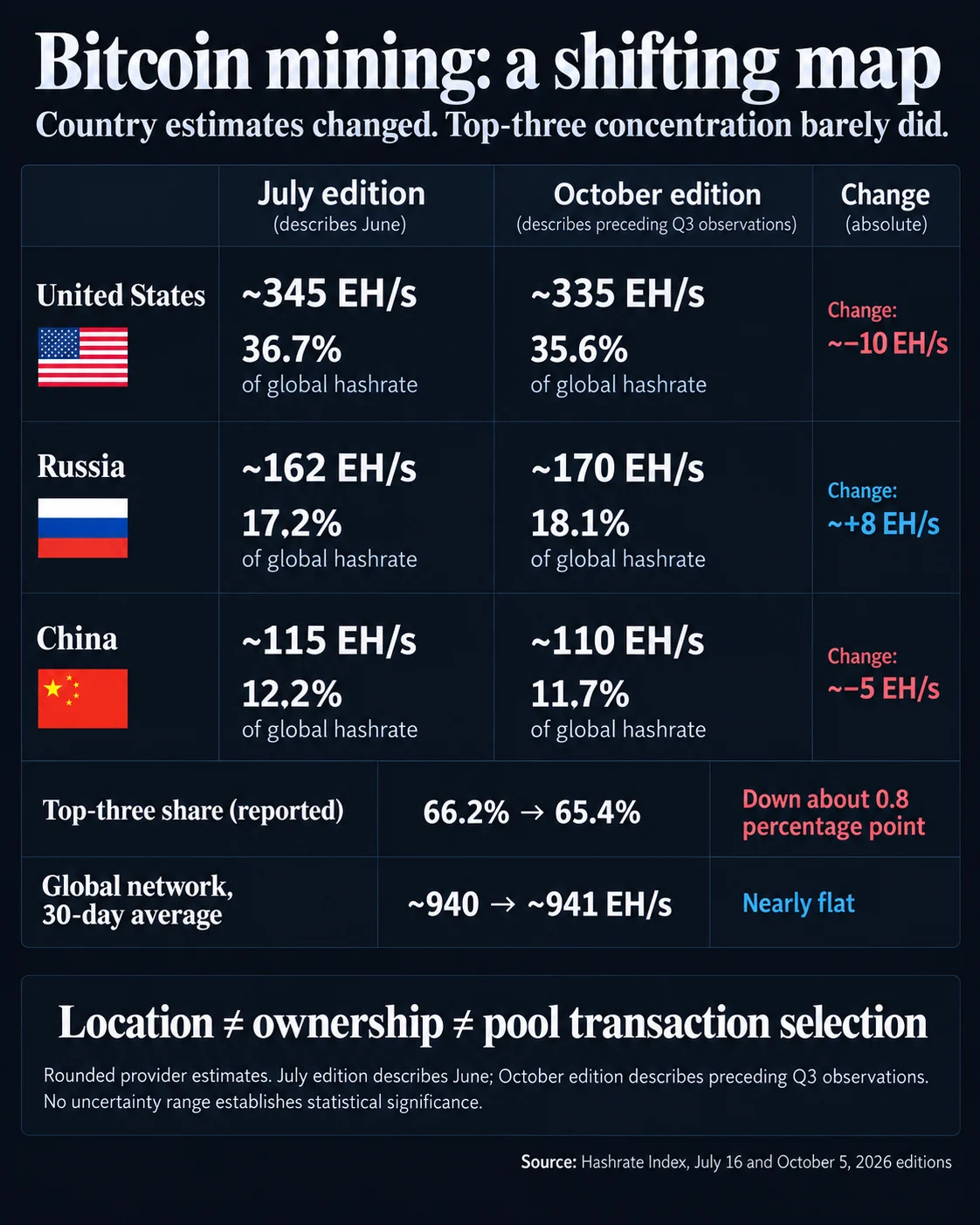
The global landscape of Bitcoin mining is undergoing a notable realignment as the United States witnesses a contraction in its share of the network’s total computing power, while Russia continues to bolster its domestic hashrate. According to the latest quarterly estimates released by Luxor Technology’s Hashrate Index on October 5, 2026, the United States’ estimated mining footprint has retreated from previous highs, dropping to approximately 335 exahashes per second (EH/s). This represents a decline from the 345 EH/s recorded in the July update. Conversely, Russia’s contribution to the network has surged, climbing from 162 EH/s to 170 EH/s over the same period. Despite these shifts in the balance of power between the two largest mining nations, the overall concentration of the network remains largely unchanged, with the top three countries—the United States, Russia, and China—continuing to command roughly two-thirds of the global hashrate.
Evolution of the Global Mining Map in 2026
The transition observed between the third and fourth quarters of 2026 highlights a cooling of the aggressive expansion previously seen in North American mining corridors. While the United States remains the undisputed leader in terms of absolute hashrate, its percentage share of the global network slipped from 36.7% in June to 35.6% by the end of September. This nearly 1.1% decrease in market share coincides with a period of significant industrial transition within the U.S. borders, characterized by a strategic pivot toward alternative high-performance computing (HPC) workloads.
In contrast, Russia has capitalized on favorable regulatory frameworks and abundant energy resources to increase its market share from 17.2% to 18.1%. This growth suggests that the Russian mining sector is maturing and expanding its infrastructure even as other regions face economic or operational headwinds. China, meanwhile, maintains its position as the third-largest contributor to the network, despite a slight decline in its estimated output from 115 EH/s to 110 EH/s, bringing its global share to approximately 11.7%.
The global 30-day simple moving average of hashrate remained remarkably stable during this transition, moving only slightly from 940 EH/s to 941 EH/s. This near-flat growth at the aggregate level indicates that the gains made in Russia and other emerging regions were almost perfectly offset by the declines observed in the U.S. and China. This stagnation in total network growth reflects a broader stabilization in the mining industry following the volatility of previous years.
Chronology of Data Reporting and Methodology
The data provided by the Hashrate Index serves as a retrospective analysis of the third quarter of 2026, despite being labeled as the "fourth-quarter update." The timeline of these reports is critical for understanding the lag between operational changes and statistical reporting. The July 16 edition of the report captured data primarily from June 2026, while the October 5 publication reflects observations from July through September.
Determining the precise geographic location of Bitcoin mining hardware is an inherently complex task. The Hashrate Index utilizes a weighted methodology that combines several data streams, including mining pool statistics, ASIC (Application-Specific Integrated Circuit) trading flows, and firmware adoption trends. This multi-faceted approach aims to bypass the limitations of traditional reporting, which often relies solely on IP addresses that can be masked or diverted through Virtual Private Networks (VPNs) and proxy servers.
The Cambridge Centre for Alternative Finance (CCAF), which maintains a separate and widely cited mining map, has historically warned that pool samples may be unrepresentative of the entire network. The potential for geographic distortion remains a significant hurdle for analysts. However, the consistency of the shift between the July and October reports from Luxor suggests a genuine trend rather than a statistical anomaly, even if the absolute figures remain estimates rather than a live census of every machine on the network.
The Strategic Pivot: AI and High-Performance Computing
One of the primary drivers behind the decline in U.S. hashrate is the accelerating trend of Bitcoin mining firms repurposing their infrastructure for artificial intelligence (AI) and high-density colocation services. As the demand for AI processing power has skyrocketed, many mining companies have found that the revenue potential per kilowatt-hour is significantly higher in the HPC sector than in the increasingly competitive Bitcoin mining market.
The industrial shift is substantiated by recent corporate disclosures. Keel Infrastructure, a significant player in the North American energy and mining space, revealed in its August 10 operational disclosure that it had completed the decommissioning of its entire U.S. Bitcoin mining fleet. This move was not an exit from the technology sector but rather a prerequisite for the construction of specialized HPC facilities. Similarly, Core Scientific announced during its July 28 results presentation that it is in the midst of an ongoing process to repurpose its remaining mining facilities. The company is transitioning toward high-density colocation services, a move that changes the operating status of these sites from active mining to infrastructure support for broader tech applications.
This "AI gold rush" within the mining industry explains why the U.S. hashrate has declined without a corresponding crash in the global network’s security. Machines are not necessarily being destroyed; they are being switched off to make room for more profitable silicon, or they are being sold and relocated to jurisdictions with lower electricity costs and fewer competing demands for power.

Geopolitical Implications and Russia’s Growth Trajectory
The rise of Russia as a mining powerhouse poses significant questions for the geopolitical distribution of the Bitcoin network. With its hashrate climbing to 170 EH/s, Russia is solidifying its role as a critical pillar of the network’s security architecture. This growth is often attributed to the country’s vast, underutilized hydroelectric and natural gas resources, particularly in regions like Siberia, where the cold climate naturally reduces the cooling costs associated with large-scale data centers.
Furthermore, the stability of the Russian share suggests a level of institutional and governmental support that contrasts with the regulatory scrutiny often faced by miners in Western jurisdictions. As Russia increases its share of the network, the influence of its domestic policies on global mining trends will likely grow. However, analysts note that a larger share of hashrate does not necessarily equate to control over the protocol itself, as the decentralized nature of Bitcoin separates the physical location of hardware from the decision-making processes of the network.
Technical Nuances: Location vs. Control
A critical distinction must be made between where a mining machine is physically located and who controls the blocks it produces. While the Hashrate Index tracks the estimated location of computing power, this does not always align with beneficial ownership or pool coordination. In the Bitcoin ecosystem, individual miners typically contribute their hashing power to a "pool," which coordinates the work and selects the transactions to be included in a block.
The Bitcoin developer guide clarifies that in traditional pooled mining (using the legacy Stratum protocol), the pool operator—not the individual miner—holds the power to select transactions. Consequently, even if a significant portion of hardware is located in the United States or Russia, the actual selection of transactions could be managed by a pool operator based in an entirely different jurisdiction.
The emergence of Stratum V2 is beginning to shift this dynamic. This updated protocol allows individual miners to optionally select their own transaction sets, potentially decentralizing the block construction process. However, the extent to which Stratum V2 is currently utilized across the global network remains unclear. Without comprehensive data on ownership and real-time pool participation, geographic estimates alone cannot provide a full picture of the network’s decentralization.
Environmental and Policy Challenges in Emerging Markets
Beyond the top three countries, the global mining landscape is being shaped by local energy policies and environmental constraints. The Hashrate Index noted a decline in Ethiopia’s mining output, which it attributed to recent power restrictions imposed by the government. Such instances highlight the vulnerability of mining operations to sudden shifts in national energy priorities.
In many emerging markets, Bitcoin mining is viewed as a double-edged sword: a source of foreign investment and a way to monetize stranded energy, but also a potential strain on domestic power grids. The "country delta"—the change in a nation’s share of hashrate—is often the result of a complex interplay between seasonal weather patterns (affecting hydroelectric output), national policy shifts, and global hardware availability.
Future Outlook and Network Resilience
As the Bitcoin network approaches the end of 2026, the data suggests a period of consolidation and maturation. The fact that the global hashrate has remained stable at 941 EH/s despite the major industrial shifts in the United States indicates a resilient and highly adaptive global market. When capacity is taken offline in one region due to economic pivots or power rationing, it is quickly absorbed by operators in other jurisdictions who are able to maintain better margins.
For stakeholders, the key metrics to watch in the coming months will be the persistence of these geographic trends. If the U.S. share continues to decline in favor of AI workloads, the network may see a more pronounced distribution of hashrate across a larger number of countries, potentially enhancing decentralization. However, if the top three countries continue to hold a 65% to 66% share, the concerns regarding geographic concentration will persist.
Ultimately, the October update from the Hashrate Index underscores that the Bitcoin mining industry is no longer just about "finding cheap power." It is now a sophisticated global arms race influenced by the competing demands of the AI revolution, national energy security, and the evolving technical protocols that govern the world’s largest decentralized financial network. Establishing whether the network is truly becoming more decentralized will require more than just hashrate location data; it will require deeper transparency into the ownership structures and pool management practices that define the true power centers of the Bitcoin ecosystem.