admin
admin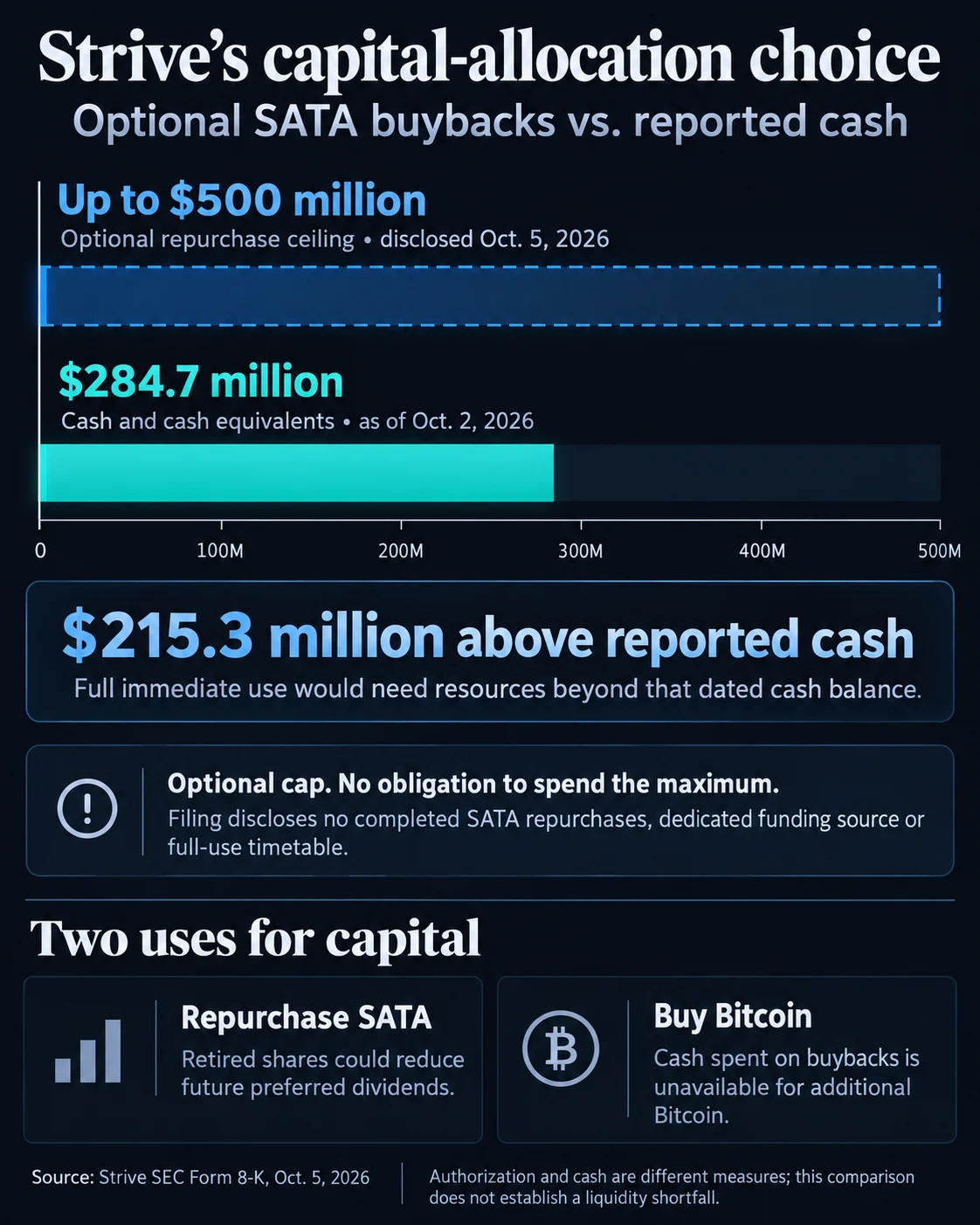
Bitcoin treasury company Strive has announced an optional program to repurchase up to $500 million of its variable-rate perpetual preferred stock, traded under the ticker SATA. This strategic move, disclosed on October 5th, provides Strive’s management with a significant new tool to manage its financial obligations, specifically by potentially reducing preferred dividend costs, and to critically re-evaluate its capital allocation strategy, particularly concerning future Bitcoin acquisitions.
The announced repurchase program’s ceiling of $500 million notably exceeds the company’s reported cash balance of $284.7 million as of October 2nd. This financial dynamic necessitates a careful balancing act for Strive’s leadership, who must now weigh the benefits of retiring dividend-bearing preferred shares against the continued acquisition of Bitcoin, the company’s primary asset. The Securities and Exchange Commission (SEC) filing details that management has the discretion to repurchase shares on a periodic basis, offering flexibility rather than a mandate. The $500 million cap represents a $215.3 million increase over the cash balance reported on October 2nd, implying that a full utilization of the repurchase authority would require accessing funds beyond the company’s immediate liquidity.
Crucially, the filing emphasizes the optional nature of this program. It does not create an obligation for Strive to spend the maximum allocated amount, nor does it signal an impending liquidity shortfall. As of the disclosure, there were no reported completed SATA repurchases, no dedicated funding source explicitly identified for the program, and no defined timetable for deploying the full repurchase capacity. This discretionary approach underscores Strive’s intention to maintain flexibility in its financial operations.
Background and Strategic Context
Strive’s operational model has been characterized by its "preferred-funded Bitcoin strategy." This approach involves issuing preferred stock, such as SATA, to raise capital, which is then largely deployed into acquiring Bitcoin. While this strategy has enabled significant Bitcoin accumulation, it also entails ongoing financial commitments, primarily through dividend payments on the preferred shares.
The SATA preferred stock carries an annualized dividend rate of $13 per share, which, based on a stated amount of $100 per share, translates to a 13% yield. This rate is subject to change and is dependent on board declaration for cash payments. A significant aspect of the preferred stock’s structure is that dividends accrue even when not formally declared. Declared cash dividend payments are then distributed across business days.
As of October 2nd, Strive reported a total of 13,498,082 SATA shares outstanding. This figure reflects an increase from the 12,193,180 shares reported on September 25th, with the latest figures including shares sold up to the 4 p.m. cutoff on the preceding business day for issuance on the following business day.
The Dual Choice: Share Buybacks vs. Bitcoin Accumulation

The introduction of the SATA repurchase program presents Strive’s management with a clear strategic dichotomy: to either reduce its future dividend obligations by retiring preferred shares or to continue allocating capital towards acquiring more Bitcoin.
Retiring SATA shares could offer several advantages. Primarily, it would reduce the company’s ongoing dividend commitments, thereby lowering its fixed cash outflows. Furthermore, repurchasing preferred shares could diminish the preferential claims that these shares hold over common shareholders in the company’s capital structure. The extent of these savings would be directly influenced by the number of shares retired and the prevailing dividend rate at the time of repurchase.
However, any capital deployed for SATA buybacks would, by definition, be unavailable for additional Bitcoin purchases. This means that a decision to aggressively repurchase shares could slow down or halt the company’s pace of Bitcoin accumulation, a core tenet of its investment strategy. The purchase price at which Strive acquires its own preferred stock will also be a critical factor in determining the overall cash cost of the buyback program.
Financial Footprint and Operational Data
Strive’s most recent disclosures reveal a substantial Bitcoin holding. As of October 2nd, the company reported holding 29,462 BTC. This figure was bolstered by a recent acquisition of 2,000 Bitcoin between September 28th and October 2nd. The average purchase price for this recent tranche was approximately $84,422 per Bitcoin, inclusive of all associated fees and expenses. These holdings are distinct from preliminary, unaudited figures for September 30th, which indicated 28,000 BTC and were subject to further revision.
The company’s website outlines its commitment to remaining debt-free and indicates a willingness to explore various capital allocation and financing alternatives. This suggests a proactive approach to financial management, seeking optimal ways to structure its balance sheet and fund its strategic objectives.
However, Strive also acknowledges the complexities introduced by its preferred equity structure. The company has cautioned that its reported Bitcoin-per-share metrics may not fully capture the impact of the senior claims established when preferred issuance is used to fund Bitcoin purchases. This nuance is important for investors to consider when evaluating the company’s financial health and shareholder value.
Key Considerations for Investors and Future Outlook
For common shareholders, the true impact of the SATA repurchase program will become clearer as Strive provides further disclosures. The critical data points to monitor will include the actual amount of capital spent on repurchases, the number of shares retired, and updated figures for the company’s cash reserves and Bitcoin holdings. These disclosures will provide tangible evidence of whether the program is effectively reducing the preferred dividend burden and how much capital remains available for the continued expansion of its Bitcoin portfolio.

The amended terms of SATA’s preferred stock, as detailed in SEC filings, allow for market repurchases independently of a contractual optional redemption clause. The latter has a specified base price of $110 per share, plus any applicable unpaid dividends. The new repurchase facility, however, does not impose this $110 price cap on every buyback, offering management greater flexibility in determining purchase prices within the overall $500 million limit.
The strategic decision-making process at Strive will likely involve a continuous assessment of market conditions, Bitcoin price volatility, and the prevailing interest rate environment, which can influence the cost of capital and dividend yields. The optional nature of the buyback program allows Strive to adapt its strategy in response to these evolving factors.
Broader Market Implications and Analysis
The move by Strive highlights a growing trend among Bitcoin-centric companies to explore sophisticated financial instruments to optimize their capital structures. As the cryptocurrency market matures, companies are increasingly looking beyond simple asset acquisition and are focusing on financial engineering to enhance shareholder value and manage operational costs.
The SATA repurchase program can be viewed as a strategic response to the cost of capital associated with preferred stock financing. While preferred stock can be an effective way to raise capital without diluting common equity in the immediate term, the ongoing dividend obligations represent a persistent expense. By offering a mechanism to reduce these obligations, Strive is seeking to improve its long-term profitability and financial flexibility.
Furthermore, the program underscores the ongoing debate within the Bitcoin investment community regarding the optimal allocation of capital. While Bitcoin’s long-term appreciation potential remains a primary driver for many investors, companies like Strive must also manage the operational and financial aspects of their business. The decision to repurchase stock versus buying more Bitcoin reflects a calculated trade-off between immediate cost reduction and potential future asset growth.
The success of this strategy will ultimately depend on Strive’s ability to execute its buyback program effectively, manage its cash reserves prudently, and continue to navigate the volatile cryptocurrency market. Investors will be closely watching for evidence that this strategic initiative leads to tangible improvements in financial performance and enhances the value proposition for common shareholders. The company’s commitment to transparency and timely disclosure will be paramount in building and maintaining investor confidence throughout this process.