Dwi Wanna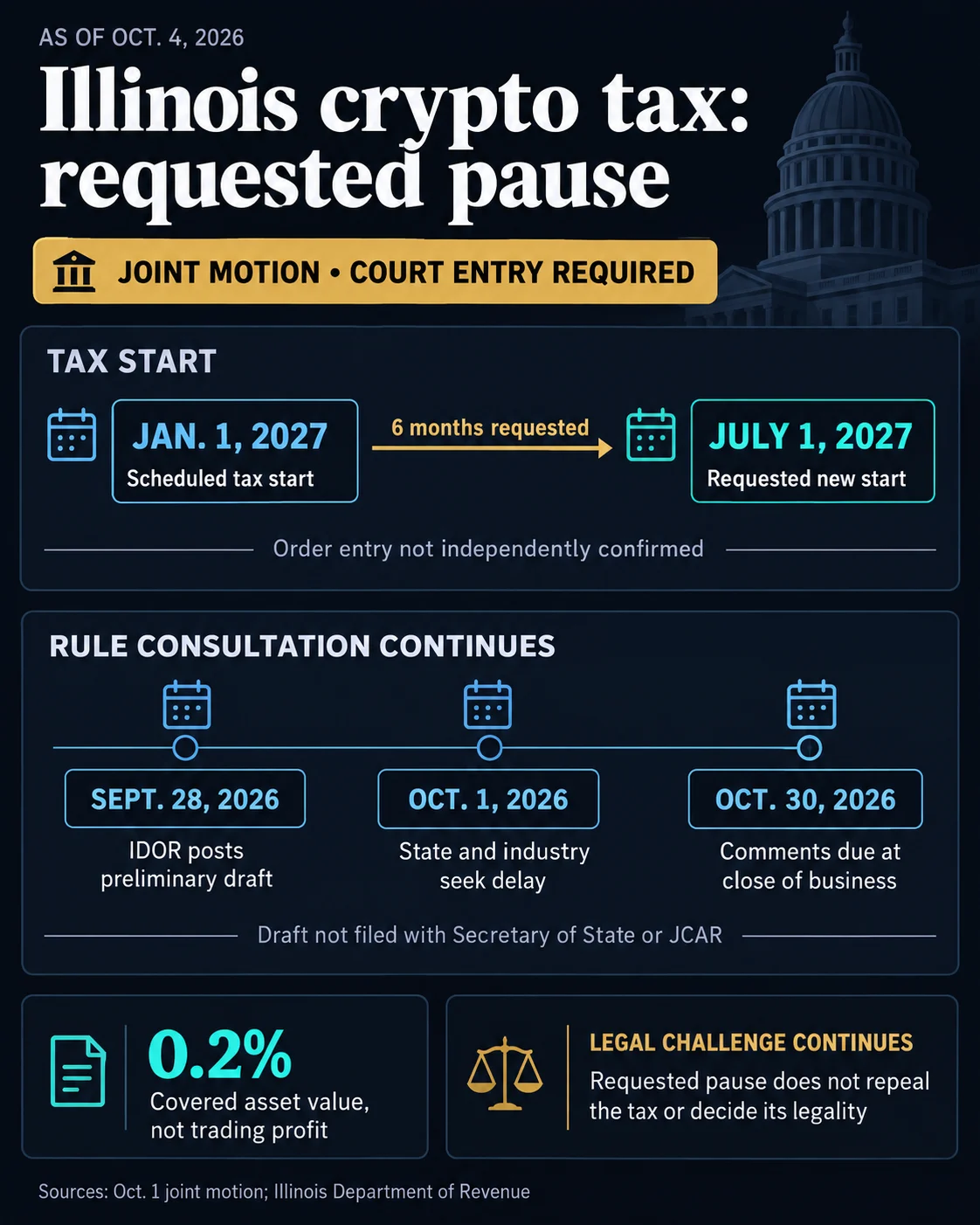
In a significant procedural shift that highlights the growing friction between state-level revenue ambitions and the nascent digital asset industry, Illinois state officials have formally joined cryptocurrency advocacy groups in requesting a six-month postponement of the state’s controversial new digital asset tax. The joint motion, filed on October 1 in Sangamon County, represents a temporary truce in a high-stakes legal and regulatory battle that has pitted the state’s Department of Revenue against some of the most prominent organizations in the blockchain sector.
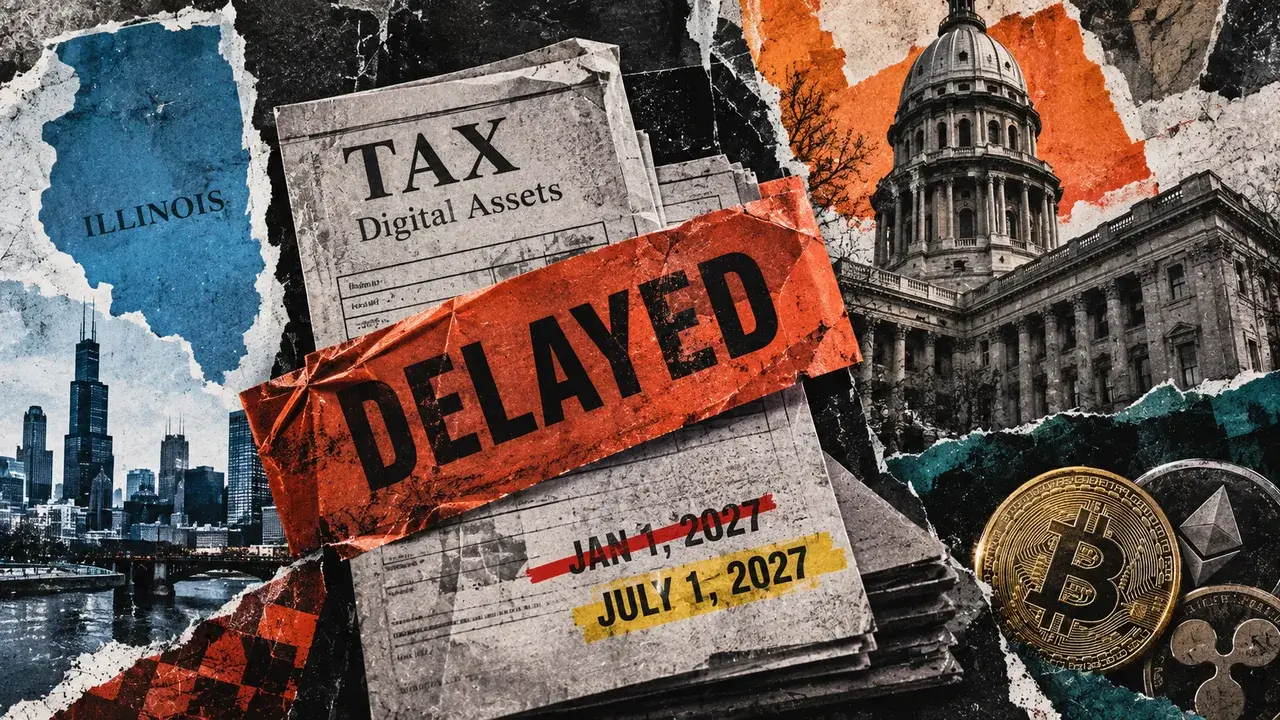
The agreed motion asks a circuit judge to push the implementation date of the levy from its original January 1, 2027, start date to July 1, 2027. This request comes as a direct response to a constitutional challenge brought forward by The Digital Chamber and the Illinois Blockchain Association. While Revenue Director David Harris and Attorney General Kwame Raoul have agreed to the delay, the state has not wavered in its defense of the law’s legality. Instead, the postponement is being framed as a necessary measure to allow for the completion of the state’s complex rulemaking process and to provide the court with sufficient time to weigh the merits of the ongoing litigation.
The Mechanics of the 0.2% Digital Asset Levy
The legislation at the heart of this dispute was enacted in June, introducing a tax structure that critics argue is fundamentally different—and significantly more burdensome—than the taxes applied to traditional financial instruments like stocks and bonds. Unlike federal and state capital gains taxes, which are levied on the profits realized from the sale of an asset, the Illinois Digital Asset Tax (DAT) imposes a 0.2% levy on the gross value of digital assets involved in "covered transactions."
According to draft rules released by the Illinois Department of Revenue, the scope of these covered transactions is notably broad. The tax is triggered when a digital asset is transferred or exchanged through a broker, provided certain statutory conditions are met. This includes not only the sale of cryptocurrency for fiat currency but potentially also fee-paid withdrawals from a centralized exchange to a self-custody wallet.
The administrative burden of this tax falls heavily on "covered brokers," who are tasked with the responsibility of calculating, collecting, and remitting the tax to the state. If a broker fails to collect the tax, they remain liable for the payment. Furthermore, the law includes a fallback provision for consumers: if a broker does not charge the tax at the time of the transaction, the individual customer is legally obligated to calculate and remit the payment themselves by the 20th day of the following month. This "use tax" style requirement has been a point of intense criticism, as industry experts argue it creates a compliance nightmare for average retail investors who may lack the sophisticated tracking tools required to monitor every micro-transaction or transfer.
A Chronology of the Legislative and Legal Conflict
The path to the current stalemate began in the spring of 2026, when Illinois legislators sought new revenue streams to address long-term budgetary pressures. The Digital Asset Tax was passed as part of a broader revenue package and signed into law in June. Almost immediately, the crypto industry signaled its intent to fight the measure, arguing that it unfairly singled out digital assets for a type of taxation that does not exist for other asset classes.
- June 2026: Governor signs the revenue bill containing the 0.2% Digital Asset Tax.
- August 2026: The Digital Chamber and the Illinois Blockchain Association file a lawsuit in Sangamon County, alleging that the tax violates the Uniformity Clause of the Illinois Constitution and the federal Commerce Clause.
- September 2026: The Illinois Department of Revenue releases draft rules for the tax, sparking a wave of negative public comments from exchanges, developers, and investors.
- October 1, 2026: State officials and industry plaintiffs file a joint motion for a consent injunction to delay the tax’s start date by six months.
- October 30, 2026: Deadline for public comments on the Department of Revenue’s draft rules.
- November 13, 2026: The new deadline for the state to formally respond to the industry’s constitutional challenge.
While the court had not officially entered the order for the delay as of October 4, the fact that both the Attorney General and the Revenue Director have signed onto the motion makes its approval highly likely. This delay provides a reprieve for crypto firms that have spent months warning that the January 1 deadline was technically unfeasible given the lack of finalized administrative guidance.
The Constitutional and Regulatory Arguments
The legal challenge mounted by The Digital Chamber and the Illinois Blockchain Association rests on several pillars. The primary argument is that the tax violates the Illinois Constitution’s Uniformity Clause, which requires that taxes be applied uniformly to objects within the same class. The plaintiffs argue that by taxing the total value of a crypto transaction—rather than just the gain—Illinois is treating digital assets more harshly than stocks or commodities, which are not subject to such gross-value levies at the state level.
Furthermore, the industry groups argue that the tax violates the federal Commerce Clause by creating an undue burden on interstate commerce. Because the digital asset market is global and decentralized, a state-specific tax based on the residency of the user or the location of the broker could lead to "double taxation" or conflicting regulatory requirements that stifle the free flow of digital commerce.
On the regulatory front, the Illinois Department of Revenue has faced significant hurdles in defining what constitutes a "covered transaction." The draft rules have attempted to clarify whether a simple transfer between a user’s own accounts is taxable, but the industry remains skeptical. The complexity of decentralized finance (DeFi) protocols and automated smart contracts makes it difficult for traditional tax authorities to identify a "broker" in many common crypto interactions.
Industry and Stakeholder Reactions
The move to delay the tax has been met with cautious optimism by the blockchain community in Chicago and across the state. Industry leaders have argued that the 0.2% levy would drive innovation out of Illinois, encouraging startups to relocate to crypto-friendly jurisdictions like Florida, Texas, or Wyoming.
"This delay is a recognition of the reality that the current rules are not ready for prime time," said a spokesperson for a major U.S.-based exchange. "Building the infrastructure to track, collect, and report a 0.2% value-based tax across millions of transactions is a massive undertaking. Doing it while the very legality of the tax is being questioned in court would have been a waste of resources for both the state and the private sector."
Consumer advocacy groups have also expressed concerns regarding the fallback liability for individual taxpayers. They argue that many Illinois residents might inadvertently become tax evaders because they are unaware of the requirement to self-report and pay the 0.2% levy on their monthly transfers. The six-month delay is seen as an opportunity to better educate the public, should the tax ultimately survive the legal challenge.

Broader Implications for State-Level Crypto Policy
The situation in Illinois is being closely watched by legislators in other states. For years, the primary regulatory focus for digital assets was at the federal level, with the SEC, CFTC, and IRS leading the charge. However, as states look for new ways to shore up their budgets, "crypto taxes" have become an enticing prospect.
If Illinois successfully implements this tax, it could serve as a blueprint for other states facing fiscal deficits. Conversely, if the court strikes it down as unconstitutional, it will set a powerful precedent protecting the digital asset industry from gross-value levies at the state level. The delay until July 2027 effectively pushes the final resolution of this issue into a new legislative session, where the political appetite for the tax may have shifted.
The Illinois Blockchain Association has emphasized that its goal is not to avoid taxation altogether but to ensure that digital assets are taxed fairly and in a way that is technically feasible. They have advocated for a system that aligns more closely with federal capital gains standards, which they argue would provide more certainty for investors and a more stable revenue stream for the state.
Looking Ahead: The Next Six Months
As the October 30 deadline for public comments approaches, the Illinois Department of Revenue is expected to receive a deluge of feedback from technical experts, tax attorneys, and everyday crypto users. These comments will be critical in shaping the final version of the rules, which must then be submitted to the state’s Joint Committee on Administrative Rules (JCAR).
The legal proceedings in Sangamon County will continue in tandem with the rulemaking. With the state’s response now due in mid-November, the first half of 2027 will likely be dominated by oral arguments and judicial deliberation. For now, the crypto industry in Illinois has won a temporary reprieve, but the long-term future of digital asset taxation in the Land of Lincoln remains deeply uncertain.
Firms operating in the state are advised to continue their compliance preparations while monitoring the court’s decisions. Even with a six-month extension, the technical requirements for implementing a value-based tax are formidable. If the injunction is granted, the industry will have until the summer of 2027 to either prepare for a new tax regime or hope that the judiciary provides a permanent exit from what they characterize as an unconstitutional and discriminatory levy.