admin
admin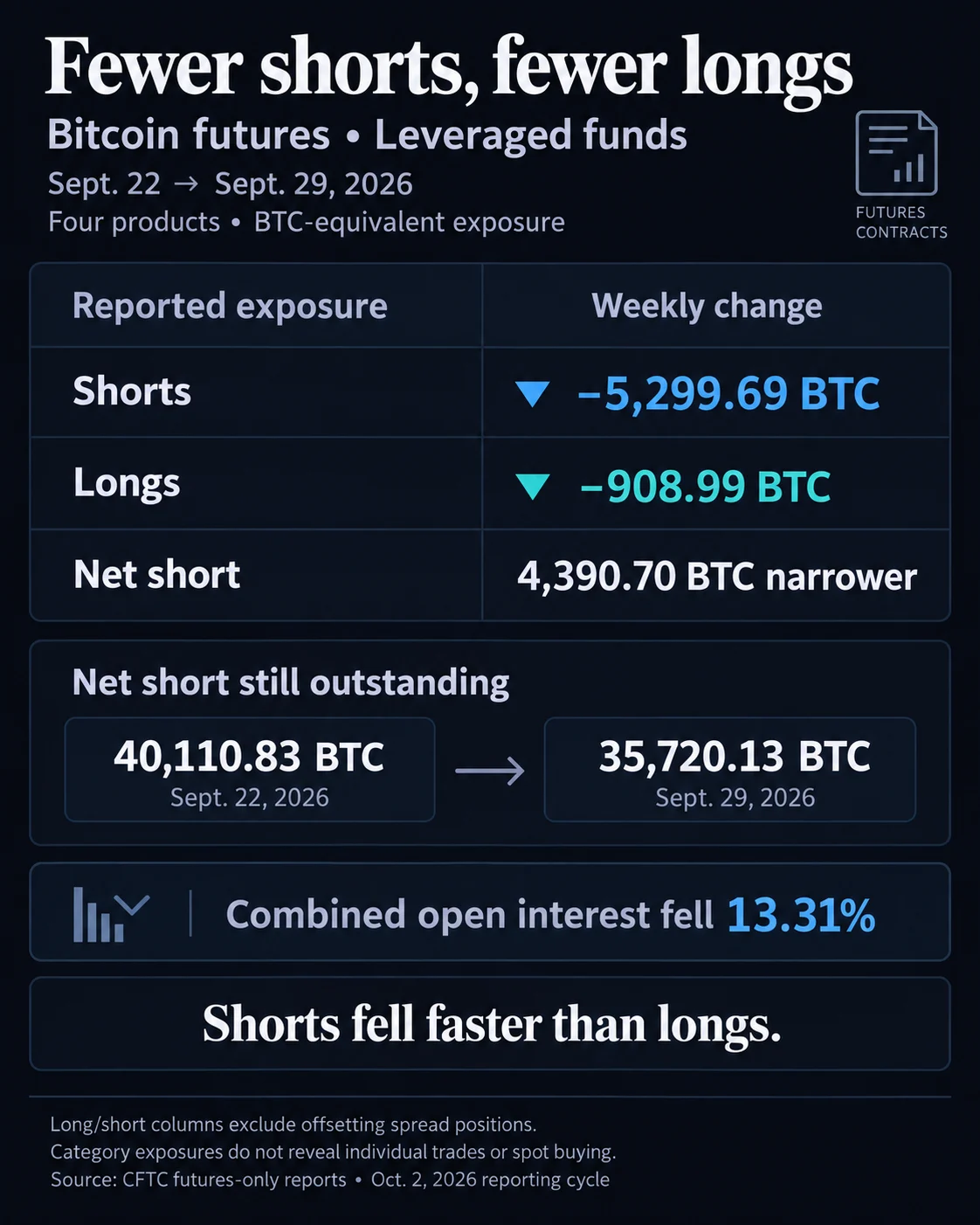
A recent snapshot of Bitcoin futures market activity, as of September 29, 2026, reveals a notable reduction in the short positions held by leveraged funds. These institutional players, who typically employ futures contracts to hedge or speculate on price movements, saw their reported short exposure decrease by approximately 5,300 Bitcoin-equivalent units. This decline, however, was accompanied by a simultaneous contraction in their aggregate long positions, suggesting a broader retrenchment or recalibration within these market segments rather than a definitive shift towards bullish sentiment.
The data, compiled by the Commodity Futures Trading Commission (CFTC) and released in the October 2 reporting cycle, aggregates positions across four key futures products: standard CME Bitcoin futures, micro CME Bitcoin futures, Coinbase Derivatives nano Bitcoin futures, and nano perpetual-style futures. It’s crucial to note that these figures represent Bitcoin-equivalent exposure within futures contracts and do not reflect the direct transfer or ownership of physical Bitcoin. The conversion of various contract sizes into a uniform BTC-equivalent allows for a comprehensive overview of the market’s leveraged landscape.
A Week of Contraction and Rebalancing
Comparing the September 29 data with positions recorded on September 22, 2026, the reduction in leveraged funds’ reported shorts was substantial, amounting to 5,299.69 BTC-equivalent. Concurrently, their aggregate long positions diminished by 908.99 BTC-equivalent. This dual movement resulted in a narrowing of their net short exposure, which decreased by 4,390.70 BTC-equivalent, moving from 40,110.83 BTC-equivalent to 35,720.13 BTC-equivalent. Despite this reduction, the data indicates that leveraged funds maintained a net short bias, with their short positions still outweighing their long holdings. These figures are specifically for outright long and short positions and exclude separately recorded offsetting spread positions, which are often used for hedging strategies.
The observed improvement in the net short figure stems from a faster decline in short positions compared to longs. The fact that aggregate futures long exposure did not expand during this period suggests that the decrease in shorts was not a direct consequence of new buying pressure entering the market. Instead, it points towards a reduction in existing bearish bets or a reallocation of capital within the futures market.
Divergent Movements Across Product Categories

While the overall trend for leveraged funds indicated a reduction in net shorts, the individual product markets did not exhibit uniform behavior. The standard CME Bitcoin futures contracts were the primary driver of the decrease in reported shorts, accounting for 4,310 BTC-equivalent of the reduction. Interestingly, within this specific market segment, leveraged funds actually saw their long positions increase by 1,175 BTC-equivalent. This suggests a targeted adjustment within the most liquid futures market.
In contrast, leveraged funds’ long positions decreased across CME micro futures and both Coinbase Derivatives products. These reductions in long exposure, when aggregated, were significant enough to offset the increase seen in standard CME futures. This divergence highlights the varied strategies and risk appetites that may exist across different futures platforms and contract sizes.
The adjustment observed in the standard CME futures market serves as a partial reversal of the trend seen in the September 22 snapshot. In that earlier report, which only covered standard CME futures, there was an observed widening of net shorts. The latest, more comprehensive figures, encompassing all four products, present a different picture, indicating a broader recalibration of leveraged positions.
Asset Managers’ Position Shift
Beyond leveraged funds, asset managers also exhibited a shift in their positioning. Their net long exposure across the four tracked products increased by 2,137.90 BTC-equivalent, reaching a total of 18,069.10 BTC-equivalent. This increase was driven by a rise in their long positions, which grew by 573.10 BTC-equivalent, coupled with a more substantial reduction in their short positions, which fell by 1,564.80 BTC-equivalent. The stronger net long position for asset managers was thus largely attributed to a decrease in their reported short exposure, mirroring a trend observed in the leveraged funds category.
Overall Market Contraction
A significant overarching development accompanying this rebalancing of positions was a contraction in the overall futures market. The combined open interest, which represents the total outstanding futures contracts across these markets, experienced a notable decline of 13.31%. It fell from 119,208.26 BTC-equivalent to 103,343.14 BTC-equivalent. This contraction in open interest suggests a general reduction in the volume of speculative and hedging activity within these Bitcoin futures markets, underscoring a broader market sentiment of caution or reduced participation.

Analysis: Smaller Shorts and the Absence of Spot Demand
The reduction in leveraged funds’ reported shorts, while seemingly positive on the surface, does not automatically translate into increased demand for spot Bitcoin. The CFTC’s reporting methodology separates outright positions from spread positions, which are designed to offset risk. The leveraged funds’ spreading column also saw a decrease, by 11,231.11 BTC-equivalent. The reported 5,300 BTC-equivalent reduction in shorts specifically refers to the outright short column, excluding these hedging legs.
Several factors can influence these reported figures, including the monthly expiry of CME micro futures contracts, which occurred on September 25, 2026, falling between the two observation dates. Such expirations can lead to position closures, rollovers into new contracts, or a general reduction in open interest as traders decide not to re-engage. However, the data does not definitively prove that these events were the sole cause of the observed contraction. Classification changes within the CFTC’s reporting categories can also impact the totals, as traders may be re-categorized based on their predominant business activities.
It is crucial to understand the limitations of these reports. The CFTC groups traders by their primary business function, and these reports do not offer insight into individual transactions or the correlation between futures positions and actual holdings of spot Bitcoin or Bitcoin Exchange-Traded Funds (ETFs). A futures short position, for instance, might be part of a sophisticated hedging strategy designed to protect existing long positions in the spot market or other assets. Therefore, a reduction in reported shorts does not necessarily indicate a decrease in overall bearish conviction or the emergence of fresh buying interest in the spot market.
Looking Ahead: The Next Reporting Cycle
The next CFTC Commitment of Traders report, scheduled for release on October 9, 2026, will be critical in determining whether the observed shift in positioning and market contraction represents a sustained trend or a temporary adjustment. Market participants will be closely watching to see if leveraged funds continue to reduce their short exposure, if long positions begin to pick up, or if the overall open interest stabilizes or further declines. This subsequent data will provide a clearer picture of the evolving sentiment and activity within the Bitcoin futures landscape.
The current data paints a picture of a leveraged market in flux, characterized by a reduction in bearish bets by key institutional players, but without a corresponding surge in bullish sentiment. The simultaneous contraction in overall market activity suggests a period of consolidation or cautious repositioning, the implications of which will become clearer in the coming weeks. The interplay between futures market dynamics and the underlying spot market remains a key area of focus for investors and analysts seeking to understand the near-term trajectory of Bitcoin’s price.