Dwi Wanna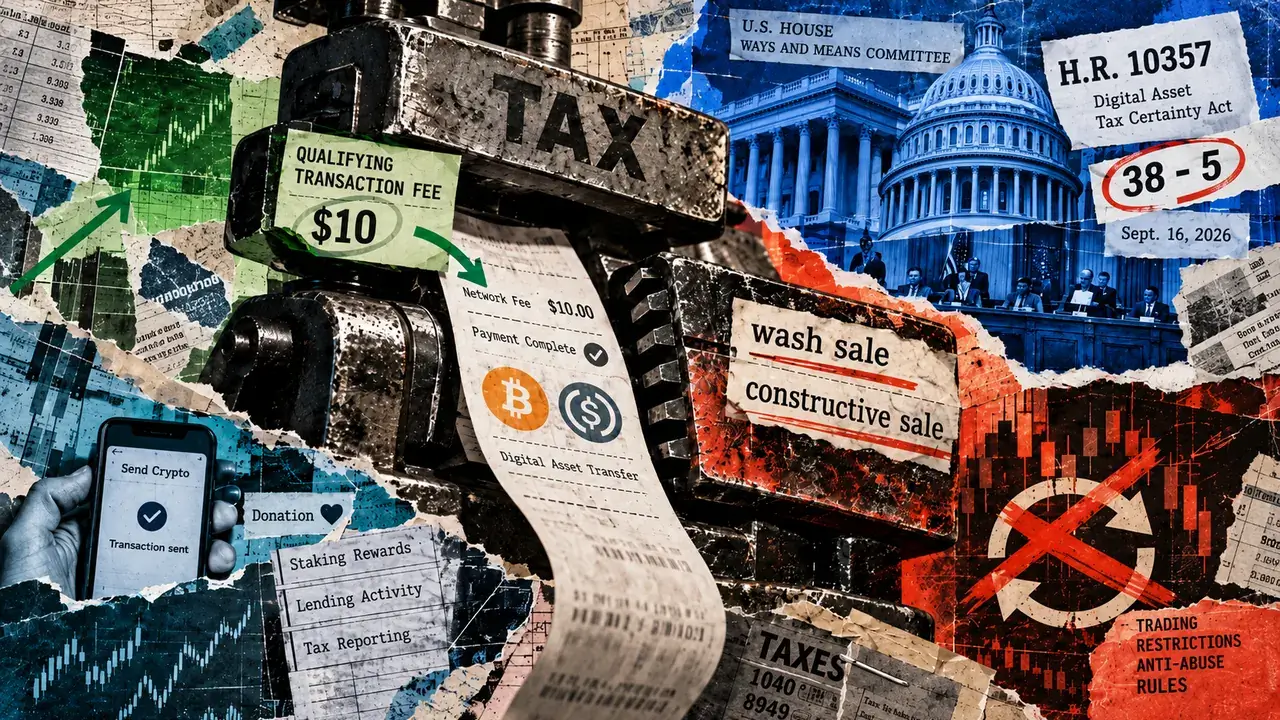
The House Ways and Means Committee has moved to reshape the landscape of cryptocurrency taxation in the United States, advancing H.R. 10357, known as the Digital Asset Tax Certainty Act, in a decisive 38-5 bipartisan vote on September 16. The legislation represents the first comprehensive digital-asset tax framework to pass through a major House panel, signaling a significant shift in how the federal government intends to treat the burgeoning multi-trillion-dollar crypto industry. While the bill addresses long-standing grievances regarding the complexity of crypto reporting, industry advocates and policy groups are already signaling that the current draft is only a starting point, urging lawmakers to broaden the scope of tax relief before the bill reaches the full House floor.
As approved, the package covers a wide array of activities including digital payments, stablecoin usage, trading, lending, staking, and mining. The committee ordered the amended bill favorably reported following the adoption of a substitute amendment from Chairman Jason Smith (R-MO). Smith, who has championed the bill as a means to "keep America the crypto capital of the world," framed the legislation as a necessary modernization of the tax code to prevent innovation from fleeing to jurisdictions with clearer regulatory environments.
The Evolution of Digital Asset Taxation: A Chronology of Uncertainty
To understand the weight of H.R. 10357, one must look at the decade-long struggle between the Internal Revenue Service (IRS) and the crypto industry. For years, the primary guidance for taxpayers was IRS Notice 2014-21, which classified virtual currencies as property rather than currency. This classification meant that every single transaction—whether buying a cup of coffee with Bitcoin or paying a transaction fee on the Ethereum network—was technically a "realization event" requiring the calculation of capital gains or losses.
By 2019, the IRS added a specific question to Form 1040 asking taxpayers about their involvement in virtual currency, signaling an era of increased enforcement. However, the lack of specific statutory language led to significant confusion. The Infrastructure Investment and Jobs Act of 2021 further complicated matters by introducing broad "broker" reporting requirements that many in the industry argued were technically impossible for decentralized entities to fulfill.
The introduction and advancement of the Digital Asset Tax Certainty Act in late 2024 represents a culmination of efforts to provide the "certainty" promised in its title. The timeline of this specific bill moved rapidly through the summer of 2024, culminating in the September 16 markup where it received overwhelming support from both sides of the aisle, reflecting a growing consensus that the status quo is untenable for both taxpayers and the Treasury.
Key Provisions: Narrow Relief and Tighter Compliance
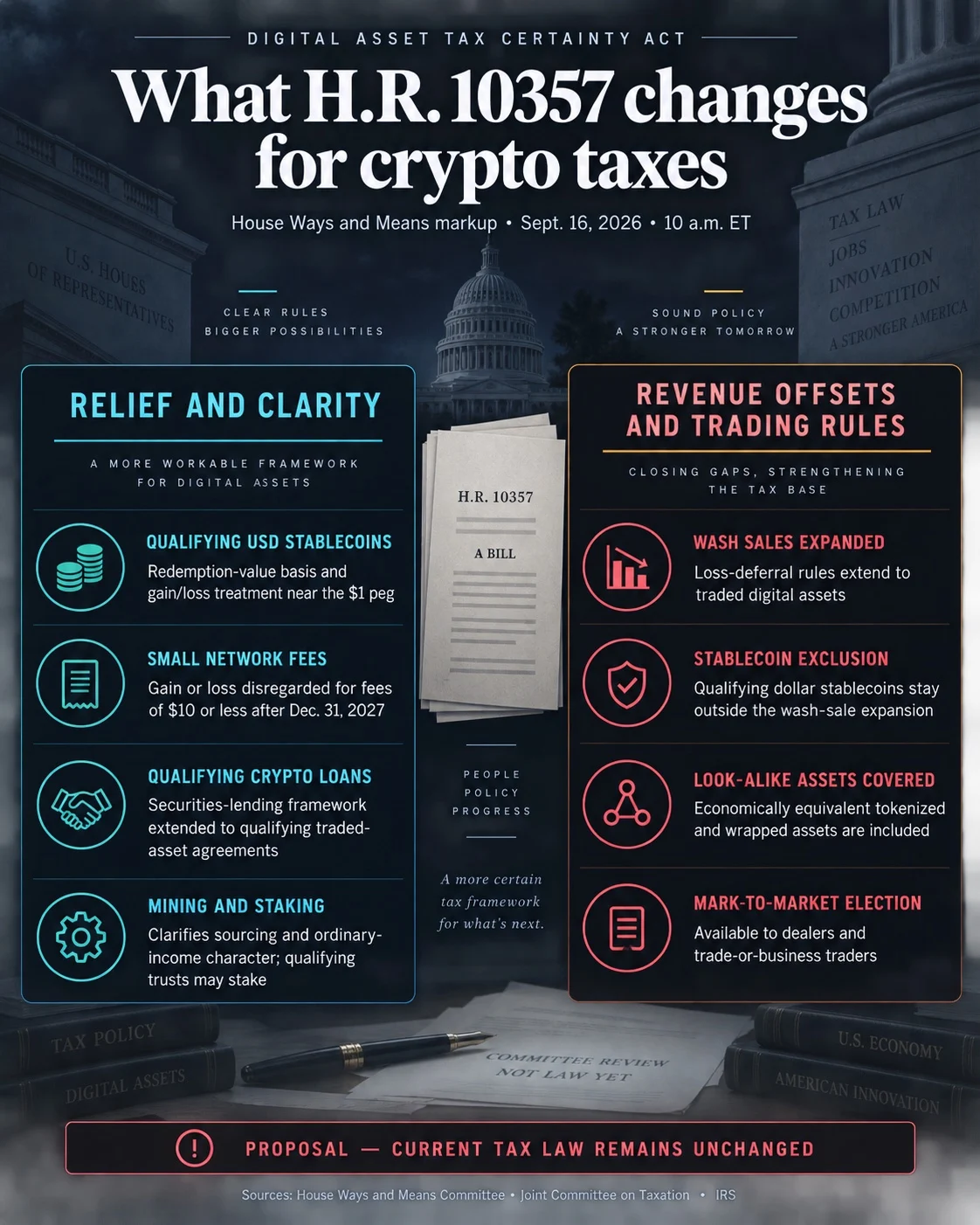
The Digital Asset Tax Certainty Act is a multifaceted piece of legislation that balances industry concessions with increased regulatory oversight. One of the most discussed provisions involves the treatment of network and transaction fees. Under the current bill, the IRS would eliminate gain-or-loss recognition when digital assets are used to pay qualifying fees of no more than $10, effective for dispositions after December 31, 2027. This is intended to stop the "tax on a tax" phenomenon where paying a gas fee to move tokens creates its own taxable event.
However, the bill also introduces stricter rules for investors by closing what many have called the "crypto wash-sale loophole." Currently, the wash-sale rule—which prevents investors from claiming a tax loss on a security if they buy a "substantially identical" security within 30 days—does not apply to cryptocurrencies because they are classified as property, not securities. H.R. 10357 would extend wash-sale and constructive-sale provisions to digital assets, bringing them in line with stocks and bonds.
Other critical components of the bill include:
- Stablecoin Treatment: Providing special tax treatment for qualifying U.S. dollar-pegged stablecoins to facilitate their use in commerce.
- Lending Safe Harbors: Extending existing financial-market treatment to crypto lending, allowing for more fluid movement of capital without triggering immediate tax liabilities.
- Mark-to-Market Accounting: Allowing eligible dealers and traders to use mark-to-market accounting, a standard practice in traditional finance that simplifies tax reporting for high-volume traders.
- Charitable Donations: Streamlining rules for donating digital assets to non-profits, aiming to encourage philanthropy within the crypto community.
Industry Advocacy: The Push for a "De Minimis" Exemption
Despite the "historic" nature of the committee vote, industry leaders argue that the $10 fee exemption is far too narrow to foster a functional payment ecosystem. The Crypto Council for Innovation (CCI) and other advocacy groups had been lobbying for a broader "de minimis" exemption for everyday transactions.
Alison Mangiero, Chief Strategy Officer and Head of U.S. Policy at CCI, characterized the vote as a vital step but emphasized that the work is far from over. "Lawmakers still have room to refine the timing of income recognition for staking and mining rewards and expand de minimis treatment for ordinary digital-asset transactions," Mangiero stated.
The distinction is vital: while the current bill waives taxes on the fees associated with a transaction (up to $10), it does not waive taxes on the purchase itself. For example, if a consumer buys a $5 sandwich using Bitcoin that has appreciated in value since it was acquired, they still owe capital gains tax on that appreciation. Industry groups are pushing for a threshold—often proposed at $200—where small personal purchases would be exempt from capital gains reporting entirely. Advocates argue that without such an exemption, crypto will never become a viable medium of exchange for the average American.
The Staking and Mining Dilemma: Timing is Everything
Perhaps the most technical and consequential unresolved issue in H.R. 10357 concerns the timing of income recognition for miners and stakers. The current legislation explicitly treats income from digital-asset validation activities as ordinary income. While this provides clarity on the type of tax owed, it does not resolve the when.
In the current framework, miners and stakers are often required to recognize income the moment a new token is created and credited to their wallet. This creates a "phantom income" problem. If a validator receives tokens during a market peak but cannot sell them immediately due to lock-up periods or liquidity issues, they may face a massive tax bill based on a valuation that has since plummeted.
The industry has long sought "optional deferral," which would allow validators to delay recognizing income until the tokens are actually sold for cash or traded for another asset. This would mirror the tax treatment of other "created property," such as a farmer growing crops or an author writing a book, where tax is typically not owed until the product is sold. H.R. 10357 stops short of this, establishing sourcing rules based on the taxpayer’s location but leaving the immediate recognition requirement largely intact.
Reclaiming the "Crypto Foundations": The DAO Provision
A standout provision in the bill, praised by venture capital and legal experts, involves the treatment of Decentralized Autonomous Organizations (DAOs). Over the past several years, many crypto projects have established "foundations" in jurisdictions like Switzerland, the Cayman Islands, or Panama to avoid the legal and tax ambiguities of the United States.
H.R. 10357 directs the Treasury Department to issue guidance within 12 months regarding the tax treatment of foreign entities associated with DAOs. Crucially, it provides a "pathway home," creating methods for these foreign foundations to reorganize as domestic U.S. corporations. It also suggests temporary safe harbors for entities formed before September 14, 2024.
Miles Jennings, Head of Policy and General Counsel at a16z crypto, noted that this could be a game-changer for American innovation. By providing a clear domestic tax structure, the bill incentivizes entrepreneurs to bring their operations—and the associated jobs and capital—back to the U.S. This "on-shoring" mechanism is seen as a strategic move to ensure the U.S. remains the primary hub for blockchain development.
Analytical Perspective: Implications for the Future
The passage of H.R. 10357 out of committee marks a transition from the "Wild West" era of crypto taxation toward a structured, institutionalized framework. While the extension of wash-sale rules will likely increase the tax burden on some retail investors who previously used aggressive loss-harvesting strategies, the broader implications are stabilizing.
By bringing digital assets closer to "comparable traditional financial instruments," the bill lowers the barrier for institutional entry. Large-scale dealers and traders benefit from mark-to-market accounting, which reduces the administrative nightmare of tracking individual "lots" of digital assets across multiple exchanges.
However, the 38-5 vote also reveals a lingering divide. The five dissenting votes suggest that some lawmakers remain wary of providing any "concessions" to an industry they still view with skepticism. Furthermore, the bill’s success in the full House and the Senate is not guaranteed, especially in a condensed legislative calendar.
As the bill moves forward, the focus will remain on the "technical changes" requested by groups like the CCI. If the industry can secure a higher de minimis threshold and a more favorable timing for validation income, H.R. 10357 could truly become the bedrock of the American digital economy. For now, it remains a "historic step" that acknowledges the reality of digital assets while leaving the door open for further refinement in the halls of Congress.