admin
admin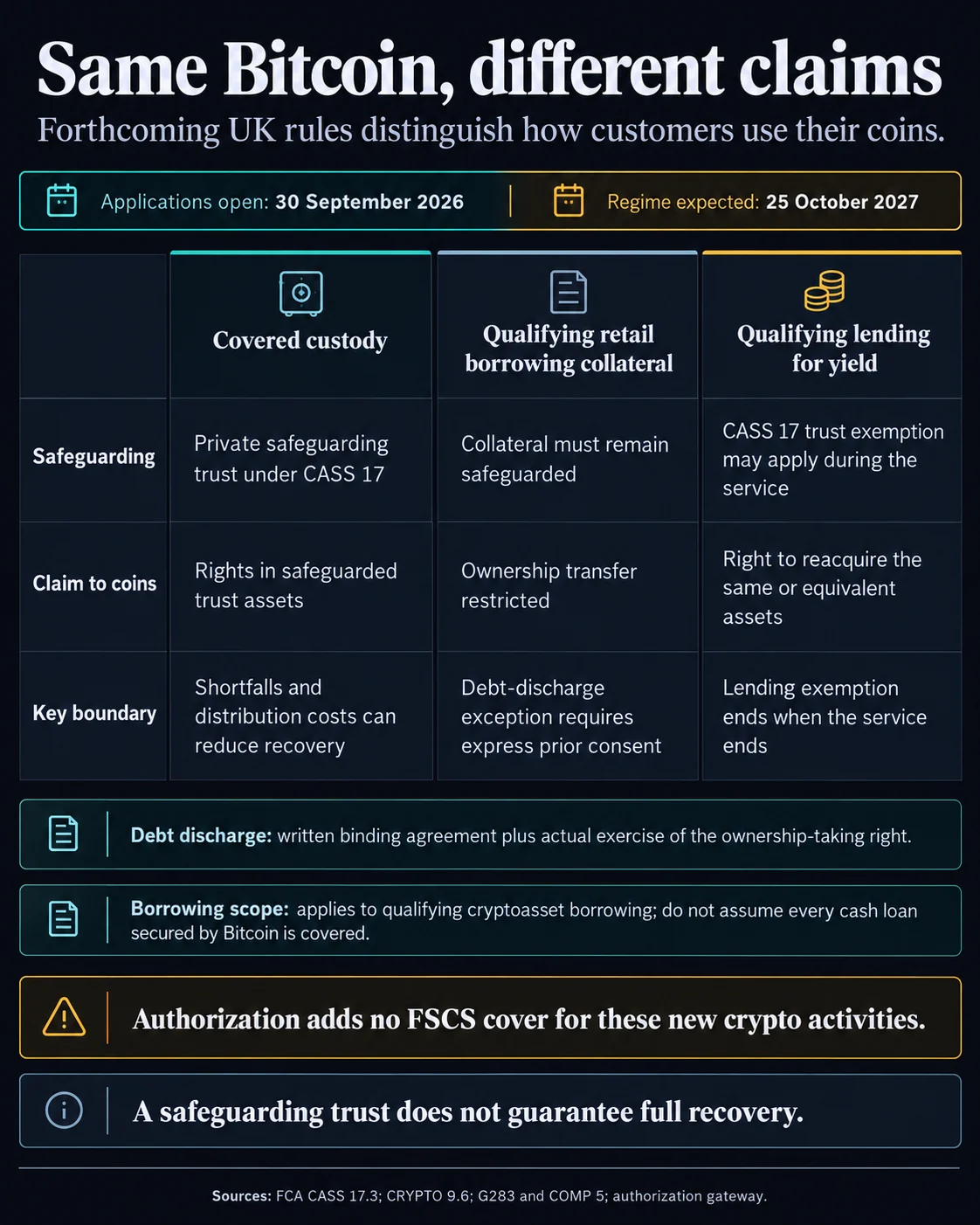
The Financial Conduct Authority (FCA) has officially opened the application window for UK-based cryptoasset firms seeking authorization, a significant development signaling a new era of regulation for the burgeoning digital asset sector. As of September 30, 2026, firms can submit their applications through the FCA’s Connect system, paving the way for a comprehensive regulatory regime expected to fully commence on October 25, 2027. This upcoming framework introduces a critical distinction in how customer assets are treated, particularly concerning Bitcoin and other cryptocurrencies used as collateral for borrowing versus those transferred for yield-generating lending services. This divergence in legal treatment could profoundly impact customer recovery prospects in the event of a platform failure.
The immediate impact of applications opening on September 30 is not the immediate establishment of authorization or the activation of the new safeguards. Instead, it marks the beginning of a formal process for firms to align themselves with the future regulatory landscape. The FCA’s finalized rules, published on June 30, lay the groundwork for this comprehensive regime, with a specific focus on consumer protection and market integrity. While firms can now begin the application process, the substantive protections and operational requirements will only come into effect with the full launch of the new regime in late 2027. This phased approach allows businesses time to adapt and for the FCA to manage the influx of applications.
The Crucial Distinction: Safeguarding vs. Lending
At the heart of the new regulations lies a fundamental differentiation in how cryptoasset platforms can manage customer funds. The forthcoming rules mandate stringent safeguarding requirements for assets designated as collateral in qualifying cryptoasset borrowing services. These assets will generally need to be held in a safeguarding trust, as outlined in CASS 17 (the crypto custody chapter of the FCA’s Client Assets Sourcebook). This ensures that collateral supporting borrowing remains protected, with a very narrow exception for debt discharge only upon explicit customer consent and fulfillment of specific contractual conditions.
Conversely, cryptoassets transferred to a platform for a qualifying lending service, where the intention is to generate yield, can operate under different conditions. These services may be exempt from the strict trust requirement while the lending arrangement is active. This exemption allows platforms greater flexibility in managing assets placed into lending pools. However, it is crucial to understand that this exemption is specific to lending and cannot be leveraged to circumvent the safeguarding obligations for collateral in borrowing arrangements. The FCA’s guidance emphasizes that the legal substance of an arrangement, rather than its marketing or superficial description, will determine its regulatory treatment. This means that a cash loan marketed as "Bitcoin-backed" will be scrutinized to determine if it truly constitutes qualifying cryptoasset borrowing, with its associated collateral protections, or falls under a different regulatory classification.
Timeline of Regulatory Development
The journey towards this new regulatory framework has been a multi-year process, reflecting the evolving nature of the cryptoasset market and the increasing need for robust oversight.
- Early 2020s: Growing concerns over consumer protection, market manipulation, and financial crime in the crypto space lead to increased scrutiny from regulators globally, including the FCA.
- 2023: The FCA consults extensively on its proposed cryptoasset regime, gathering feedback from industry participants and consumer groups. Key areas of focus include safeguarding client assets, market abuse, and operational resilience.
- June 30, 2026: The FCA publishes its final policy statement, detailing the rules and requirements for cryptoasset firms. This document outlines the distinctions in asset treatment for borrowing collateral and lending services.
- September 30, 2026: The application portal opens for cryptoasset firms to begin the authorization process. This marks the official start of firms actively seeking to comply with the new regime.
- October 25, 2027: The full regulatory regime is expected to come into effect, with all authorized firms expected to be operating under the new rules. This date represents the deadline for firms to achieve full compliance and authorization.
- Future Consultations: The FCA has indicated plans to consult on managing cryptoasset firm failures, including distribution rules for failed custodians and stablecoin issuers, further refining the regulatory landscape.
Pledged Coins: Safeguarding Remains Paramount
The forthcoming retail collateral rule, detailed in the FCA’s handbook, will impose a clear obligation on firms providing qualifying cryptoasset borrowing services to ensure the safeguarding of relevant crypto collateral. This safeguarding can be undertaken by the firm itself, provided it possesses the necessary permissions, or by a third-party custodian authorized by the FCA.
A critical aspect of this rule is the prevention of firms from unilaterally assuming full ownership of pledged cryptoassets. Unless a retail client has provided explicit prior consent to a transfer of ownership to discharge a debt arising from the borrowing service, the firm cannot simply incorporate these assets into its general inventory for other uses. This measure is designed to protect borrowers from losing their collateral through unauthorized transactions by the platform.
Furthermore, the debt-discharge provision adds another layer of conditionality. For a firm to legitimately take ownership of pledged collateral, a written and binding agreement must exist granting this right. Crucially, the firm must actively exercise this right in accordance with the agreement. Merely having such an agreement in place does not automatically permit the firm to claim ownership; the coins remain subject to safeguarding requirements until the firm formally exercises its agreed-upon right to discharge the debt.
The practical implication for individuals using their Bitcoin as collateral is that this action does not automatically transform their assets into the platform’s freely usable property. The safeguarding obligation persists unless a specifically permitted change in their treatment occurs, such as the debt being discharged. This underscores the importance of distinguishing between borrowing against assets and entrusting them to a platform for yield generation.
The Nuances of Lending: A Different Customer Claim
In contrast to collateralized borrowing, qualifying cryptoasset lending involves a customer transferring cryptoassets to a platform with the expectation of reacquiring the same or equivalent assets, typically in exchange for a yield. The FCA’s description highlights that this is an arrangement where a person disposes of cryptoassets with an obligation or right to reacquire them.
The right to reacquire is fundamentally different from an instruction to maintain custody. Under CASS 17.3.4, a firm operating a qualifying lending service can be exempt from acting as a trustee for those assets during the lending period. If the firm already holds these assets within a safeguarding trust, this exemption allows it to temporarily cease treating them as client cryptoassets for the duration of the service.
However, this exemption is not permanent. It ends when the lending service concludes, including situations where the client exercises their right to terminate the service. The actual return of assets will still depend on their availability, the agreed-upon return timing, and any applicable access restrictions. Therefore, even with the lending exemption, practical challenges regarding asset retrieval can arise.
Significantly, the lending exemption cannot be applied to collateral used in qualifying borrowing arrangements. Similarly, other exemptions that might permit ownership transfers are also unavailable for such collateral. This regulatory architecture aims to prevent firms from using these exemptions to undermine the essential safeguards for borrowed collateral.
For a customer whose coins have been transferred into a lending service outside the required trust structure, a claim based on CASS 17 trust provisions cannot be automatically assumed. Their recovery may instead be contingent on the terms of their contractual return right and the applicable insolvency treatment of the firm. The specific contract and service structure will dictate the nature of their claim, and the lending exemption does not grant all lending customers an identical creditor ranking.
Transparency and Information Requirements
The FCA’s forthcoming information requirements will ensure that this crucial distinction between safeguarding and lending becomes an integral part of customer disclosures. Firms will be obligated to provide clear information regarding asset transfer and return processes, access restrictions, yield generation mechanisms, and associated risks. The FCA’s guidance also mandates explanations of the implications of any ownership transfers, including what might happen in the event of the firm’s or another relevant party’s insolvency.

For customers earning yield, the governing agreement is paramount to understanding their claim against the balance displayed on their account. This agreement needs to clarify whether their coins remain safeguarded, whether ownership has been transferred, and what their rights are upon the conclusion of the service.
Custody and Recovery: The Limits of Protection
In the context of covered custody, CASS 17 generally requires firms to safeguard cryptoassets as trustees, operating under documented arrangements. The FCA’s intention behind these trusts is to fortify clients’ rights against competing claims, particularly in instances of custodian insolvency.
These rules stipulate that firms must establish private trusts through appropriate legal arrangements. The safeguarding obligation is contingent upon the successful implementation of these arrangements, rather than arising automatically from the rules themselves. The effectiveness of these trusts and their operation must consistently meet the specified legal and safeguarding requirements.
The precise scope of applicable assets also plays a role. CASS 17’s application rules pertain to regulated activities conducted from a UK establishment, subject to specific exceptions. The FCA’s final policy overview indicates that the custody of relevant specified investment cryptoassets will initially fall under the existing CASS 6 requirements. This means that different types of assets and service structures may be subject to varying custody provisions.
Robust record-keeping is essential for establishing ownership within these trusts. The forthcoming reconciliation requirements will mandate firms to calculate what they must hold for each client, trust, and asset class at least once daily. While this supports the identification of entitlements, establishing an entitlement is distinct from ensuring that all necessary assets are available to satisfy it.
The terms of these trusts must clearly define how shortfalls are allocated when multiple clients share a trust. They must also specify whether client assets can be used to cover distribution costs following a trustee failure and, if so, how these deductions will be applied. The FCA generally anticipates that any shortfall within an asset class in a trust will be shared proportionally among the affected clients.
These provisions provide a concrete framework for understanding the limits of recovery. While a trust can strengthen the basis for an asset claim, it does not guarantee full repayment following losses or the imposition of costs.
Staking, another common crypto activity, is also subject to specific rules. The FCA’s collateral guidance stipulates that staking eligible collateral is permissible only under strict conditions: compliance with staking rules, no transfer of full ownership, and continued trust safeguarding. This conditional treatment does not grant an exemption for using borrowing collateral in staking activities.
Authorization Does Not Mean FSCS Protection
A critical point to emphasize is that the new authorization regime for cryptoasset firms will not extend coverage under the Financial Services Compensation Scheme (FSCS). While the FCA is integrating new crypto activities into the definition of designated investment business for general handbook purposes, it has explicitly excluded them from the compensation rules.
This exclusion encompasses a wide range of crypto services, including crypto safeguarding, arranging safeguarding, operating trading platforms, dealing in and arranging deals in qualifying cryptoassets, stablecoin issuance, and arranging staking. Consequently, authorization for these activities does not translate into FSCS investment compensation protection for customers.
It is possible for a firm to conduct other regulated business that may be eligible for FSCS coverage. However, authorization for an uncovered crypto service cannot retroactively grant FSCS eligibility to claims arising from that service.
The Financial Ombudsman Service (FOS) remains a separate avenue for dispute resolution. The FOS’s jurisdiction rules may permit eligible complaints concerning regulated activities, subject to applicable conditions. An eligible complaint typically addresses the firm’s conduct. Any awarded payment still hinges on the specific circumstances, and FSCS eligibility remains a distinct consideration.
Broader Impact and Future Considerations
The opening of applications signifies a major step towards a more regulated UK crypto market. The FCA’s proactive approach aims to foster innovation while mitigating risks to consumers and the wider financial system. The distinction between borrowing collateral and lending assets is particularly significant for investors, as it directly impacts their rights and recovery options should a platform encounter financial difficulties.
The FCA’s commitment to further refining the regulatory framework is evident in its plans to consult on managing cryptoasset firm failures. This will involve developing specific distribution rules for failed custodians and stablecoin issuers, which will be crucial in determining the practical outcomes for customers in such scenarios. The eventual shape of this failure and distribution framework will undoubtedly influence the confidence and security perceived by users of UK-regulated crypto services.
For Bitcoin holders and other crypto users, the immediate takeaway from this development is the increased clarity and potential for enhanced protection. However, it is imperative to understand that authorization does not equate to a risk-free environment. Recovery will continue to be contingent on the specific arrangement, the availability of assets, and the prevailing failure process. The October 2027 regime promises to make these distinctions more explicit, empowering customers with a clearer understanding of their rights and the inherent risks associated with different cryptoasset services. The coming years will be pivotal in observing how these new regulations shape the UK’s crypto landscape and the confidence of its participants.