admin
admin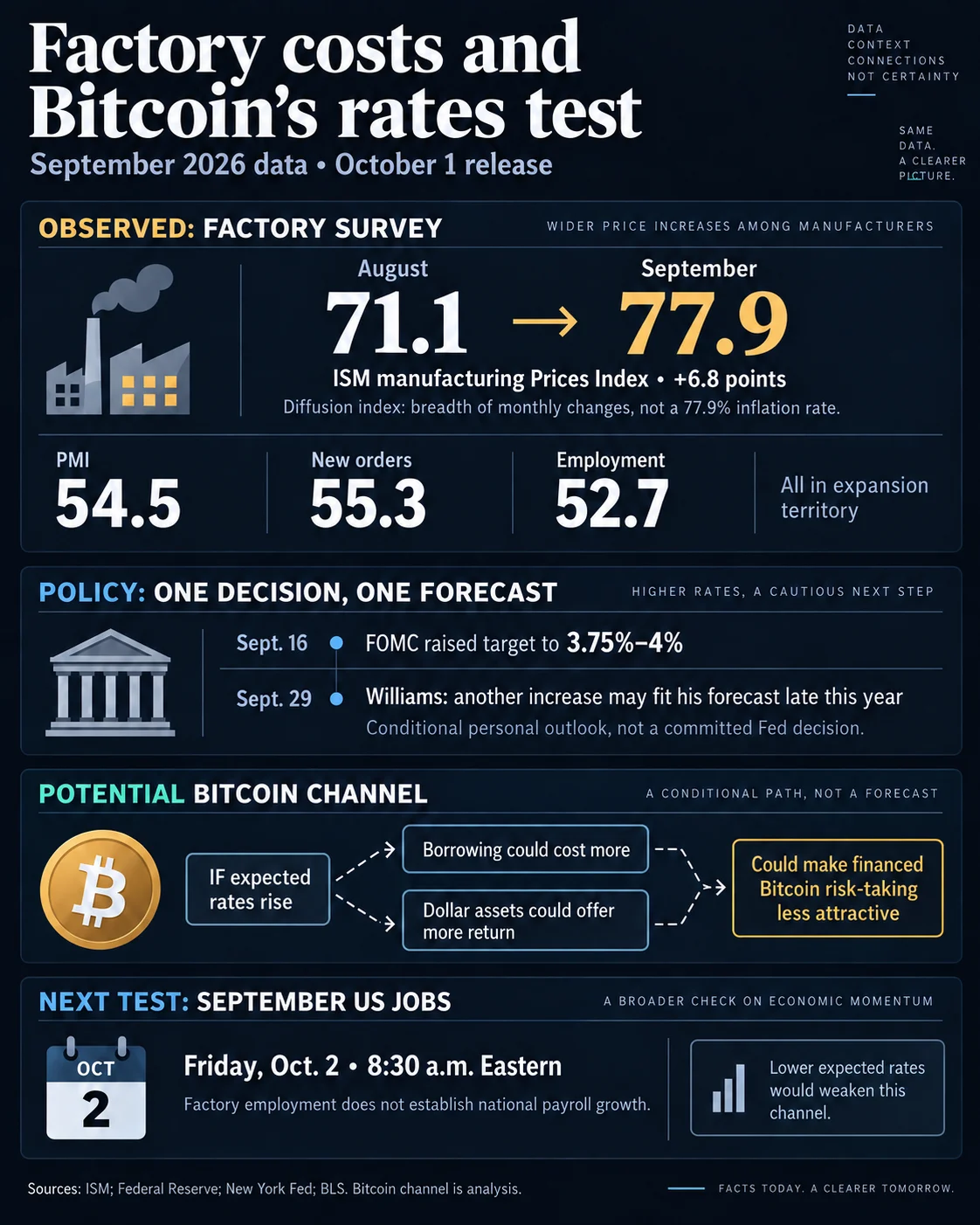
More manufacturers reported rising input prices as orders and employment expanded, adding evidence to the rates debate before Friday’s payrolls.
By Liam ‘Akiba’ Wright, Editor-in-Chief, CryptoSlate
United States manufacturers are signaling a potential shift in the economic landscape, with a significant increase in reported input price hikes for September. This development raises concerns for Bitcoin’s recent rally, particularly if it prompts investors to anticipate higher interest rates in the lead-up to the crucial jobs report scheduled for Friday. The latest data from the Institute for Supply Management (ISM) paints a complex picture of an economy grappling with both expanding activity and escalating costs, creating a delicate balancing act for monetary policy and financial markets.
The ISM’s Manufacturing Prices Index, a key indicator of inflationary pressures within the manufacturing sector, surged to 77.9 in September. This represents a notable increase of 6.8 points from the 71.1 recorded in August. This upward trajectory is further underscored by the broader Manufacturing Purchasing Managers’ Index (PMI), which stood at 54.5, indicating continued expansion in the sector. New orders also showed healthy growth, registering 55.3, and employment within manufacturing increased to 52.7.
For Bitcoin, this confluence of data is particularly significant. A robust manufacturing sector, evidenced by expanding orders and employment, coupled with widening cost pressures, could complicate the narrative for a swift reduction in interest rates. Investors closely scrutinize such economic indicators as they attempt to forecast the Federal Reserve’s future monetary policy decisions. An environment characterized by sustained economic activity and rising input costs may lead the Federal Reserve to maintain a tighter monetary stance, which could, in turn, negatively impact risk assets like Bitcoin.
It is important to clarify that the ISM’s prices gauge does not represent a direct inflation rate. Instead, the 77.9 reading signifies the breadth of reported price increases. In September, 58.6% of respondents reported higher input prices, a substantial jump from the 46.2% who reported such increases in August. The diffusion-index methodology employed by ISM calculates this figure by including all responses reporting higher prices plus half of those reporting unchanged prices. This widespread increase suggests that inflationary pressures are becoming more entrenched within the supply chains of American manufacturers.
The Potential Pressure Runs Through Interest Rates
The current policy environment is already shaped by recent actions from the Federal Reserve. In a move that signaled a commitment to combating inflation, the Federal Open Market Committee (FOMC) completed a quarter-percentage-point increase to its target range for the federal funds rate, bringing it to 3.75% to 4% on September 16. This move was part of a broader campaign to cool down an overheating economy.

Further insights into the Fed’s thinking came from New York Fed President John Williams in remarks delivered on September 29. Williams indicated that an additional upward adjustment to interest rates might be considered later in the year, contingent on the economy broadly aligning with his projections. He, however, also emphasized that there was no definitive evidence yet of the identified price shocks disseminating into more generalized and persistent inflation. This nuanced statement highlights the Fed’s careful approach, balancing the need to address current inflationary pressures with the desire to avoid stifling economic growth unnecessarily.
The September factory survey, therefore, injects a significant data point into this ongoing policy debate. The Federal Reserve’s transmission framework illustrates how policy changes influence short-term borrowing costs and Treasury bill yields. Crucially, expectations about future policy actions play a pivotal role in shaping longer-term interest rates and broader financial conditions.
For Bitcoin, the implications of these dynamics are multifaceted. Higher interest rates, or the anticipation thereof, can lead to more expensive borrowing costs. This can diminish the attractiveness of financed risk-taking activities, which are common within the cryptocurrency market. Simultaneously, elevated returns on interest-bearing dollar assets, such as Treasury bonds, can increase the required rate of return that investors demand to hold less liquid and more volatile assets like Bitcoin. This creates a competitive pressure, as investors may shift capital from riskier assets to safer, yield-generating instruments.
Economic Indicators and Their Impact on Bitcoin
The upcoming release of the Bureau of Labor Statistics’ Employment Situation report for September, scheduled for October 2, is a critical event for market participants. While the ISM’s manufacturing employment reading provides an early indication of the labor market’s health, it cannot substitute for the comprehensive national data that the jobs report will offer. Market expectations for this report are already high, with analysts forecasting robust job creation and potentially steady wage growth, which could further embolden the Federal Reserve to continue its tightening cycle.
The implications for Bitcoin will largely hinge on how investors interpret the totality of this incoming economic data. If the September jobs report significantly strengthens expectations of continued or even accelerated interest rate hikes, then the headwinds from more expensive financing and competing dollar returns could become a more formidable obstacle for Bitcoin’s price. Conversely, if front-end Treasury yields or expected policy rates were to decline, perhaps due to signs of cooling inflation or a less robust labor market than anticipated, this would likely alleviate some of the pressure on Bitcoin.
A February 2023 study conducted by the New York Fed explored the historical relationship between Bitcoin and macroeconomic news. This research, which analyzed intraday price movements, found no systematic or consistent response of Bitcoin to monetary and macroeconomic news within its sample period. This suggests that while economic indicators are important, the market’s reaction is not always direct or predictable. The practical test for Bitcoin will therefore be whether the prevailing rate expectations genuinely shift in response to the accumulating data, rather than assuming that a particular economic report, such as the rise in factory costs, will automatically trigger a sell-off.
Historical Context and Federal Reserve Policy Evolution
The current inflationary environment is a consequence of a complex interplay of factors, including pandemic-related supply chain disruptions, increased consumer demand fueled by fiscal stimulus, and geopolitical events impacting commodity prices. The Federal Reserve’s response has evolved over time, moving from a period of accommodative monetary policy aimed at supporting economic recovery to a more aggressive stance focused on bringing inflation back to its target.
In late 2021 and early 2022, as inflation began to accelerate, the Fed initially signaled a more gradual approach to tightening. However, as inflation proved more persistent than anticipated, the Fed pivoted to more aggressive rate hikes, including a series of significant 75-basis-point increases during 2022. The September 2026 FOMC meeting, where rates were raised by 25 basis points, marked a potential moderation in the pace of hikes, but the accompanying statements and economic projections kept the door open for further increases.

The ISM data on manufacturing prices adds another layer to this evolving narrative. Historically, rising input costs for manufacturers can act as a leading indicator of broader consumer price inflation. If these increased costs are passed on to consumers, it could necessitate a more prolonged period of higher interest rates to curb demand and bring inflation under control. This scenario would present a challenging environment for risk assets.
The Bitcoin Market’s Sensitivity to Macroeconomic Factors
Bitcoin, while often touted as a hedge against inflation, has demonstrated a complex relationship with macroeconomic variables, particularly interest rates. During periods of quantitative easing and low interest rates, Bitcoin and other cryptocurrencies often thrived, as investors sought higher yields in riskier assets. However, as interest rates have risen, the opportunity cost of holding non-yielding assets like Bitcoin has increased, leading to greater price volatility and, at times, significant downturns.
The concept of "financing risk" is particularly relevant here. Many investors in the crypto space utilize leverage or borrowed funds to amplify their positions. When borrowing costs rise, the economics of leveraged trades become less favorable, potentially leading to deleveraging and downward price pressure. Furthermore, the increasing yields available on traditional safe-haven assets like U.S. Treasury bonds can draw capital away from speculative investments, including cryptocurrencies.
The current market capitalization of Bitcoin, which stands at approximately $1.7 trillion, and its daily trading volume of around $33.46 billion, underscore its significance as a global asset class. Fluctuations in its price can have ripple effects across the broader digital asset ecosystem. The rally observed over the past 24 hours, with a 1.26% increase, highlights its inherent volatility and the ongoing tug-of-war between bullish sentiment and macroeconomic headwinds.
Looking Ahead: The Interplay of Data and Expectations
The coming days will be crucial for assessing the immediate outlook for Bitcoin. The September jobs report will provide the most significant piece of incoming data, offering a comprehensive view of labor market conditions. Beyond that, investors will be closely watching for any further commentary from Federal Reserve officials regarding their assessment of inflation and their policy intentions.
The ISM manufacturing data, while providing an early signal, is just one piece of the economic puzzle. The Fed’s decision-making process is data-dependent, meaning that future policy will be shaped by a continuous stream of economic indicators. The narrative surrounding Bitcoin’s price will likely remain closely intertwined with the evolving story of inflation, interest rates, and the overall health of the global economy. The potential for higher factory prices to translate into sustained inflationary pressures and, consequently, a more hawkish Federal Reserve, presents a significant bearish risk for Bitcoin, challenging its recent upward momentum. The market’s ability to digest this information and adjust its expectations will be key to determining Bitcoin’s trajectory in the short to medium term.
The market cap for Bitcoin currently sits at an estimated $1.7 trillion, with a 24-hour trading volume of $33.46 billion, indicating a slight decrease of 7.26% in volume over the past day. The circulating supply is approximately 20.09 million BTC, contributing to a fully diluted valuation (FDV) of around $1.78 trillion. These figures highlight the substantial scale of the Bitcoin market and its sensitivity to shifts in investor sentiment and macroeconomic conditions.