admin
admin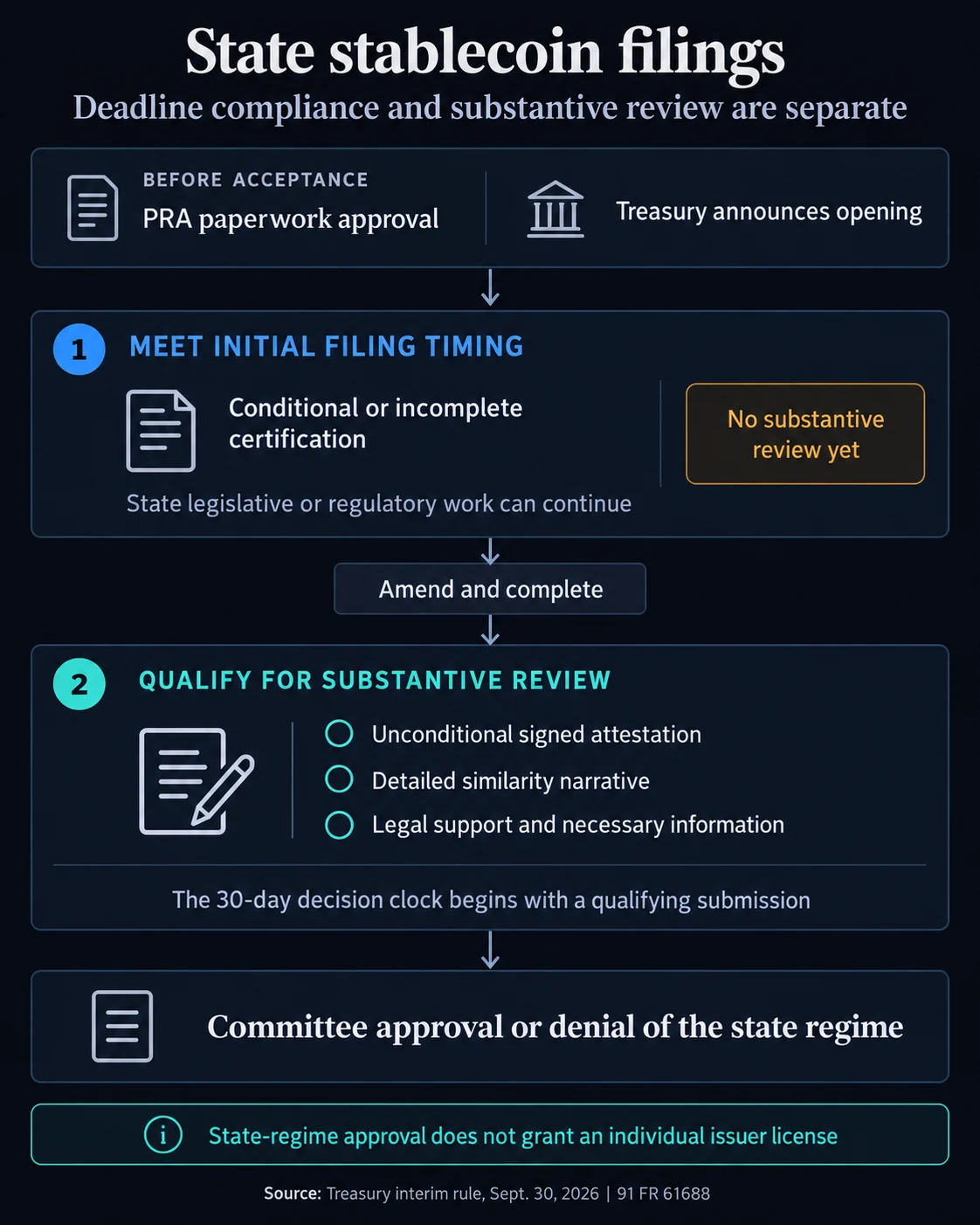
The U.S. Department of the Treasury has introduced a new procedural framework that allows states to initiate the process of seeking federal approval for their stablecoin regulatory regimes, even if their domestic rules are still under development. This interim final rule, published on September 30, 2026, provides a critical pathway for states to meet initial filing deadlines while simultaneously working to finalize their legislative and regulatory frameworks. The move is designed to accommodate the complexities of establishing comprehensive stablecoin oversight, offering flexibility to states that are committed to aligning with federal standards under the proposed GENIUS Act.
A Flexible Pathway to Federal Recognition
The core of the Treasury’s announcement lies in its recognition that the development of robust state-level stablecoin regulations is a complex and time-consuming endeavor. The new rule, which establishes the forms and procedures for the Stablecoin Certification Review Committee, allows for "conditional" or "incomplete" certifications to satisfy the initial filing timeframe. This means that a state can submit its application for review, signaling its intent and adherence to the process, even if certain legislative or regulatory actions are still pending. This strategic flexibility is crucial for ensuring that states can preserve their place in the queue for federal review without being penalized for the ongoing nature of their rule-making processes.
This approach is particularly significant for state-qualified payment stablecoin issuers that have consolidated outstanding payment stablecoin issuance not exceeding $10 billion. These entities may opt for state regulation, provided that the state regulator certifies its regime meets Treasury’s "substantial-similarity" criteria. Furthermore, the Stablecoin Certification Review Committee must unanimously approve the state’s regime as meeting or exceeding the standards and requirements outlined in Section 4(a) of the GENIUS Act. The interim rule, while setting forth the procedural mechanics, does not finalize the specific principles of substantial similarity, which are addressed in a separate Treasury proposal.
The Mechanics of the Approval Process
The interim final rule clarifies the distinction between an initial, potentially conditional filing and a submission that triggers substantive review. A conditional filing, while fulfilling the initial timing requirement, does not commence the substantive review process nor does it start the Committee’s 30-day clock for an approval or denial decision. This crucial period of review only begins once a state has submitted a certification that fully complies with the established procedures.
To reach this stage of substantive review, a state must provide an unconditional attestation signed by an authorized representative. This attestation must be accompanied by a detailed explanation of how its regulatory regime aligns with Treasury’s principles of substantial similarity. Additionally, states must furnish supporting legal materials and any other information deemed necessary by the Committee. This multi-faceted submission process is designed to ensure that the Committee has a comprehensive understanding of the state’s regulatory framework before undertaking its formal evaluation.

The rule also outlines the timeline for initial certifications, referencing January 18, 2028, as the date for these submissions. This date is predicated on the anticipated January 18, 2027, effective date of the GENIUS Act. The statutory filing deadline is set for one year after the Act officially takes effect. However, the GENIUS Act itself contains provisions for an earlier effective date, which can occur either 18 months after its enactment or 120 days after primary federal payment stablecoin regulators issue any final regulations implementing the Act. This forward-looking timeline underscores the urgency and importance of states preparing their regulatory frameworks.
Background and Context: The GENIUS Act and Stablecoin Regulation
The regulatory landscape for stablecoins has been evolving rapidly, driven by concerns about financial stability, consumer protection, and illicit finance. The GENIUS Act (Guidance on Ensuring National Integrity and Understanding of Stablecoins) represents a significant federal effort to establish a comprehensive regulatory framework for payment stablecoins. The Act aims to provide clarity and consistency in how these digital assets are regulated, fostering innovation while mitigating potential risks.
A key component of the GENIUS Act is the concept of "state-qualified" stablecoin issuers. This provision allows states to develop and implement their own regulatory regimes for stablecoins, provided these regimes are deemed "substantially similar" to federal requirements. This approach acknowledges the role of states in financial regulation and offers a degree of flexibility for different jurisdictions to tailor their oversight to local market conditions and priorities. However, achieving this "substantial similarity" requires rigorous scrutiny by federal authorities, including the Stablecoin Certification Review Committee.
Prior to this interim rule, the path for states to gain federal recognition for their stablecoin regimes was less defined, particularly regarding the initial stages of the application process. As CryptoSlate reported in July 2026, the difficulty in assessing state equivalence was exacerbated by the fact that federal, Treasury, and OCC rules were themselves still in various stages of development. The absence of clear procedural guidelines for initial filings created uncertainty for states eager to establish their frameworks and for issuers seeking to operate under state-approved regulations. The Treasury’s new rule directly addresses this ambiguity by providing concrete forms and review procedures, including the critical initial filing flexibility.
Implications for the Stablecoin Market
The Treasury’s decision to allow conditional filings is likely to be viewed positively by both state regulators and the stablecoin industry. For state regulators, it offers a practical solution to the challenges of legislative and administrative processes, allowing them to proactively engage with the federal approval process. This can lead to more robust and well-considered state-level regulations, as states will have a clear incentive to finalize their rules to gain federal recognition.
For stablecoin issuers, this move signals a more predictable and accessible pathway to market. By enabling states to move forward with their applications, the Treasury is accelerating the overall process of establishing a recognized and regulated stablecoin ecosystem. This clarity can encourage further investment and development within the stablecoin sector, as issuers will have greater confidence in the regulatory environment in which they will operate.

The emphasis on "substantial similarity" is also a critical aspect. It suggests that while states have some latitude, the core principles of stablecoin regulation—such as reserves, transparency, and risk management—will be subject to a high degree of federal oversight. This is essential for maintaining the integrity and stability of the broader financial system.
A Step Towards Broader Adoption
The establishment of clear federal guidelines for state stablecoin regimes is a significant step towards broader adoption and integration of stablecoins into the mainstream financial system. By fostering a coordinated approach between federal and state authorities, the Treasury is working to create a regulatory environment that is both innovative and secure.
The rule highlights the ongoing evolution of digital asset regulation in the United States. As the market for stablecoins continues to grow, so does the need for comprehensive and adaptable regulatory frameworks. The Treasury’s proactive approach, offering procedural flexibility while maintaining rigorous substantive review, demonstrates a commitment to navigating this complex landscape effectively.
The comment period for this interim rule is open until November 30, 2026, allowing stakeholders an opportunity to provide feedback on the proposed procedures. This inclusive approach is vital for ensuring that the final regulatory framework is practical, effective, and conducive to responsible innovation in the stablecoin market. The ultimate goal is to build a stablecoin ecosystem that is both resilient and trustworthy, capable of supporting the future of digital finance.