admin
admin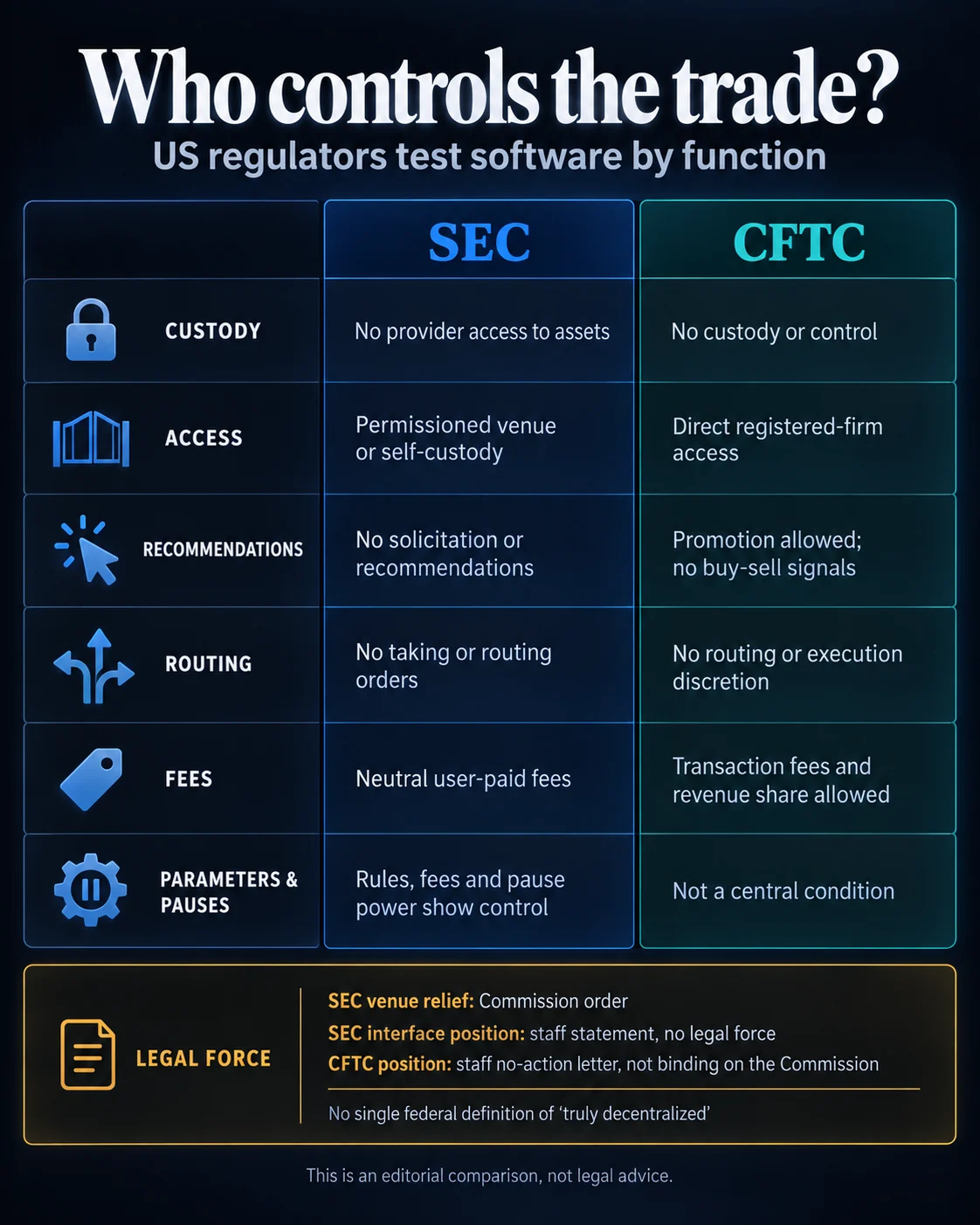
On September 17th, U.S. Securities and Exchange Commission (SEC) Commissioner Hester Peirce articulated a firm stance on decentralized finance (DeFi), asserting that investors should not require special exemptions to engage in peer-to-peer trading using permissionless smart contracts. Her statement, delivered amidst a flurry of regulatory actions from both the SEC and the Commodity Futures Trading Commission (CFTC), highlighted a critical divergence in how these agencies are approaching the burgeoning DeFi landscape. While these actions aim to delineate the boundaries of intermediary control, a central, unresolved question persists: how much authority can a software provider retain before its operations begin to resemble a regulated financial intermediary?
Commissioner Peirce’s individual statement, while representing her personal position, does not carry the binding weight of a formal Commission rule. Such a definition would necessitate a vote and formal adoption by the SEC. The agency’s recent order concerning tokenized securities, alongside a separate staff statement, has left the crucial concept of what constitutes "truly decentralized" open to interpretation. The specific provisions within these regulatory pronouncements focus on granular aspects of control, including custody of assets, user access, software parameter management, fee structures, investment recommendations, and the routing and execution of trades.
Each of these regulatory interventions operates under distinct statutory frameworks, carrying varied legal implications. When viewed collectively, they illustrate a concerted effort by federal regulators to scrutinize the extent of authority wielded by identifiable providers within the digital asset ecosystem. However, a unified, overarching federal test for decentralization remains conspicuously absent, leaving a complex and often contradictory regulatory environment for innovators and market participants.
SEC Traces Control from Market Infrastructure to User Interface
The SEC’s September 17th tokenized-securities order, a formal Commission action, grants temporary, conditional relief to a specific entity designated as a Tokenized Securities Venue (TSV). This relief permits the TSV to utilize automated market maker (AMM) pools for permissioned trading of Tokenized NMS Stocks. Within the context of this order, a TSV fulfills two primary functions: it establishes and manages one or more AMM pools accessible to permissioned participants, and it dictates the criteria and standards for access to these pools.
The SEC’s order provides a functional definition for what constitutes "provision" in the context of this exemption. The act of selecting and designating an AMM pool can be interpreted as provision. Furthermore, deploying the pool’s trading contract, modifying its operational rules or parameters, setting associated fees, or retaining the authority to temporarily halt trading activities can all be construed as establishing provision or control. Conversely, the mere administrative task of encoding a pre-existing whitelist, without further discretionary input, falls outside this definition.
This regulatory nuance underscores that even within automated systems, critical decision-making power often remains in human hands. Individuals or entities may still retain the authority to select the trading venue, establish fee schedules, initiate trading pauses, or determine participant eligibility. Commissioner Peirce’s categorization of this specific order as distinct from genuinely decentralized finance, while describing truly permissionless software as a separate model, highlights why operational control remains a significant factor, even when smart contracts are executing trades. The permissioned venue, in this instance, serves as a practical illustration of this principle.
An additional layer of regulatory scrutiny is applied to the user interface, representing another critical point of control. In April, the SEC’s Division of Trading and Markets issued a statement outlining circumstances under which staff would refrain from objecting to certain crypto asset securities interface providers operating without formal broker-dealer registration under Section 15 of the Securities Exchange Act of 1934. It is crucial to note that this statement carries limited legal force; it represents staff guidance, does not create new legal obligations, and is subject to withdrawal by the Commission within five years of its issuance absent further action.
The interfaces covered by this staff statement facilitate user transactions through self-custodial wallets, where users retain control over their private keys. These interfaces allow users to select or customize transaction parameters, digitally sign transactions, and transmit instructions. A key requirement is that multiple displayed execution routes must be filterable or sortable based on objective criteria. If an interface presents only one route, users must be able to view available alternatives. The software used for transaction preparation or route information display must operate on pre-disclosed, objective, and independently verifiable parameters.
The staff position explicitly excludes functions that more closely resemble traditional brokerage activities. This includes providers that solicit specific crypto asset securities transactions, offer investment recommendations, hold or access user assets, execute or settle transactions, or take or route orders on behalf of users.
The method by which a provider is compensated also plays a significant role in the regulatory analysis. The SEC staff indicated they would refrain from objecting to interfaces where users pay a flat fee or a percentage transaction charge that is objectively determined, consistently applied, and neutral across different products, routes, venues, and counterparties. Conversely, payments received from a third party based on the size, value, or occurrence of a transaction would fall outside the scope of this no-action position.
These conditions effectively integrate the frontend user experience into the regulatory calculus. Even when users retain control of their private keys and sign transactions from self-custodial wallets, default settings, route rankings, preferred venue suggestions, and fee incentives embedded within an interface can subtly steer user decisions.

CFTC Allows Greater Promotional Scope Under a Narrower Registration Framework
In parallel, the CFTC issued its own guidance on September 17th, announcing a staff no-action position through a press release and a related staff letter. The Market Participants Division stated its intention to refrain from recommending enforcement actions against qualifying passive software providers for failing to register as introducing brokers, and against associated personnel for failing to register as associated persons.
This position is contingent upon users transacting directly on a designated contract market (DCM) as members, or indirectly through a futures commission merchant (FCM) or introducing broker (IB) that is a DCM member. The relief is fact-specific, preserves the Commission’s underlying authority, and can be modified, suspended, or terminated by the Division at its discretion.
The activities permitted under the CFTC’s no-action position encompass a broader scope for promotion and compensation compared to the SEC’s interface guidance. A qualifying provider may actively promote specific derivatives, direct users towards particular registered firms, charge users transaction-based fees, and even receive a share of a registrant’s revenue.
However, the CFTC’s position still imposes significant restrictions on the provider’s involvement. Users must have the ability to contact the registered firm directly. Providers are prohibited from holding or controlling customer property, providing explicit buy or sell signals, affirmatively participating in a specific order, or exercising discretion over routing or execution.
This relief is also contingent upon stringent disclosures, marketing controls, written undertakings with registered firms, robust recordkeeping, and notification to the CFTC Division. These requirements aim to maintain accountability while allowing software providers to operate outside the formal introducing-broker registration framework.
The core distinctions between the SEC and CFTC approaches revolve around six key areas of control: custody, access, recommendations, routing, fees, and the management of software parameters and system pauses. While both agencies are seeking to define the boundaries of intermediary influence, their methods and the specific lines they draw differ significantly.
The Elusive Definition of "Truly Decentralized"
Commissioner Peirce’s guiding principle for DeFi is that the removal of a trusted intermediary inherently weakens the regulatory rationale that is built around such intermediaries. Her individual statement, however, lacks the authority to establish a definitive category of "truly decentralized" at the Commission level.
The regulatory authority in this space is fragmented across the actions described. The SEC Commission itself defines the scope of its TSV order. The SEC’s Division of Trading and Markets interprets and applies its own non-binding staff position concerning Section 15. The CFTC’s Market Participants Division exercises discretion in determining whether presented facts align with its conditional enforcement posture. Each of these judgments addresses a specific question arising under a particular statute and form of regulatory relief.
A blockchain protocol, its governance mechanisms, and its frontend user interface can exist at different points along the spectrum of control. While the core protocol might be inherently difficult to alter, its associated interface can remain curated, capable of charging fees, and designed to steer user behavior. Similarly, software can connect users to regulated firms while ensuring that orders, assets, and execution remain outside the provider’s discretion.
For developers and users navigating this evolving landscape, the practical inquiry begins with specific questions about control: Who holds sway over access to assets? Who has the authority to recommend trades, route orders, or execute transactions? Who determines fee structures or modifies software parameters? Who possesses the power to pause system operations? The governing statute and the identity of the actor exercising these powers will ultimately dictate which regulator and legal standard apply.
The term "truly decentralized," as articulated by Commissioner Peirce, remains a descriptive aspiration rather than a legally defined category within U.S. federal law. The recent SEC and CFTC actions, while disparate in their immediate scope and legal effect, collectively provide a fact-specific map of retained authority, delineating separate boundaries for the Commission’s order and each of the respective staff positions. This evolving regulatory landscape underscores the complexity of applying traditional financial oversight to the innovative, and often fluid, world of decentralized finance. The implications for market participants are significant, demanding careful attention to the specific details of control and compliance within each regulatory framework.