admin
admin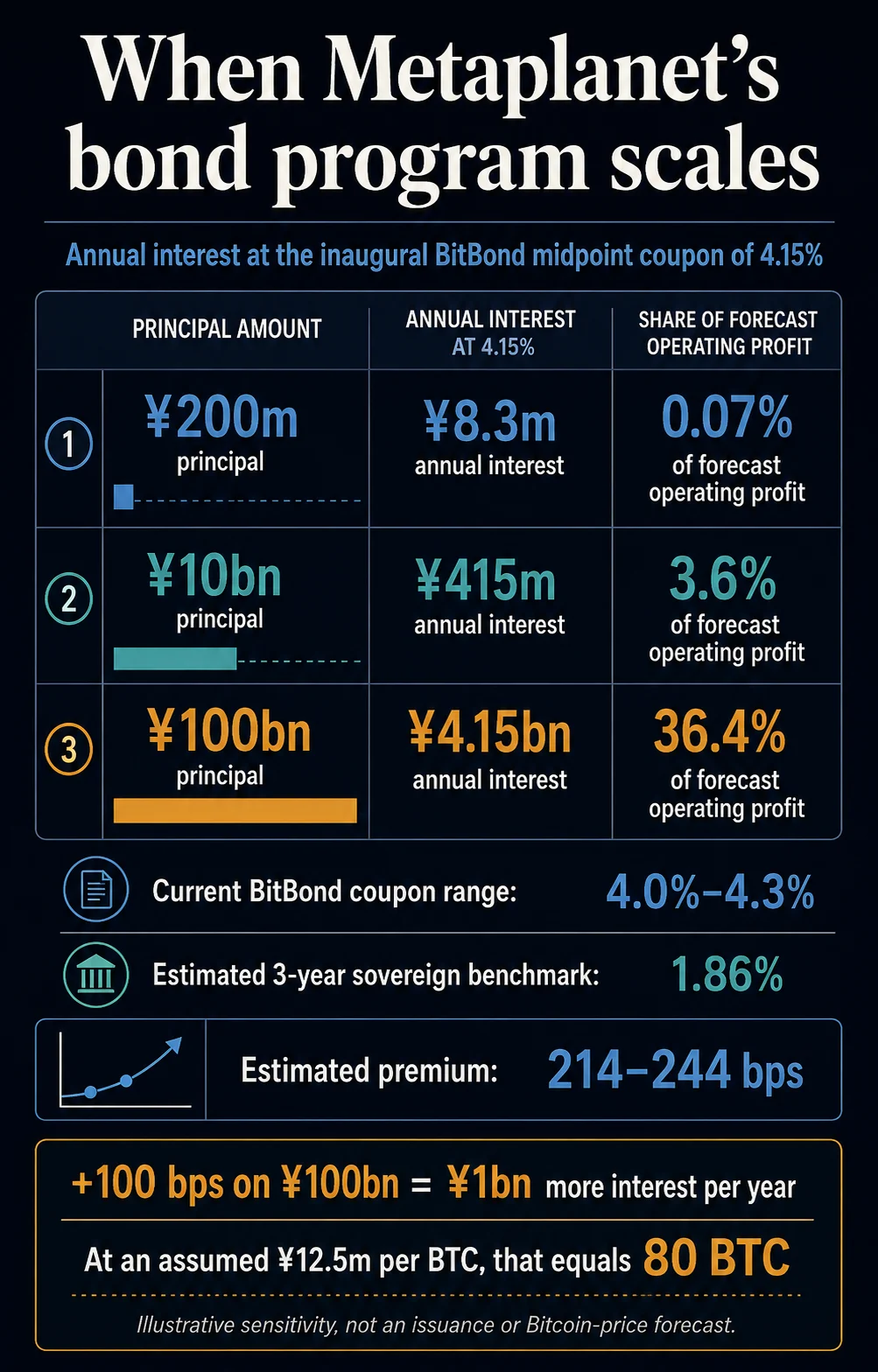
Japan’s recent 30-year government bond auction, which cleared at an elevated average yield of 4.079% on September 3rd, has underscored a tightening financial landscape for companies like Metaplanet. This significant increase in the cost of long-term borrowing serves as a crucial market indicator, suggesting that future capital raised by Metaplanet, particularly for its strategic Bitcoin acquisitions, may come at a higher price. While the long bond auction provides a broad signal, the more immediate concern for Metaplanet lies in the pricing of shorter-tenor debt and the refinancing of its existing obligations.
The average yield on the 30-year Japanese government bond (JGB) saw a notable increase of 14.2 basis points, rising from 3.937% at the previous auction held on August 6th. This upward trend in long-term yields contrasts with the more moderate figures seen across the curve. For instance, Japan’s 10-year JGB auction on September 1st averaged a yield of 2.995%. This disparity indicates that while longer-duration debt is experiencing a more pronounced yield hike, the 4% threshold is currently more of a concern at the longer end of the yield spectrum rather than a pervasive issue across all maturities. Meanwhile, the Bank of Japan continues to maintain its accommodative monetary policy, with an operating guideline for the uncollateralized overnight call rate hovering around 1%. This divergence in yield movements between short-term and long-term debt is a critical factor for companies managing a diversified debt portfolio.
Metaplanet’s existing fixed-income obligations are structured to retain their contractual cash flows, offering a degree of insulation from immediate market fluctuations. The company’s ¥8 billion 20th-series ordinary bond, a zero-coupon instrument maturing on April 23, 2027, represents a significant fixed obligation. Similarly, its inaugural BitBonds, which are designed to facilitate Bitcoin acquisitions, carry fixed coupon payments. However, the recent upward shift in Japanese sovereign yields establishes a higher benchmark for any future debt issuance and refinancing activities. This means that while current debt instruments are protected, any new capital raised will be subject to these elevated borrowing costs.
This evolving yield environment effectively narrows Metaplanet’s funding advantage. The bilateral zero-coupon bond offers a protective shield for near-term cash flows, but the prospect of replicating such favorable terms on the scale required for sustained Bitcoin accumulation remains uncertain. The company’s strategy of leveraging debt markets to acquire Bitcoin is directly impacted by the cost and availability of capital, making the recent JGB auction results a significant development.
Metaplanet’s BitBonds Face a Shorter-Tenor Funding Test
Metaplanet’s initial foray into the BitBond market, comprising the 21st through 24th series, amounts to ¥200 million. These bonds offer fixed coupons ranging from approximately 4.0% to 4.3% and have a maturity of roughly three years. To contextualize these rates, recent Japanese government bond auctions provide a benchmark. The Ministry of Finance reported average yields of 1.708% for two-year debt and 2.163% for five-year debt in August.
A linear interpolation between these official sovereign yield figures suggests an estimated three-year sovereign benchmark of approximately 1.8597%. It is important to note that this estimation is an analytical exercise for tenor comparison and does not represent a traded three-year market quote or a precise cash-flow duration calculation.
Against this estimated sovereign benchmark, Metaplanet’s inaugural BitBonds are priced with a premium of about 214 to 244 basis points. This premium is a reflection of the additional risk investors perceive in holding unrated, unsecured, and unguaranteed senior obligations. Should the sovereign benchmark yield increase while Metaplanet’s credit spread remains constant, future coupon payments on these bonds would naturally rise. Conversely, an expansion of Metaplanet’s credit spread would exert further upward pressure on borrowing costs.
The specific terms of the BitBonds help explain why investors demand this premium. These instruments are unrated, unsecured, and unguaranteed senior obligations. They also carry transfer restrictions, and secondary market liquidity is not assured. Metaplanet has indicated that subsequent series of BitBonds may feature different maturities and interest rates, contingent upon prevailing market conditions and investor demand. This flexibility is crucial for adapting to a dynamic financial environment.
Metaplanet’s existing debt instruments face a different set of considerations. While higher interest rates can impact their market valuation, the stated coupon and principal cash flows remain fixed as per their contractual terms. The company’s 20th-series ordinary bond, for example, was instrumental in funding Bitcoin purchases before the full expected cash influx from its 27th-series stock acquisition rights materialized. A portion of the proceeds from the exercise of these warrants was designated for the repayment of this bond, allowing Metaplanet to accelerate its funding without incurring immediate annual coupon expenses. This strategic use of convertible instruments and warrants highlights Metaplanet’s multifaceted approach to managing its capital structure.
Metaplanet’s Funding Channels Carry Different Costs
By mid-year, Metaplanet was actively utilizing several funding channels. As of June 30th, the company reported holding 43,000 BTC. Its financial disclosures indicated a draw of $414 million from a $500 million Bitcoin-collateralized credit facility. In addition, Metaplanet had ¥67.486 billion in short-term borrowings, ¥8 billion in bonds maturing within one year, and reported first-half interest expenses of ¥1.805 billion.
The Bitcoin purchases executed in the second quarter were financed through a combination of sources: the 20th-series bond, the Bitcoin-collateralized credit facility, proceeds from the 27th-series rights, and revenue generated from Bitcoin income. This diversified funding mix enabled Metaplanet to continue its acquisition strategy even when its mark-to-market net asset value (mNAV) remained below 1.0x for a significant portion of the first half of the year. Furthermore, the company refrained from discretionary common-share allotments during the second quarter. This approach effectively segregates Metaplanet’s funding into two distinct categories: fixed-rate structures that preserve current economic terms and new capital rounds that are subject to prevailing market conditions.

Scale Turns a Coupon into a Constraint
The inaugural BitBond issuance, while a strategic step, is currently too small to fundamentally alter Metaplanet’s overall financial economics. At a coupon rate of 4.15%, the midpoint of its stated range, the annual interest on ¥200 million amounts to approximately ¥8.3 million. This figure represents a modest 0.07% of the company’s projected full-year operating profit of ¥11.4 billion.
However, the impact of this interest rate becomes significantly more pronounced when applied to larger, illustrative funding programs. These sensitivity analyses reveal the critical importance of securing capital at acceptable rates for sustained growth.
| Illustrative BitBond Principal | Annual Interest at 4.15% | Share of ¥11.4bn Operating-Profit Forecast |
|---|---|---|
| ¥200 million | ¥8.3 million | About 0.07% |
| ¥10 billion | ¥415 million | About 3.6% |
| ¥100 billion | ¥4.15 billion | About 36.4% |
The rows representing ¥10 billion and ¥100 billion in principal are illustrative sensitivities, not issuance forecasts. They highlight why the ability to scale the BitBond program at favorable rates is more critical than the relatively small coupon burden of the initial tranche.
Consider a hypothetical scenario where the interest rate increases by one percentage point on an illustrative ¥100 billion program. This would add ¥1 billion to the annual interest expense. Assuming a Bitcoin purchase price of ¥12.5 million per coin, this additional interest alone could equate to approximately 80 BTC per year if the funds were diverted from cash reserves otherwise available for accumulation.
Metaplanet could potentially absorb this increased expense through its operating cash flow or by accessing other financing sources. The 80 BTC figure is contingent on the stated Bitcoin price and cash-use assumptions, serving to translate interest rate movements into the company’s capacity to acquire more Bitcoin on a per-share basis.
The balance sheet implications of rising interest rates can grow rapidly, potentially outpacing the headline figures. A 4.079% yield on a 30-year sovereign bond may have minimal immediate impact on a ¥200 million BitBond issuance. However, a future debt program of significant size, priced near the current coupon range, could consume a substantial portion of projected operating profit, even before accounting for any further increases in the benchmark sovereign yield or Metaplanet’s credit spread. This underscores the imperative for Metaplanet to manage its debt carefully and secure favorable terms for future funding rounds.
Equity Access Depends on Metaplanet’s Valuation
Metaplanet’s ability to access equity markets is closely tied to its valuation, particularly its mark-to-market net asset value (mNAV). The 27th-series rights, for instance, can generally only be exercised when the company-notified mNAV stands at a minimum of 1.01x. In August, no rights were exercised, leaving 947,300 rights outstanding as of August 31st. These rights represent potential for 94.73 million new shares, equating to approximately 7.0% of the company’s 1.345 billion issued shares.
This situation presents a material, albeit conditional, overhang of potential dilution. If the mNAV threshold prevents the exercise of these rights, Metaplanet’s ability to fund Bitcoin purchases through warrants may be curtailed, and the proceeds intended, in part, for the repayment of its zero-coupon bond could arrive more slowly. Conversely, should the mNAV threshold be met and exercises resume, Metaplanet would gain access to new funding, but existing shareholders would experience an increase in the total number of outstanding shares.
Furthermore, Metaplanet held the authority to repurchase up to 150 million shares for an aggregate value of up to ¥75 billion, with this authorization set to expire on October 28th. During August, the company executed zero share repurchases, and cumulatively, no shares had been bought back under this authorization by August 31st. This absence of buyback activity meant that share repurchases did not serve as a counterbalance to potential dilution during this period.
For the first half of the fiscal year, Metaplanet’s internally defined metric of Bitcoin holdings per 1,000 fully diluted shares saw an increase of 9.6%, reaching 0.0263554 BTC. The reported funding mix during this period was accretive to this metric. However, future accretion is likely to become more challenging as the company’s debt principal expands, coupon rates rise, or a larger number of rights are converted into shares.
Consequently, Japan’s September 3rd JGB auction serves as a critical test for Metaplanet’s funding advantage at the margin. The zero-coupon bond structure provides a clear benefit on existing terms, and the BitBond program demonstrates access to fixed-rate yen debt at a meaningful premium over comparable sovereign tenors. The ultimate price and scale of Metaplanet’s next funding round will be the decisive factors in determining how much of its funding advantage can be effectively translated into Bitcoin acquisitions per outstanding share.