admin
admin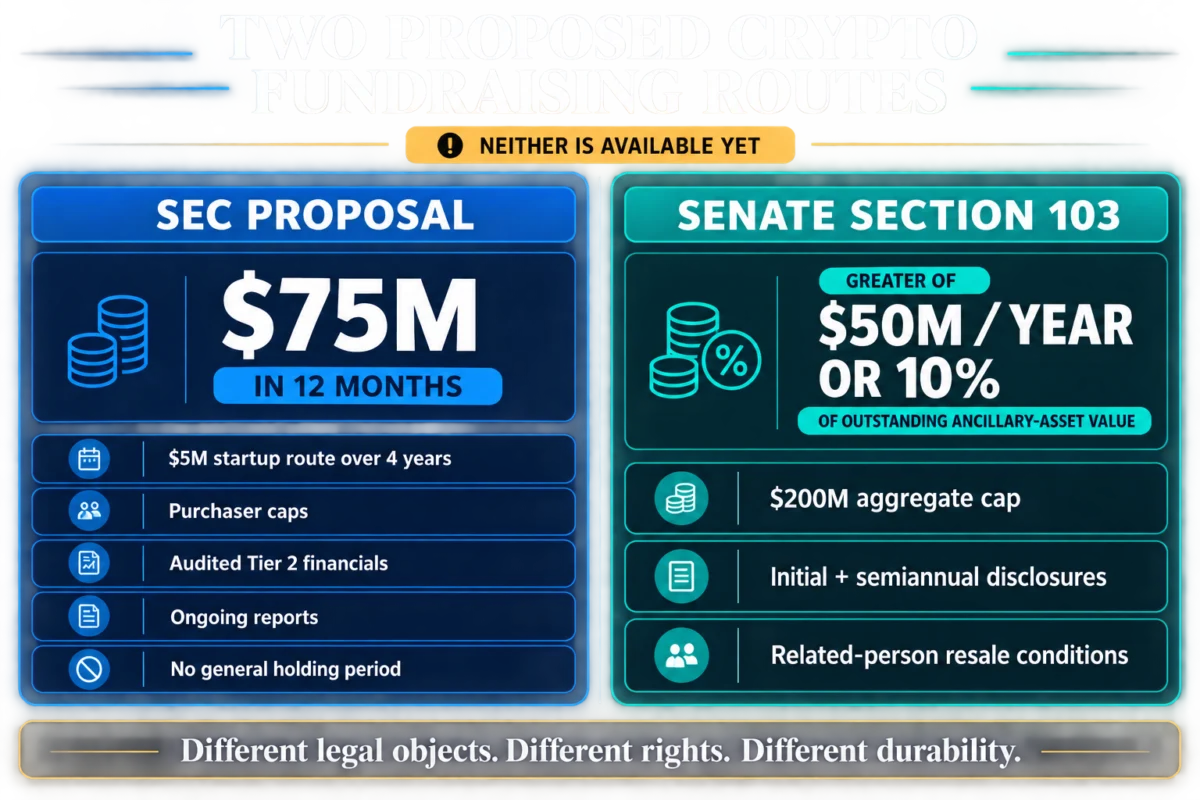
The U.S. Securities and Exchange Commission (SEC) has put forth a proposed Regulation Crypto Assets that includes a $75 million fundraising ceiling for certain digital asset offerings. Concurrently, a Senate market-structure framework is emerging with a more flexible fundraising limit, calculated as the greater of $50 million or 10% of an issuer’s outstanding ancillary assets. While these figures appear superficially comparable, they are anchored to fundamentally different legal mechanisms and carry distinct implications for issuers, investors, and the broader digital asset ecosystem. Understanding these nuances is critical as both proposals navigate distinct regulatory and legislative pathways, each with its own set of conditions, limitations, and potential interactions.
Divergent Legal Foundations: Rulemaking vs. Statutory Exemption
The core distinction between the SEC’s proposal and the Senate’s framework lies in their legal underpinnings. The SEC’s initiative, formally proposed as amendments to existing rules and the creation of new exemptions, operates through administrative rulemaking. This process involves the agency identifying specific categories of crypto-asset offerings that, under defined conditions, would be exempt from certain registration requirements. Section 103 of the Senate’s proposed CLARITY Act, conversely, aims to establish a statutory exemption, meaning it would be enacted into law by Congress. This legislative approach would create a direct carve-out from federal securities laws for specific transactions involving what the bill defines as "ancillary assets" sold pursuant to an investment contract.
This difference in origin—agency rulemaking versus congressional legislation—profoundly impacts which issuers and instruments qualify, the nature of protections afforded to buyers, and how these two potential regulatory pathways might interact or even conflict. The SEC proposal seeks to refine existing exemptions and create new ones tailored to the evolving digital asset landscape, while the Senate bill endeavors to provide a more foundational legislative solution for a specific class of digital assets.
Current Status and Timelines: A Regulatory Race Against Time
Neither of these proposed avenues is currently operational. The SEC’s proposal is in a public comment phase, with interested parties having until October 20, 2026, to submit their feedback. Following this period, the SEC will review comments and potentially revise the proposal before issuing a final rule. This rulemaking process, even when expedited, can take many months.
The Senate framework, on the other hand, remains unfinished legislation. It has progressed through various committee stages and discussion drafts, but it must still navigate the full legislative process, including votes in both the Senate and the House of Representatives, before it can be signed into law. The timeline for this legislative journey is inherently uncertain, subject to political considerations, the legislative calendar, and the broader priorities of Congress. The most recent significant development was the Senate Banking Committee advancing a text in May, followed by a reported Senate version in June, and an updated discussion text appearing in July. Any definitive legal analysis must therefore be based on the most current legislative text, acknowledging that further amendments are likely.
Delineating Fundraising Limits and Structures
The SEC’s proposal outlines two primary routes for fundraising exemptions. The first is a limited "startup" exemption, which would permit issuers to raise up to $5 million over a four-year period. This is designed for early-stage ventures with modest capital needs. The second, and more substantial, exemption would allow for offerings of up to $75 million within a 12-month period. However, this larger exemption comes with significant strings attached, including robust disclosure requirements and ongoing reporting obligations, akin to those faced by publicly traded companies.
The Senate’s Section 103 takes a distinctly different approach. It proposes an exemption for qualifying transactions in "ancillary assets" sold under an investment contract. The annual fundraising limit is structured as the greater of $50 million or 10% of the total dollar value of the issuer’s outstanding ancillary assets. This calculation is measured over a four-year period. Importantly, there is an aggregate sales cap of $200 million under this exemption.
This "greater of" formula introduces a dynamic ceiling that is not fixed at $50 million. For an issuer whose outstanding ancillary assets are valued above $500 million, the 10% threshold would exceed $50 million. In such cases, the $200 million aggregate limit would become the effective cap. This structure suggests a preference for allowing larger, more established projects within the defined "ancillary asset" category to raise more capital, provided their asset valuations support it. However, the critical caveat is the definition and scope of "ancillary assets," which may not precisely align with the types of crypto assets and transactions contemplated by the SEC’s proposal.
Defining the "Covered Object": A Crucial Distinction
The classification of the asset itself is a pivotal point of divergence. The SEC’s proposal focuses on "qualifying crypto-asset offerings" that meet the specific criteria of its proposed exemptions. This language suggests a broad application to various digital assets that are offered and sold in a manner that brings them within the purview of securities regulations.
In contrast, the Senate’s Section 103 specifically targets "qualifying ancillary-asset transactions" sold under an investment contract. The term "ancillary asset" is not a standard term of art in securities law and its precise definition within the CLARITY Act will be crucial. This specificity implies that the Senate’s exemption is intended for a narrower subset of digital assets, possibly those whose primary function or value is secondary to another underlying asset or service. This definitional difference could lead to a scenario where a token sale that qualifies under the SEC’s proposed framework might not fit the criteria for the Senate’s exemption, and vice versa.
Investor Protections: Purchaser Limits and Resale Conditions
The nature of investor protections also varies significantly between the two proposals. Under the SEC’s proposed $75 million exemption route, there are provisions for purchaser limits. These limits are generally designed to restrict how much an individual investor can purchase, often calculated based on a percentage of their financial capacity. The proposal mandates offering disclosures, audited financial statements for the larger tier of offerings, and a commitment to annual, semiannual, and current reports. Notably, the SEC’s proposal indicates that there would be no general holding period required for resales under this route, a move aimed at facilitating liquidity. Furthermore, it proposes federal preemption of state registration and qualification requirements for covered offerings, aiming to create a more unified national market.

The Senate’s framework presents a different set of investor safeguards. Section 103 requires an initial filing after the first sale and mandates semiannual disclosures for as long as the exemption’s conditions apply. Crucially, the Senate bill preserves specified federal liability provisions, including Section 12(a)(2) of the Securities Act and Section 10(b) and Rule 10b-5 of the Exchange Act. This preservation ensures that traditional anti-fraud provisions and private rights of action remain intact, rather than being replaced by a bespoke remedy.
A significant distinction lies in the treatment of resales. While the SEC’s larger proposed exemption does not impose a general holding period, the Senate text introduces specific conditions for sales by "related persons" and holders acting as part of a "coordinated group" to control the network. These rules are likely to be most impactful for founders, insiders, and concentrated holders, potentially imposing restrictions on their ability to liquidate their holdings, even if ordinary downstream trading appears less constrained.
Another key area of divergence is federal preemption of state laws. The SEC proposal explicitly addresses state registration and qualification for its covered offerings, aiming for a clear federal override. The Senate text, by contrast, operates through a federal statutory exemption and related market-structure provisions. Its preemption consequences will likely be derived from the enacted text as a whole, potentially leading to a more nuanced and context-dependent application of state securities laws.
Implications for Issuers: Navigating the Dual Landscape
For issuers considering fundraising in the digital asset space, the practical choice between these two potential pathways would hinge on more than just the desired capital amount. Legal counsel would first need to meticulously analyze the specific asset, the nature of the transaction, the issuer’s eligibility for each exemption, and any affiliate or control relationships. A token sale structured to meet the criteria for one exemption might not qualify for the other, requiring careful strategic planning.
The SEC’s proposal, with its tiered structure and specific reporting obligations, might be more appealing to a broader range of crypto projects, especially those seeking to raise moderate amounts and willing to adhere to enhanced disclosure. The $75 million ceiling, coupled with the potential for no general resale restrictions, offers a clear, albeit demanding, path.
The Senate’s framework, with its focus on "ancillary assets" and a more complex valuation-based ceiling, could be particularly relevant for issuers whose digital assets have a clear tie to underlying real-world assets or established services. The preservation of established liability provisions and the nuanced resale restrictions suggest a framework designed for a specific segment of the market, with a focus on preventing concentrated insider manipulation.
The Interplay of Legislation and Regulation: Coexistence and Conflict
The prospect of both a new SEC rule and a new federal statute coexisting presents a complex regulatory environment. If Congress enacts legislation that directly conflicts with an existing SEC rule, the agency would be obligated to administer its rules in a manner consistent with the later-enacted statute. However, the current texts suggest room for coexistence rather than outright conflict. The SEC’s proposal explicitly states that its exemptions would be nonexclusive, meaning an issuer could potentially rely on another available exemption if the facts and conditions of that alternative route are met. Similarly, the Senate bill creates a targeted statutory route for ancillary assets, which could operate alongside other exemptions.
An issuer might find it strategically advantageous to assess both pathways, provided it can independently satisfy all the conditions of whichever route it chooses to utilize. The ultimate legislative outcome could also influence the SEC’s rulemaking. Congress could direct, narrow, or supersede portions of the SEC’s proposed framework, and subsequent SEC rulemaking could modify its proposal before it is finalized.
Uncertainty and Future Outlook
The timing of these developments adds another layer of uncertainty. The SEC must complete its notice-and-comment rulemaking process, which is a multi-stage procedure. The Senate text also has its own effective and implementation provisions, including periods tied to enactment and required rulemaking by relevant agencies. While transition provisions may address some existing offerings and reporting obligations, the unfinished nature of the legislation means it is not currently operative.
The dynamic nature of congressional proposals further complicates predictions. The Senate Banking Committee’s text has seen revisions, and any legal conclusions drawn today must be verified against the final version that emerges from the legislative process.
Ultimately, the headline $25 million difference in the primary fundraising ceilings—$75 million for the SEC proposal versus $50 million for the Senate framework—is the least reliable indicator of the practical impact of these initiatives. The SEC route pairs a fixed 12-month ceiling with specific purchaser caps, mandatory audited financials, and continuing reporting duties. In contrast, the Senate route employs an asset-valuation alternative, a four-year framework, and a $200 million aggregate ceiling, all while preserving a distinct liability and disclosure structure. For issuers and investors alike, the operative divide lies not in the initial figures, but in the fundamental legal objects being regulated, the specific conditions attached, and the resulting rights and obligations that will shape the future of digital asset fundraising.