admin
admin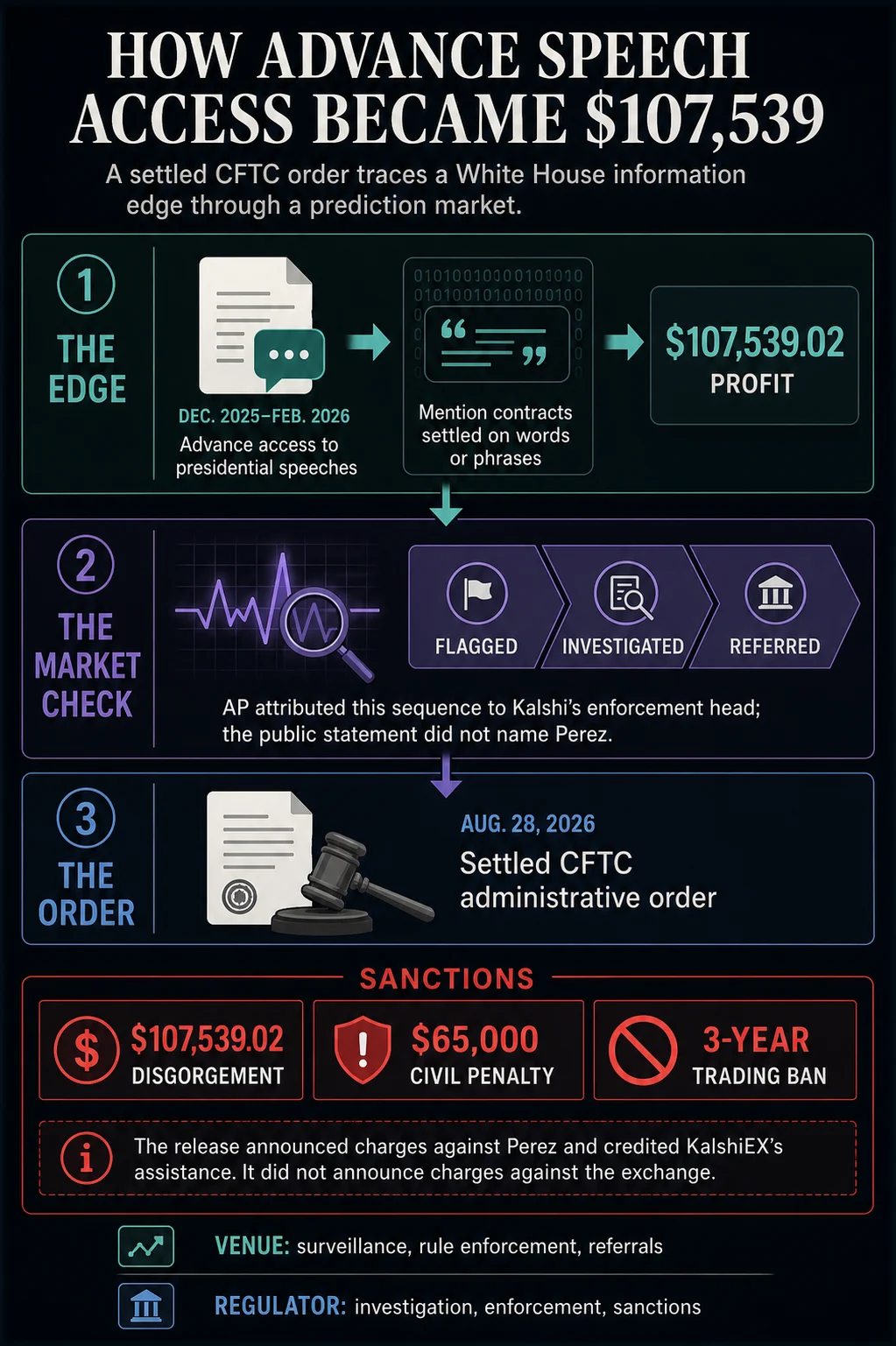
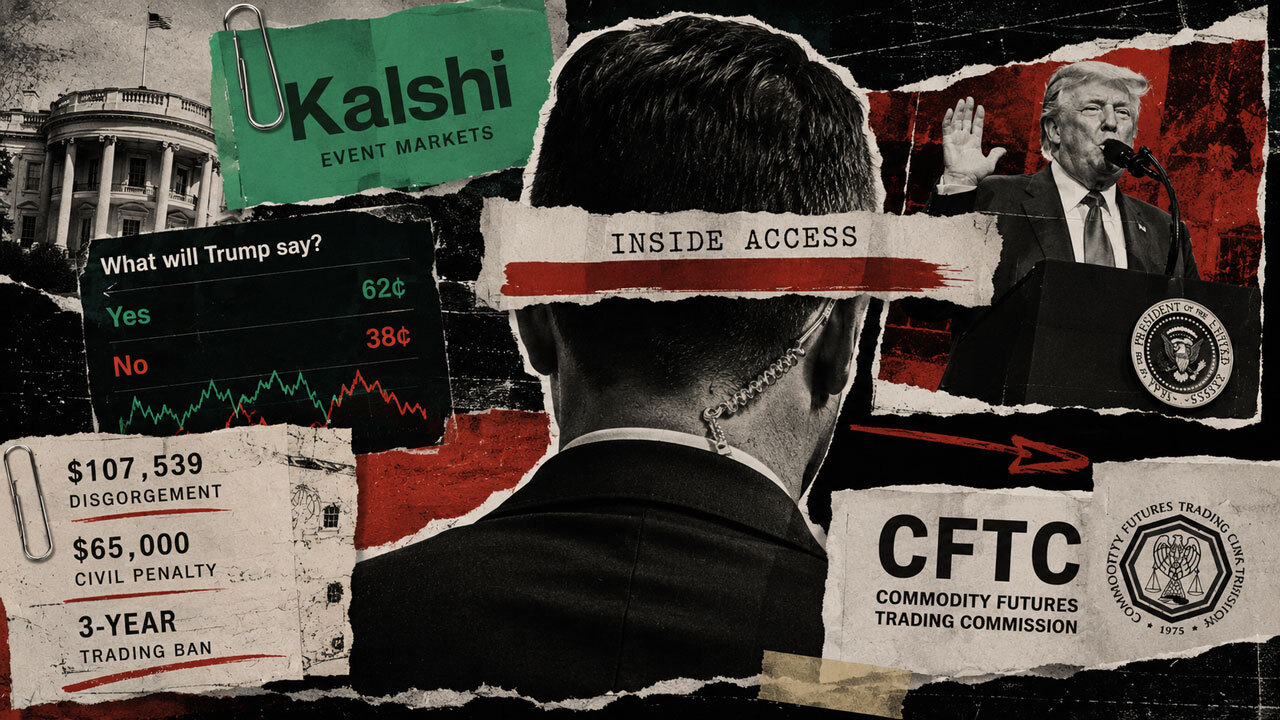
A White House speech insider, who operated as a teleprompter operator, has been ordered to forfeit $107,539.02 in profits derived from prediction markets. This action follows a determination by the Commodity Futures Trading Commission (CFTC) that he traded on advance access to presidential speeches, a clear violation of insider trading regulations. The settled administrative order also mandates a $65,000 civil monetary penalty and imposes a three-year ban from trading. Notably, the CFTC acknowledged Gabriel Perez’s substantial cooperation, which led to a significant reduction in the penalty. It is important to clarify that the cited materials detail a civil regulatory settlement and do not indicate a criminal conviction.
The Mechanics of an Unfair Advantage: How Nonpublic Information Fueled Market Gains
The CFTC’s investigation revealed that Gabriel Perez, while employed as a White House teleprompter operator, engaged in trading on "mention market" contracts between December 2025 and February 2026. These event contracts, characterized by the regulator as swaps, were designed to settle based on whether the President would utter specific words or phrases during public addresses.
According to the order, Perez had access to the full text of presidential speeches prior to their delivery. The CFTC asserted that Perez misappropriated this material nonpublic information, breaching a fundamental duty of trust and confidence. This illicit access allowed him to convert foreknowledge of prepared remarks into over $107,500 in illicit profits. While other market participants were attempting to price the probability of certain phrases being spoken, Perez possessed the definitive information, creating an insurmountable information asymmetry that directly influenced the contract’s settlement outcome.
A Timeline of Alleged Misconduct and Regulatory Intervention
The sequence of events leading to the CFTC’s action can be pieced together through the available documentation and subsequent reporting:
- December 2025 – February 2026: Gabriel Perez, in his capacity as a White House teleprompter operator, allegedly accesses advance copies of presidential speeches. During this period, he reportedly trades on prediction markets, specifically "mention markets," where the outcome of contracts is tied to specific words or phrases used in presidential addresses.
- Undisclosed Date (Likely within the trading period or shortly after): The prediction market exchange, KalshiEX, through its internal surveillance mechanisms, identifies suspicious trading activity.
- Undisclosed Date: KalshiEX’s enforcement head, Robert DeNault, reportedly states that the exchange’s surveillance team "promptly flagged, investigated and referred" the trades to the CFTC.
- July 2026 (as reported by Associated Press): The Associated Press reports on the alleged insider trading, citing Kalshi’s proactive role in flagging the activity. However, at this stage, the individual involved was not publicly named by the exchange.
- August 28, 2026: The CFTC issues a settled administrative order against Gabriel Perez. The order details the findings of misappropriation of nonpublic information and the resulting profits. It also outlines the penalties: disgorgement of $107,539.02, a $65,000 civil monetary penalty, and a three-year trading ban. The order specifically commends KalshiEX for its assistance in the investigation.
Supporting Data and Regulatory Framework
The CFTC’s action underscores the critical role of regulatory oversight in maintaining the integrity of financial markets, including emerging prediction markets. The agency’s authority stems from the Commodity Exchange Act (CEA), which prohibits fraud, manipulation, and deceptive practices in connection with the purchase or sale of commodity interests, a category that includes the event contracts traded on exchanges like Kalshi.
The "mention market" contracts are a type of derivative that allows participants to bet on the occurrence of specific events, in this case, the use of particular words or phrases in presidential speeches. These markets, while offering a novel way to engage with political and economic discourse, are inherently susceptible to information asymmetry if not properly regulated.
The CFTC’s February advisory provided crucial context for the responsibilities of designated contract markets. These entities are independently tasked with maintaining robust audit trails, conducting comprehensive surveillance of trading activity, and enforcing rules against prohibited practices. The CFTC, in parallel, retains its authority to investigate and prosecute illegal trading, often working in coordination with exchanges through referral processes.
The financial details of the settlement are significant:
- Disgorgement of Profits: $107,539.02. This represents the direct financial gain derived from the alleged insider trading.
- Civil Monetary Penalty: $65,000. This penalty serves as a punitive measure and a deterrent against future violations.
- Trading Ban: Three years. This restricts Perez’s ability to participate in regulated markets for a substantial period.
The credit given to KalshiEX for its assistance highlights a collaborative approach between regulators and market operators in combating market abuse. While the CFTC’s release confirms this assistance, it does not provide granular details regarding the exact timing of Kalshi’s internal review or its referral to the commission.
Kalshi’s Evolving Market Integrity Measures
In response to the evolving landscape of prediction markets and the inherent risks of insider trading and manipulation, Kalshi has implemented enhanced market integrity measures. These initiatives, announced in June, were introduced after the period of Perez’s alleged trading activity, and their effectiveness in preventing such trades is not definitively established by the available information. These measures include:
- Risk Scoring for Markets: Implementing a system to assess and flag markets with a heightened risk of insider trading or manipulation. This allows for more focused surveillance on potentially vulnerable contracts.
- Employment Verification: Requiring employment verification for certain participants. This aims to identify individuals who may have privileged access to nonpublic information based on their professional roles.
- Expanded Whistleblower Tools: Enhancing mechanisms for individuals to report suspicious activities, thereby leveraging external insights to bolster internal surveillance.
These proactive steps by Kalshi demonstrate a commitment to strengthening market integrity. However, the settlement with Perez, which occurred after these measures were announced, underscores the ongoing challenge of staying ahead of sophisticated attempts to exploit information advantages.
Broader Implications for Prediction Markets and Regulatory Enforcement
The case involving Gabriel Perez and KalshiEX carries significant implications for the burgeoning prediction market industry and the broader regulatory landscape.
1. Reinforcement of Insider Trading Prohibitions: The CFTC’s decisive action firmly reiterates that existing regulations against insider trading apply to prediction markets. The principle of trading on material nonpublic information is not confined to traditional securities markets but extends to any market where such information can confer an unfair advantage.

2. The Dual Role of Exchanges: The case highlights the critical, albeit sometimes reactive, role of exchanges in market surveillance. Kalshi’s proactive flagging and referral were instrumental in bringing the alleged misconduct to light. However, the fact that the trades occurred and profits were realized before detection also raises questions about the timeliness and comprehensiveness of pre-trade surveillance systems.
3. Importance of Information Control: The White House, like any organization handling sensitive or proprietary information, faces the ongoing challenge of safeguarding that data. The teleprompter operator’s role, while seemingly technical, provided a unique vantage point for accessing material information that could be leveraged for financial gain. This incident serves as a stark reminder of the need for robust internal controls and employee training regarding information handling.
4. Public Perception and Trust: For prediction markets to gain wider acceptance and trust, demonstrable efforts to ensure fair play are paramount. Incidents like this, even when addressed by regulators, can erode public confidence. The transparency of regulatory actions and the effectiveness of market integrity measures are crucial for building and maintaining that trust.
5. Future of Event Contracts: The incident may prompt a closer examination of the structure and regulation of event contracts, particularly those tied to politically sensitive information. Regulators and exchanges may explore more stringent pre-trade vetting or limitations on who can participate in certain high-risk markets.
The settled order against Gabriel Perez represents a convergence of market referral and regulatory enforcement, where profits were made, identified, and subsequently addressed through disgorgement, penalties, and market bans. While Kalshi was credited for its assistance, the sequence of events does not, on its own, definitively establish that existing safeguards were sufficiently timely or robust to prevent the alleged trades from occurring in the first place. This case will likely serve as a key reference point in ongoing discussions about regulatory oversight and market integrity within the evolving domain of prediction markets.