admin
admin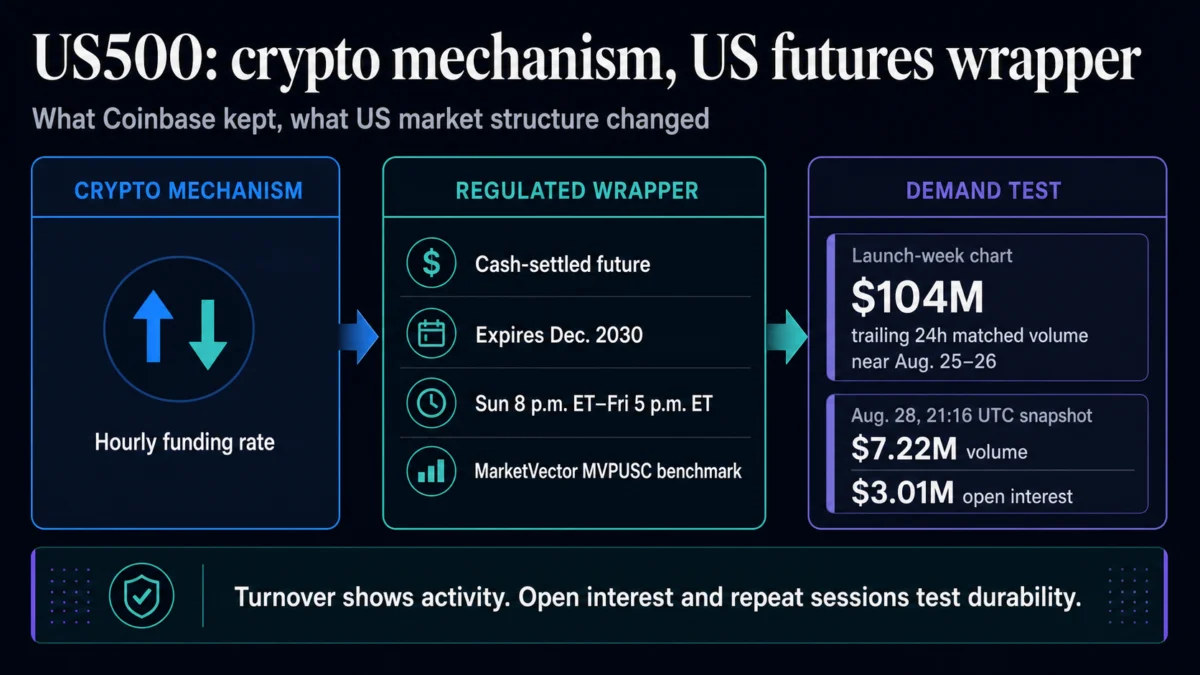
The nascent Coinbase US500 futures contract has achieved a significant early milestone, surpassing $100 million in trailing 24-hour matched volume. This accomplishment marks a critical initial test for Coinbase’s ambitious endeavor to integrate a crypto-native trading mechanism, specifically its signature funding rate system, into the highly regulated landscape of U.S. equity markets. The performance of this innovative product, which commenced trading on August 17th, offers a compelling early indicator of whether such a hybrid financial instrument can gain traction and acceptance among a broader base of traders accustomed to traditional equity derivatives.
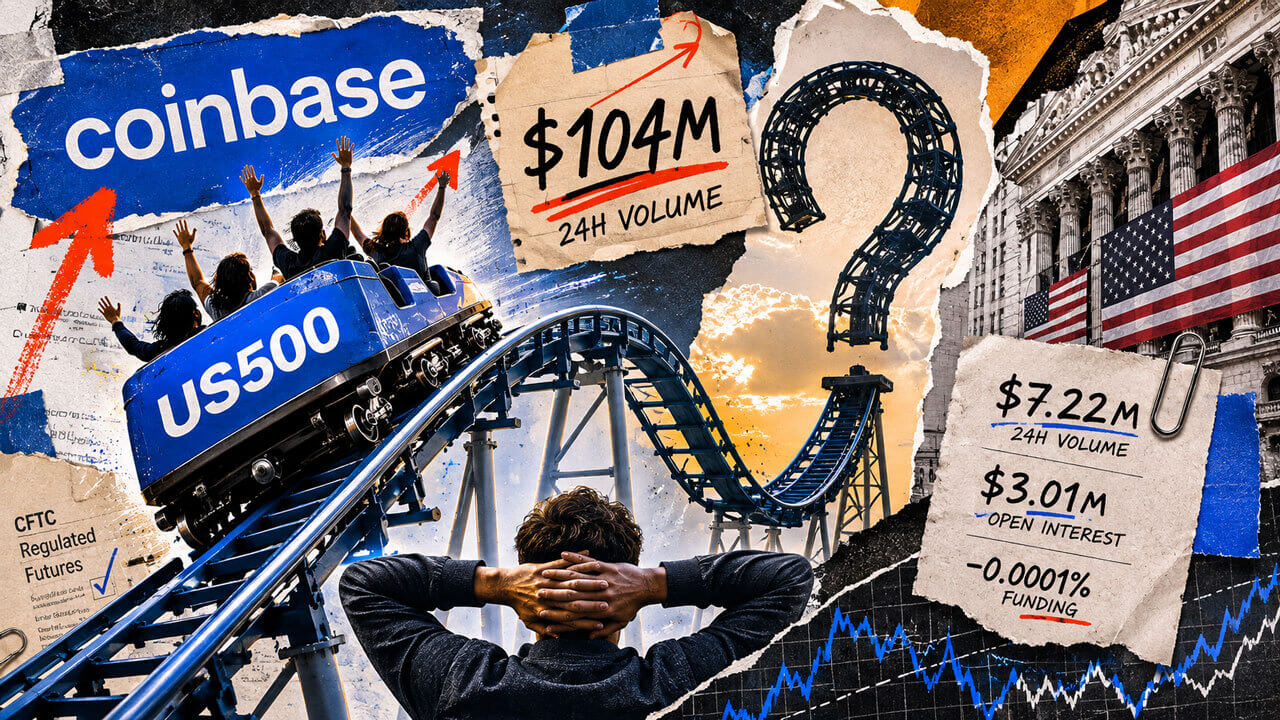
Analysis of data shared by Coinbase CEO Brian Armstrong on August 28th reveals a dynamic trajectory for the US500 futures contract. Armstrong’s accompanying chart, which meticulously tracked the trailing 24-hour matched volume from the contract’s inception, indicated a surge to approximately $104 million by August 25th-26th. This figure represents a substantial increase from the lower readings observed during the contract’s initial trading week, underscoring a growing market interest and participation. While the specific day-to-day fluctuations are crucial for a comprehensive understanding, this milestone volume provides a compelling narrative of the product’s early market reception.
Further examination of Coinbase’s product page, accessed approximately 15 hours after Armstrong’s public announcement, provided a snapshot of the contract’s status at that specific moment. The data revealed $7.22 million in 24-hour volume and $3.01 million in open interest. Notably, the funding rate was recorded at a negative 0.0001%, signifying that short positions were paying long positions. It is essential to acknowledge that these figures represent different rolling windows and therefore do not directly reverse or supersede the earlier $104 million figure. Instead, they offer a granular view of the contract’s evolving liquidity and participant positioning, highlighting the inherent volatility and rapid shifts that can characterize derivative markets, especially those with novel mechanics. The later reading provides a singular data point on outstanding positions, offering a glimpse into the market’s immediate sentiment and exposure.
The fundamental innovation behind the Coinbase US500 futures lies in its unique design, which seamlessly blends established crypto derivatives principles with the stringent regulatory framework governing U.S. equity markets. Coinbase has effectively imported the funding-rate mechanism, a cornerstone of perpetual futures contracts in the cryptocurrency space, and embedded it within a long-dated, cash-settled futures contract designed to comply with U.S. market regulations. This strategic integration aims to offer traders a familiar mechanism for price discovery and risk management, albeit applied to a traditional asset class.
Adapting Crypto Mechanisms to U.S. Market Rules
Coinbase’s approach to the US500 futures contract is characterized by what the company describes as a "perp-style" design. The instrument’s regulatory foundation was established through a self-certification filing with the Commodity Futures Trading Commission (CFTC) on July 30th. This filing formally defined the contract as a five-year, U.S. dollar-settled equity-index future, eligible for offering on or after August 17th.
The initial contract’s maturity is set for the third Thursday of December 2030, providing a significant long-term horizon for traders. Final settlement of the contract will be based on the value of its underlying reference index, with all open positions being settled in cash. This cash settlement mechanism means that holders of the futures contract receive price exposure to the index without taking physical delivery of the component shares. Consequently, these positions do not confer any ownership rights or shareholder voting privileges in the underlying companies.
The novel "funding" mechanism serves as the crucial crypto-style link within this regulated structure. Coinbase Derivatives is responsible for calculating this hourly rate, which is derived from the difference between the futures contract’s price and the spot price of the underlying index. This calculated rate is then aggregated by the clearing house, Nodal Clear, during its midday and end-of-day margin runs. The resulting amounts are applied through cash adjustments to the accounts of traders, effectively incentivizing convergence between the futures price and the spot index price.
This dynamic funding system is designed to exert a gravitational pull on the long-dated futures contract, encouraging its price to track closely with its reference index, while preserving the broader structural integrity of the futures market. The contract operates within the established parameters of regulated futures trading, adhering to exchange-imposed position limits, price limits, and market-wide circuit breakers designed to ensure market stability. Its trading sessions are also synchronized with the regulated market calendar, running from Sunday at 8 p.m. Eastern Time to Friday at 5 p.m. Eastern Time, with allowances for market holidays and closures. While Coinbase’s consumer-facing pages may employ "24/7" language in other contexts, the official CFTC filing and the listed trading session clearly delineate its operational hours within the established Sunday-to-Friday framework.
The Benchmark: A Distinguishing Feature
A key element differentiating the Coinbase US500 futures from more conventional equity index products is its underlying benchmark. The US500 contract references the MarketVector Top 500 US Profitable Companies Continuous Index, identified in the CFTC filing as MVPUSC. MarketVector, a distinct index provider, describes MVPUSC as a continuous index designed to track the performance of the largest securities issued by profitable U.S. companies. This benchmark commenced its operations on August 7th, just ten days prior to the futures contract’s launch. As of August 28th, the index comprised 501 components, as indicated on its dedicated information page.
The establishment of a separate provider, methodology, and index identity for the MVPUSC benchmark clearly distinguishes the Coinbase US500 futures from contracts based on widely recognized indices such as the S&P 500. Traders engaging with the Coinbase US500 futures gain cash-settled exposure to MarketVector’s proprietary benchmark, rather than a tokenized representation of S&P 500 shares. This distinction is significant, as it introduces a new reference point for traders and potentially offers a different risk-return profile compared to more established benchmarks.
In essence, the contribution of the cryptocurrency world to this product is precisely defined: the novel funding rate mechanism and an extended trading session are carried over. However, the underlying financial instrument is a regulated equity-index future with a fixed term, a commitment to cash settlement, and a proprietary reference index. This fusion represents a deliberate effort to bridge the gap between the rapid innovation seen in crypto markets and the stability and regulatory oversight expected in traditional finance.
Evaluating the Volume Milestone: A Need for Extended Data
While the $104 million volume milestone is an encouraging early indicator, a comprehensive assessment of the Coinbase US500 futures’ long-term viability requires a more extended data record. The trailing 24-hour matched volume, as reported by Armstrong, represents the total value of trades executed within that period. However, this metric can include repeated trading activity involving the same capital, and therefore does not necessarily reflect unique deposits, unique users, or the net retained exposure in the market.
Open interest, a key metric for gauging the depth of market participation and outstanding positions, provides a complementary perspective. At the August 28th reading, the $7.22 million in 24-hour volume was approximately 2.4 times the $3.01 million in open interest. This calculation illustrates the relationship between trading activity and outstanding positions at a specific moment in time but does not translate directly into a definitive count of traders or the total capital deployed.
| Metric | Observed Signal | Limitations |
|---|---|---|
| Trailing 24-hour matched volume | $104 million near Aug. 25-26; $7.22 million at later Aug. 28 reading | Different windows; no unique-user or unique-capital count. |
| Open interest | $3.01 million at the later reading | No multi-session trend or position-concentration data. |
| Funding | Negative 0.0001%, shorts paying longs, at the preserved reading | One point cannot establish a lasting directional imbalance. |
| Contract structure | Five-year, cash-settled future with hourly funding calculations | Price exposure rather than share ownership. |
Sustained trading volume throughout ordinary market sessions would be a critical indicator that trading activity extends beyond the initial launch window. Similarly, stable or increasing open interest across multiple trading days would signal that traders are maintaining their exposure to the contract, suggesting conviction in its utility. Furthermore, the depth of the order book and the bid-ask spreads are essential metrics for evaluating liquidity. A consistent and tight spread, even as the initial trading burst fades, would demonstrate that the market remains usable and efficient for participants.
A more extensive history of funding rate data will offer another valuable signal. Persistent payments from one side of the market could indicate a sustained directional bias among traders. Conversely, funding rates that oscillate around zero might suggest a more balanced market positioning. A single funding rate reading, as provided in the initial data, is insufficient to definitively ascertain the prevailing market sentiment or directional imbalance.
To fully understand participant engagement, data on participant breadth and concentration is necessary. The information shared thus far, including Armstrong’s chart and Coinbase’s public product page, does not reveal the number of individual traders contributing to the turnover or the distribution of positions among market participants. This granular data would provide insights into whether the trading activity is concentrated among a few large players or distributed across a broader base of retail and institutional traders.
Broader Implications and Future Outlook
The Coinbase US500 futures contract has already demonstrated a significant achievement: the successful operation of a crypto-inspired funding mechanism within the established framework of regulated U.S. equity-index derivatives. This translation involved several key modifications to adapt the crypto perpetuals model to the traditional finance environment. The concept of perpetual contracts was replaced by a fixed, long-term expiry date of December 2030. The continuous, 24/7 access characteristic of many crypto markets was adjusted to scheduled trading sessions aligned with the regulated market calendar. The delivery mechanism was shifted from physical share delivery to cash settlement, a standard practice in equity index futures. Finally, the reference benchmark was changed from a widely recognized index like the S&P 500 to MarketVector’s proprietary MVPUSC index.
The $104 million volume figure serves as compelling evidence that traders have actively tested this novel contract. The true measure of its success, however, will lie in its ability to sustain this initial interest. Consistent trading volume, persistent open interest, and durable liquidity will be the ultimate determinants of whether the Coinbase US500 futures contract can carve out a lasting niche in the U.S. derivatives market. The platform’s ability to attract a diverse range of participants, from sophisticated institutional investors to retail traders seeking new avenues for market exposure, will be critical. The ongoing performance and evolution of this hybrid instrument will undoubtedly be closely watched by both the cryptocurrency and traditional finance industries, offering valuable insights into the potential for future integrations and innovations at the intersection of these two dynamic sectors. The early success, while promising, represents only the initial chapter in what could be a transformative development in financial market infrastructure.